
Technical Guide on Demographic Estimates at Statistics Canada
Chapter 7
Non-permanent residents
Text begins
In Canada, immigration can be either permanent or temporary. Some people come to Canada temporarily to work or study, while others arrive seeking asylum. These people are called non-permanent residents (NPRs). The number of NPRs has increased significantly over the years following the COVID-19 pandemic. Statistics Canada publishes estimates of the net number of NPRs, which is a key component of population growth, along with inflows, outflows and number of NPRs living in Canada.
Definitions and concepts
A non-permanent resident is a person from another country with a usual place of residence in Canada and who (1) has claimed refugee status (asylum claimants, protected persons and related groups) or (2) holds a work permit, a study permit, or a temporary resident permit.
Family members living with permit holders are also included, unless these family members are already Canadian citizens, landed immigrants (or permanent residents), or NPRs themselves.
Three elements must be specified to precisely define NPRs in the context of population estimates:
- Children born in Canada to parents with NPR status are considered Canadian citizens by birth and are included in the births component of population growth.
- NPRs who obtain permanent residence are removed from the NPR component and added to the immigrants component. Thus, a change in status reduces the size of the NPR population and increases the number of immigrants. The impact on the total population is therefore zero, as this is a transfer between two components of population growth.
- Visitors are excluded from the NPR component, except when they are family members of a permit holder living in the same household.
Types of NPRs
As mentioned above, the two main types of NPRs are (1) asylum claimants, protected persons and related groups (AC+); and (2) permit holders (PHs) and their family members. These two types are distinguished by the nature of their presence in the country.
The types of NPRs are mutually exclusive and are derived in the following order of classification: AC+ then PH. Therefore, there are no AC+ among the PHs and their family members. This implies that an AC+ can obtain a work or study permit but is still classified as AC+ in the breakdown by type of NPRs.
Asylum claimants, protected persons and related groups
AC+ include the following three groups:
- Asylum claimants are foreign nationals who have made a refugee claim while in Canada on a temporary basis and whose claim is pending a decision.
- Protected persons are individuals who have made a claim in Canada and received a positive decision. For the Demographic Estimates Program (DEP), protected persons are removed from the NPR population if they obtain permanent residence.
- Related groups include those who received a negative decision or withdrew or abandoned their claim and have not yet regularized their status or departed Canada.
When an NPR is both an AC+ and a PH, AC+ status prevails to avoid double counting. Thus, if a person holds a work or study permit while having applied for asylum, they are counted only in the AC+ category.
Permit holders and their family members
PHs and their family members are NPRs who are not AC+, but who hold a work, study or temporary resident (formerly known as “ministerial permits”) permit. This category also includes family members who are not already Canadian citizens, landed immigrants (permanent residents) or NPRs themselves.
Family members residing with certain PHs are not required to hold a work or study permit to reside in Canada. Certain family members may accompany PHs if they meet the conditions issued by Immigration, Refugees and Citizenship Canada (IRCC).
Final estimates
Data sources
The collection of statistics on temporary residents and asylum claimants in Canada has been regulated since 2002 by the Immigration and Refugee Protection Act (IRPA). It replaces the Immigration Act, which was passed in 1976 and amended more than 30 times thereafter. IRCC, along with other government departments, collects and processes the administrative records of asylum claimants. IRCC also collects and processes administrative records from work, study, and temporary resident permit holders in Canada. Information is then sent to Statistics Canada from the Global Case Management System (GCMS) files. This information is used as a basis for obtaining the number and demographic characteristics of NPRs.
The data extracted from GCMS and used by the DEP to produce the NPR estimates are as follows:
- permanent resident file;
- asylum claim file;
- removal file;
- permit files (work, study and temporary resident);
- mailing address file.
IRCC assigns a unique client identifier (UCI) to all AC+ and PHs. This number uniquely identifies each person, regardless of the number of asylum claims or permits issued in their name. The UCI is used by Statistics Canada to produce estimates of the number of NPRs. This makes it possible to track NPRs over time and avoid double counting.
Method
Since the two types of NPRs are administratively different, estimates for each must be produced separately. Estimates of the total number of NPRs are calculated by as the sum of each NPR type as per the following formula:
Equation 7.1:
where
=
estimated number of non-permanent residents
=
estimated number of asylum claimants, protected persons and related groups
=
estimated number of work permit holders only
=
estimated number of study permit holders only
=
estimated number of work and study permit holders
=
estimated number of temporary resident permit holders, family members and Canada-Ukraine Authorization for Emergency Travel holders without permits
Asylum claimants, protected persons and related groups
Estimates of the number of AC+ are based directly on asylum claimants’ data from IRCC’s GCMS.
AC+ are counted as NPRs from the date of their asylum claim. Since asylum claims do not have an end date, AC+ are no longer counted as NPRs if they:
- obtain permanent residency. In this situation, they are subtracted from the NPR numbers and added as immigrants;
- were deported;
- withdrew their refugee claim;
- have not contacted IRCC in 10 years. IRCC keeps information about communications with each AC+ (for a change of address for example). When an AC+ file remains inactive for more than 10 years, the DEP assumes that the person has left the country. However, this rule applies to a very limited number of cases.
The province or territory of residence of AC+ is determined using postal code information from IRCC’s mailing address file. This file contains information on addresses provided to IRCC by AC+. The most recent address before the reference date is used. If this information is missing, the province or territory where the claim was made is used.
Permit holders and their family members
Estimates of the number of PHs are derived from data on work, study and temporary resident permits from IRCC’s GCMS. These estimates are calculated in two main steps.
First, IRCC data are processed by Statistics Canada using the UCIs. Issuance and expiry dates are also considered. This step identifies PHs with valid work, study or temporary resident permits on the given reference date and avoids counting individuals with multiple valid permits or permanent residence more than once. PHs that hold a valid permit on the reference date are included in the estimate of the number of NPRs. Conversely, they are excluded from the NPR count when their permit expires and is not renewed. The assumption underlying this approach is that PHs leave the country when their permit ends.
Second, Statistics Canada applies several demographic adjustments to IRCC data. The adjustments allow for the assignment of a province or territory of residence to all PHs, consideration of the permit extension process, estimation of the number of family members accompanying NPRs to the country, and consideration of those who arrived under the Canada-Ukraine Authorization for Emergency Travel (CUAET).
An adjustment is also applied to account for PHs who leave Canada before their permits expire. Using entry and exit data from the Canada Border Services Agency (CBSA), aggregated probabilities of early departures are estimated for selected reference dates and applied to the estimates of the number of NPRs.
Province or territory of residence
As with AC+, the province or territory of residence of the PH is determined using postal code information from IRCC’s mailing address file.
The province or territory of residence is not available for some PHs when these files are processed by Statistics Canada. In these situations, the province or territory is taken from the permit information.
In some cases, information from these two data sources is not available in IRCC data. These individuals are then assigned a province or territory of residence based on the type of permit they hold:
- Open work permit holders can work for any employer in Canada, subject to the conditions issued by IRCC. For the census year, the provincial/territorial distribution of these holders is established based on the distribution of open work permit holders enumerated in the Census. For subsequent periods, it is updated quarterly using IRCC’s mailing address file.
- For closed work permits, study permits and temporary resident permits, cases are distributed proportionally across provinces and territories based on the observed distribution of other work, study and temporary resident permit holders in IRCC data.
Permit extension process
Many PHs extend their stay in Canada by applying for a permit extension. However, this administrative process can take time leading to PHs remaining in Canada after the end of their permit (while awaiting permit extension). IRCC data contain information on permits issued to PHs as part of an extension. However, Statistics Canada does not receive this information until the extensions are issued to the PHs.
Three subsequent steps are distinguished in the integration of these extensions into the estimates of the number of NPRs:
- When a permit expires and no extension is identified in the various IRCC databases, the DEP removes the individual from the NPR population in accordance with the assumption that PHs leave the country when their permit ends.
- Once a work or study extension within Canada is observed in the data, the PH is considered to have remained in the country for the entire period between the end of their initial permit and the start of their extension. Thus, during the usual revisions to NPR estimates, this person is reintegrated into the NPR population and considered to have never left Canada during this period.
- An adjustment is applied to NPR estimates to better account for permit extensions when calculating preliminary estimates. This adjustment consists of applying a completeness factor that allows for estimating the expected number of permit extensions that have not yet been observed in the administrative data at the time the preliminary estimates are calculated. The factor is established using the three most recent reference dates for which the DEP has at least 12 months of data available. For each of these dates, a factor is calculated by comparing the number of extensions observed in the most recent available IRCC data with the number obtained when calculating the preliminary estimates. The average of these three factors is used to reduce the impact of seasonal variations and ensure greater stability of the adjustment across releases. This approach is similar to that used for other components of demographic growth, such as interprovincial migration.
Figure 7.1 illustrates the calculation of completeness factors using fictitious data. In this figure, the rows show the number of permit extensions issued to individuals with maintained status according to different reference dates, while the columns correspond to the successive monthly versions of the IRCC files. IRCC information is stacked from left to right, with each new version of the file incorporating data available in previous versions.

Description for Figure 7.1
This figure illustrates, using fictitious data, the calculation of adjustment factors used to estimate the expected number of permit extensions. It shows the evolution of the number of observed extensions across successive versions of IRCC files, the calculation of adjustment factors based on earlier periods, and their application to obtain an adjusted estimate of the number of extensions as of April 1, 2026.
In the last row, the value of 3,700 represents the number of permit extensions currently observed for the April 1, 2026, estimate. This value is calculated using IRCC data received in May 2026. Since administrative data requires additional time to reach their final level of completeness, this number underestimates the actual number of extensions that will be observed in subsequent releases.
In order to obtain a more accurate estimate, adjustment factors are calculated using previous periods for which the data are considered sufficiently complete. The three most recent reference dates for which at least 12 months of data are available are March 1, April 1, and May 1, 2025. Each factor is obtained by dividing the most up-to-date observed number of extensions (last column) by the number initially observed (first value in the row). Thus, we obtain:- 12,500 / 2,800 = 4.464 for March 1, 2025 (orange line)
- 12,600 / 2,600 = 4.846 for April 1, 2025 (green line)
- 12,600 / 2,500 = 5.040 for May 1, 2025 (blue line)
An average of the three adjustment factors is then calculated to reduce the impact of seasonal variations and to ensure greater stability in the adjustment. In this example, the resulting average factor is 4.783.
This factor is then applied to the 3,700 observed extensions used for the April 1, 2026, estimate, resulting in an estimated total of 17,699 extensions. The difference between this estimated total and the currently observed number of extensions (17,699 − 3,700 = 13,999) represents the number of additional extensions to be incorporated into the April 1, 2026, estimate.
For subsequent periods, new information received from IRCC files is incorporated into the adjustment. The adjustment is maintained for a maximum period of 12 months, which is the estimated time required for the data to reach a sufficient level of completeness to be used directly. However, if the observed data exceeds the adjusted estimates before the end of this 12-month period, the adjustment is replaced with the observed data.
Family members
Some programs allow PHs to come to Canada with family members without those family members needing permits in their names. Information on these family members who reside with the PH is not directly available in IRCC data. Therefore, their number is estimated from record linkages between IRCC data and the census.
The family relationships observed in the census make it possible to identify the family members of PHs without permits. The ratios of the number of PHs to that of their family members are calculated using census data, then applied to the estimates of the number of PHs for a given date. These ratios are kept constant until the next census. The following equation shows how this is calculated:
Equation 7.2:
where
=
estimated number of family members of permit holders
=
province or territory
=
reference date
=
type of permit holders (work, study or temporary resident permit)
=
Census of Population
=
estimated number of temporary resident permit holders, family members and Canada-Ukraine Authorization for Emergency Travel holders without permits
Since they do not hold work or study permits, family members of PHs are counted in the “other” category of NPR demographic statistics.
Holders of a Canada-Ukraine Authorization for Emergency Travel
As of March 17, 2022, CUAET holders present in Canada are included in the NPR estimates.
The majority of CUAET holders were issued a work or study permit upon arrival in the country. The DEP already takes these people into account in the estimates of the number of PHs. An adjustment is applied to include persons who arrived in Canada under the CUAET and do not have other permits. These individuals are included in the “other” subtype of the PH.
This adjustment is based on the number of people who arrived in Canada under the CUAET, available on the IRCC’s website. The DEP then identifies work or study permit holders who hold a valid CUAET. By subtracting these holders from the total number of persons who arrived in Canada under the CUAET, the DEP obtains an estimate of the number of persons present in Canada solely under the CUAET.
CUETA holders who also have a work or study permit leave the NPR population in the same way as other permit holders, as explained previously. Since the last arrivals in Canada under CUETA were recorded on July 31, 2024, this number is no longer updated. Accordingly, the DEP adjusts the estimate of those present in Canada solely under CUAET proportionally to the size of the group of work or study permit holders who simultaneously hold a CUAET.
Preliminary and updated estimates
The difference between the preliminary, updated and final NPR estimates is the timeliness of the GCMS files used for the calculations. These files are continually updated, and new tabulations are performed each year to update NPR estimates.
NPR estimates are preliminary in the first year and updated in the following year. They become definitive two to three years after the reference year.
Non-permanent residents estimates by age and gender
Asylum claimants, protected persons and related groups
The age and gender information for AC+ is included in the GCMS file provided by IRCC and is therefore obtained directly from this source.
However, some information is not available for certain people. These cases are distributed proportionately according to the characteristics of the AC+ for whom information is available.
Permit holders and their family members
Similar to AC+, information on the age and gender of PHs is available in IRCC data and is therefore used directly. Unknown cases are distributed proportionately according to the characteristics of the PHs for whom information is available.
For the age and gender of family members, the information comes from record linkages between IRCC data and the census, as explained above. The resulting age and gender distribution is then applied to the estimate of family members.
Net non-permanent residents
For the DEP, net NPRs is one of the components of demographic growth added to the base population to produce population estimates for a given date using the component method.
The net change in NPRs represents the component of demographic growth that reflects changes in the number of NPRs over a given period. It is calculated by subtracting the number of NPRs at the beginning of the period from the number at the end of the period, according to the following equation.
Equation 7.3:
where
=
interval between the previous reference date t and the estimate date t+i;
=
change in the NPR estimate between dates t and t+i;
=
estimated number of NPRs at date t+i;
=
estimated number of NPRs at date t.
Non-permanent residents’ inflows and outflows
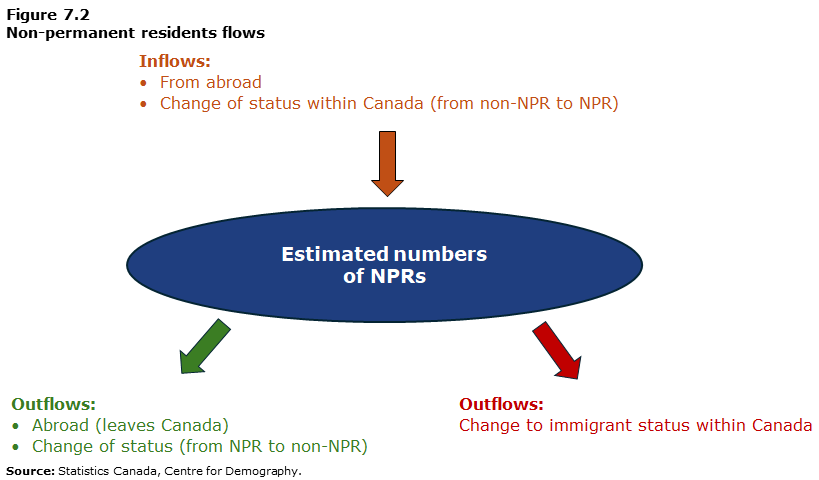
Movements into and out of the NPR population are referred to as “flows”. Individuals entering the NPR population are called inflows, while those who leave are called outflows.
These flows can occur in various contexts:
- A person coming from abroad or who previously had non-resident status in Canada (e.g., a visitor) may join the NPR population: this person is then considered an inflow.
- Conversely, an NPR who leaves the country, is deported, becomes a non-resident or obtains immigrant status leaves the NPR population: this is an outflow.
Figure 7.2 start
Description for Figure 7.2
This figure shows the sources of inflows and destinations of outflows for the estimates of the number of non-permanent residents. Entries into the non-permanent resident’s population come either from inflows from abroad or from status changes from non-resident to non-permanent resident within Canada. Exits from the non-permanent resident population consist of outflows to other countries or through a change to non-resident status in Canada. Obtaining permanent residence also constitutes another type of outflow.
Figure 7.2 end
As illustrated in Figure 7.2, a person coming from abroad or holding non-resident status in Canada (e.g., a visitor) may be added to the NPR population (inflow). Conversely, when a person leaves the NPR population (outflow), it is assumed that they have either left the country, become a non-resident or obtained immigrant status.
Net NPRs can also be calculated as the difference between inflows and outflows over a given period for a specific region.
Equation 7.4:
where
=
change in the NPR estimate between dates t and t+i;
=
estimated number of NPR inflows between dates t and t+i;
=
estimated number of NPR outflows between dates t and t+i;
Consistency between quarterly and annual estimates
Quarterly and annual NPR estimates are consistent with each other. However, caution is required for data manipulation related to annual information.
- To obtain the estimate of the number of NPRs on a quarterly or annual basis, refer to the estimate for the desired reference date. Estimates of the number of NPRs should not be summed, as they represent a point-in-time estimate.
- To obtain the estimate of net NPRs on a quarterly basis, refer to the estimate for the desired reference date. However, it is possible to add the quarterly net NPRs to calculate annual growth.
Comparisons between DEP estimates of NPRs and alternative data sources
Other data sources on NPRs, temporary residents and asylum claimants are also available from Statistics Canada and IRCC. However, caution should be exercised when comparing statistics from different sources, since they are compiled in different ways and serve different purposes.
The products titled Non-permanent residents data at Statistics Canada, “Statistics on non-permanent residents at Statistics Canada,” and “How does Statistics Canada estimate the number of non-permanent residents?” describe Statistics Canada’s NPR data and the various data sources that users can access.
Differences between Statistics Canada and Immigration, Refugees and Citizenship Canada data on NPRs
Statistics Canada works closely with IRCC and other federal departments and agencies to estimate the number of NPRs living in Canada. IRCC publishes statistics on temporary residents and asylum claimants. These data are used to provide information on the number of work and study permits issued in Canada or on the number of individuals with valid status in the country. They support the planning, development, delivery, monitoring, and evaluation of immigration-related programs, policies or services.
While IRCC and DEP statistics are based on the same starting data, DEP estimates are designed to examine the effects of immigration on Canada’s population, society, and economy. For example, the DEP identifies and processes individuals holding more than one valid permit at the same time to avoid double-counting and applies demographic adjustments to IRCC data to better reflect the demographic reality of this population.
Differences between NPR estimates and census figures
The Census of Population, conducted every five years, provides extensive socio-economic characteristics of NPRs at detailed geographic levels, such as municipalities. However, some NPRs were unable to respond to the census questionnaire, despite Statistics Canada’s efforts to enumerate all individuals usually residing in Canada. DEP NPR estimates are published quarterly and are calculated by combining IRCC administrative data with demographic adjustments. As a result, census counts of NPRs are lower than those published through DEP.
Historical comparisons of NPR estimates
Historical comparisons of NPR estimates should be made with caution because of changes in definitions, methods and available data.
Estimates dating back to 2021 incorporate several methodological improvements, particularly regarding family members of PHs, the processing of permit extensions, and the assignment of a province or territory of residence.
Breakdowns of NPR estimates by type, and statistics on NPR inflows and outflows are available only from 2021 onward.
A series of NPR estimates is available from the third quarter of 1971 to the second quarter of 2018 and is based on information from IRCC’s former system, the Field Operations Support System. From the third quarter of 2021 onward, NPR estimates are based on the current system, the GCMS.
Subprovincial non-permanent resident estimates
Postal codes from IRCC’s mailing address file are used to determine the subprovincial and subterritorial distributions of NPRs. These postal codes are geocoded using the Postal CodeOM Conversion File PlusNote so that they are assigned a census division and census metropolitan area/census agglomeration geographic code. When the postal code is missing, the province or territory where the asylum claim was submitted is used to determine the place of residence of AC+. For PHs and their family members, the intended municipality of residence is used for this purpose. Finally, the subprovincial distributions are applied to provincial and territorial totals using the two-dimensional iterative proportional fitting method to ensure internal consistency.
Limitations
Estimates of NPRs are based on IRCC data, which are governed by the IRPA. These data are of very high quality, since they are timely and cover all regular immigration. They make it possible to identify NPRs who have become immigrants or who hold more than one permit.
Information on permit extensions is available only once an extension has been approved. However, it may happen that a PH remains in the country after the expiry of their permit while awaiting a decision on their extension application. Such PHs are initially removed from the NPR population in accordance with the assumptions regarding PH departures and are subsequently added back when the extension information becomes available in IRCC data, as part of Statistics Canada’s regular demographic revision process. However, a completeness factor is applied in order to reduce the number of PHs that need to be added during the annual revisions.
Demographic models are required to adjust IRCC data. The number of family members of PHs is derived from the most recent census data, assuming that the relationship between the number of PHs and their family members remains constant. The province or territory of intended destination is used for a small number of NPRs. However, this province or territory of intention does not always reflect the NPR’s usual place of residence.
- Date modified: