
Education Indicators in Canada: An International Perspective 2017
Chapter C
Access to education, participation and progression

Archived Content
Information identified as archived is provided for reference, research or recordkeeping purposes. It is not subject to the Government of Canada Web Standards and has not been altered or updated since it was archived. Please "contact us" to request a format other than those available.
C1 International students
Context
This indicator presents international students as a proportion of enrolment in tertiary education in accordance with the three International Standard Classification of Education (ISCED) categoriesNote 1, which represent enrolments in colleges and universitiesNote 2. Changes in the number of international students over time are also presented, as well as their distribution by province of study and by region of origin.
Students choose to pursue their education abroad for many reasons. Some may do so because they wish to explore different cultures, societies and languages while improving their employment prospects. Growing recognition of the importance of tertiary education as a determinant of higher earnings and employability has led to a growing demand, one that educational institutions in some countries may find difficult to meet. At the same time, the globalization of markets has increased demand for workers with broader knowledge and competencies, with work increasingly performed by teams that span regions and countries.
Several factors may contribute to the choice of country for study. The language spoken and used in instruction, the quality of education offered, the tuition fees and cost of living, and the immigration policy of the destination country are all important factors. Other factors include recognition of foreign degrees, future job opportunities, and any geographical, trade and cultural links between countries.
International students are well received because they represent an additional source of revenue for the institutions they attend. They may also contribute to the viability of programs when the domestic student base is somewhat limited. In Canada, as in other countries that belong to the Organization for Economic Co-operation and Development (OECD), many institutions and governments are now actively marketing their educational programs to attract such students. In addition to the economic benefits they may provide, international and foreign students also add to the social and cultural dimensions of the communities in which they study. They may become future citizens, or they may become unofficial ambassadors when they return home.
Observations
International students in tertiary education
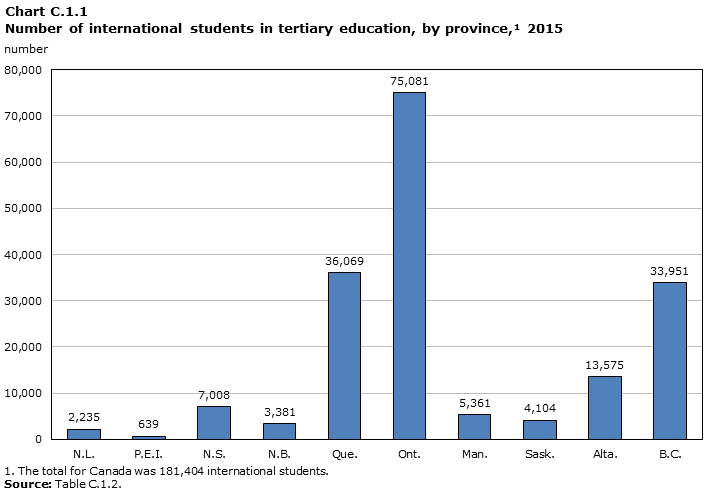
Data table for Chart C.1.1
| Number | |
|---|---|
| N.L. | 2,235 |
| P.E.I. | 639 |
| N.S. | 7,008 |
| N.B. | 3,381 |
| Que. | 36,069 |
| Ont. | 75,081 |
| Man. | 5,361 |
| Sask. | 4,104 |
| Alta. | 13,575 |
| B.C. | 33,951 |
|
1. The total for Canada was 181,404 international students. Source: Table C.1.2. |
|
- In 2015, there were 181,404 international students studying in Canada. Ontario attracted the largest proportion of international students (41%), followed by Quebec (20%) and British Columbia (19%).
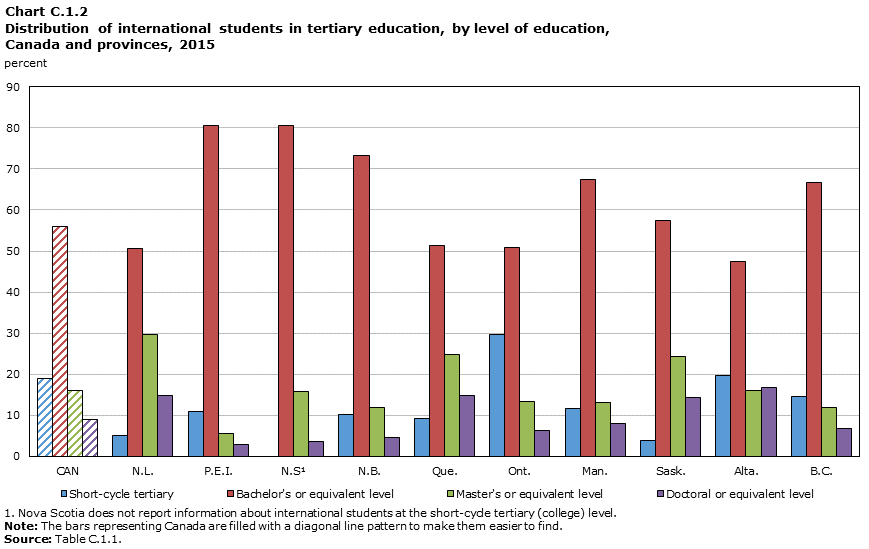
Data table for Chart C.1.2
| Short-cycle tertiary | Bachelor's or equivalent level | Master's or equivalent level | Doctoral or equivalent level | |
|---|---|---|---|---|
| percent | ||||
| CAN | 19.0 | 56.0 | 16.1 | 9.0 |
| N.L. | 5.0 | 50.5 | 29.7 | 14.9 |
| P.E.I. | 10.9 | 80.5 | 5.6 | 3.0 |
| N.SData table Note 1 | Note ..: not available for a specific reference period | 80.5 | 15.9 | 3.5 |
| N.B. | 10.1 | 73.2 | 12.0 | 4.7 |
| Que. | 9.1 | 51.4 | 24.8 | 14.7 |
| Ont. | 29.6 | 50.9 | 13.4 | 6.2 |
| Man. | 11.6 | 67.5 | 13.1 | 7.9 |
| Sask. | 3.9 | 57.4 | 24.4 | 14.4 |
| Alta. | 19.8 | 47.4 | 16.0 | 16.8 |
| B.C. | 14.5 | 66.8 | 12.0 | 6.8 |
.. not available for a specific reference period
Source: Table C.1.1. |
||||
- The majority of international students in tertiary education in Canada were registered in Bachelor’s or equivalent level programs. This was true for every province.
- The proportion of international students registered at the short-cycle tertiary level (college) varied greatly by province; accounting for almost a third in Ontario (30%) to only 4% in Saskatchewan.

Data table for Chart C.1.3a
| Doctoral or equivalent level | Master's or equivalent level | Bachelor's or equivalent level | Short-cycle tertiary | |
|---|---|---|---|---|
| percent | ||||
| OECD | 25.7 | 11.5 | 4.3 | 2.5 |
| CAN | 30.2 | 18.6 | 9.8 | 10.1 |
| N.L. | 46.5 | 22.4 | 7.9 | 3.9 |
| P.E.I. | 32.8 | 11.1 | 14.1 | 4.3 |
| N.S.Data table Note 1 | 30.1 | 18.9 | 16.0 | Note ..: not available for a specific reference period |
| N.B. | 29.5 | 24.4 | 14.5 | 9.2 |
| Que. | 32.8 | 15.6 | 8.3 | 3.6 |
| Ont. | 22.4 | 19.0 | 8.5 | 13.8 |
| Man. | 39.8 | 17.6 | 10.0 | 10.2 |
| Sask. | 47.1 | 25.7 | 8.1 | 5.2 |
| Alta. | 32.9 | 19.8 | 7.0 | 8.4 |
| B.C. | 40.5 | 24.6 | 16.0 | 15.1 |
.. not available for a specific reference period
Source: Table C.1.1, and Education at a Glance 2017 OECD Indicators. |
||||
- While the Canada figure for Doctoral or equivalent level programs (30%) is similar to the proportion observed for all OECD countries (26%) overall, there are variations across provinces, as this proportion ranges from 22% in Ontario to 47% in Newfoundland and Labrador, and Saskatchewan.
- The percentage of international students rises with level of study at the university level (Bachelor’s, Master’s, and Doctoral levels), except in Prince Edward Island where the Bachelor’s level has a higher proportion of international students than the Master’s level.

Data table for Chart C.1.3b
| Doctoral or equivalent level | Master's or equivalent level | Bachelor's or equivalent level | Short-cycle tertiary | |
|---|---|---|---|---|
| percent | ||||
| OECD | 25.7 | 11.5 | 4.3 | 2.5 |
| CAN | 30.2 | 18.6 | 9.8 | 10.1 |
| DEU | 9.1 | 12.9 | 4.7 | 0.0 |
| FRA | 40.1 | 13.3 | 7.3 | 4.7 |
| GBR | 42.9 | 36.9 | 14.0 | 5.2 |
| JPN | 18.2 | 6.8 | 2.4 | 4.0 |
| USA | 37.8 | 9.5 | 3.8 | 2.2 |
| AUS | 33.8 | 42.6 | 13.3 | 6.6 |
|
1. International student information was not available for Italy. 2. Australia is also shown as an example of a comparable English speaking country. Note: The bars representing Canada and the OECD are filled with a diagonal line pattern to make them easier to find. Sources: Table C.1.1, and Education at a Glance 2017: OECD Indicators. |
||||
- In comparison to other G7 countries, Canada had a higher proportion of international students than Germany and Japan at all education levels. The patterns for France, the United Kingdom and the United States were more similar to Canada’s, except that they all had much higher proportions at the doctoral level, and also for the master’s level in the United Kingdom.
- Australia, while not a G7 country is included for comparison because it also hosts large numbers of immigrants. In comparison to Canada, with the exception of short-cycle tertiary (college), Australia had higher proportions of international students at all levels of education.

Data table for Chart C.1.4
| Asia | Europe | Africa | Latin America and the Caribbean | North America | Oceania | |
|---|---|---|---|---|---|---|
| percent | ||||||
| CAN | 63.7 | 14.0 | 11.2 | 5.9 | 4.8 | 0.5 |
| N.L. | 62.6 | 6.6 | 17.0 | 8.6 | 5.1 | 0.1 |
| P.E.I. | 52.3 | 2.3 | 17.8 | 9.3 | 18.2 | 0.0 |
| N.S. | 75.6 | 2.8 | 8.2 | 9.3 | 4.0 | 0.1 |
| N.B. | 34.1 | 4.3 | 35.1 | 23.4 | 2.8 | 0.2 |
| Que. | 24.1 | 44.0 | 18.5 | 5.1 | 7.5 | 0.8 |
| Ont. | 76.8 | 6.1 | 8.4 | 5.5 | 2.8 | 0.4 |
| Man. | 66.7 | 3.1 | 22.4 | 4.2 | 3.3 | 0.2 |
| Sask. | 73.0 | 3.2 | 17.6 | 3.9 | 2.1 | 0.2 |
| Alta. | 74.7 | 5.7 | 9.1 | 6.8 | 3.1 | 0.6 |
| B.C. | 74.7 | 8.1 | 4.7 | 4.8 | 7.1 | 0.6 |
|
Note: These proportions were calculated based on students for whom the country of origin was known (the “other” category [not reported origin] was excluded from the calculation). The bars representing Canada are filled with a diagonal line pattern to make them easier to find. Source: Table C.1.2. |
||||||
- The majority of international students in Canada were from Asia (64%). Asia was the largest source region for every province except New Brunswick and Quebec.
- In New Brunswick, for the first time the primary region of origin was Africa (35%), which was still very close with Asia (34%).
- In Quebec, the largest source region was Europe (44%), followed by Asia (24%), then Africa (19%).
- Africa was the second highest source region in 5 provinces, in addition to being first in New Brunswick.
Definitions, sources and methodology
This indicator examines the proportion of international students in the different categories of tertiary education.
International students are those who are pursuing education in a country other than their country of residence or the country in which they were previously educated. In Canada, the concept of “international students” includes non-permanent residentsNote 3, such as those with a study permit. It also includes those enrolled in a Canadian program from a Canadian institution that is not located in Canada (also known as “offshore students”) as well as non-Canadian students studying via the Internet.
Foreign students correspond to a broader concept that includes students who are educated in a country for which they do not hold citizenship. In Canada, the concept of “foreign students” includes all “international students”, plus all students who are landed immigrant/permanent residentsNote 4.
The proportion of enrolment at a given education level by international students is obtained by dividing the number of students who are neither Canadian citizens nor permanent residents of Canada by the total number of students at that level, and multiplying this ratio by 100. The total number of students includes all individuals educated in Canada, whether they are Canadian citizens, permanent residents or foreign nationals as well as “off-shore students”, but it excludes all Canadian citizens and permanent residents who are educated abroad.
The Canadian data were drawn from Statistics Canada’s Postsecondary Student Information System (PSIS), which covers only public postsecondary institutions. Results for some jurisdictions rely in part on estimates made for non-responding institutions. Due to certain methodological adjustments that have been made to the PSIS collection tool to improve reporting and mapping to ISCED, comparisons of results with those from previous years should not be made.
The OECD data on foreign students and international students reflect the same academic year as for Canada, and are drawn from the UOE collection of statistical data on education, which was carried out by the OECD. In Canada and other OECD countries, domestic and international students are usually counted on a specific day or period of the year (e.g., the PSIS enrolment data reflect the number of students who were enrolled in courses between September 30 and December 1). This procedure may not capture the total number of international students as some students may study abroad for less than a full academic year (e.g., those that enter in the winter or spring terms).
Note: The corresponding OECD indicator is C4, Who studies abroad and where?.
Tables for C1 International students
C2 Transitions to the labour market
Context
This indicator focuses on transitions from education to the working world. The percentages of individuals between 15 and 29 years of age who are considered to be “in education” or “not in education” are presented, along with their respective employment situations. Such information can be helpful in understanding how young adults may combine school and work, or how they may transition from one to the other. The “not in education” portion of this population is further examined with a focus on those individuals who are neither employed nor in education (or training), a group sometimes referred to as the “NEET” population.
In Canada and most other Organisation for Economic Co-operation and Development (OECD) countries, education policy-makers strive to encourage young people to complete at least their secondary education. As successfully reaching this milestone has become the norm for students in the majority of OECD countries, those who fail to do so will likely have much more difficulty when they enter the labour market, where lacking a high school education is usually an impediment to finding a job.
Recognition of the importance of postsecondary education for economic and social success—both for individuals and society—is widespread. However, the decisions that young people make regarding their education are often influenced by economic conditions. They may, for example, be inclined to leave school and enter the work force when the labour market is strong, or they may decide to continue with or return to their education when the labour market is weak and it is more difficult to find a job.
The transition from school to work is not always an easy process, and complexity may be added by a combination of factors including personal circumstances, the type and length of schooling received, and the labour market and overall economic conditions that younger people may face. It is also important to find ways to understand how this complexity may affect the NEET group, particularly the youngest members, as teens aged 15 to 19 will have both lower educational attainment and less work experience than young adults in their twenties.Observations
Young adults in education, not in education

Data table for Chart C.2.1
| In education | Not in education, employed | Neither employed nor in education or training (NEET) | |
|---|---|---|---|
| percent | |||
| 15 to 19 years old | 84.9 | 9.2 | 5.8 |
| 20 to 24 years old | 42.8 | 44.1 | 13.2 |
| 25 to 29 years old | 12.3 | 71.4 | 16.3 |
|
Source: Table C.2.1 |
|||
- In 2017, the majority of young Canadians aged 15 to 19 (85%) were in school. For young adults aged 20 to 24, similar proportions were noted between individuals who had transitioned to the labour market and were employed (44%) and those who were still in school (43%). For those in the 25- to 29-year-old age group, most (71%) were no longer in school and were employed.
- In 2017, the proportion of young Canadians “not in education, employment or training” (NEET) was higher for those aged 25 to 29 years (16%) than for those aged 20 to 24 years (13%) or 15 to 19 years (6%). This trend was also noted in the OECDNote 5 average and is observed year after year.

Data table for Chart C.2.2.1
| In education | Not in education, employed | Neither employed nor in education or training (NEET) | |
|---|---|---|---|
| percent | |||
| OECD | 87.3 | 6.9 | 6.1 |
| CAN | 84.9 | 9.2 | 5.8 |
| N.L. | 85.9 | 5.8 | 8.3 |
| P.E.I. | 81.1 | 8.3 | 10.6 |
| N.S | 85.9 | 7.6 | 6.5 |
| N.B. | 81.9 | 9.7 | 8.4 |
| Que. | 84.7 | 9.4 | 6.0 |
| Ont. | 87.7 | 7.2 | 5.1 |
| Man. | 80.6 | 13.2 | 6.2 |
| Sask. | 79.8 | 12.5 | 7.7 |
| Alta. | 82.9 | 11.0 | 6.1 |
| B.C. | 81.6 | 12.4 | 6.0 |
|
Note: The bars representing Canada and the OECD are filled with a diagonal line pattern to make them easier to find. Sources: Table C.2.1 and Education at a Glance 2017: OECD Indicators. |
|||
- In 2017, the majority of young Canadians aged 15 to 19 years (85%) were still studying, the same as the OECD average of 87%. For the provinces, this percentage varied from 80% in Saskatchewan to 88% in Ontario.

Data table for Chart C.2.2.2
| In education | Not in education, employed | Neither employed nor in education or training (NEET) | |
|---|---|---|---|
| percent | |||
| OECD | 45.1 | 38.7 | 16.2 |
| CAN | 42.8 | 44.1 | 13.2 |
| N.L. | 36.3 | 39.2 | 24.4 |
| P.E.I. | 37.5 | 40.6 | 21.9 |
| N.S | 40.8 | 43.8 | 15.4 |
| N.B. | 31.0 | 48.9 | 20.1 |
| Que. | 51.0 | 38.7 | 10.2 |
| Ont. | 45.0 | 41.7 | 13.3 |
| Man. | 34.3 | 48.7 | 17.0 |
| Sask. | 32.9 | 51.7 | 15.4 |
| Alta. | 33.7 | 51.3 | 15.0 |
| B.C. | 37.6 | 50.6 | 11.7 |
|
Note: The bars representing Canada and the OECD are filled with a diagonal line pattern to make them easier to find. Sources: Table C.2.1 and Education at a Glance 2017: OECD Indicators. |
|||
- At the national level, for young adults in the 20- to 24-year age group, similar percentages were observed between individuals who were employed (44%) and those who were in school (43%). The corresponding OECD averages were 39% and 45% respectively. These percentages varied more widely at the provincial level. In general, more young adults in this age group were employed than in school. This trend was observed in all provinces except Quebec and Ontario, where the situation was the reverse.
- The proportion of NEETs among 20- to 24-year-olds ranged from 10% in Quebec to 24% in Newfoundland and Labrador. The Canadian average was 13%, compared with 16% for the OECD average.
- For the NEET population aged 20 to 24, there was greater variation among the provinces than for NEETs in the other age groups (charts C.2.2.1 and C.2.2.3), which showed relatively similar distributions.

Data table for Chart C.2.2.3
| In education | Not in education, employed | Neither employed nor in education or training (NEET) | |
|---|---|---|---|
| percent | |||
| OECD | 15.8 | 65.4 | 18.8 |
| CAN | 12.3 | 71.4 | 16.3 |
| N.L. | 10.4 | 60.0 | 29.7 |
| P.E.I. | 6.6 | 75.6 | 17.8 |
| N.S | 10.6 | 68.8 | 20.5 |
| N.B. | 9.8 | 68.4 | 21.7 |
| Que. | 15.7 | 70.4 | 13.8 |
| Ont. | 11.7 | 71.5 | 16.8 |
| Man. | 12.0 | 72.6 | 15.4 |
| Sask. | 9.9 | 73.9 | 16.2 |
| Alta. | 12.4 | 70.4 | 17.1 |
| B.C. | 9.7 | 74.9 | 15.3 |
|
Note: The bars representing Canada and the OECD are filled with a diagonal line pattern to make them easier to find. Sources: Table C.2.1 and Education at a Glance 2017: OECD Indicators. |
|||
- In 2017, the majority (71%) of young Canadians aged 25 to 29 were no longer in school and were employed. The corresponding OECD average was 65%. Among the provinces, this proportion ranged from 60% in Newfoundland and Labrador to 76% in Prince Edward Island.
- The highest rate of young NEETs was observed in the 25-to-29 age group: the Canadian average was 16% and provincial findings ranged from 14% in Quebec to 30% in Newfoundland and Labrador. The corresponding OECD average was 19%.
Not employed, not in education (NEET)

Data table for Chart C.2.3
| Not in education, unemployed or not in the labour force (NEET) | |
|---|---|
| percent | |
| CAN | 12.2 |
| OECD | 14.0 |
| DEU | 9.6 |
| FRA | 17.2 |
| GBR | 13.2 |
| ITA | 26.0 |
| JPN | 9.8 |
| USA | 14.1 |
|
Note: The bars representing Canada and the OECD are filled with a diagonal line pattern to make them easier to find. Source: Table C.2.1, Education at a Glance 2017: OECD Indicators. |
|
- In 2017, 12% of Canadians 15 to 29 years were not in education, employment or training (NEET). This rate compares with the OECD average of 14%. However, there is a greater variability between individual countries. Among the G7 countries, this rate varied from 10% for Germany and Japan to 26% for Italy.
Not employed, not in education (NEET) by sex

Data table for Chart C.2.5.1
| Not in the labour force (inactive) males | Not in the labour force (inactive) females | Unemployed males | Unemployed females | |
|---|---|---|---|---|
| percent | ||||
| OECD | 5.2 | 11.3 | 6.4 | 5.2 |
| CAN | 6.3 | 8.3 | 6.2 | 3.5 |
| N.L. | 9.2 | 11.0 | 15.5 | 6.7 |
| P.E.I. | 6.6 | 8.5 | 12.4 | 6.3 |
| N.S | 6.7 | 9.5 | 9.8 | 3.1 |
| N.B. | 10.5 | 11.1 | 8.2 | 3.8 |
| Que. | 5.9 | 6.4 | 5.8 | 2.6 |
| Ont. | 6.5 | 8.2 | 5.6 | 4.0 |
| Man. | 6.0 | 10.9 | 6.1 | 3.3 |
| Sask. | 5.4 | 10.4 | 7.3 | 3.8 |
| Alta. | 5.1 | 9.4 | 8.2 | 4.0 |
| B.C. | 6.8 | 8.3 | 4.6 | 2.8 |
|
Note: The bars representing Canada and the OECD are filled with a diagonal line pattern to make them easier to find. Sources: Table C.2.2 and Education at a Glance 2017: OECD Indicators. |
||||
- In 2017, there was little variation between women (12%) and men (13%) in the 15-to-29 age group for the Canadian average of young NEETs. At the Canadian average, a greater proportion of women (8%) than men (6%) were not in the labour force, whereas more men (6%) than women (4%) were unemployed (see Chart 2.5.1). This trend was observed in all provinces and in the OECD average.
Combining work and school

Data table for Chart C.2.6
| Males | Females | |
|---|---|---|
| percent | ||
| OECD | 10.6 | 12.4 |
| CAN | 15.0 | 20.8 |
| N.L. | 14.0 | 17.9 |
| P.E.I. | 16.4 | 21.9 |
| N.S | 13.4 | 19.3 |
| N.B. | 9.4 | 17.2 |
| Que. | 17.9 | 28.5 |
| Ont. | 15.0 | 17.7 |
| Man. | 14.0 | 19.8 |
| Sask. | 12.1 | 19.4 |
| Alta. | 12.8 | 20.2 |
| B.C. | 14.3 | 19.7 |
|
Note: The bars representing Canada and the OECD are filled with a diagonal line pattern to make them easier to find. Sources: Table C.2.2 and Education at a Glance 2017: OECD Indicators. |
||
- In Canada in 2017, a greater proportion of women (21%) than men (15%) aged 15 to 29 years were working while in school.Note 6 This trend, which has persisted for several years, is observed in all the provinces as well as in the OECD average.
Definitions, sources and methodology
The indicator is calculated using cross-tabulations for the following variables: school attendance, labour force status, sex, age (15 to 29 overall; 15 to 19; 20 to 24; and 25 to 29) and educational attainment (highest level of education attained). Individuals are categorized by their education status (in education or not in education) and their labour force status (employed, unemployed, or not in the labour force). Some historical data are also presented.
The “in education” group captures both full- and part-time students, while “not in education” portrays those who are no longer pursuing a formal education. As per the OECD definition, the educational institutions considered for this indicator are primary and secondary educational institutions, colleges and universities. Employment status is based on International Labour Organization (ILO) guidelines. The employed are defined as those who during the survey reference week: (i) work for pay (employees) or profit (self-employed and unpaid family workers) for at least one hour; or (ii) have a job but are temporarily not at work (through injury, illness, holiday, strike or lock-out, educational or training leave, maternity or parental leave, etc.). The unemployed are defined as individuals who are, during the survey reference week, without work, actively seeking employment and currently available to start work. And not in the labour force captures individuals who are not working and who are not unemployed; i.e., individuals who are not looking for a job.
In addition to those who are employed, the total “not in education” portion of the 15- to 29-year-old population also includes those who are neither employed nor in education (or training). Such individuals are sometimes referred to as the “NEET” population. This captures a somewhat diverse group of young people in a number of possible situations. Some may be part of this group by choice, perhaps taking time off work and/or school to travel or to start families and care for their young children. Some might prefer to be working, but have abandoned the job search temporarily. These people would be seen as “not in the labour force”Note 7 as opposed to those who are seeking work but are unemployed. The group of people who are not in education and are either “unemployed” or “not in the labour force” is a population that could potentially be at risk for economic and social difficulties.
The data were obtained from Statistics Canada’s Labour Force Survey (LFS), and they cover the first quarter or the average of the first three months of the calendar year, which excludes summer employment. The LFS does not collect data on official work-study programmes in which students might participate; in Canada, these would be considered education in the form of a co-op or student intern programme.
Note: The corresponding OECD indicator is C5, Transition from school to work: Where are the 15-29 year-olds?.
- Date modified: