
Education Indicators in Canada: An International Perspective 2017
Chapter A
The output of educational institutions and the impact of learning

Archived Content
Information identified as archived is provided for reference, research or recordkeeping purposes. It is not subject to the Government of Canada Web Standards and has not been altered or updated since it was archived. Please "contact us" to request a format other than those available.
A1 Educational attainment of the adult population
Context
This indicator provides a profile of the educational attainment of the adult population aged 25 to 64; that is, the percentage of that population that has successfully completed a certain level of education. For this international indicator, educational attainment reflects the highest level of education completed, based on the International Standard Classification of Education (ISCED) categories.Note 1 As all subsequent indicators are examined by educational attainment within this international structure, this opening indicator, A1, sets the stage with an overview of the situation in Canada, including a breakdown of attainment by sex to reveal any gender differences. Information on generational differences reflects the shifts in educational attainment over time. Overall trends are also presented. This portrait of educational attainment places Canada and its provinces and territories in an international context.
Education helps give individuals the tools they need to participate in social and economic life and is key to the social and economic well-being of a country. As a large number of people in the 25-to-64 age range will have completed their formal education, this indicator provides some information on the skills and knowledge of this segment of the population, the core segment active in the labour market. Overall, the educational attainment of all individuals in the working-age population influences the competitiveness of economies and the prosperity of societies. Variations in attainment over time reflect differences in access to education, and indicate the evolution of knowledge available in the working-age population.
The distribution of educational attainment across Canada should not be considered an exact reflection of any educational system’s output because many other factors come into play; for example, differences in labour market and economic situations, in the relative magnitude of international and inter-jurisdictional migrations, and the overall mobility of students and workers.
Observations
Educational attainment in Canada
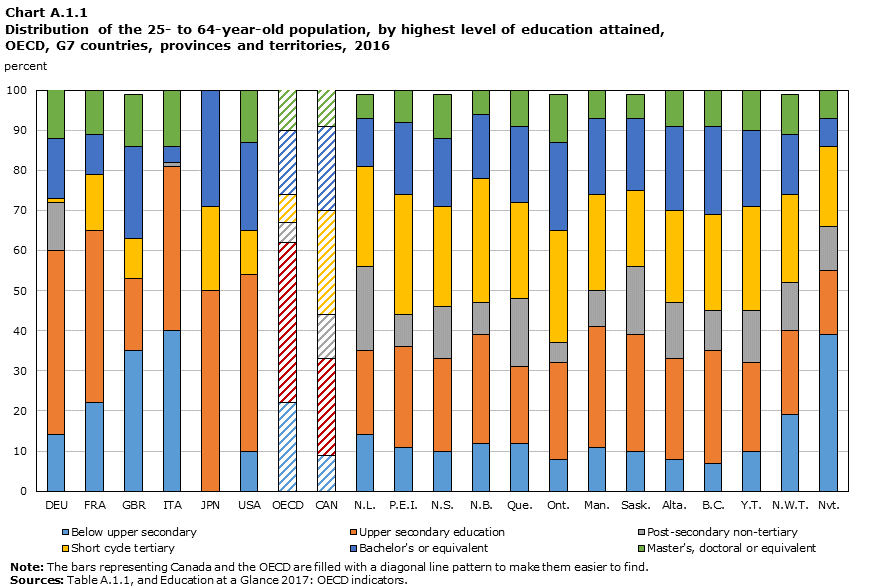
Data table for Chart A.1.1
| Below upper secondary | Upper secondary education | Post-secondary non-tertiary | Short cycle tertiary | Bachelor's or equivalent | Master's, doctoral or equivalent | |
|---|---|---|---|---|---|---|
| percent | ||||||
| DEU | 14 | 46 | 12 | 1 | 15 | 13 |
| FRA | 22 | 43 | 0 | 14 | 10 | 11 |
| GBR | 35 | 18 | Note ..: not available for a specific reference period | 10 | 23 | 13 |
| ITA | 40 | 41 | 1 | 0 | 4 | 14 |
| JPN | Note ..: not available for a specific reference period | 50 | Note ..: not available for a specific reference period | 21 | 29 | Note ..: not available for a specific reference period |
| USA | 10 | 44 | Note ..: not available for a specific reference period | 11 | 22 | 13 |
| OECD | 22 | 40 | 5 | 7 | 16 | 13 |
| CAN | 9 | 24 | 11 | 26 | 21 | 10 |
| N.L. | 14 | 21 | 21 | 25 | 12 | 6 |
| P.E.I. | 11 | 25 | 8 | 30 | 18 | 8 |
| N.S. | 10 | 23 | 13 | 25 | 17 | 11 |
| N.B. | 12 | 27 | 8 | 31 | 16 | 6 |
| Que. | 12 | 19 | 17 | 24 | 19 | 9 |
| Ont. | 8 | 24 | 5 | 28 | 22 | 12 |
| Man. | 11 | 30 | 9 | 24 | 19 | 7 |
| Sask. | 10 | 29 | 17 | 19 | 18 | 6 |
| Alta. | 8 | 25 | 14 | 23 | 21 | 9 |
| B.C. | 7 | 28 | 10 | 24 | 22 | 9 |
| Y.T. | 10 | 22 | 13 | 26 | 19 | 10 |
| N.W.T. | 19 | 21 | 12 | 22 | 15 | 10 |
| Nvt. | 39 | 16 | 11 | 20 | 7 | 7 |
|
.. not available for a specific reference period Note: The bars representing Canada and the OECD are filled with a diagonal line pattern to make them easier to find. Sources: Table A.1.1, and Education at a Glance 2017: OECD indicators. |
||||||
- Almost 6 in 10 Canadians (57%) had attained a tertiary level (college or university) education in 2016. Canada had the highest proportion of its population with a tertiary level of education among the G7 countries, with other countries ranging from 18% in Italy to 50% in Japan.
- One-quarter (26%) of Canadians had attained a college qualification. Among OECD countries, Canada had the highest proportion of its population with short-cycle tertiary education (college) (26%).
- At the university level, the proportion of Canadians with university as the highest educational qualification is more similar to that of most other G7 countries at 31%.
- Eleven percent of Canadians had attained a “postsecondary non-tertiary education”, which includes certificates or diplomas from vocational schools or apprenticeship trainingNote 2. Among G7 countries, this is not a common level of attainment – only Germany had a substantial proportion of the population (12%) who had postsecondary non-tertiary education as their highest level of attainment.
- Roughly 1 in 10 Canadians (9%) had not completed high school (“upper secondary”). Among G7 countries, Canada is comparable to the United States at 10% and Germany at 14%, but significantly lower than the United Kingdom (20%), France (22%) and Italy (40%).
Gender differences, Canada and OECD

Data table for Chart A.1.2
| Men (Canada) | Women (Canada) | Men (OECD) | Women (OECD) | |
|---|---|---|---|---|
| percent | ||||
| Below upper secondary | 11 | 8 | 22 | 22 |
| Upper secondary | 25 | 23 | 42 | 37 |
| Postsecondary non-tertiary | 14 | 7 | 5 | 4 |
| Short cycle tertiary |
22 | 29 | 7 | 8 |
| Bachelor's or equivalent | 18 | 23 | 15 | 18 |
| Master's, doctoral or equivalent | 10 | 10 | 13 | 14 |
|
Sources: Table A.1.1 and Education at a Glance 2017: OECD indicators. |
||||
- Men and women had similar levels of educational attainment until the end of high school (upper secondary). Larger gender differences emerge for postsecondary attainment.
- At the post-secondary non-tertiary level, which captures the traditionally male-dominated areas of trades, the proportion of men (14%) was double that of women (7%). The opposite was true at the college and university levels, with the gap more marked at college (29% for women vs 22% for men) than university (33% for women and 28% for men).
Tertiary attainment

Data table for Chart A.1.3
| Bachelor's, master's or doctoral or equivalent | Short cycle tertiary | Total tertiary | |
|---|---|---|---|
| percent | |||
| DEU | 28 | 1 | 28 |
| FRA | 20 | 14 | 35 |
| GBR | 36 | 10 | 46 |
| ITA | 18 | 0 | 18 |
| JPN | 29 | 21 | 50 |
| USA | 35 | 11 | 46 |
| OECD | 29 | 8 | 37 |
| CAN | 31 | 26 | 57 |
| N.L. | 18 | 25 | 43 |
| P.E.I. | 26 | 30 | 57 |
| N.S. | 28 | 25 | 54 |
| N.B. | 22 | 31 | 53 |
| Que. | 27 | 24 | 52 |
| Ont. | 34 | 28 | 63 |
| Man. | 26 | 24 | 50 |
| Sask. | 25 | 19 | 44 |
| Alta. | 30 | 23 | 53 |
| B.C. | 31 | 24 | 55 |
| Y.T. | 29 | 26 | 55 |
| N.W.T. | 25 | 22 | 47 |
| Nvt. | 15 | 20 | 35 |
|
Notes: The bars representing Canada and the OECD are filled with a diagonal line pattern to make them easier to find. Due to rounding, totals may not match the sum of the individual values. Sources: Table A.1.1, Table A.1.3. and Education at a Glance 2017: OECD indicators. |
|||
- Among OECD countries 7% of 25- to 64-year-olds, on average, had completed college programs in 2016, far fewer than the 26% reported for Canada. This number reflects Canada’s well-developed college sector.
- The corresponding OECD average for university (bachelor’s, master’s, doctoral or equivalent) was 29%, just under Canada’s average at 31%.
- Within Canada, university attainment ranged from 15% in Nunavut to 34% in Ontario. For college, the numbers range from 19% in Saskatchewan to 31% in New Brunswick. Both educational sectors are strong in all jurisdictions.
Generational differences in tertiary attainment

Data table for Chart A.1.4
| 25 to 34 years | 55 to 64 years | 25 to 34 years Men | 55 to 64 years Men | 25 to 34 years Women | 55 to 64 years Women | |
|---|---|---|---|---|---|---|
| percent | ||||||
| DEU | 31 | 26 | 30 | 32 | 32 | 21 |
| FRA | 44 | 22 | 39 | 22 | 49 | 22 |
| GBR | 52 | 38 | 51 | 39 | 53 | 36 |
| ITA | 26 | 12 | 20 | 13 | 32 | 12 |
| JPN | 60 | 40 | 58 | 43 | 62 | 36 |
| USA | 48 | 42 | 43 | 41 | 52 | 43 |
| OECD | 43 | 27 | 37 | 27 | 49 | 26 |
| CAN | 61 | 46 | 51 | 43 | 70 | 50 |
| N.L. | 53 | 31 | 44 | 28 | 62 | 35 |
| P.E.I. | 64 | 48 | 52 | 39 | 75 | 56 |
| N.S. | 62 | 43 | 51 | 36 | 72 | 50 |
| N.B. | 62 | 40 | 54 | 34 | 69 | 45 |
| Que. | 57 | 39 | 48 | 38 | 67 | 40 |
| Ont. | 68 | 53 | 60 | 51 | 75 | 55 |
| Man. | 52 | 43 | 43 | 39 | 61 | 48 |
| Sask. | 48 | 36 | 37 | 26 | 59 | 47 |
| Alta. | 54 | 45 | 44 | 37 | 65 | 53 |
| B.C. | 57 | 47 | 46 | 42 | 66 | 51 |
| Y.T. | 51 | 52 | 42 | 41 | 61 | 62 |
| N.W.T. | 42 | 39 | 34 | 30 | 49 | 49 |
| Nvt. | 30 | 41 | 22 | 41 | 38 | 42 |
|
Note: The bars representing Canada and the OECD are filled with a diagonal line pattern to make them easier to find. Source: Table A.1.3. and Education at a Glance 2017: OECD Indicators; OECD stat Web site at stats.oecd.org. |
||||||
- With the exception of the Yukon and Nunavut, younger people had a higher level of educational attainment than their older counterparts in Canada and overall in OECD countries. In addition, Canada’s level of tertiary attainment among the older and younger generations was higher than the OECD average.
- The largest difference in tertiary attainment between the younger and older age groups was in Newfoundland and Labrador and New Brunswick, where the younger age group had an attainment rate 22 percentage points above that of the older age group. The smallest difference was in the Northwest Territories, with a difference of three percentage points between the age groups.
- As in previous years, a greater proportion of women in Canada obtained a higher level of education compared to men in 2016. This trend was more prevalent in the younger age group than in the older age group. The trend also occurred for the younger population among all other G7 countries.
Trends in attainment levels

Data table for Chart A.1.6.2
| Below upper secondary | Upper secondary and post-secondary non tertiary | Tertiary | |
|---|---|---|---|
| percent | |||
| DEU | -1.8 | -0.8 | 2.8 |
| FRA | -3.0 | 0.2 | 0.9 |
| GBR | -5.9 | -0.4 | 3.6 |
| ITA | -2.4 | -0.3 | 4.3 |
| JPN | Note ..: not available for a specific reference period | Note ..: not available for a specific reference period | 1.1 |
| USA | -4.0 | -0.7 | 1.7 |
| OECD | -1.9 | -1.4 | 2.7 |
| CAN | -2.6 | -1.2 | 1.1 |
| N.L. | -4.9 | -1.1 | 1.8 |
| P.E.I. | -6.5 | -0.6 | 1.1 |
| N.S. | -4.7 | -1.3 | 1.5 |
| N.B. | -3.9 | -2.0 | 1.9 |
| Que. | -3.0 | 0.3 | 0.4 |
| Ont. | -1.5 | -2.4 | 1.3 |
| Man. | -3.4 | -0.7 | 1.2 |
| Sask. | -2.5 | -1.0 | 1.6 |
| Alta. | -1.9 | -1.2 | 1.3 |
| B.C. | -4.0 | -1.3 | 1.6 |
| Y.T. | -2.9 | -1.7 | 2.4 |
| N.W.T. | -0.6 | 1.6 | -1.0 |
| Nvt. | -1.0 | 0.4 | 1.1 |
|
.. not available for a specific reference period Notes: The bars representing Canada and the OECD are filled with a diagonal line pattern to make them easier to find. Data for upper secondary attainment in the United Kingdom include completion of a sufficient volume and standard of programmes that would be classified individually as completion of intermediate upper secondary programmes. Sources: Table A.1.4 and Education at a Glance 2017:OECD indicators. |
|||
- In general, the annual growth rate of the highest level of education attained between 2005 and 2016 for 25- to 34-year-olds increased among all G7 countries (including Canada as well as the provinces and territories).
- Among the G7 countries, the annual growth rate for 25- to 34-year-olds for tertiary education ranged from 0.9% in France to 4.3% in Italy.
- With the exception of the Northwest Territories, in which the compound annual growth rate for 25- to 34-year-olds for tertiary education decreased by 1%, the increase in the compound annual growth rate ranged from 0.4% in Quebec to 2.4% in the Yukon from 2005 to 2016.
Definitions, sources and methodology
This indicator examines educational attainment among Canada’s adult population aged 25 to 64, by age group and sex. It presents a portrait of the situation in 2016, but also shows the evolution since 2005.
The percentage of the population represented by a given age group that has attained a particular education level is obtained by taking the number of persons in this age group who have received a diploma attesting to that level, dividing it by the total number of persons in this same age group, and then multiplying by 100.
Growth calculations in this indicator make use of the compound annual growth rate (CAGR) formula. The CAGR formula calculates growth between two (often extended) points in time, assuming that growth is compounded annually.
The education level corresponds to the highest level of education an individual has attained. The designation of the different levels of schooling is based on the International Standard Classification of Education (ISCED-2011) (see the “ISCED classifications and descriptions” and the “Mapping to ISCED” section for the Labour Force Survey [LFS] in Notes to readers). An individual must have successfully completed a programme at a given ISCED level to be considered as having attained that level of education. An individual who has not successfully completed a programme is assigned the preceding education level. For example, a secondary school graduate, as well as an individual who has undertaken some postsecondary education but who has not obtained a credential at that level, is considered to have attained ISCED level 3 (upper secondary education); a student who has not successfully completed secondary school is considered to have obtained ISCED level 2 (lower secondary education).
The information presented for Canada on population and educational attainment is based on data from the LFS, which surveys approximately 56,000 households every month.Note 3 The LFS seeks to obtain a detailed and timely picture of the population aged 15 or older throughout the country. It allows proxy reporting, meaning that information on the entire household can be collected from a single member of the household. In all, this type of reporting accounts for approximately 65% of all information collected. Figures from the Organisation for Economic Co-operation and Development (OECD) are those reported by the OECD, and are drawn from OECD and Eurostat databases, as compiled from national labour force surveys or population registers.
Some limitations are encountered when using LFS data to examine and categorize educational attainment using ISCED as it is not possible to make a precise delineation between “postsecondary non-tertiary education” and “short-cycle tertiary education”. LFS data reported for the Canadian population that has attained ISCED level 5 (short-cycle tertiary education) will be somewhat overestimated because this category includes, for example, some CEGEP or college university transfer program graduates who, under the international classification standards, would have been placed in ISCED level 4 (Post-secondary non-tertiary education).
In Statistics Canada’s LFS the master’s or equivalent and doctors or equivalent levels cannot be cannot be identified separately; therefore, educational attainment in the ISCED 7 and 8 (Master’s or equivalent and doctoral or equivalent) categories are combined.
Note: The corresponding OECD indicator is A1, To what level have adults studied?.
Tables for A1 Educational attainment of the adult population
A2 Upper secondary graduation
Context
This indicator presents upper secondary school graduation rates. Graduation rates are often seen as a measure of student achievement. A comparison of overall rates gives some information about the extent to which school systems are succeeding in providing students with what is universally recognized as an important educational milestone. Presenting rates by sex reveals whether any gender differences exist; this in turn can signal whether those systems are meeting the needs of both male and female students. The share of graduates under 25 years of age among all graduates is also presented.
Upper secondary graduation is the foundation for further education. It has become an essential milestone for most students and provides economic and social benefits for society. Historically, males had been much more likely to graduate from secondary school; however, that pattern has been reversed for many years in Canada and almost all other OECD member countries. Whether male or female, the value of graduating from high school also extends beyond the academic qualification by giving individuals what is now widely considered the minimum requirement for entry into the labour market.
Another dimension presented by this indicator is the successful completion of upper secondary programmes based on a synthetic cohort for public schools. To a certain extent, this indicator reveals the effectiveness of Canada’s various public education systems in producing graduates within the three-year period typically considered by the OECD as the normal duration of an upper secondary education program (on-time graduation). In Canada, this period would be equivalent to Grades 10 to 12, or, in Quebec, Grades 9 to 11.Observations

Data table for Chart A.2.1
| Both sexes | Females | Males | |
|---|---|---|---|
| percent | |||
| FIN | 99 | 102 | 96 |
| JPN | 98 | 99 | 97 |
| KOR | 93 | 92 | 94 |
| ITA | 92 | 94 | 91 |
| DEU | 87 | 86 | 87 |
| USA | 83 | 86 | 80 |
| OECD | 86 | Note ..: not available for a specific reference period | Note ..: not available for a specific reference period |
| CAN | 87 | 91 | 84 |
| N.L. | 83 | 85 | 80 |
| P.E.I. | 82 | 84 | 80 |
| N.S. | 87 | 87 | 86 |
| N.B. | 86 | 91 | 81 |
| Que. | 98 | 102 | 94 |
| Ont. | 90 | 93 | 87 |
| Man. | 75 | 76 | 73 |
| Sask. | 78 | 83 | 73 |
| Alta. | 74 | 78 | 71 |
| B.C. | 80 | 83 | 76 |
| Y.T. | 69 | 73 | 66 |
| N.W.T. | 58 | 65 | 51 |
| Nvt. | 31 | 37 | 26 |
|
.. not available for a specific reference period 1. This rate reports the percentage of people who obtain a secondary-school qualification for the first time in their life during a given year, from public, private, and First Nation-operated schools, as a proportion of the population of the corresponding age. During a period when an unexpected number of people go back to school, this rate can be very high - even above 100%. Thus, this rate should be interpreted as the probability that an individual will graduate from secondary education during his or her lifetime, and should not be confused with a graduation rate as the term is generally used in Canada, which reports on how many students who enter a program complete it successfully. Notes: The most recent data available for Canada and jurisdictions are for 2015, reflecting reports for the 2014/2015 academic year. Countries other than Canada are ranked in descending order and include the G-7 group of countries. Data are not available for the U.K. and France. The bars representing Canada and the OECD are filled with a diagonal line pattern to make them easier to find. The OECD female and male upper secondary graduation rates are not available. Sources: Table A.2.1., Education at a Glance 2017: OECD Indicators, OECDstat Web site at stats.oecd.org. |
|||
Upper secondary graduation rates
- Canada’s high school (“upper secondary”) first time graduation rate was 87% in 2015Note 4. The majority of other OECD member countries reported graduation rates of at least 80%. Countries with higher graduation rates included Finland and Japan (99% and 98%, respectively), Korea (93%) and Italy (92%). Graduation rates for the United States (83%) and the OECD average (86%) were both lower than that of Canada.
Graduation rates higher for females
- In Canada in 2015, the upper secondary graduation rate for females was higher (91%) than that for males (84%). This pattern remained for all provinces and territories, notably in the Northwest Territories (14 percentage point difference), New Brunswick and Saskatchewan (10 percentage point difference). Germany and Korea were the only countries in the OECD whose graduation rates were higher for males than for females (1% and 2% higher).
Trends in upper secondary graduation rates

Data table for Chart A.2.2
| 2010 | 2015 | |
|---|---|---|
| percent | ||
| OECD | 85 | 86 |
| CAN | 83 | 87 |
| N.L. | 80 | 83 |
| P.E.I. | 81 | 82 |
| N.S. | 84 | 87 |
| N.B. | 86 | 86 |
| Que. | 91 | 98 |
| Ont. | 87 | 90 |
| Man. | 72 | 75 |
| Sask. | 81 | 78 |
| Alta. | 70 | 74 |
| B.C. | 78 | 80 |
| Y.T. | 72 | 69 |
| N.W.T. | 54 | 58 |
| Nvt. | 37 | 31 |
|
Note: The bars representing Canada and the OECD are filled with a diagonal line pattern to make them easier to find. Sources: Education Indicators in Canada: An International Perspective 2013, Table A.2.1: Upper secondary graduation rates, by programme orientation and sex, Canada, provinces and territories, 2010., Education Indicators in Canada: An International Perspective 2017, Table A.2.1: Upper secondary graduation rates, by sex, Canada, provinces and territories, 2015; Education at a Glance 2017: OECD Indicators, Table A2.3, Trends in upper secondary and post-secondary non-tertiary first-time graduation rates (2005, 2010 and 2015). |
||
- The first-time upper secondary graduation rate increased in Canada by 4 percentage points between 2010 and 2015, compared to a 1 percentage point increase for the OECD countries overall. Among the provinces and territories, Quebec experienced the largest increase in its upper secondary graduation rate from 2010 to 2015 (7 percentage points), while a decrease was reported in Saskatchewan, the Yukon and Nunavut.
Successful completion of upper secondary programmes

Data table for Chart A.2.3
| Both sexes | Females | Males | |
|---|---|---|---|
| percent | |||
| CAN | 77 | 81 | 74 |
| N.L. | 82 | 86 | 79 |
| P.E.I. | 80 | 83 | 78 |
| N.S. | 84 | 85 | 84 |
| N.B. | 84 | 86 | 81 |
| Que. | 64 | 71 | 57 |
| Ont. | 84 | 87 | 82 |
| Man. | 76 | 77 | 75 |
| Sask. | 72 | 75 | 69 |
| Alta. | 75 | 77 | 72 |
| B.C. | 77 | 79 | 74 |
| Y.T. | 65 | 68 | 63 |
| N.W.T. | 35 | 39 | 31 |
| Nvt. | 17 | 19 | 15 |
|
Notes: 15- to 18-year-olds in Quebec. The most recent data available for Canada and jurisdictions are for 2015, reflecting reports for the 2014/2015 academic year. The bar representing Canada is filled with a diagonal line pattern to make it easier to find. Source: Table A.2.2. |
|||
- Over three quarters of students (77%) in Canada completed high school within the three-year period typically covered by upper secondary education.Note 5
- The proportion of students who completed their education in the expected time varied considerably across the country: from 17% in Nunavut to 84% in Nova Scotia, New Brunswick and Ontario.
- The successful on-time completion of upper secondary programmes was higher for females than for their male counterparts in all provinces and territories. For the provinces, the lowest female-male gap was in Nova Scotia at one percentage point while the highest was in Quebec at 14 percentage points. At the Canada level the difference was 7 percentage points.
Definitions, sources and methodology
This indicator presents net upper secondary graduation rates without duplication (i.e., first-time graduates) by sex. It also presents successful completion of upper secondary programmes of a proxy cohort in public schools.
Upper secondary graduation rates
These rates are an estimation of the probability that an individual will graduate from high school during his or her lifetime, assuming that current conditions related to graduation all remain the same.Note 6
Upper secondary graduation rates are the sum of graduation rates by age, and the latter are obtained by dividing graduates of a specific age by the population of the corresponding specific age. Rates without duplication only count individuals who had obtained, during a given year, a diploma at this level for the first time.Note 7 In general, a graduate of upper secondary education is considered to have successfully completed the last year of education at this level, regardless of his or her age.
All data for Canada reflect the 2014/2015 school year; the OECD averages also reflect 2014/2015. Information for Canada was drawn from the Elementary-Secondary Education Survey (ESES), an administrative survey that collects data for public and private educational institutions from the provincial and territorial ministries/departments of education.Note 8 To ensure comparability with other OECD countries, Statistics Canada added, for all provinces and territories (except Nova Scotia, for which data were estimated), the number of 2014/2015 graduates from private schools provided by provinces and territories at ESES collection. The number of graduates from First Nations band-operated schools (these data were obtained from Indigenous and Northern Affairs Canada), were also added to the number of public and private school graduates and included in the calculation of the upper secondary graduation rates presented. Please note that Manitoba graduates from Adult Learning Centres in the province are not included in the graduation rate calculation.
For Indigenous and Northern Affairs Canada (INAC), prior to 2014/2015, funding recipient reports included automatically pre-filled graduation data for potential high school graduates, which led to inaccurate reporting results. As a result, this pre-filled data was removed from reports as of 2014/2015, contributing to a decrease in the reported graduation rate since then.
Population estimates used in the denominator of the graduation rate calculation cover the entire population, including Aboriginal people, as of January 1, 2015.
Successful completion of upper secondary programmes in public schools
An adjusted proxy cohort for examination of the successful (on-time) completion of upper secondary programmes has been developed for public schools (as per the scope of the ESES data collection) for Canada and the jurisdictions. It was calculated by dividing the number of 16- to 19-year-old graduates (15- to 18-year-olds in Quebec) in 2014/2015 by the number of Grade 10 (3e secondaire in Quebec) enrolments recorded three years earlier (i.e., in 2012/2013). This ratio has been adjusted to take into account deaths and interprovincial and international migration factors.
The adjustment factor is generated by dividing the 14- to 15-year-old population in 2012 (which represents the Grade 10 students) by the 17- to 18-year-old population in 2015 (which represents the Grade 10 students who graduated three years later). If this adjustment is not made, the inclusion of recent in-migrants who were not part of the original Grade 10 cohort would result in an overestimation of the number of graduates that were part of the original universe (the 2012 Grade 10 enrolments). This adjustment implicitly assumes that graduation rates of recent immigrants are identical to graduation rates of those in the original cohort.
Other possible flows in and out of the public school system between enrolment in Grade 10 and graduation at the end of Grade 12 may exist; for example, movement between public and private schools. Such possibilities could not be taken into consideration, however, as the appropriate data that would be needed to estimate such flows are not available at this time.
International data collection
The international figures used by the OECD are obtained from the UOE collection of statistical data on education, carried out jointly by three international organizations (UNESCO, the OECD, and Eurostat), and conducted in 2016 by the OECD.
Note: The corresponding OECD indicator is A2, How many students are expected to complete upper secondary education?
Tables for A2 Upper secondary graduation
A3 Labour market outcomes
Context
This indicator examines the connection between educational attainment and the labour market by looking at employment rates among the adult population aged 25 to 64. This relationship is explored by sex and by age group (25 to 34 and 55 to 64). Trends in employment rates by educational attainment are also presented. Educational attainment reflects the highest level of education successfully completed, based on the International Standard Classification of Education (ISCED) categories.Note 9
One of the main objectives of education systems is to prepare individuals so they can participate in a knowledge-oriented economy and society. Job prospects and employment rates are generally better for those individuals with higher education.Observations
Employment rates by attainment

Data table for Chart A.3.1
| Below Upper secondary | Lower secondary |
Upper secondary | Short cycle tertiary | Bachelor's or equivalent |
Master's and doctoral levels or equivalent | |
|---|---|---|---|---|---|---|
| percent | ||||||
| Men (OECD) | 67 | 70 | 82 | 87 | 87 | Note ..: not available for a specific reference period |
| Women (OECD) | 48 | 50 | 67 | 76 | 79 | Note ..: not available for a specific reference period |
| Men (Canada) | 63 | 65 | 77 | 84 | 87 | 87 |
| Women (Canada) | 43 | 48 | 65 | 78 | 80 | 81 |
|
.. not available for a specific reference period Note: OECD average is not available for combined master's and doctoral levels. Sources: Tables A.3.1, A.3.3.1 and Education at a Glance 2017: OECD Indicators. |
||||||
- Employment rates rose with levels of educational attainment both in Canada and at the OECD average.
- In Canada and for the OECD average, women had consistently lower employment rates than men.
- This gender gap in employment rates in Canada was largest (20 percentage points) among those with the least education and smallest (6 percentage points) among the men and women with bachelor’s or equivalent educationNote 10. This was also true at the OECD average, with a larger gap between men and women at the below upper secondary level (19 percentage points) and a smaller gap at the bachelor’s or equivalent (8 percentage points).

Data table for Chart A.3.2
| Below upper secondary | Upper secondary education | Postsecondary non-tertiary | Tertiary | |
|---|---|---|---|---|
| percent | ||||
| DEU | 59 | 80 | 86 | 88 |
| FRA | 51 | 73 | 60 | 85 |
| GBR | 60 | 83 | 85 | |
| ITA | 51 | 71 | 73 | 80 |
| USA | 57 | 69 | 82 | |
| OECD | 58 | 74 | 79 | 84 |
| CAN | 55 | 71 | 79 | 82 |
| N.L. | 41 | 61 | 70 | 77 |
| P.E.I. | 52 | 70 | 73 | 80 |
| N.S. | 50 | 66 | 71 | 81 |
| N.B. | 46 | 69 | 73 | 81 |
| Que. | 54 | 71 | 79 | 83 |
| Ont. | 53 | 69 | 79 | 82 |
| Man. | 60 | 75 | 81 | 84 |
| Sask. | 64 | 76 | 84 | 84 |
| Alta. | 60 | 74 | 83 | 82 |
| B.C. | 59 | 72 | 80 | 80 |
| Y.T. | 66 | 84 | 83 | 86 |
| N.W.T. | 59 | 77 | 84 | 90 |
| Nvt. | 43 | 67 | 72 | 85 |
|
Note: The markers representing Canada and the OECD are enlarged and without colour to make them easier to find. Sources: Table A.3.1, Table A.3.2. and Education at a Glance 2017: OECD Indicators. |
||||
- Employment rates also rose with levels of educational attainment across all provinces, territories, G7 countries and at the OECD average. However, the magnitude and the nature of the educational advantage varied among the Canadian jurisdictions.
- Although tertiary graduates generally had the highest employment rates in 2016, this was not true in Saskatchewan, Alberta and British Columbia, where those with postsecondary non-tertiary had higher employment rates.
- Employment rates for Canadians with tertiary education were comparable to those of G7 countries, with Canada’s employment rate being slightly higher than the US or Italy, but lower than that of France, Germany and the United Kingdom.
- Employment rates for Canadians with less than upper secondary education ranged widely across the country, from 41% in Newfoundland and Labrador to 66% in the Yukon.
Employment rates by attainment, 2005 and 2016

Data table for Chart A.3.3
| 25-34 (2005) | 25-34 (2016) | 55-64 (2005) | 55-64 (2016) | |
|---|---|---|---|---|
| percent | ||||
| Below upper secondary | 62 | 57 | 41 | 47 |
| Upper secondary | 78 | 72 | 56 | 59 |
| Postsecondary non-tertiary | 86 | 85 | 60 | 65 |
| Tertiary | 85 | 85 | 62 | 67 |
| Sources: Tables A.3.3.2 and A.3.3.3 and Education at a Glance 2017: OECD Indicators. | ||||
- In 2016, 76% of young adults with upper secondary or postsecondary non-tertiary were employed versus 80% for this same age group in 2005.
- This was not true for young adults with postsecondary non-tertiary or tertiary education, as between the two time periods, employment rates were more similar.
- In Canada, for 55-to 64-year-olds, the employment rate was higher in 2016 at every level of education than the rate observed in 2005 indicating that the older generation increasingly postponed retirement and continued working beyond age 55. For most of the OECD countries the employment rate did not change for this age group during the same time period.
Definitions, sources and methodology
This indicator, labour market outcomes, examines the relationship between educational attainment and the employment rates of 25-to 64-year-olds, overall, by sex, and by age group. It also provides insight into how this relationship has evolved over time.
The employment rate represents the percentage of employed people in this population. To calculate the employment rate for a group with a particular level of educational attainment, the number of employed persons with the particular level of educational attainment is divided by the total number of persons in the population aged 25 to 64 who have attained that education level and then multiplying this quotient by 100.
The concepts and definitions of “employment” and “unemployment” adopted by the Labour Force Survey (LFS) are based on those endorsed by the International Labour Organisation (ILO). Employed persons are those who, during the reference week: (1) did any work at all at a job or business, that is, paid work in the context of an employer-employee relationship, or self-employment. It also includes unpaid family work, which is defined as unpaid work contributing directly to the operation of a farm, business or professional practice owned and operated by a related member of the same household; or (2) had a job but were not at work due to factors such as own illness or disability, personal or family responsibilities, vacation, labour dispute or other reasons (excluding persons on layoff, between casual jobs, and those with a job to start at a future date). The education level is measured according to the highest level of schooling completed.
The data for Canada and its provinces and territories were drawn from the Labour Force Survey (LFS), which surveys approximately 56,000 households every month.Note 11 The LFS excludes the following from the scope of the survey: individuals who live on reserves or in other Aboriginal settlements in the provinces, full-time members of the Canadian Forces and institutional residents. The LFS employment rate is based on a monthly average from January to December. Figures from the Organisation for Economic Co-operation and Development (OECD) are those reported by the OECD, and they are extracted from the OECD and Eurostat databases compiled from national labour force surveys for the OECD member countries.
Note: The corresponding OECD indicator is A5, How does educational attainment affect participation in the labour market?
Tables for A3 Labour market outcomes
- Date modified: