
Monthly estimates of business openings and closures, March 2022

Archived Content
Information identified as archived is provided for reference, research or recordkeeping purposes. It is not subject to the Government of Canada Web Standards and has not been altered or updated since it was archived. Please "contact us" to request a format other than those available.
Released: 2022-07-04
In March 2022, the number of active businesses (-0.2%; -1,927) decreased for the second consecutive month but remained above its February 2020 pre-COVID-19 pandemic level. This decrease was entirely due to the decline in the opening rate from 4.8% in February to 4.6% in March, as the business closure rate remained unchanged at 4.8%.
Transportation and warehousing (-1.0%; -484) and other services (except public administration) (-0.5%; -369), which both fell for the second consecutive month, drove the decline in the number of active businesses in March 2022. The number of active businesses continued to increase in accommodation and food services (+0.3%; +189) and other tourism industries (+0.4%; +312) but remained below its respective pre-pandemic level. Ontario (-0.2%; -744) led the decrease in the national number of active businesses, followed by Manitoba (-0.6%; -182) and Saskatchewan (-0.7%; -174).
The series on temporary business closures and exits (or "permanent closures") is now updated to include data up to September 2021. The exit rate held steady at 1.6% from August to September 2021, slightly below its 2015-to-2019 historical average of 1.7%.
In September 2021, the transportation and warehousing sector (2.6%) posted a higher exit rate than its historical average of 1.5% for the 11th consecutive month. The exit rate was lower than or close to its respective historical average in all other industries.
What happened to the businesses that were active businesses in February 2020?
Although the number of active businesses recovered to its February 2020 pre-pandemic level in October 2021, a large number of businesses that existed in February 2020 had closed. In February 2022, 76.6% of the businesses that were active in February 2020 were still active while the remaining 23.4% closed. This closure rate was 0.7 percentage point (pp) lower than the average closure rate of the four similar two-year periods prior to the pandemic (e.g., February 2015 to February 2017; February 2018 to February 2020). In addition, the businesses that closed accounted for 8.3% of employment in February 2020. This indicates that the businesses that closed were smaller on average than incumbents.
In most industries, the closure rate of businesses that were active in February 2020 was lower than the average closure rate of similar two-year periods pre-pandemic. The industries in which the closure rates for February 2020 active businesses exceeded those in the past include transportation and warehousing (+2.0 pp), educational services (+1.7 pp) and, arts, entertainment and recreation (+0.9 pp). On the other hand, the industries in which the closures rates for February 2020 active businesses were below those in the past include utilities (-7.6 pp), finance and insurance, and management of companies and enterprises (-4.6 pp), forestry, fishing and hunting (-3.4 pp), and information and cultural industries (-3.4 pp).
The presence of the Canada Emergency Wage Subsidy (CEWS) and other emergency response programs aimed at supporting businesses over the pandemic may have influenced the closure rates over the February 2020-to February 2022 period relative to previous periods. Of the active businesses in February 2020, 41.6% used CEWS at least once over the March 2020-to-October 2021 period. Among those firms that used CEWS, 10.3% closed by February 2022. The pattern of lower closure rates for businesses that used CEWS compared with businesses that did not is consistent across industries, except in utilities (18.1% vs 19.9%). However, these patterns cannot be interpreted as the impact of CEWS because the use of CEWS is not random. The probability of using CEWS could be associated with firm characteristics, such as firm size, that also improve a firm's chance of survival. For more information on estimates of the relationship between the usage of CEWS and firm survival and growth, see the Canada Emergency Wage Subsidy program and business survival and growth during the COVID-19 pandemic in Canada.
Chart 1

Change in the number of active businesses, business sector, January 2019 to March 2022, seasonally adjusted series

Chart 2
Number of active businesses in February 2020 that are active in February 2022 as a percentage of active businesses in February 2020, by industry
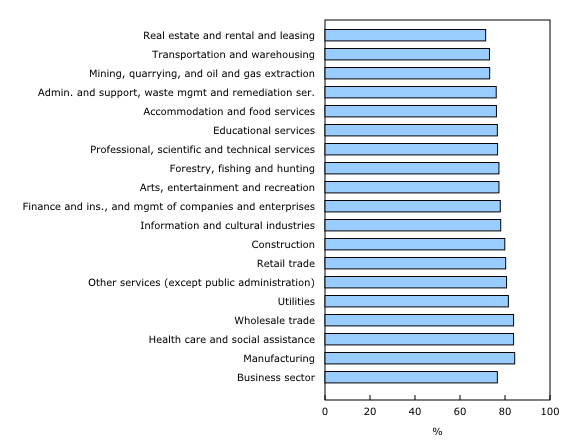
Chart 3
Business closure rate, by industry

Note to readers
April 2022's release introduced a new process for seasonally adjustment in the presence of the outliers generated by the response to the COVID-19 pandemic. The new process has a greater number of outliers that are explicitly recognized at the outset of the seasonal adjustment process. This leads to a greater number of outliers being taken into account than was previously occurring. Examinations of seasonally adjusted data using the new process show results that are more stable over time and produce smaller revisions.
Every new month of data leads to a revision of the previously released data due to such factors as the seasonal adjustment process and a new version of the Generic Survey Universe File (or vintage of the Business Register). As such, the estimates may vary compared with a previous release.
Openings are defined as businesses with employment in the current month and no employment in the previous month, while closures are defined as businesses that had employment in the previous month, but no employment in the current month. Continuing businesses are those that have employees in both months, and the active population in any given month is the number of opening and continuing businesses in that month. Reopening businesses are defined as opening businesses that were also active in a previous month (that is, they closed in a given month and had positive employment in a subsequent month). In contrast, entrants are opening businesses that were not active in a previous month.
The definition of exits is based on the Longitudinal Employment Analysis Program (LEAP) annual exits. Because the LEAP definition can require up to 24 months of data to be counted as an exit, projections of exits using predicted growth rates are implemented using a regression model of exits on closures of more than six months. As a result, there are no published exits in the last six months. A temporary business closure is the difference between closures and exits. For more information on temporary business closures and exits, see "Defining and measuring business exits using monthly data series on business openings and closures."
A business is defined as an enterprise operating in a particular geography and industry.
The vast majority of businesses operate in one industry and one location or geography. For these businesses, in the monthly estimates of openings and closures, they will be counted once at the national/provincial level. For example, a retailer in Windsor, Ontario, will be counted as an active business in the Ontario estimates and once in the national estimates.
Some businesses can have multiple operations, and these can be in different industries and geographies. For such businesses, in the monthly estimates of openings and closures, they can be counted more than once because they are active in multiple industries or geographies. For example, if a retailer has operations in both Alberta and Ontario, it will be counted as an active business in both provinces, but only once at the national level because it represents only one active firm. Similarly, a firm with retail and wholesale operations will be counted in both industries when individual industries are examined. However, when the business sector is examined, the firm counts only once because at that level it represents one firm active in the business sector.
Contact information
For more information, or to enquire about the concepts, methods or data quality of this release, contact us (toll-free 1-800-263-1136; 514-283-8300; infostats@statcan.gc.ca) or Media Relations (statcan.mediahotline-ligneinfomedias.statcan@statcan.gc.ca).
- Date modified: