
Section 3: Family violence against children and youth, 2013
by Tamy Superle
[Highlights] [Full article in PDF]
- Police-reported violent victimization rates lower for children and youth than for adults while sexual assault rates are higher
- One-quarter of those accused of violence against children and youth are family members
- Police-reported family violence rates increase as children grow older
- Girls are more likely than boys to be the victims of family violence
- Physical assault is the most common form of family violence against children and youth
- Physical and sexual assaults by family members down overall for children and youth
- Six in ten child and youth victims of homicide were killed by a family member
- Strangulation, suffocation or drowning most common cause of death in the homicides of children and youth
- Saskatchewan records the highest rate of family violence against children and youth among the provinces
- Charges laid in less than half of family violence incidents against children and youth
- Summary
- Detailed data tables
- References
- Notes
Child maltreatment,Note 1 including violence, is a significant public health issue (Afifi 2011) and can cause harm to the individual victims, their families and friends, as well as to society as a whole (Fox and Shonkoff 2012). Violence and maltreatment of children and youth can have immediate consequences such as physical injury, as well as long-term physical, psychological, and emotional effects (Fang et al. 2012; Afifi 2011; Tanaka et al. 2011; Murray and Farrington 2010). Additionally, research indicates that violence against children and youth may contribute to decreased productivity of the economyNote 2 and consequently have negative financial implications on society as a whole (Fang et al. 2012; Bowlus et al. 2003).
Not all criminal victimization by family members is reported to police. This can be partly explained by the fact that infants and younger children are not capable of reporting victimization themselves. Additionally, children and youth of all ages may be reluctant to report family violence for many reasons including fear of reprisal and/or dependency on the perpetrator (Schaeffer et al. 2011; United Nations 2011; AuCoin 2005). Therefore, the victimization of children and youth within the family may be less likely to be reported to the police than non-familial victimization. It is difficult to know exactly the extent of underreporting, but research suggests that violence against children is more likely to be underreported than violence against older victims (Cotter and Beaupré 2014; United Nations 2011; AuCoin 2005).
There is little information available on children’s reporting of criminal victimization. This is partially because most victimization surveys, such as the General Social Survey (GSS) on Victimization, do not interview children under 15.Note 3 However, the 2014 GSS on VictimizationNote 4 has been expanded to include detailed questions to participants about their experiences of violence as children.Note 5
While police-reported data may be an underestimate of violence against children, especially for the very young, they still provide important insights and information about those cases that do come to the attention of police. The current analysis examines police-reported family violence using data from the Incident-based Uniform Crime Reporting Survey and the Homicide Survey. All types of Criminal Code violent violations against children and youth are included in this analysis; however forms of child abuse that are not a Criminal Code offence are not included, for example emotional abuse and various forms of neglect.Note 6
Police-reported violent victimization rates lower for children and youth than for adults, while sexual assault rates are higher
In 2013, police reported just over 58,000 child and youthNote 7 victims of violence (Table 3.1) which represented a rate of 848.8 victims per 100,000 population under the age of 18. As has been the case historically, violent victimization rates for children and youth were slightly lower than those of the adult population (995.3 victims per 100,000).
The exception to this was police-reported sexual offences which were more likely to occur among children and youth than among those 18 years of age and over. More specifically, in 2013, the rate of police-reported sexual offences against children and youth was five times higher than the rate recorded for adults (202.0 victims per 100,000 versus 40.4 victims per 100,000). This difference was most prevalent for level 1 sexual assaultNote 8 with a rate of 141.5 per 100,000 for children and youth compared to a rate of 37.5 per 100,000 for adults.
One-quarter of those accused of violence against children and youth are family members
Overall, police reported about 16,700 child and youth victims of family-related violence in 2013. This represented a rate of 243.5 victims of family violence per 100,000 population under the age of 18.
Similar to police-reported violent crime in general, the majority of violence against children and youth is committed by someone known to the victim (81%). More specifically, of those accused of violence against children and youth in 2013, over half (52%) were acquaintances or friends,Note 9 while more than one-quarter (29%) were family membersNote 10 and 19% were strangers (Chart 3.1).

While the majority of children and youth were victimized by someone known to them, the type of relationship between the victim and the accused varies by offence. For instance, the majority of violations causing death committed against children and youth were perpetrated by family members (63%) (Chart 3.1). Family members were also the most common accused in both attempted murders (48%), and abductions and kidnappingsNote 11 (43%). In contrast, physical assaults, sexual offences, and other violent offences (such as criminal harassment and uttering threats) against children and youth were more often perpetrated by friends or acquaintances.
In 2013, family members most often accused of violence against children and youth were parents (60%) (Table 3.2). This is especially true for incidents of violence involving children under the age of four, for which parents accounted for 79% of accused family members. The proportion of accused parents decreased as children grew older.
Police-reported family violence rates increase as children grow older
Similar to police-reported violence against children in general, the rate of police-reported family violence committed against children and youth generally tended to increase with age. In 2013, as in previous years, younger children generally continued to have the lowest rates of family violence while youth typically had the highest rates (Chart 3.2). However, very young children may not have the ability to report their victimization themselves and as such the observed lower rates for young children may be an underestimation.

Even though young children had lower rates of police-reported victimization, when they were victimized they were more likely to be victimized by a family member. In 2013, 7 in 10 victims (71%) of police-reported violence who were under the age of four were victimized by a family member. The proportion of children victimized by a family member began to gradually decrease at the age of four, coinciding with the age when the majority of children begin to participate more independently in activities outside of the home, such as school, clubs, and sports.
Girls are more likely than boys to be the victims of family violence
As in previous years, girls (relative to boys) continued to be victimized at a higher rate by family members in 2013. More specifically, the rate of police-reported victimization by family members was about 1.5 times higher for girls than for boys (298.2 per 100,000 versus 191.5 per 100,000) (Table 3.3). Starting at the age of two, girls had a consistently higher rate of victimization than boys. The difference in victimization rates peaked at the age of 15 when the rate for girls was more than double the rate for boys (529.7 per 100,000 versus 240.3 per 100,000).
Girls experience higher rates of family-related victimization for nearly every type of offence, but especially so for sexual victimization. Girls were four times more likely than boys to be the victim of a police-reported sexual offence committed by a family member in 2013 (125.0 per 100,000 versus 30.2 per 100,000).
Physical assault is the most common form of family violence against children and youth
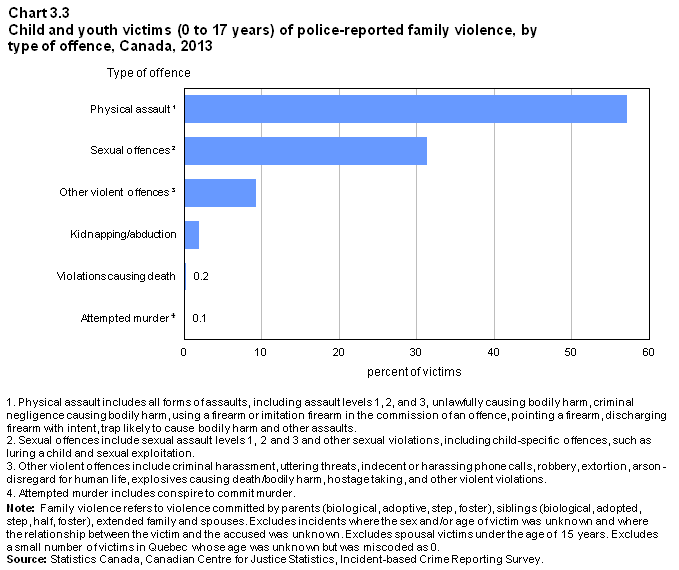
Family violence against children and youth can take many forms, but the most common type of victimization reported to the police in 2013 was physical assault. In total, more than half (57%) of child and youth victims of police-reported family violence were victims of physical assault (Chart 3.3). Reflecting the fact that the majority of these physical assaults were classified as level 1 (common assault), less than 4 in 10 (37%) victims sustained a physical injury as a result of the incident.Note 12 Of those who did sustain injuries, 96% were minor requiring little or no medical treatment (e.g. first aid).
It is important to note, however, that physical injury does not have to be inflicted in order for there to be significant harm to the victim (Fang et al. 2012; Fox and Shonkoff 2012; Tanaka et al. 2011). To date, there has been considerable research indicating that childhood maltreatment can have prolonged negative effects on emotional and physical wellbeing throughout the life course of the victim regardless of the infliction of physical injury (Fang et al. 2012; Fox and Shonkoff 2012; Tanaka et al. 2011). Furthermore, family-related victimization, especially if it is ongoing, can create stress and anxiety that may affect long-term brain development in children and youth, as well as potentially impacting their ability to relate to others and contribute positively to their community (Fox and Shonkoff 2012). These negative effects can also be experienced by those who witness family violence (Sinha 2012; Moss 2003).
Physical and sexual assaults by family members down overall for children and youth
Trends in police-reported physical and sexual assaults of children and youth can be examined for a five-year period using the Incident-based Uniform Crime Reporting (UCR) Trend database, which covers virtually all police services in Canada.Note 13 After remaining relatively stable from 2009 to 2011, the overall rate of physical assaults committed against children and youth by a family member decreased for the second consecutive year, dropping 13% between 2011 and 2013 (Table 3.4). The rate of police-reported physical assault for both girls and boys decreased between 2009 and 2013, although the rate for girls was slightly higher than for boys over that time.
The rate of police-reported sexual assault for girls and boys in which a family member was accused decreased 12% between 2009 and 2013. Despite the decrease, girls still experienced a higher rate of sexual assault than boys. In every year from 2009 to 2013 the overall rate of sexual assault for girls was at least 3.5 times higher than for boys.
There are a number of sexual violations within the Criminal Code that, by definition, apply only to children and youth and these include sexual interference, invitation to sexual touching, sexual exploitation, luring a child via a computer/agreement or arrangement, and making sexually explicit material available to a child for the purpose of facilitating sexual offences against children/youth. For these violations, information on relationship is not always provided. However, it is notable that overall, these specific violations increased in 2013 (Boyce, Cotter and Perreault 2014).Note 14
Six in ten child and youth victims of homicide were killed by a family member
Since 2003, 319 children and youth were victims of familial homicide and accounted for one in five family-related homicides. Between 2003 and 2013, 59% of all children and youth victims of homicide were victims of family-related homicide compared to 30% of adult victims.
Children were more at risk of being the victims of familial homicide than youth. Victims of homicide 11 years old and younger were more often killed by a family member than a non-family member. In particular, between 2003 and 2013, those under the age of one were most at risk to be killed by a family member (Chart 3.4). Since 2003, one in five (22%) infant victims of family-related homicide were killed on the day they were born.

Children aged 1 to 4 were also at higher risk of being victims of familial homicide than older children, with rates generally decreasing with age until late adolescence when rates increased. Because homicides are the most severe type of violence and are often difficult to hide from others, homicide rates may not be as prone to underestimation as other types of family violence (Sinha 2012).
Strangulation, suffocation or drowning most common cause of death in the homicides of children and youth
Overall, the most common method of familial homicides of children and youth between 2003 and 2013 was strangulation, suffocation or drowning (27%) (Table 3.5). In comparison, strangulation, suffocation or drowning was considerably less common in non-familial homicide, accounting for 7% of homicides of children and youth. Stabbing, which was the most common method of homicide (familial and non-familial) for all adults (34%) as well as for children and youth killed by non-family members (36%), accounted for 16% of familial homicide against children and youth.
Using the Homicide Survey, it is possible to examine the motivating factors that underlie familial homicide. Between 2003 and 2013, the most common motive in familial homicides of children and youth was frustration of the accused (62%) (Table 3.6). This was especially true for homicides of children 6 years of age or younger, in which about two-thirds (67%) of familial homicides were motivated by frustration. For homicide against youth aged 12 to 17, frustration was a less common motive, accounting for just over one-quarter (28%) of all homicides committed by family members. The next highest reported motivation for familial homicides of 12-to-17 year olds was arguments (21%). Among this 12-to-17 year-old age group, 21% of homicides had no apparent motive.
Saskatchewan records the highest rate of family violence against children and youth among the provinces
Jurisdictional differences in reporting requirements and variation in child welfare statutesNote 15 can contribute to variations in provincial and territorial rates of police-reported violence against children and youth (Trocmé et al. 2010). Despite possible jurisdictional differences, the geographical trends for family violence generally reflect the trends for other types of violent crime (Perreault 2013).
Provincially, Saskatchewan had the highest rate of child and youth victims of family violence at 465.3 per 100,000, followed by Manitoba (386.6 per 100,000) and New Brunswick (324.2 per 100,000) (Table 3.7). The provinces with the lowest rates were Ontario (166.2 per 100,000) followed by British Columbia (210.4 per 100,000) and Alberta (223.8 per 100,000). These three provinces were also the only provincial jurisdictions to record rates that were below the national rate.
The territories have the highest rates of police-reported family violence against children and youth in the country. All three territories had rates that were more than double the national rate with Nunavut having the highest rate at six times the overall rate (1,474.8 per 100,000 versus 243.5 per 100,000).
Overall, Saguenay had the highest rate of police-reported family violence against children and youth among all census metropolitan areas (CMAs)Note 16 in the country at 467.7 child and youth victims per 100,000 (Table 3.8). The three largest CMAs, Toronto, Montréal, and Vancouver, all had rates below the national rate. The combined rate of police-reported family violence against children and youth in CMAs is considerably lower than the combined rate in non-CMAs (183.6 per 100,000 compared to 382.9 per 100,000).
Charges laid in less than half of family violence incidents against children and youth
Due to the vulnerability of young victims, every province and territory has developed mandatory reporting laws that require people to notify the authorities of any suspected child abuse (Trocmé et al. 2010). However, given the hidden nature of some forms of familial violence, it is often difficult for others to detect it and subsequently report it. As a result, the violence may continue in the absence of intervention (Kellogg and the Committee on Child Abuse and Neglect 2007; Flaherty and Sege 2005).
When family-related violence against children and youth does come to the attention of authorities various organizations including police services, child welfare agencies, and other relevant organizations work together in order to investigate the incident and minimize further trauma to the child and families (Regan n.d.). For example, Children’s Advocacy Centres (CAC) allows children and their caregivers to have a single point of contact with law enforcement professionals, child welfare authorities and other forms of support (Boyes 2011).
In order to clear an incident, police may charge an accused or may choose to deal with the incident in another way, such as through departmental discretion.Note 17 Not all incidents are cleared however; for example, an incident may not be cleared when there is insufficient evidence to lay a charge against a suspect.Note 18 In 2013, police laid or recommended charges in 45% of incidents of family violence against children and youth, while another 29% of incidents were cleared in another way, such as through departmental discretion. In comparison, a larger proportion of family violence incidents (59%) involving adult victims aged 18 years and over resulted in charges being laid or recommended.Note 19
Summary
This section examined police-reported family violence against children and youth. In 2013, one-quarter of all child and youth victims reported by police were victimized by a family member. Among the youngest victims, the vast majority had been victimized by a family member.
Girls were more likely than boys to be victims of police-reported family violence, especially sexual assault. Almost two-thirds of children and youth who were victims of family violence did not suffer physical injury.
Rates of police-reported family violence increased with the age of the child with the exception of familial homicides, which were more common in younger age groups. Overall, there has been a decrease in the rates of both family-related physical and sexual assaults among girls and boys over the last five years.
Detailed data tables
References
Afifi, T. O. 2011. “Child Maltreatment in Canada: An Understudied Public Health Problem.” Canadian Journal of Public Health. Vol. 102, no. 6. p 459-461.
AuCoin, K. 2005. “Children and youth as victims of violent crime.” Juristat. Vol. 25, no. 1. Statistics Canada Catalogue no. 85-002-X.
Bowlus, A. J., McKenna, K. M. J., Day, T., Wright, D. 2003. The economic costs and consequences of child abuse in Canada: report to the Law Commission of Canada. Law Commission of Canada.
Boyce, J., Cotter, A., Perreault, S. 2013. “Police-reported crime statistics in Canada, 2013”. Juristat. Statistics Canada Catalogue no. 85-002.
Boyes, A. 2011. “An innovative justice solution for child victims of abuse and their caregivers: Children’s Advocacy Centres in the Canadian Context”. Effectius Newsletter. Issue 15.
Cotter, A. and Beaupré, P. 2014. “Police-reported sexual offences against children and youth in Canada, 2012”. Juristat. Statistics Canada Catalogue no. 85-002.
Fang, X., Brown, D.S., Florence, C.S., and Mercy, J.A. 2012. “The economic burden of child maltreatment in the United States and implications for prevention.” Child Abuse and Neglect. Vol. 36. p. 156– 165.
Flaherty, E.G. and R. Sege. 2005. “Barriers to physician identification and reporting of child abuse”. Pediatric Annals. Vol. 34, no. 5. p. 349-56.
Fox, N. A., and Shonkoff, J. P. 2012. “How persistent fear and anxiety can affect young children’s learning, behaviour and health.” Social and Economic Costs of Violence: Workshop Summary. National Academies Press.
Kellogg, N.D. and the Committee on Child Abuse and Neglect. 2007. “Evaluation of Suspected Child Physical Abuse.” Pediatrics. Vol. 119, no. 6. p. 1232 -1241.
Moss, K. 2003. “Witnessing violence aggression and anxiety in young children.” Supplement to Health Reports. Statistics Canada, Catalogue no. 82-003.
Murray, J. and D. P. Farrington. 2010. “Risk factors for conduct disorder and delinquency: Key findings from longitudinal studies.” The Canadian Journal of Psychiatry. Vol. 55, no. 10. p. 633-642.
Perreault, S. 2013. “Police-reported crime statistics in Canada, 2012.” Juristat. Statistics Canada Catalogue no. 85-002-X.
Regan, M. n.d. Child Abuse Investigations and the Role of Police Services. Research Institute for Evidence-based Social Work. University of Toronto. (accessed January 27, 2014).
Schaeffer, P., Leventhal, J. M., and Asnes, A.G. 2011. “Children’s disclosures of sexual abuse: Learning from direct inquiry”. Child Abuse and Neglect Vol. 35, no. 5. p. 343–352.
Sinha, M. 2012. “Family Violence in Canada: A statistical profile, 2010.” Juristat. Statistics Canada Catalogue no. 85-002.
Tanaka, M., C. Wekerle, M. Schmuck, A. Paglia-Boak, and the MAP Research Team 1. 2011. “The linkages among childhood maltreatment, adolescent mental health, and self-compassion in child welfare adolescents.” Child Abuse & Neglect. Vol. 35, no. 10. p. 887–898.
Trocmé, N., B. Fallon, B. MacLaurin, V. Sinha, T. Black, E. Fast, C. Felstiner, S. Hélie, D. Turcotte, P. Weightman, J. Douglas, and J. Holroyd. 2010. “Chapter 1: Introduction.” Canadian Incidence of Reported Child Abuse and Neglect – 2008: Major findings. Ottawa.
United Nations. 2011. Manual for the Measurement of Indicators of Violence against Children.
World Health Organization. 2006. Preventing child maltreatment: a guide to taking action and generating evidence. Geneva, Switzerland: WHO.
World Health Organization. 2010. Child maltreatment: Fact sheet N150. Geneva: WHO.
Notes
- Date modified: