|
|
| |
Information identified as archived is provided for reference, research or recordkeeping purposes. It is not subject to the Government of Canada Web Standards and has not been altered or updated since it was archived. Please "contact us" to request a format other than those available.
| Labour force information Not for release before 7 A.M. E.S.T. Friday, November 4, 2005 Week ending October 15, 2005 Analysis — October 2005 After several months of moderate growth, employment jumped by an estimated 69,000 in October, almost all part-time. The unemployment rate dipped 0.1 percentage points to 6.6%, the lowest in three decades. The employment increase in October brings gains over the first ten months of the year to 204,000 (+1.3%). Despite a large increase in part-time jobs in October, gains so far this year have been mostly in full-time employment. Average hourly wages of employees have risen by 3.9% over the past 12 months, slightly above September’s 3.4% year-over-year increase in the Consumer Price Index. More private sector employees Nearly all of the employment growth in October was among private sector employees (+59,000). This brings overall job gains among employees in the private sector to 97,000 (+ 0.9%) since the start of the year. Over the same 10 month period, the number of self-employed has grown by 87,000 (+3.5%) while the number of public sector workers is up only 21,000 (+0.7%). Retail fuels job growth In October, employment rose by 30,000 in trade, mostly retail, with increases among youths and adult men. The largest gains were in furniture and home furnishing stores as well as building material and garden equipment dealers. This month’s increase brings total gains in trade since the beginning of the year to 76,000 (+3.0%), driven by strength in British Columbia. Employment in finance, insurance, real estate and leasing rose by 26,000 in October, offsetting the previous month’s decline. This leaves the number of people working in the industry up slightly (+1.3%) since the start of the year. The largest increases in October were in Quebec and Alberta. There were 18,000 more people employed in professional, scientific and technical services in October. So far in 2005, employment in the industry is up 3.6% (+37,000). Most of the increase in October was in Ontario. Employment in natural resources continued to increase, up 9,000 in October, bringing total gains to 29,000 (+9.9%) from 12 months ago. Over the past year, there has been strong growth in the oil and gas sector in Alberta. In October, there were 13,000 fewer people working in public administration, leaving employment down slightly from 12 months ago (-1.2%). Most of this decline has been in federal public administration. The number of factory jobs edged down again in October. Compared to 12 months ago, employment in manufacturing is down 5.6% (-129,000). Although weakness continues to be widespread, the largest declines have occurred in furniture, machinery, and textile processing as well as in printing activities. Youths and adult women find jobs Youth employment rose by 32,000 in October, all in part-time. Despite this increase, youth employment has been weak in 2005 with a gain of only 0.3%. This contrasts with the first ten months of last year when employment among 15 to 24 year-olds increased by 1.3%. Their unemployment rate fell 0.6 percentage points in October to 12.1%. Employment among adult women aged 25 and over rose by 27,000, with gains in both full and part-time. Their unemployment rate dipped 0.1 percentage points to 5.6%. For adult men, employment was little changed in October and their unemployment rate edged up to 5.6% (+0.1 percentage points) as more men aged 25 and over entered the labour force. So far in 2005, employment growth among adult women has been similar to that of adult men (+1.4% and +1.5%, respectively). The increases over this period have been predominantly in full-time work. Provincial focus In October, employment increased by 21,000 in Ontario with the largest gains in professional, scientific and technical services as well as education. Despite more people working, there was a similar increase in the number of entrants to the labour force, leaving the unemployment rate unchanged at 6.4%. Since the start of the year, employment in the province has increased by 92,000 (+1.4%) with the largest gains in education, construction, and professional, scientific and technical services. In contrast, the manufacturing sector now employs 42,000 (-3.9%) fewer workers than at the end of 2004. In October, employment continued on its upward trend in Quebec with an increase of 16,000. Since last May, when the trend began, employment is up 66,000 (+1.8%), mostly in educational services and in health care and social assistance. The number of workers employed in manufacturing continued on its downward trend over the same period. The unemployment rate edged down 0.1 percentage points in October to 8.3%. Employment in British Columbia rose by 14,000 in October, with strong gains in retail and wholesale trade. Overall employment in the province is now 2.8% (+59,000) above the level at the end of 2004, the strongest job growth rate in the country. In October, the unemployment rate fell 0.6 percentage points to 5.1%, the lowest in the last thirty years. Employment in Alberta rose by 11,000 in October, all in part-time. This month’s employment increase brings total gains since the start of the year to 27,000 with strength in professional, scientific and technical services, transportation and warehousing, and in natural resources. However, there has been weakness over the same period in accommodation and food as well as manufacturing. The unemployment rate in the province edged down in October to 4.0% (-0.1 percentage points). In Nova Scotia, employment increased by 5,000 in October with strong gains in retail and wholesale trade as well as in construction. However, the unemployment rate edged up to 8.5% (+0.1 percentage points) as more people joined the labour market. Despite the job increase in October, employment is up by only 0.4% so far in the year. Employment in the other provinces was little changed in October. Chart 2

Chart 3

Chart 4
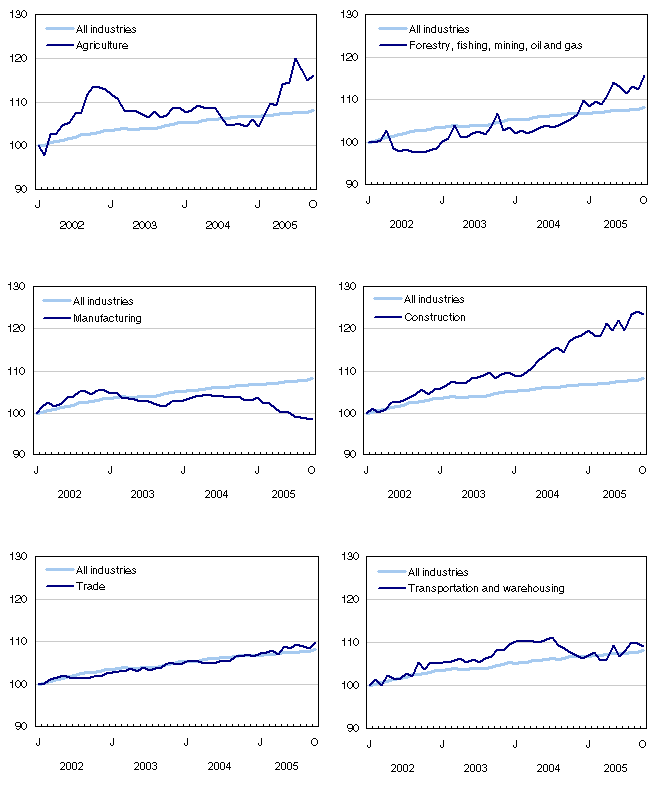
Chart 5

Chart 6

Chart 7

Chart 8

|

|
|