
Economic and Social Reports
Characteristics of home-based child care serving children aged 0 to 5 years in Canada, 2021 to 2022

DOI: https://doi.org/10.25318/36280001202500700002-eng
Text begins
Abstract
Child care provided in home-based settings by non-relatives remains a prominent model of care in Canada. Following commitments of over $27.2 billion in Budget 2021, the Canada-wide Early Learning and Child Care agreement was formed, encompassing collaborations between the federal government, provinces and territories, and Indigenous groups to develop an affordable, inclusive, flexible and high-quality system of child care. This report examines characteristics of licensed and unlicensed home-based child care providing care to children aged 0 to 5 years in Canada at the outset of this agreement. To inform a workforce strategy, this report further examines the reasons unlicensed providers gave for not obtaining a licence and the factors associated with being a licensed home-based child care provider. This report uses data from the 2022 Canadian Survey on the Provision of Child Care Services, the first national survey of child care services in Canada. The results suggest an estimated 14,435 licensed and 14,022 unlicensed child care homes were providing care to children aged 0 to 5 in Canada in April 2022. A descriptive overview of home-based child care settings included information on licensing status, child enrolment and staffing, services provided, and providers’ demographic characteristics and educational background. Compared to unlicensed homes, licensed homes were more likely to provide full-time care and less likely to provide part time or flexible care options, were more likely to have employees and more likely to have providers with formal training in early childhood education. The reasons unlicensed home-based providers selected for not obtaining a licence varied considerably by province. Overall, about two-thirds agreed that they saw no benefit in obtaining a licence or considered it unnecessary given their intended duration of providing care. Multivariate analyses found that provider characteristics independently associated with being licensed included an intention to continue providing care in the home in three years, higher educational attainment, and province or territory of residence.
Keywords: Family child care, child care providers, licensing, Canada.
Authors
Thomas Charters and Leanne Findlay are with the Health Analysis and Modelling Division, Analytical Studies and Modelling Branch, at Statistics Canada.
Introduction
The demand for child care in Canada has increased following a number of societal trends, including the increase in dual-earner families with children (Statistics Canada, 2016) and one-parent families (Uppal, 2015). The labour market participation of parents with young children has been further influenced by the affordability and availability of child care (Cleveland, Gunderson & Hyatt, 1996; Lefebvre & Merrigan, 2008). However, parents may also seek out child care to have their children socialize and to foster cognitive development in their children (Belsky et al., 2007; Peisner‐Feinberg et al., 2001). Participation in child care in Canada has increased over time, from 42% of children younger than 6 years attending non-parental child care in 1994/1995 (Bushnik, 2006) to 56% in 2023 (Statistics Canada, 2023c).
The types of child care arrangements parents select for their children have also changed over time. In 1973, among children younger than 5 years with working mothers, half were cared for by a relative, 44% were in child care with a non-relative and 6% attended a child care centre. By 1994/1995, care provided by non-relatives outside the home was the most common form of child care arrangement, accounting for 43% of all arrangements. However, this declined to 30% of all arrangements in 2002/2003 (Bushnik, 2006). In 2023, fewer than 1 in 10 children in child care (9%) were in home-based child care arrangements (Statistics Canada, 2023b).
The impact of the COVID-19 pandemic on home-based child care
The COVID-19 pandemic disrupted the provision of child care services in Canada. At the onset of the pandemic, approximately half of licensed and unlicensed home-based child care was temporarily closed (Statistics Canada, 2021). Closures of regulated home-based child care throughout March to August 2020 were mandated in five provinces and in Nunavut (Beach et al., 2023). Following the closure of non-essential businesses, overall employment declined by 36% among child care workers in April 2020. This was more than twice the decrease for the general workforce (15%), and employment remained below pre-pandemic levels into 2021 (Uppal & Savage, 2021). While some evidence suggests that child care homes were comparatively less impacted than centres during the initial waves of the pandemic (Friendly, Forer, Vickerson & Mohamed, 2021), many regulated homes experienced persistent losses in enrollment and worsened financial situations throughout the pandemic period in addition to health and safety concerns (Vickerson, Friendly, Forer, Mohamed & Nguyễn, 2022; Statistics Canada, 2022c). Additionally, many home-based child care providers faced limited access to emergency financial supports through federal benefit programs due to eligibility restrictions (Friendly et al., 2021; Vickerson et al., 2022; Statistics Canada, 2023b).Note The challenges arising from the effects of the pandemic reinforced the importance of child care services as essential social and economic infrastructure, particularly in supporting women’s employment (Beach et al., 2023).
Canada-wide Early Learning and Child Care System
Recent developments in child care policy are changing the funding and provision of child care in Canada. Budget 2016 and Budget 2017 committed $7.5 billion over 11 years (up to 2027/2028) to support the development of a child care system for children aged 0 to 5 years. Furthermore, in 2021, $27.2 billion was dedicated to building the Canada-wide Early Learning and Child Care (CWELCC) system through partnerships with provinces, territories and Indigenous groups (Department of Finance, 2021; Employment and Social Development Canada, 2022a). These investments are to be allocated to support a child care system that increases access to child care based on the foundational principles of the Multilateral Early Learning and Child Care (ELCC) Framework, including child care that is affordable, inclusive, flexible and high-quality (Employment and Social Development Canada, 2017). In addition, the Indigenous ELCC Framework was co-developed with Indigenous partners to reflect a vision for high-quality child care with foundations respecting Indigenous culture and aspirations (Employment and Social Development Canada, 2022b). Commitments arising from Budget 2021 included fee reduction targets for regulated care (to an average of $10 per day) and the creation of 250,000 regulated child care spaces by March 2026 (Department of Finance, 2021). As part of the bilateral agreements established between the federal government and the provinces and territories to carry out the CWELCC Plan, many jurisdictions initiated specific targets intended to address home-based child care, including enhanced funding for home-based child care specifically (e.g., equipment, repairs and maintenance, and professional development and training for providers), the development of hybrid group home/centre facilities, and the expansion of affordable spaces in licensed home-based child care services (Pasolli, 2019).
Characteristics of home-based child care and providers
In Canada, child care arrangements for children younger than school age commonly include centres (i.e., daycare centres, nursery schools, preschools); regulated, licensed or approved home-based child care; and unlicensed home-based child care (Beach et al., 2023). Child care may otherwise be provided in the child’s home by relatives or non-relatives (Statistics Canada, 2023b). Prior to the CWELCC system, oversight and financial assistance of child care was primarily the responsibility of the provinces and territories. Child care arrangements were largely paid for by parents and predominantly provided by privateNote for-profit or non-profit services (Cleveland, 2015). Kindergarten (offered one or two years prior to entry in grade school) comprised a separate stream of early childhood education (ECE) and care administered and funded through the public school system.
This report focuses on licensed and unlicensed home-based child care (sometimes called family home child care) and providers working in these settings. This excludes informal, unpaid child care arrangements provided in home settings (often by relatives or family friends), or care provided by non-relatives in the child’s home (e.g., nannies). Home-based child care is typically provided in private residences where the provider lives and operates a child care service. Home-based services generally provide care for mixed-age groups of children, potentially allow siblings to receive care together, enable the same provider to maintain continuity of care and permit the provider to care for their own children alongside others (Lanigan, 2011). When providing care to mixed-age groups, materials and activities accommodate a range of developmental levels. Home-based providers tend to charge lower fees compared with centres (Findlay & Guèvremont, 2023; Macdonald & Friendly, 2020).
Home-based child care is somewhat more common in rural areas, where the number of children is too small or dispersed for child care centres to be economically viable (Swenson, 2008). Some evidence supports that unlicensed home-based child care is selected by parents in part because of a lack of accessible or affordable regulated care options (Breitkreuz & Colen, 2018). However, evidence that unlicensed home-based child care is more common in areas underserved by licensed child care is limited (Macdonald, 2018). Results from the You Bet I Care! project suggested that home-based child care is more likely than child care centres to offer flexible or extended periods of care, such as during evenings or weekends (Doherty, Lero, Goelman, Tougas & LaGrange, 2000). Furthermore, many home-based child care services are active in the market for short durations. Records from Canadian tax filings suggest that many home-based child care providers operate for short periods of time, with about one-third (36%) of providers exiting the market within the same calendar year they opened and 53% exiting within two years (Abbes & Macdonald, 2022).
Results from the 2016 Census suggested that there were 81,800 home-based child care providers in Canada in 2015, which was 30% of all child care workers. More recent results from the 2021 Census found far fewer home-based child care providers were active in 2020, with a total of 44,815 providers comprising 18% of the child care workforce (Statistics Canada, 2024). According to provincial and territorial administrative data, licensed home-based child care provided about 141,700 child care spaces in 2019, accounting for an estimated 9% of all licensed spaces (Friendly et al., 2020).
Nearly all home-based child care providers (95%) are women, most of whom have a high school diploma or equivalency certificate. Almost half are immigrants or non-permanent residents, and about two-fifths belong to racialized groups (Choi, 2022; Uppal & Savage, 2021). Home-based providers typically work alone, with work periods encompassing both time directly caring for children in addition to time spent in preparation for activities, meals, and administrative tasks (Doherty et al., 2000). Home-based providers generally do not have benefits, such as sick days or vacation time (Stitou, Bourgeault & Kohen, 2018). Their average annual income was $22,000 from 2008 to 2016 (Archer, Duhamel, Macdonald, Watt & Yam, 2021), with nearly one-third of home-based provider families classified as being in low income; this proportion rises to more than half when providers are immigrants (Abbes & Macdonald, 2022). Providers with young children (younger than 6 years) living at home make up the minority, with proportions varying from 16% (Uppal & Savage, 2021) to 33% (Abbes & Macdonald, 2022). Given the minority of providers with young children and high market turnover, it has been suggested that home-based providers use their service as a temporary source of household income and potential path to other opportunities (Abbes & Macdonald, 2022).
Licensing of home-based child care differs by provincial and territorial jurisdiction, where child care is licensed by the province or territory directly or through contractual agreements with a child care agencyNote that provides oversight and support (Beach et al., 2023). Home-based child care providers often cite that they joined the licensed system to show that their care meets quality and professional standards, to gain access to supports such as training and equipment loans, and to care for children whose families received subsidies (Doherty et al., 2000). In contrast, unlicensed home-based child care legally operates within provinces and territories and is required to adhere to regulations related to the number of children enrolled. Unlicensed home-based child care is not routinely monitored, although provinces and territories may investigate if complaints are made. Concern has been raised that unlicensed home-based child care, which is not monitored, may provide lower-quality care and poses potential safety risks (Ferns & Friendly, 2015; Japel, Tremblay & Côté, 2005; Varmuza, Perlman & White, 2021).
Provinces and territories are responsible for developing regulations for child care service delivery, licensing, providing operational funding, and monitoring (if directly licensed) and investigating complaints (Friendly et al., 2020). Provincial and territorial oversight of home-based regulated, licensed or approved child care (hereafter termed licensed) covers a range of areas, such as provider training, child enrolment, facilities, educational programs and safety measures (Beach et al., 2023). Appendix Table A.1 summarizes the regulations for home-based child care by province and territory. Generally, the maximum number of children who can attend is dependent on the ages of the children, the presence of an assistant adult caregiver, and whether the provider’s children are included. Provincial and territorial regulations for licensed home-based child care may require that providers complete a course or workshop in ECE before or shortly after beginning operations. However, some jurisdictions do not require specific training (Beach et al., 2023). Meeting additional conditions, such as first aid certification, criminal record checks for providers and other adults in the household, and immunization records, may be required. In some jurisdictions, separate regulations may apply to licensed home-based child care where the provider is supported by an assistant caregiver or where there are higher enrolment caps and ECE training requirements.
In 2022, all provinces and territories provided some form of direct operational funding to support the operating costs of licensed home-based child care. Grant amounts varied depending on enrolment, the age of the children and other considerations (Beach et al., 2023). In contrast, unlicensed home-based child care does not receive operational funding. Apart from operational funding, most child care services outside Quebec have primarily been funded through parental fees, generally set by providers or by child care agencies. All provinces and territories outside Quebec have provided some level of fee subsidy to children of eligible families to attend licensed home-based child care. Eligibility may depend on net family income, medical needs, or other requirements stipulated by the province or territory. In contrast, Quebec offers a universal subsidized flat rate for all children aged 0 to 5 years in licensed home-based child care, irrespective of family income or employment status, set at $8.70 per day in 2022 (Beach et al., 2023). In Quebec, licensed home-based child care typically offers reduced-rate spaces (Ministère de la Famille, 2019).Note Children identified as having special needs or disabilities may receive additional individual funding support and, in some cases, additional operational funding for the child care provider.
Nationally representative data provides a crucial tool to assess the status and progress made in child care services, inform policy development, and provide analytical insights into the child care sector. Information on home-based child care in Canada is particularly limited (Woodman, 2023). Previous research on home-based child care in Canada has largely relied on administrative data sources, which lack information on unlicensed child care services and provider characteristics, and labour force surveys, which may not differentiate child care workers by type of setting and typically omit information specific to the child care context, such as ECE training. This report uses the Canadian Survey on the Provision of Child Care Services (CSPCCS) to examine characteristics of licensed and unlicensed home-based child care providing care to children 0 to 5 years of age in Canada at the outset of the Canada-wide Early Learning and Child Care System (CWELCC). To help inform a workforce strategy, this report further examines the reasons unlicensed providers gave for not being licensed, how these differ by province and territory, and the factors associated with being a licensed home-based child care provider.
Materials and methods
Data source
The Canadian Survey on the Provision of Child Care Services (CSPCCS) 2022 is a cross-sectional survey conducted by Statistics Canada in partnership with Employment and Social Development Canada (Statistics Canada, 2022a). The 2022 CSPCCS provides a snapshot of child care services in Canada in 2022 for children aged 12 and younger at the national, provincial and territorial levels. Data were collected using an electronic questionnaire with telephone follow-up in instances of full or partial non-response. Survey collection took place from April to July 2022.
The target population for the 2022 CSPCCS consisted of child care businesses, including licensed and unlicensed home-based child care providers and child care centres.Note The survey frame was constructed from 1) businesses identified as child day-care services (North American Industry Classification System (NAICS) code 62441) on Statistics Canada’s Business Register as of February 2022 reporting at least $CAD 2,500 in annual revenue, and 2) publicly available provincial/territorial lists of licensed child care. More information on the frame is available elsewhere (Statistics Canada, 2022a). Sampling was stratified by the probability of being in one of the three types of child care (centre, licensed home-based, unlicensed home-based) and by province or territory, with corrections for misclassification between categories. Auxiliary information relating to employment and revenue was used to predict the type of child care for survey frame development. A sample of 20,000 units was contacted across all three domains. While the response rate for licensed centres was 71%, response rates were comparatively lower in licensed (54%) and unlicensed (30%) home-based child care. In this report, only child care homes that provided care to children aged 5 years and younger (potentially in addition to older children) were included (licensed n=1,783; unlicensed n=1,990). These criteria included home-based child care that provided care to children who were school-aged and younger but excluded dedicated before- and after-school programs, which were often excluded from the CSPCCS sampling frame.
Measures
Home-based child care providers responded to questions on licensing, child enrollment and staffing, services provided in their home-based child care, demographic characteristics, and educational background as of April 6, 2022. Several response options were specific to nominal child age categories (i.e., infants, toddlers, preschool-aged children and school-aged children). As regulations relating to age groups differ by province or territory (Friendly et al., 2020), respondents were asked to answer in accordance with how these categories were defined in their respective jurisdictions. Notably, the toddler age category is not defined in certain jurisdictions,Note wherein “toddler” was not a valid response.
Licensing status determined whether a home-based child care was licensed by the province or territory directly, was approved or registered by a child care agency, association, or coordinating office, or neither (i.e., unlicensed). Questions on child enrolment and staffing asked whether any children were enrolled in the home-based child care on a full-time or part-time basis and, if so, the number of children enrolled in these capacities.Note Providers further indicated whether their own children (up to school age) were cared for at their home-based child care. Information was collected on whether children in the following age categories (according to provincial or territorial definitions) were enrolled: (1) infants, (2) toddlers (if applicable), (3) preschool-aged children and (4) school-aged children. All enrolment counts and indicators included the provider’s own children, if applicable. Providers reported whether they had paid employeesNote who provided direct care to children (excluding themselves, unpaid students, volunteers, workers on leave and employees not providing direct care to children).
Information was also collected on five types of care options: (1) full-time care; (2) part-time care; (3) before- or after-school care; (4) evening, weekend or overnight care; and (5) drop-in or flexible care. Providers indicated whether they cared for children with a disability for whom accommodations were providedNote or children who were receiving a fee subsidy (licensed home-based child care only). Providers offering full-time care reported the full-time daily fee charged per child (including subsidies) by age category. To avoid bias from Quebec’s unique child care program, information on fees and subsidies was included only for home-base child care outside Quebec.Note Expected continuity of care was assessed through a question on whether the provider intended to continue providing child care services in their home three years from the survey date.
Home-based child care providers were profiled based on demographic characteristics, education and training. Providers indicated whether they identified as male or female, were Indigenous (First Nations, Métis or Inuit), were a newcomer or recent immigrant,Note and were a person with a disability.Note Highest educational attainment of the provider included the following categories: (1) less than a high school diploma or equivalent; (2) a high school diploma or high school equivalency certificate; (3) a trades certificate or diploma; (4) a college, CEGEP or other non-university certificate or diploma; or (5) any certificate, diploma or degree from a university. Formal training in ECE was reported in the following categories: (1) no formal training in ECE; (2) a family child care-specific workshop; (3) an ECE course or workshop lasting less than one year; (4) a one-, two- or three-year certificate or diploma in ECE from a postsecondary institution; or (5) a four-year degree or graduate training in ECE. Providers also responded to questions on their participation in any professional development activities or training related to child care in the past year. These included (1) training in child health and personal care or in child development, (2) Indigenous or culturally relevant ways of knowing and learning, (3) communicating effectively with parents, (4) working with children with disabilities, (5) facilitating learning and play, and (6) curriculum implementation and pedagogical approaches. An indicator was created to sum these categories as “any professional development” in the past year.
Other questions were directed specifically to unlicensed home-based child care providers. Providers in unlicensed home-based child care were asked a series of questions on why they were unlicensed. Responses included (1) wanting control over their business, (2) believing licensing offered no benefit or was unnecessary or not worthwhile given the time they planned on providing care, (3) finding that licensing had too many requirements or that costs were too high, and (4) not knowing about the licensing system. Providers could select more than one response.
Analytical strategy
Descriptive analyses examined licensing status of child care homes, child enrollment and staffing, services provided, and provider characteristics among home-based child care separately for licensed and unlicensed settings. To reduce bias in the mean estimates because of implausibly high values (outliers), cases where the number of children or the fees charged were above the 99th percentile were excluded. Responses relating to nominal age categories were aggregated nationally. Because age definitions varied by province or territory, these categories should be interpreted with caution. Between-group differences were examined using unpaired t-tests.
For unlicensed home-based child care, responses to why the provider had not obtained a licence were broken down by province and territory. The tendency for unlicensed providers in each province or territory to provide a given rationale may relate to the relative accessibility or perceived costs of licensing in each jurisdiction.
This report further examined the characteristics of home-based child care providers that may be associated with licensing status (licensed versus unlicensed). Independent associations between licensing status and characteristics of home-based child care providers were estimated using multivariate logistic regression. Predictors of licensing status were selected to avoid representing a requirement or expected outcome of licensing. These predictors included caring for one’s own child, the intention to continue providing care in three years, gender, Indigenous identity, immigrant status, disability status, highest educational attainment, and province or territory of home-based child care. Provider characteristics found to be independently associated with licensing status could inform a potential workforce strategy, as many provinces and territories are working toward increasing the number of spaces in licensed child care under the CWELCC agreements. Analyses were performed in SAS Enterprise Guide 8.3 using G-estimation macros (G-Est 2.03.004) for domain and variance estimation (Statistics Canada, 2022b).
Results
In April 2022, there were an estimated 14,435 licensed and 14,022Note unlicensed home-based child care services across Canada that provided care to children aged 0 to 5 years (see Chart 1). Quebec had the greatest number of licensed home child care services (7,593), over half of those in Canada (53%). Ontario had the greatest number of unlicensed child care home services (5,486), comprising nearly two in five unlicensed homes (39%) in Canada. All provinces except Quebec and British Columbia had more unlicensed than licensed home-based child care. Approximately 78,400 children were enrolled full time and 10,900 children were enrolled part time in licensed home-based child care, while approximately 48,800 children were enrolled full time and 17,700 children were enrolled part time in unlicensed home-based child care.
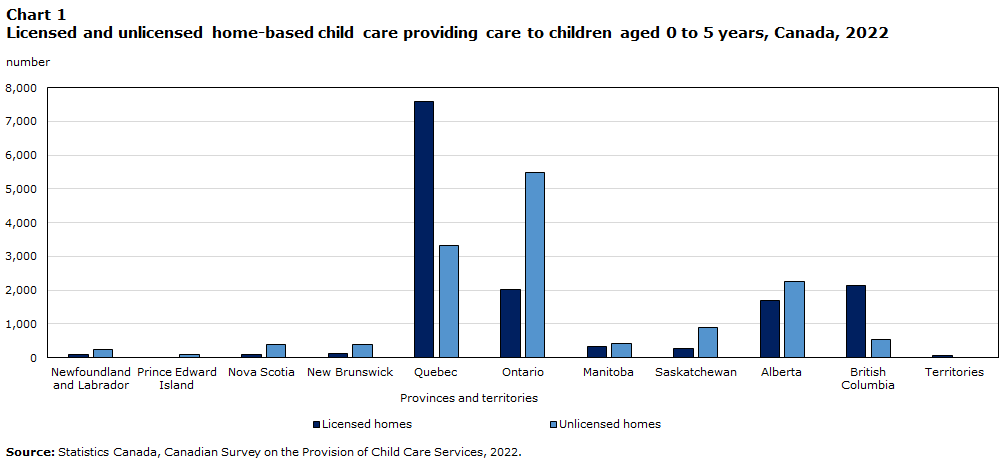
Data table for Chart 1
| Provinces and territories | Licensed homes | Unlicensed homes |
|---|---|---|
| number | ||
|
||
| Newfoundland and Labrador | 94 | 234 |
| Prince Edward Island | 0 | 99 |
| Nova Scotia | 104 | 403 |
| New Brunswick | 122 | 375 |
| Quebec | 7,593 | 3,335 |
| Ontario | 2,016 | 5,486 |
| Manitoba | 340 | 421 |
| Saskatchewan | 278 | 903 |
| Alberta | 1,700 | 2,241 |
| British Columbia | 2,126 | 523 |
| Territories | 62 | x suppressed to meet the confidentiality requirements of the Statistics Act |
| Total | 14,435 | 14,022 |
Table 1 shows the characteristics of licensed and unlicensed home-based child care and providers. About one-quarter (26%) of licensed homes were directly licensed by the province or territory, while three-quarters (74%) were approved or registered through a child care agency, association or coordinating office. Most licensed (95%) and unlicensed (85%) home-based child care services cared for children on a full-time basis, with an average enrolment of six and four children, respectively. Part time care was more common in unlicensed (46%) than licensed (24%) homes. Among those providing part-time services, three children, on average, were enrolled on a part-time basis. Similar proportions of licensed (16%) and unlicensed (19%) providers also cared for their own child at home. Most licensed and unlicensed homes provided care for toddlers and preschool-aged children. However, licensed homes were more likely to provide care for infants and unlicensed homes care for school-aged children. Nearly one in five licensed homes (19%) had one or more paid employees providing direct care to children, whereas very few unlicensed homes (3% [use with caution]) did so.
| Licensed homes | Unlicensed homes | Difference | |
|---|---|---|---|
|
|||
| Count | 14,435 | 14,036 | ... not applicable |
| Licensing status | |||
| Home child care licensing status (proportion) | |||
| Licensed by province or territory directly | 26.1 | 0.0 | ... not applicable |
| Approved or registered by a child care agency, association or coordinating office | 73.9 | 0.0 | ... not applicable |
| Not licensed or approved | 0.0 | 100.0 | ... not applicable |
| Enrolment and staff | |||
| Enrolment | |||
| Has children enrolled full time (proportion yes) | 95.2 | 85.4 | 9.8 Table 1 Note * |
| Number of children enrolled, full time Table 1 Note 1 (mean all ages) | 5.7 | 4.1 | 1.7 Table 1 Note * |
| Has children enrolled part time (proportion yes) | 24.3 | 46.4 | -22.1 Table 1 Note * |
| Number of children enrolled, part time Table 1 Note 1 (mean all ages) | 3.1 | 2.7 | 0.4 Table 1 Note * |
| Provider cares for own child (proportion yes) | 16.4 | 19.4 | -3.0 |
| Provides care to groups in age categories Table 1 Note 2 Table 1 Note 3(proportion) | |||
| Infants | 54.7 | 39.8 | 15.0 Table 1 Note * |
| Toddlers | 73.8 | 75.5 | -1.7 |
| Preschool-aged children | 65.4 | 68.0 | -2.6 |
| School-aged children | 23.1 | 38.4 | -15.3 Table 1 Note * |
| Has paid employees providing direct care to children (proportion) | |||
| Yes | 19.3 | 2.6 E use with caution | 16.7 Table 1 Note * |
| Services provided | |||
| Options offered at homechild care Table 1 Note 3 (proportion) | |||
| Full time | 96.2 | 83.5 | 12.7 Table 1 Note * |
| Part time | 32.8 | 53.2 | -20.4 Table 1 Note * |
| Before or after school | 16.7 | 29.8 | -13.1 Table 1 Note * |
| Evening, weekend or overnight | 5.3 E use with caution | 6.1 | -0.9 |
| Drop in or flexible | 11.4 | 19.6 | -8.1 Table 1 Note * |
| Has child enrolled with disability (proportion) | |||
| Any enrolment | 14.4 | 5.2 E use with caution | 9.2 Table 1 Note * |
| Children enrolled with fee subsidy Table 1 Note 4 (proportion) | |||
| Any enrolment | 64.0 | ... not applicable | ... not applicable |
| No enrolment | 20.2 | ... not applicable | ... not applicable |
| Don't know | 15.8 | ... not applicable | ... not applicable |
| Average full-time daily fee charged per child Table 1 Note 4 Table 1 Note 5 (mean) | |||
| Infant age | 43.8 | 41.6 | 2.2 |
| Toddler age | 45.0 | 39.9 | 5.2 Table 1 Note * |
| Preschool-age | 40.4 | 39.2 | 1.2 |
| School-age | 33.1 | 28.7 | 4.3 Table 1 Note * |
| Intent to provide child care services in home in three years (proportion) | |||
| Yes | 83.8 | 63.7 | 20.1 Table 1 Note * |
| Profile of home-based providers | |||
| Sociodemographic profile (proportion) | |||
| Identifies as male | 1.3 E use with caution | 3.1 E use with caution | -1.8 |
| Has Indigenous identity (First Nations, Métis, Inuit) | 2.7 E use with caution | 4.6 E use with caution | -1.8 |
| Is a newcomer or recent immigrant | 2.5 E use with caution | 4.8 E use with caution | -2.4 |
| Is a person with a disability | 1.7 E use with caution | F too unreliable to be published | ... not applicable |
| Highest educational attainment (proportion) | |||
| Less than high school diploma or equivalent | 7.7 | 12.1 | -4.4 Table 1 Note * |
| High school diploma or high school equivalency certificate | 22.9 | 32.3 | -9.3 Table 1 Note * |
| Trades certificate or diploma | 9.5 | 11.3 | -1.9 |
| College, CEGEP or other non-university certificate or diploma | 32.7 | 28.7 | 4.0 |
| Any certificate, diploma or degree from a university | 27.2 | 15.6 | 11.6 Table 1 Note * |
| Formal training in early childhood education (ECE) (proportion) | |||
| No formal training in ECE | 41.7 | 72.3 | -30.6 Table 1 Note * |
| Family child care-specific workshop | 18.5 | 5.4 E use with caution | 13.1 Table 1 Note * |
| ECE courses or workshops lasting less than one year | 8.1 | 6.1 | 2.0 |
| One-, two- or three-year ECE certificate or diploma from a postsecondary institution | 28.6 | 15.3 | 13.3 Table 1 Note * |
| Four-year ECE degree or graduate training | 3.0 E use with caution | 0.9 E use with caution | 2.1 Table 1 Note * |
| Previous-year child care-related professional development or training (proportion) | |||
| Any professional development or training | 87.1 | 34.1 | 53.0 Table 1 Note * |
| Child health and personal care or child development | 81.4 | 29.4 | 51.9 Table 1 Note * |
| Indigenous or culturally relevant ways of knowing and learning | 17.6 | 5.9 | 11.6 Table 1 Note * |
| Communicating effectively with parents | 52.6 | 18.8 | 33.8 Table 1 Note * |
| Working with children with disabilities | 35.3 | 7.3 | 28.0 Table 1 Note * |
| Facilitating learning and play | 60.0 | 21.3 | 38.7 Table 1 Note * |
| Curriculum implementation and pedagogical approaches | 54.6 | 14.4 | 40.2 Table 1 Note * |
Most licensed and unlicensed homes offered full-time care, with about one-third of licensed and over half of unlicensed homes offering options for part time care. Unlicensed homes were 13 percentage points more likely to offer before- or after-school care and 8 percentage points more likely to offer drop-in or flexible care. Comparatively few licensed (5%) and unlicensed (6%) homes offered care during the evening, on weekends or overnight. While few licensed homes reported enrolling a child with a disability (14%), this was even less common in unlicensed homes (5% [use with caution]). Almost two thirds of licensed homes enrolled one or more children receiving a fee subsidy (unlicensed homes are ineligible). In licensed and unlicensed homes full-time daily fees (including subsidies) were comparable for infants, toddlers and preschool-aged children ($45 to $39 per day), while they were lower for school-aged children. Fees were comparatively higher for toddlers and school-aged children in licensed compared to unlicensed homes. Over four in five licensed providers (84%) intended to provide care in their homes in three years—20 percentage points higher than unlicensed providers (64%).
Few licensed or unlicensed providers identified as being male, Indigenous, or a newcomer or recent immigrant, or as having a disability. Licensed providers were most likely to have a college, CEGEP or other non-university certificate or diploma (33%) or university-level qualifications (27%). The highest educational attainment for unlicensed providers was most commonly a high school diploma or equivalent (32%), followed by a college, CEGEP or other non-university certificate or diploma (29%). About 4 in 10 licensed providers and 7 in 10 unlicensed providers had no formal training in ECE. Nearly twice as many licensed providers (29%) as unlicensed providers (15%) had a one-, two- or three-year postsecondary ECE certificate or diploma, whereas similar proportions (6% to 8%) had taken ECE courses or workshops lasting less than one year. Nearly 9 in 10 licensed providers (87%) had participated in professional development training in the previous year, compared with about one-third of unlicensed providers (34%). For both types of providers, the most common training activities undertaken included those related to child health and personal care or child development and facilitating learning and play.
Table 2 breaks down the reasons unlicensed home-based child care providers gave for not being licensed by province (territories had too few unlicensed homes for reliable estimates). Wanting control over their business was most common in Alberta (68%) and Quebec (64%), while this reason was comparatively uncommon in British Columbia (8%). Across all provinces, unlicensed providers were most likely to state that they saw no benefit to or need for becoming licensed or did not plan on providing care long enough for it to be worthwhile, with the highest percentages in British Columbia (84%) and Nova Scotia (75%). The majority of unlicensed providers across most provinces did not indicate that there were too many requirements or the costs of licensing were too high, except in Newfoundland and Labrador (58% reported this as a reason for being unlicensed). The proportion of unlicensed providers who did not know about the licensing system was comparatively low and could not be estimated in most provinces. It ranged from 4% to 8% in the provinces where it could be estimated.
| Province or territory | Want control over my own business | Unnecessary or no benefit to becoming licensed | Requirements or costs of licensing too high | Did not know about licensing system | ||||
|---|---|---|---|---|---|---|---|---|
| Yes | No | Yes | No | Yes | No | Yes | No | |
| percentage | ||||||||
|
||||||||
| Newfoundland and Labrador | 38.2 | 61.8 | 65.1 | 34.9 | 58.1 | 41.9 | F too unreliable to be published | ... not applicable |
| Prince Edward Island | 53.6 | 46.4 | 69.8 | 30.2 E use with caution | 39.2 | 60.8 | F too unreliable to be published | ... not applicable |
| Nova Scotia | 56.0 | 44.0 | 75.1 | 24.9 | 37.0 | 63.0 | 4.3 E use with caution | 95.7 |
| New Brunswick | 39.6 | 60.4 | 70.5 | 29.5 | 39.2 | 60.8 | 4.1 E use with caution | 95.9 |
| Quebec | 64.4 | 35.6 | 56.8 | 43.2 | 34.8 | 65.2 | F too unreliable to be published | ... not applicable |
| Ontario | 56.6 | 43.4 | 70.5 | 29.5 | 33.5 | 66.5 | F too unreliable to be published | ... not applicable |
| Manitoba | 52.7 | 47.3 | 64.4 | 35.6 | 39.8 | 60.2 | F too unreliable to be published | ... not applicable |
| Saskatchewan | 58.1 | 41.9 | 65.1 | 34.9 | 49.1 | 50.9 | 7.5 E use with caution | 92.5 |
| Alberta | 68.2 | 31.8 | 65.4 | 34.6 | 46.8 | 53.2 | F too unreliable to be published | ... not applicable |
| British Columbia | 7.6 E use with caution | 92.4 | 84.4 | 15.6 E use with caution | 22.1 E use with caution | 77.9 | F too unreliable to be published | ... not applicable |
| Territories (grouped) | x suppressed to meet the confidentiality requirements of the Statistics Act | x suppressed to meet the confidentiality requirements of the Statistics Act | x suppressed to meet the confidentiality requirements of the Statistics Act | x suppressed to meet the confidentiality requirements of the Statistics Act | x suppressed to meet the confidentiality requirements of the Statistics Act | x suppressed to meet the confidentiality requirements of the Statistics Act | x suppressed to meet the confidentiality requirements of the Statistics Act | x suppressed to meet the confidentiality requirements of the Statistics Act |
Table 3 presents the adjusted odds ratios (ORs) and 95% confidence intervals (CIs) from multivariate logistic regression, showing the characteristics of home-based child care providers that were independently associated with being licensed, while controlling for all other characteristics in the model. Providers who intended to continue providing child care services in their home in three years had three times the odds of being licensed compared with those who did not (OR=3.05 [95% CI=1.79, 5.21]). Higher educational attainment was also associated with being licensed. Compared with providers with less than a high school diploma or equivalent, providers with a high school diploma or equivalency certificate had about 30% higher odds of licensing (OR=1.28 [95% CI=1.10, 1.51]); providers with a college, CEGEP or other non-university certificate or diploma had over twice the odds of licensing (OR=2.16 [95% CI=1.34, 3.46]); and providers with any university-level credentials had five times the odds of licensing (OR=5.07 [95% CI=3.81, 6.74]). Independent of these characteristics, providers in some jurisdictions had substantially greater odds of being licensed compared with providers in Ontario (reference), including the territories (OR=16.60), British Columbia (OR=12.51) and Quebec (OR=8.42).
| Characteristic | Odds ratio | 95% confidence interval | |
|---|---|---|---|
| Lower | Upper | ||
|
|||
| Provider cares for own child | |||
| Yes | 0.79 | 0.59 | 1.07 |
| No (reference) | ... not applicable | ... not applicable | ... not applicable |
| Intends to provide child care services in home in three years | |||
| Yes | 3.05 | 1.79 | 5.21 |
| No (reference) | ... not applicable | ... not applicable | ... not applicable |
| Identifies as male | |||
| Yes | 0.65 | 0.20 | 2.18 |
| No (reference) | ... not applicable | ... not applicable | ... not applicable |
| Has Indigenous identity (First Nations, Métis, Inuit) | |||
| Yes | 0.69 | 0.26 | 1.79 |
| No (reference) | ... not applicable | ... not applicable | ... not applicable |
| Is a newcomer or recent immigrant | |||
| Yes | 0.67 | 0.20 | 2.25 |
| No (reference) | ... not applicable | ... not applicable | ... not applicable |
| Is a person with a disability | |||
| Yes | 1.60 | 0.94 | 2.73 |
| No (reference) | ... not applicable | ... not applicable | ... not applicable |
| Highest educational attainment | |||
| Any certificate, diploma or degree from a university | 5.07 | 3.81 | 6.74 |
| College, CEGEP or other non-university certificate or diploma | 2.16 | 1.34 | 3.46 |
| Trades certificate or diploma | 1.38 | 0.73 | 2.6 |
| High school diploma or high school equivalency certificate | 1.28 | 1.10 | 1.51 |
| Less than high school diploma or equivalent (reference) | ... not applicable | ... not applicable | ... not applicable |
| Province or territory of home-based child care | |||
| Newfoundland and Labrador | 1.20 | 1.16 | 1.24 |
| Prince Edward Island | ... not applicable | ... not applicable | ... not applicable |
| Nova Scotia | 0.69 | 0.63 | 0.76 |
| New Brunswick | 0.97 | 0.92 | 1.01 |
| Quebec | 8.42 | 7.72 | 9.17 |
| Ontario (reference) | ... not applicable | ... not applicable | ... not applicable |
| Manitoba | 2.72 | 2.49 | 2.97 |
| Saskatchewan | 0.95 | 0.87 | 1.03 |
| Alberta | 1.82 | 1.61 | 2.04 |
| British Columbia | 12.51 | 11.18 | 14.01 |
| Territories (grouped) | 16.60 | 11.82 | 23.3 |
Discussion
This report provides an overview of licensed and unlicensed home-based child care and providers caring for children aged 0 to 5 years in Canada in April 2022. An estimated 14,435 licensed home-based child care providers cared for 89,200 children and 14,022Note unlicensed home-based child care providers cared for 66,500 children on either a full-time or a part-time basis across Canada. The report provides a descriptive overview of licensed and unlicensed home-based child care, including information on licensing status, child enrolment and staffing, services provided, and providers’ demographic characteristics and educational backgrounds. The CSPCCS also captured the perspectives of unlicensed home-based child care providers, finding that about two-thirds of those who were unlicensed saw no benefit to becoming licensed or felt it was unnecessary given their intended time providing care. Interestingly, the reasons for being unlicensed varied considerably by province. Multivariate analyses found that provider characteristics independently associated with a greater likelihood of being licensed included an intention to continue providing care in the home in three years, higher educational attainment, and province or territory of residence.
The number of home-based child care services in the CSPCCS differs from that in other sources in key respects. Assuming a single caregiver in each home-based setting, the combined count of 28,457 services in the CSPCCS is lower than other estimates since the start of the COVID-19 pandemic, such as 44,815 from the 2021 Census (Statistics Canada, 2024). This disparity may be attributed to various causes, such as the revenue threshold of $2,500 for inclusion in the CSPCCS sample frame (approximately 12% of child care businesses on the Business Register reported less than $2,500 in revenue and were therefore considered out of scope); potentially unreported revenues; high market exit (Abbes & Macdonald, 2022) from their inclusion in the Business Register to the interview dates; and the use of codes from the National Occupational Classification 2016 to generate occupational counts in the census, which does not collect data on industry or place of employment.
Results describing the providers of licensed home-based and unlicensed home-based child care generally correspond to previous research on the gender and educational attainment of providers. Among licensed home-based providers, nearly three-quarters were approved or registered through a child care agency, association or coordinating office. Some have supported the agency model of licensing for alleviating administrative tasks from providers’ workloads and reducing potential work stress (Doherty et al., 2000; Stitou et al., 2018; Woodman, 2023). However, the CSPCCS lacks information on provider well-being or job satisfaction to address these questions. About one in five providers in licensed and unlicensed home-based child care also cared for their own children, a finding consistent with previous Canadian research (Abbes & Macdonald, 2022; Uppal & Savage, 2021) but contradicting theories that home-based providers generally provide services to earn incomes while caring for their own children. The majority of licensed (86%) and unlicensed (64%) home-based child care providers indicated that they intended to continue providing care in their homes in three years, a finding exceeding that which would be anticipated by average rates of market exit (Abbes & Macdonald, 2022) but perhaps indicative of the difficulty in anticipating future employment.
Parents who work non-standard hours (e.g., regular evening or night shifts, irregular or rotating shifts) are less likely to use child care (Zhang, Garner, Heidinger & Findlay, 2021). Previous research found that more than 625,000 families with preschool-aged children had a parent working non-standard hours in 2016\2017 (Lero, Prentice, Friendly, Richardson & Fraser, 2021). While most home-based providers provided full-time child care options, it was less common (particularly among licensed providers) to offer other options, such as drop-in or flexible hours, or evening, weekend or overnight care, compared with full-time or part-time care. This suggests that accessibility to home-based child care may be limited for parents working non-standard hours.
This report fills gaps in the literature relating to home-based child care providers’ education and qualifications in ECE. About 6 in 10 licensed providers and 3 in 10 unlicensed providers had some form of ECE qualification. Differences between these groups can be explained by the training requirements for licensed providers. Provider training in ECE has been associated with measures aligned with quality of care, where children have positive and developmentally appropriate interactions with caregivers, other children and the home environment (Bigras et al., 2010; Doherty, Forer, Lero, Goelman & LaGrange, 2006; Fukkink & Lont, 2007). As child care quality is a foundational principle of the Canada-wide ELCC bilateral agreements (Employment and Social Development Canada, 2017), enhancing training and professional development has been a common commitment pursued across the provinces and territories (Pasolli, 2019). Furthermore, among licensed and unlicensed home-based child care providers, training in areas related to Indigenous or culturally relevant ways of knowing and learning and working with children with disabilities were comparably less common. Training in these areas may be beneficial to meeting the goals of inclusivity inherent in the Government of Canada’s commitments to serving children from diverse backgrounds and with different support needs (Employment and Social Development Canada, 2017).
The CSPCCS is the first nationally representative survey to collect information on unlicensed home-based child care services and their providers. The reasons given by providers for being unlicensed may provide insights into perspectives relating to costs, benefits, and knowledge of licensing. The most common reasons for not obtaining a licence were that there was no benefit or necessity in being licensed or that it was not worthwhile given the time the provider intended to offer home-based child care services. This relates to previous analyses suggesting that many home-based child care providers appear to use their child care business as a short-term means to increase family income during transitory periods (Abbes & Macdonald, 2022). In most provinces, one-third to half of unlicensed home-based child care providers reported that there were too many requirements to obtaining a licence or the costs were too high. Responses by province did not differ based on the provincial licensing model (direct, individual or agency) or educational requirements (Beach et al., 2023). Nearly all unlicensed providers had knowledge of the licensing system.
This report examined the associations between several characteristics of home-based child care providers and their licensing status. Provider characteristics such as caring for their own child, gender, Indigenous identity, disability and being a recent immigrant were not associated with being licensed. However, intent to continue providing care in three years was strongly associated with licensing. This aligns with the common rationale provided by unlicensed providers, who did not feel licensing was a benefit or need given the duration they intended to provide care. Providers with higher educational attainment were also more likely to be licensed. These combined results partially correspond to previous analysis from Abbes and Macdonald (2022) on the longevity of home-based child care. They found that low family income (strongly associated with lower educational attainment [Zeman, 2023]) predicted early exit from the market. Providers who become licensed may view child care in more career-based terms and seek out the benefits and legitimizing effects of licensing (Doherty et al., 2000).
Limitations
Limitations of this analysis should be noted. The CSPCCS sampling frame was drawn from the Canadian Business Register and publicly available lists of licensed and regulated child care providers. Home-based child care may have been inadequately sampled because they were omitted from publicly available lists for being unlicensed or approved through agencies. Further, the number of home-based child care providers may have been limited because of short durations of activity and higher rates of non-response, particularly for unlicensed home-based child care (Statistics Canada, 2023a).
Limitations may also relate to the wording of survey questions. For example, providers were asked to report fees including subsidies. However, funding models vary between jurisdictions in ways that could influence responses to this question. Further, providers contracted through agencies may be less knowledgeable of fees and subsidies. For instance, licensed providers in the agency model were over three times more likely to respond that they did not know whether a child with a fee subsidy was enrolled (not shown). For the child’s age, CSPCCS respondents were referred to definitions from their province or territory of operation. Because these definitions vary by jurisdiction, aggregation of these categories to the national level should be interpreted with caution as these represent nominal age categories and not standardized ranges of child age. The analyses could have been improved with access to additional information. For instance, information on factors such as the provider’s family, spousal employment and previous income has been linked with the market activity of home-based child care services (Abbes & Macdonald, 2022) and could inform a workforce strategy.
Conclusion
This study provides the first national estimates of licensed and unlicensed home-based child care in Canada. While constituting a smaller share of child care services relative to centres, home-based child care remains an important option for many families seeking child care. This report provides a snapshot of home-based child care in Canada in 2022, near the beginning of the implementation of the CWELCC system and during the pandemic. Future research may continue to explore the characteristics of home-based child care and any changes that occur over time during the ongoing implementation of the CWELCC system. For instance, certain reforms arising from this system may incentivize unlicensed providers to obtain a licence for their home child care in order to gain access to funding (Childcare Resource and Research Unit, 2023). Continued research and data collection will be important to understand this sector’s contribution in providing child care for Canadian families with young children.
Appendix
Abbreviations
- CSPCCS = Canadian Survey on the Provision of Child Care Services
- CWELCC = Canada-wide Early Learning and Child Care
- ELCC = early learning and child care
- ECE = early childhood education
- OR = odds ratio
- CI = confidence interval
| Province or territory | Licensing | Licensed home-based child care: Minimum training requirements Table A.1 Note 1 | Licensed home-based child care: Maximum enrolment | Unlicensed home-based child care: Restrictions and requirements |
|---|---|---|---|---|
Source: Beach et al., Early childhood education and care in Canada, 2023. |
||||
| Newfoundland and Labrador | • Agency (St John’s metro area and Corner Brook) • Individual licensing |
• Orientation course and proof of registration in ECE program • One-year ECE certificate plus infant care (postsecondary) course if caring for infants only |
Maximum of seven children depending on child age: • Three (if three infants) • Five (two infants and three toddlers) • Six (two infants and two toddlers) • Seven (if no infants or toddlers) Provider’s children included if they are an infant, a toddler or preschool-aged; up to two of the provider’s children exempt from the count of school-aged children |
• Child care offered for less than 10 hours per week OR • Four or fewer children (younger than 13 years) cared for if two or fewer are younger than 2 years Provider’s children included in the count |
| Prince Edward Island | Individual licensing | 30-hour ECE course | Maximum of eight children of all ages if provider-to-child ratios (indoors) are met: • Younger than 22 months: 1 to 3 • 22 months to 3 years: 1 to 5 • Older than 3 years to school entry: 1 to 10 • School age: 1 to 15 Provider’s children included in the count |
Maximum of seven children depending on child age: • Five (with up to two infants) • Six (with mixed preschool age or school age only) • Seven (school age only) Provider’s children included in the count |
| Nova Scotia | Agency | 40-hour ECE course | Maximum of nine children: • Three (if three infants) • Seven (mixed ages, no more than three younger than 3 years and up to two infants) • Nine (school age only) Provider’s children included in the count |
• Maximum of six children of mixed ages OR • Maximum of eight school-aged children Provider’s children included in the count |
| New Brunswick | Individual licensing | 90-hour introductory course | Maximum of nine children: • Three (infants) • Five (preschool-aged children) • Six (mixed-age groups, up to two infants and including one or more school-aged children) • Nine (school-aged children) Provider’s children included in the count |
• Maximum of eight children • Up to two infants, up to four preschool-aged children, up to eight school-aged children, up to five children in mixed-age groups Provider’s children included in the count |
| Quebec | Agency | • 45-hour course, including a minimum of 30 hours about child development and educational programming • Assistants: 12-hour training on child development |
• Single provider: Maximum of six children, no more than two children younger than 18 months • With assistant: Maximum of nine children, no more than four children younger than 18 months Provider’s children included in the count |
• Maximum of six children, no more than two children younger than 18 months Provider’s children included in the count |
| Ontario | Agency | None required | • Maximum of six children younger than 13 years, with no more than three children younger than 2 years Provider’s children younger than 4 years included in the count |
• Maximum of five children younger than 13 years, with no more than three children younger than 2 years Provider’s children younger than 4 years included in the count |
| Manitoba | Individual licensing | 40-hour course | • Family child care: Maximum of eight children younger than 12 years, with no more than three children younger than 2 years and no more than five children younger than 6 years • Group family child care: Maximum of 12 children younger than 12 years, with no more than 3 children younger than 2 years Provider’s children included in the count |
• Maximum of four children younger than 12 years, with no more than two children younger than 2 years Provider’s children included in the count |
| Saskatchewan | Individual licensing | • Family child care home: 40-hour introductory course • Group family child care home: Postsecondary ECE orientation course or three ECE courses • Assistant: None required |
• Family child care home: Maximum of eight children, with no more than two infants and toddlers, and no more than five infants, toddlers or preschool-aged children • Group family child care home: Maximum of 12 children, with no more than 3 infants; no more than 5 infants and toddlers; and no more than 10 children of infant, toddler or preschool age Provider’s children younger than 10 years included in the count |
• Maximum of eight children younger than 13 years, with no more than two infants or toddlers, and up to five infants, toddlers and preschool-aged children Provider’s children younger than 10 years included in the count |
| Alberta | Agency | • 54-hour orientation program or 45-hour postsecondary course related to child development or equivalent | • Family day home: Maximum of six children up to 12 years, with no more than two children younger than 2 years and three children younger than 3 years • Group family child care program: Maximum of 10 children Provider’s children not included in the count |
• Maximum of six children Provider’s children not included in the count |
| British Columbia | Individual licensing | • Family child care: 20-hour ECE course • In-home multi-age child care: One-year ECE certificate |
• Family child care: Maximum of seven children up to 12 years, with no more than three children younger than 48 months if including children younger than 12 months (maximum of one child younger than 12 months), or four children younger than 48 months, of which two are younger than 24 months if no child is younger than 12 months • In-home multi-age child care: Maximum of eight children, with no more than three children younger than 36 months, of which one child may be younger than 12 months |
• License-not-required (LNR) child care: Maximum of two children (or sibling group) • Registered LNR (RLNR) child care: Maximum of two children (or sibling group) Provider’s children not included in the count |
| Yukon | Individual licensing | 60-hour introductory course | • Maximum of eight children if all are older than 18 months, or up to six if no more than three are older than 18 months, or up to four if all are younger than 18 months Provider’s children included in the count if younger than school age |
• Maximum of seven children if school-aged • Maximum of three children younger than school age Provider’s children not included in the count |
| Northwest Territories | Individual licensing | None required | • Maximum of eight children up to 12 years, with no more than two children 2 years and younger and no more than six children 6 years and younger Provider’s children included in the count |
• Maximum of four children up to 12 years Provider’s children included in the count |
| Nunavut | Individual licensing | None required | • Maximum of eight children up to 12 years, with no more than two children 2 years and younger, no more than three children 3 years and younger, and no more than six children 5 years and younger Provider’s children included in the count |
• Maximum of four children up to 12 years Provider’s children included in the count |
References
Abbes, C., & Macdonald, R. (2022). Exploring the business dynamics of self-employed child care service providers. Economic and Social Reports, 2(8), Statistics Canada Catalogue no. 36-28-0001.
Archer, J., Duhamel, B., Macdonald, R., Watt, J., & Yam, H.N.C. (2021). The early learning and child care industry in Canada: Business characteristics and industry gross domestic product. Economic and Social Reports, 1(8), Statistics Canada Catalogue no. 36-28-0001.
Beach, J., Friendly, M., Nguyễn, N.T., Borges-Nogueira, P., Taylor, M., Mohamed, S.S., Rothman, L., & Forer, B. (2023). Early childhood education and care in Canada 2021. Toronto: Childcare Resource and Research Unit.
Belsky, J., Vandell, D.L., Burchinal, M., Clarke‐Stewart, K.A., McCartney, K., Owen, M.T. & NICHD Early Child Care Research Network. (2007). Are there long‐term effects of early child care? Child Development, 78(2), 681-701.
Bigras, N., Bouchard, C., Cantin, G., Brunson, L., Coutu, S., Lemay, L., Tremblay, M., Japel, C. & Charron, A. (2010). A comparative study of structural and process quality in center-based and family-based child care services. Child & Youth Care Forum, 39(3), 129-150.
Breitkreuz, R., & Colen, K. (2018). Who cares? Motivations for unregulated child care use. Journal of Family Issues, 39(17), 4066-4088.
Bushnik, T. (2006). Child care in Canada. Children and Youth Research Paper Series, Statistics Canada Catalogue no. 89-599-MIE — No. 003. Ottawa: Statistics Canada.
Charters, T.J., & Findlay, L.C. (2023). Characteristics of child care centres serving children aged 0 to 5 years in Canada, 2021 to 2022. Economic and Social Reports, 3(3), Statistics Canada Catalogue no. 36-28-0001.
Childcare Resource and Research Unit. (2023). A summary of the Canada-Wide Early Learning and Child Care Agreements and Action Plans. Toronto: Childcare Resource and Research Unit.
Choi, Y. (2022). Gender differences in sociodemographic and economic characteristics of early learning child care workers. Economic and Social Reports, 2(1), Statistics Canada Catalogue no. 36-28-0001.
Cleveland, G. (2015). ECEC Policy in Canada: Availability, affordability and quality. Toronto: University of Toronto Scarborough Department of Management.
Cleveland, G., Gunderson, M., & Hyatt, D. (1996). Child care costs and the employment decision of women: Canadian evidence. Canadian Journal of Economics, 132-151.
Department of Finance. (2021). Budget 2021: A Canada-wide Early Learning and Child Care Plan. Ottawa: Department of Finance Canada.
Doherty, G., Forer, B., Lero, D.S., Goelman, H., & LaGrange, A. (2006). Predictors of quality in family child care. Early Childhood Research Quarterly, 21(3), 296-312.
Doherty, G., Lero, D.S., Goelman, H., Tougas, J. & LaGrange, A. (2000). Caring and Learning Environments: Quality in Regulated Family Child Care across Canada. Guelph: Centre for families, Work and Well-Being, University of Guelph.
Employment and Social Development Canada. (2017). Multilateral Early Learning and Child Care Framework. Ottawa: Employment and Social Development Canada.
Employment and Social Development Canada. (2022a). Engagement on federal early learning and child care legislation: What We Heard Report – November 2022. Ottawa: Employment and Social Development Canada.
Employment and Social Development Canada. (2022b). Indigenous Early Learning and Child Care Framework. Ottawa: Employment and Social Development Canada.
Ferns, C., & Friendly, M. (2015). Background paper on unregulated child care for the Home child care: More than a home project. Occasional paper 28. Toronto: Childcare Resource and Research Unit.
Findlay, L.C., & Guèvremont, A. (2023). Estimates of parental child care expenses in January to February 2022. Economic and Social Reports, 3(7), Statistics Canada Catalogue no. 36-28-0001.
Friendly, M., Feltham, L., Mohamed, S.S., Nguyễn, N.T., Vickerson, R. & Forer, B. (2020). Early childhood education and care in Canada, 2019. Toronto: Childcare Resource and Research Unit.
Friendly, M., Forer, B., Vickerson, R., & Mohamed, S.S. (2021). COVID-19 and Childcare in Canada: A Tale of Ten Provinces and Three Territories. Journal of Childhood Studies, 46(3), 42-52.
Friendly, M., Vickerson, R., Mohamed, S.S., Rothman, L., & Nguyễn, N.T. (2021). Risky business: Child care ownership in Canada past, present, and future. Occasional Paper 34. Toronto: Childcare Resource and Research Unit.
Fukkink, R. G., & Lont, A. (2007). Does training matter? A meta-analysis and review of caregiver training studies. Early Childhood Research Quarterly, 22(3), 294-311.
Japel, C., Tremblay, R. E., & Côté, S. (2005). Quality counts! Assessing the quality of daycare services based on the Quebec Longitudinal Study of Child Development. IRPP Choices, 11(5), 1-42.
Lanigan, J.D. (2011). Family child care providers’ perspectives regarding effective professional development and their role in the child care system: A qualitative study. Early Childhood Education Journal, 38, 399-409.
Lefebvre, P., & Merrigan, P. (2008). Child-care policy and the labor supply of mothers with young children: A natural experiment from Canada. Journal of Labor Economics, 26(3), 519-548.
Lero, D. S., Prentice, S., Friendly, M., Richardson, B., & Fraser, L. (2021). Non-standard work and child care in Canada: A challenge for parents, policy makers, and child care provision. Toronto: Childcare Resource and Research Unit and University of Guelph.
Macdonald, D. (2018). Child care deserts in Canada. Ottawa: Canadian Centre for Policy Alternatives.
Macdonald, D., & Friendly, M. (2020). In progress: Child care fees in Canada 2019. Ottawa: Canadian Centre for Policy Alternatives.
Ministère de la Famille. (2019). Types de services de garde au Québec.
Pasolli, L. (2019). An analysis of the Multilateral Early Learning and Child Care Framework and the Early Learning and Child Care Bilateral Agreements. Ottawa: Child Care Now.
Peisner‐Feinberg, E.S., Burchinal, M.R., Clifford, R. M., Culkin, M. L., Howes, C., Kagan, S.L. & Yazejian, N. (2001). The relation of preschool child‐care quality to children’s cognitive and social developmental trajectories through second grade. Child Development, 72(5), 1534-1553.
Statistics Canada. (2016). The rise of the dual-earner family with children. Statistics Canada catalogue no. 11-630-X. Ottawa: Statistics Canada.
Statistics Canada. (2021). Canadian Survey on the Provision of Child Care Services, January 2021. The Daily. Statistics Canada catalogue no. 11-001-X.
Statistics Canada. (2022a). Canadian Survey on the Provision of Child Care Services (CSPCCS). Surveys and Statistical Programs.
Statistics Canada. (2022b). G-est 2.03.004 [SAS Macro]. Ottawa: Statistics Canada.
Statistics Canada. (2022c). Survey on Early Learning and Child Care Arrangements, 2022. The Daily.
Statistics Canada. (2023a). Canadian Survey on the Provision of Child Care Services, 2022. The Daily.
Statistics Canada. (2023b). Child care arrangements for children 0 to 5 years, 2023. Statistics Canada Catalogue no. 11-627-M.
Statistics Canada. (2023c). Child care arrangements, 2023. The Daily.
Statistics Canada. (2024). Early Learning and Child Care Information Hub: Workforce.
Stitou, M., Bourgeault, I.-L., & Kohen, D. (2018). The job content, context, and requirements of regulated home-based childcare workers. NEW SOLUTIONS: A Journal of Environmental and Occupational Health Policy, 27(4), 607-628.
Swenson, K. (2008). Child care arrangements in urban and rural areas. Washington D.C.: U.S. Department of Health and Human Services, 1-16.
Uppal, S. (2015). Employment patterns of families with children. Insights on Canadian Society. Statistics Canada Catalogue no. 75-006-X. Ottawa: Statistics Canada.
Uppal, S., & Savage, K. (2021). Child care workers in Canada. Insights on Canadian Society. Statistics Canada catalogue no. 75-006-X. Ottawa: Statistics Canada.
Varmuza, P., Perlman, M., & White, L.A. (2021). Ontario as a case study for modernizing Home Child Care licensing and support. Canadian Public Administration, 64(3), 485-505.
Vickerson, R., Friendly, M., Forer, B., Mohamed, S.S., & Nguyễn, N.T. (2022). One year later: Follow up results from a survey on COVID-19 and child care in Canada. Toronto: Childcare Resource and Research Unit.
Woodman, L. (2023). Out of the shadows: An epistemological examination of family childcare in Canada. Journal of Childhood, Education & Society, 4(2), 219-229.
Zeman, K. (2023). From high school, into postsecondary education and on to the labour market. Education, learning and training: Research paper series. Statistics Canada catalogue no. 81-595-M. Ottawa: Statistics Canada.
Zhang, S., Garner, R., Heidinger, L., & Findlay, L. (2021). Parents’ use of child care services and differences in use by mothers’ employment status. Insights on Canadian Society. Ottawa: Statistics Canada.
- Date modified: