
Travel between Canada and other countries, June 2026
Released: 2026-08-20
3,180,470
June 2026
3.6% 
(12-month change)
3,767,868
June 2026
5.5%
(12-month change)
3,711,650
June 2026
0.6%
(monthly change)
2,596,167
June 2026
-2.9% 
(monthly change)
Highlights
In June, the number of Canadian-resident return trips from the United States increased 5.0% year over year, while trips to Canada by US residents rose 6.1%.
The number of Canadian-resident return trips from overseas edged up 0.2% in June compared with the same month a year earlier. Meanwhile, trips to Canada by overseas residents increased 3.4%.
Using seasonally adjusted data, the number of Canadian-resident return trips from abroad (from the United States and overseas countries) rose slightly in June (+0.6%) compared with May, while the number of US-resident arrivals (-3.5%) and overseas-resident arrivals (-1.1%) decreased in June.
Trips abroad by Canadian residents continue to increase
Canadian-resident return trips from abroad were up 3.6% to 3.2 million in June, marking the third straight month of year-over-year increases.
In June, Canadian residents returned from 2.3 million trips to the United States, representing a 5.0% year-over-year increase and the third consecutive month of growth following 15 consecutive months of year-over-year decreases. Nonetheless, despite this shift in travel trends, Canadian-resident return trips from the United States were 24.6% below their June 2024 level.
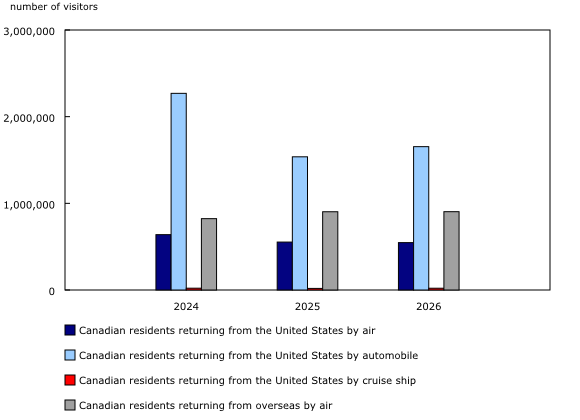
Canadian-resident return trips from the United States by automobile rose 7.6% compared with the same month one year earlier to reach 1.7 million in June 2026, with 66.2% of these being same-day trips. Return trips by air continued to fall, down 1.2% year over year, settling at 546,500. At the same time, return trips by cruise ship rose 13.6% to 20,700.
Canadian residents made 906,400 return trips from overseas countries in June, inching up 0.2% from a year earlier.
Chart 1

Number of Canadian residents returning from abroad, by mode of transportation, June, 2024 to 2026
Trips to Canada by United States residents continue to increase
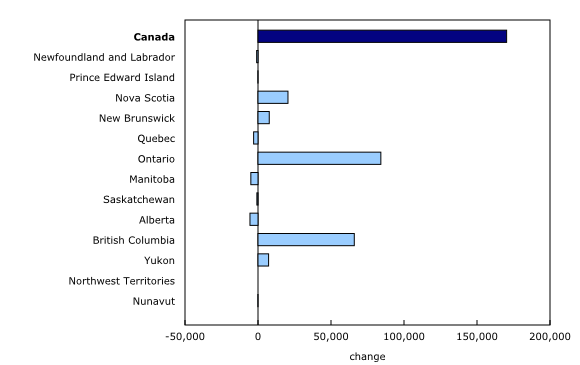
In June, US-resident trips to Canada totalled 3.0 million, up 6.1% from the same month in 2025 and marking the fifth consecutive month of year-over-year increases.
Arrivals by automobile rose 8.1% year over year to 1.7 million in June 2026, with 53.5% of these arrivals being overnight trips. However, arrivals by air decreased 1.3% to 725,600. Meanwhile, the number of US residents who disembarked in Canada from cruise ships rose 20.5% to 335,800 on a year-over-year basis.
Chart 2
Year-over-year change in the number of United States residents entering Canada, by province or territory of arrival, June 2026
Trips to Canada by overseas residents increase, and Oceania records its largest year-over-year gain for the month of June since 2010
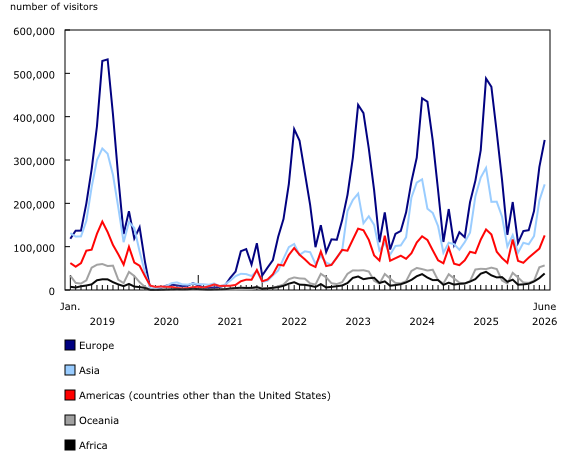
In June, 811,000 overseas residents arrived in Canada, up 3.4% from the same month one year earlier. The majority (85.2%) of these arrivals were by air.
By volume, arrivals from Europe (+23,900; +7.4%), the Americas (excluding the United States) (+9,800; +8.5%) and Oceania (+7,900; +16.2%) drove the year-over-year increase in overseas-resident arrivals in June. These increases more than offset the decrease in arrivals from Asia (-15,700; -6.1%). For Oceania, this marked the largest year-over-year increase for June since 2010 (excluding the COVID-19 pandemic period). This gain coincided with the 2026 FIFA World Cup, during which Australia and New Zealand played three matches in Vancouver.
In June, the top three countries of residence for overseas visitors were the United Kingdom, India and France, which together accounted for 27.7% of all overseas arrivals in Canada.
Chart 3
Overseas visitors entering Canada, by continent of residence, January 2019 to June 2026
World Cup
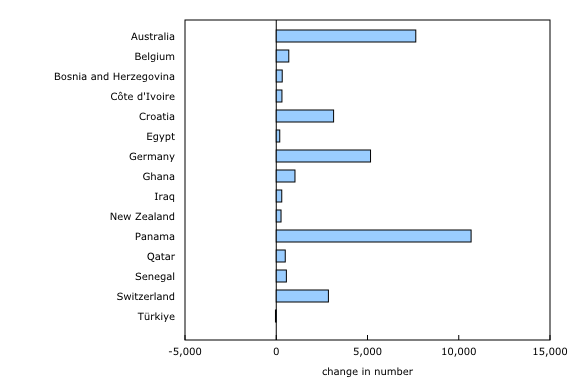
In June, Canada hosted 13 FIFA World Cup matches in Toronto and Vancouver, where teams from 15 overseas countries played.
Total arrivals from these 15 countries were up 28.6% (+33,600) in June 2026 compared with the same month one year earlier. With the exception of Türkiye, all participating countries recorded year-over-year increases in arrivals, with higher volumes observed in the respective host cities where their teams played. Together, visitors from Panama (+10,700), Australia (+7,700) and Germany (+5,100) accounted for 67.1% of the total year-over-year increase.
According to the Consumer Price Index for June 2026, notable price increases were observed for traveller accommodations in both Toronto and Vancouver, where the FIFA World Cup matches were played.
Chart 4
Year-over-year change in the number of overseas residents entering Canada from countries that played in Canada during the World Cup, June 2026
Seasonally adjusted arrivals
Tourism is influenced by seasonal and calendar effects. All statistics in this section are based on seasonally adjusted data (for more information, see the Note to readers).
On a monthly basis, the number of Canadian-resident return trips from abroad edged up 0.6% in June. Although Canadian residents made fewer return trips from overseas (-0.4%) in the month, this decrease was offset by an increase in return trips from the United States (+1.1%).
Chart 5
Canadian residents returning to Canada and non-resident visitors entering Canada, January 2019 to June 2026, seasonally adjusted data
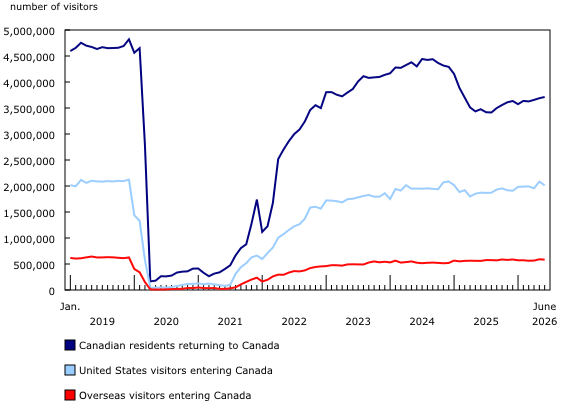
The overall number of arrivals in Canada by US residents decreased 3.5% in June compared with the previous month, on account of fewer arrivals by automobile (-3.9%) and by air (-5.5%).
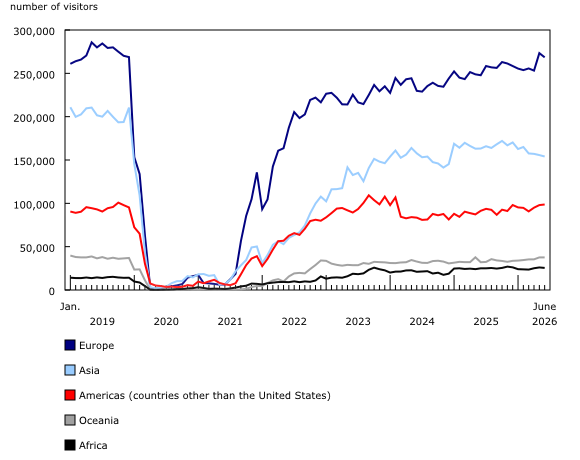
In June, the number of overseas-resident arrivals in Canada decreased modestly by 1.1% on a monthly basis, driven by declines in arrivals from Europe (-1.8%) and Asia (-1.0%). At the country level, the overall monthly decrease was driven by fewer visitors from the United Kingdom, Mexico and Italy, offsetting the increase in visitors from India.
Chart 6
Overseas visitors entering Canada, by continent of residence, January 2019 to June 2026, seasonally adjusted data
Explore tourism data
To further explore current and historical data in an interactive format, see the product Frontier Counts: Interactive Dashboard.
For more current estimates of international arrivals to Canada, please see the release, "Leading indicator of international arrivals to Canada."
For other tourism-related information, see the Travel and Tourism Statistics portal.
Note to readers
Unless otherwise specified, this release uses unadjusted (raw) data.
For more information on concepts, definitions, data sources and methods, refer to Frontier Counts.
Seasonal adjustment
Tourism is influenced by seasonal effects (e.g., actual seasons and holidays such as Canada Day and Thanksgiving) and calendar effects (e.g., number of weekends in a month). Seasonally adjusted data are data that have been modified to eliminate the effect of seasonal and calendar influences to allow for more meaningful comparisons of economic conditions from period to period. For more information on seasonal adjustment, see Seasonal adjustment: Concepts and interpretation, 2026.
Revisions
Seasonally adjusted data for March to May 2026 have been revised. No revisions were made to the unadjusted data.
Integrated Primary Inspection Line – Air integration
In 2025, Statistics Canada integrated information about travellers processed through the Canada Border Services Agency's Integrated Primary Inspection Line – Air (IPIL Air) system into the Frontier Counts. Users are advised to exercise caution when comparing 2025 and 2026 reference months with previous years since published data before 2025 do not include IPIL Air.
For users who would like to make year-over-year comparisons, selected supplementary time series with IPIL Air data for reference years 2023 and 2024 are available, upon request.
Next release
The release "Travel between Canada and other countries" for July will be released on September 22.
Products
The product "Frontier Counts: Interactive Dashboard," part of the Data Visualization Products series (71-607-X), is available.
The article "Canadian-resident travel to the United States: A year in review" is available.
The StatsCAN Plus articles "The Stampede: It's not Calgary's first rodeo" and "The World Cup: Soccer stats versus StatCan stats" are available.
The StatsCAN Plus article "Canada's cruise industry even keeled in 2025" and its accompanying infographic "Cruise ship tourism in Canada, 2025" are available.
Contact information
For more information, or to enquire about the concepts, methods, or data quality of this release, contact us (toll-free 1-800-263-1136; 514-283-8300; infostats@statcan.gc.ca) or Media Relations (statcan.mediahotline-ligneinfomedias.statcan@statcan.gc.ca).
- Date modified: