
Labour productivity, hourly compensation and unit labour cost, first quarter 2026
Released: 2026-06-03
First quarter 2026
-0.5% 
(quarterly change)
Productivity continues to decline in the first quarter
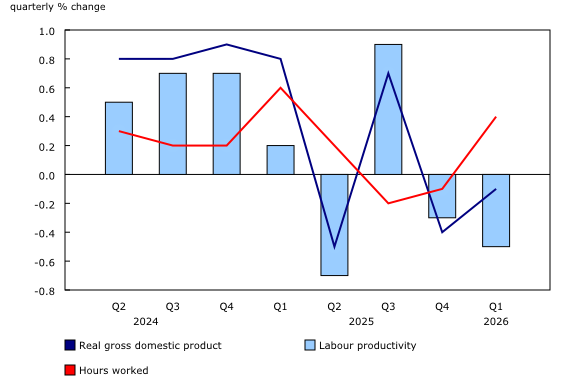
The labour productivity of Canadian businesses fell 0.5% in the first quarter, after edging down in the previous quarter (-0.3%). The decline in the first quarter reflects the mild contraction in the pace of business output. Meanwhile, hours worked increased.
Chart 1

Business output declines as hours worked edge up
Goods-producing businesses lead the overall decline in productivity
The first quarter decline in business sector productivity was driven by goods-producing businesses (-1.7%). Meanwhile, productivity in services-producing businesses edged up 0.3%.
Overall, productivity decreased in 10 of the 16 main industry sectors in the first quarter. Construction and agriculture, forestry, fishing and hunting were the main contributors to this decline, while retail trade and transportation and warehousing saw the strongest increases in productivity.
Hours worked rise following two consecutive quarters of slight decline
Hours worked in the business sector increased 0.4% in the first quarter, after posting slight declines in the previous two quarters. The increase in the first quarter reflects a 0.1% growth in the number of jobs. Meanwhile, average hours worked went up 0.3%.
In the first quarter, hours worked in goods-producing businesses rose 1.2% following a 0.4% increase in the previous quarter. In contrast, after edging down in the previous two quarters, hours worked in service-producing businesses were unchanged in the first quarter.
Growth in unit labour costs accelerates in the first quarter
As labour productivity dropped in the first quarter, the 0.9% rise in hourly compensation resulted in a 1.4% growth in unit labour costs to businesses, which marks the fourth consecutive quarterly increase.
Unit labour costs represent the labour costs required to produce one unit of output.
Learn more about labour productivity
To learn more about productivity, the factors that influence it and why it matters for Canadians, listen to the Eh Sayers podcast episode, "Why economists are sounding the alarm on productivity."
Sustainable Development Goals
On January 1, 2016, the world officially began implementing the 2030 Agenda for Sustainable Development—the United Nations' transformative plan of action that addresses urgent global challenges over the following 15 years. The plan is based on 17 specific Sustainable Development Goals (SDGs).
The release "Labour productivity, hourly compensation and unit labour cost" is an example of how Statistics Canada supports the reporting on the global SDGs. This release will be used to help measure the following goal:

Note to readers
Revisions
With this release, data were revised back to the first quarter of 2025 at both the aggregate and industry levels. The revisions incorporate the latest quarterly gross domestic product (GDP) by income and expenditure and monthly GDP by industry, released on May 29, 2026.
Productivity measures
The term productivity in this release refers to labour productivity. For the purposes of this analysis, labour productivity and related variables cover the business sector only.
Labour productivity is a measure of real GDP per hour worked.
Unit labour cost is defined as the cost of workers' wages and benefits per unit of real GDP.
The approach to measuring real output in the business sector differs from the one that is used in the estimates by industry. For the business sector, output is measured using the expenditure-based GDP approach at market prices, while the measure of output by industry is based on the value-added approach at basic prices.
All the growth rates reported in this release are rounded to one decimal place. They are calculated with index numbers rounded to three decimal places, which are now available in data tables.
All necessary basic variables for productivity analyses (such as hours worked, employment, output and compensation) are seasonally adjusted. For information on seasonal adjustment, see Seasonal adjustment: Concepts and interpretation, 2026.
Products
The document "Labour productivity measurement at Statistics Canada," which is part of Latest Developments in the Canadian Economic Accounts (13-605-X), is available.
The study, "Canadian regional labour statistics and inter-regional movements of paid workers, 2001 to 2021," which is part of Latest Developments in the Canadian Economic Accounts (13-605-X), is available.
The Economic accounts statistics portal, accessible from the Subjects module of the Statistics Canada website, features an up-to-date portrait of national and provincial economies and their structures.
The Latest Developments in the Canadian Economic Accounts (13-605-X) is available.
The User Guide: Canadian System of Macroeconomic Accounts (13-606-G) is available.
The Methodological Guide: Canadian System of Macroeconomic Accounts (13-607-X) is available.
Contact information
For more information, or to enquire about the concepts, methods or data quality of this release, contact us (toll-free 1-800-263-1136; 514-283-8300; infostats@statcan.gc.ca) or Media Relations (statcan.mediahotline-ligneinfomedias.statcan@statcan.gc.ca).
- Date modified: