
Educational attainment in Canada has continued to rise over the past decade, 2025
Released: 2026-03-25
In 2025, nearly two-thirds of Canadian adults aged 25 to 64 (64%) held a college or university credential, up from 55% in 2015. This increase was largely the result of growth in the number of adults with a bachelor's degree or a master's or doctoral degree.
University-level education drives rising postsecondary attainment
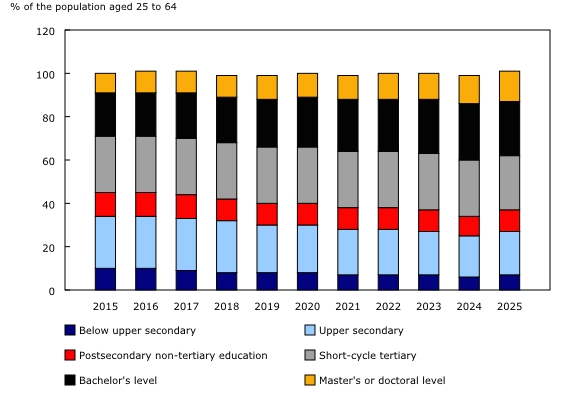
From 2015 to 2025, the educational profile of Canadians aged 25 to 64 shifted markedly toward higher levels of formal education. The proportion holding a bachelor's degree rose from 20% to 25%, while the proportion with a master's or doctoral degree increased from 9% to 14%.
During this period, the proportion of adults with lower levels of education declined. The share without a high school diploma fell from 10% to 7%, while the share with only a high school education decreased from 24% to 20%, and the share with only a college education was down from 26% to 25%.
These shifts largely reflect generational replacement within the working-age population, as younger cohorts—who are more likely to pursue a college or university education—gradually replace older cohorts who historically had more limited educational opportunities. As a result, the overall educational profile of the working-age population continues to move upward.
Chart 1

Educational attainment in Canada rose from 2015 to 2024, driven by gains at the university level
Canada's postsecondary attainment stands out among member countries of the Organisation for Economic Co-operation and Development
In 2025, 64% of Canadians aged 25 to 64 held a college or university credential, above the average of 41% across member countries of the Organisation for Economic Co-operation and Development (OECD).
This gap is driven largely by Canada's college system. In 2025, 25% of Canadians aged 25 to 64 held a college credential—more than three times the OECD average of 7%. Strong college participation, combined with rising university-level attainment, remain defining features of Canada's education system.
Women leading the way in higher levels of education
In 2025, 71% of women aged 25 to 64 had attained a college or university credential, up from 61% in 2015. The share remained lower among men, but also increased over the same period, from 49% to 57%. Together, these trends point to a widening gender gap in postsecondary attainment between women and men.
The growth in women's postsecondary attainment was driven largely by gains at the university level, including increases in bachelor's degree completion and continued growth in master's or doctoral degree attainment. By contrast, men were more likely to pursue skills-focused pathways leading directly to the labour market. In 2025, 36% of men had completed high school or postsecondary programs of this type, compared with 23% of women—highlighting a growing divergence in educational pathways over the past decade, with important implications for future workforce composition, earnings and skills demand.
Note to readers
This content was created with the assistance of a generative artificial intelligence (AI) tool and refined and verified by Statistics Canada experts. To learn more about how we use AI responsibly, please visit the Trust Centre.
Educational attainment refers to the highest level of education completed by an individual. In Canada, it is typically reported across four broad levels: less than high school, high school, college and university. These groupings provide a standardized way to track long-term trends in educational outcomes and compare populations over time.
Educational attainment is a core indicator of a country's human capital—the collective skills, knowledge and capabilities of its workforce. Higher levels of education are strongly associated with improved employment outcomes, higher earnings, better health and greater civic engagement. A more educated population supports productivity growth, innovation and economic resilience.
The educational attainment rate represents the percentage of the population aged 25 to 64 who have completed a given level of education. It is calculated by dividing the number of people aged 25 to 64 with the specified level of education by the total population in that age group, then multiplying by 100. The data for this indicator are based on a 12-month average from January to December using the Labour Force Survey. For more information, see the Guide to the Labour Force Survey.
This release uses data from Statistics Canada's educational attainment table, which classifies credentials according to the International Standard Classification of Education (ISCED) 2011. For readability, simplified terms are used in the analysis. The corresponding ISCED 2011 categories are as follows:
Upper secondary (ISCED 3): High school completion.
Postsecondary non-tertiary (ISCED 4): Upgrading programs, trade certificates, technical or professional training, and apprenticeship programs. These are not considered college credentials in the article.
Short-cycle tertiary (ISCED 5): College diplomas, undergraduate diplomas, certificate programs and post-career professional training programs. These are considered college credentials in the article.
This release refers to the gender of a person. The category "men" includes men and some non-binary people, and the category "women" includes women and some non-binary people. Given that the non-binary population is small, data aggregation to a two-category gender variable is necessary to protect the confidentiality of responses provided.
For more information on the concepts and methodology used in this release, please refer to Education Indicators in Canada: Handbook for the Report of the Pan-Canadian Education Indicators Program.
The Pan-Canadian Education Indicators Program is an ongoing initiative of the Canadian Education Statistics Council, which is a partnership between Statistics Canada and the Council of Ministers of Education, Canada. The program provides a set of statistical measures on education systems in Canada.
Products
The publication Education Indicators in Canada: Report of the Pan-Canadian Education Indicators Program, March 2026 (81-582-X) is now available.
The new Pan-Canadian Education Indicators Program (PCEIP) Data Explorer is now available. This interactive tool allows users to explore, visualize and download data based on various PCEIP indicators. The datasets can also be accessed through an application programming interface (API) for automated retrieval.
Contact information
For more information, or to enquire about the concepts, methods or data quality of this release, contact us (toll-free 1-800-263-1136; 514-283-8300; infostats@statcan.gc.ca) or Media Relations (statcan.mediahotline-ligneinfomedias.statcan@statcan.gc.ca).
- Date modified: