
Government finance statistics, third quarter 2025
Released: 2026-01-09
General government surplus driven by higher revenue from social security funds
In the third quarter, the Canadian general government posted a surplus of $4.1 billion, compared with a deficit of $6.2 billion in the same quarter of 2024. Excluding social security funds, the general government recorded a deficit of $9.4 billion in the third quarter of 2025, down from the $14.3 billion deficit recorded in the third quarter of 2024.
Social security funds posted a surplus of $13.5 billion in the third quarter of 2025, a surge of $5.4 billion from the same period in 2024, largely driven by higher interest and dividend income. The federal government recorded a deficit of $7.0 billion, slightly lower than the $7.9 billion deficit reported in the third quarter of 2024. The deficit of the provincial and territorial governments decreased by $1.5 billion to $3.6 billion in the third quarter of 2025, partly because of the first compensation payments received from the tobacco companies through a court settlement. Local governments posted a surplus of $1.2 billion, compared with a deficit of $1.4 billion a year earlier.
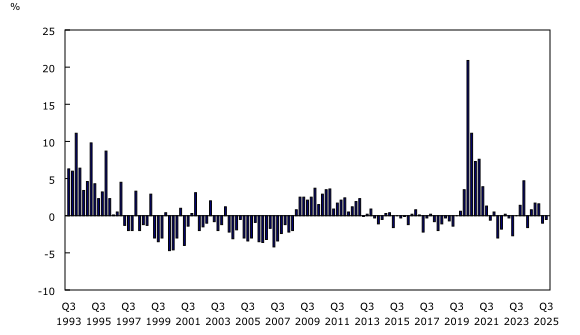
As a percentage of nominal gross domestic product (GDP), the Canadian general government surplus was 0.5% in the third quarter of 2025, compared with a deficit of 0.8% in the third quarter of 2024. The federal government posted a deficit equivalent to 0.8% of GDP, down from 1.0% a year earlier. Provincial and territorial governments recorded a deficit of 0.4% of GDP in the third quarter of 2025, down from a deficit of 0.6% of GDP in the same quarter the previous year. The surplus of local governments was 0.1% of GDP in the third quarter of 2025, while the surplus of the social security funds was 1.6%.
Chart 1

Canadian general government deficit as a percentage of nominal gross domestic product
Federal government deficit decreases, as revenue growth outpaces increase in spending
The federal government's deficit narrowed slightly from a year ago in the third quarter of 2025 (-$0.9 billion), as revenue growth outpaced the rise in expenses. Federal government revenue increased by $3.5 billion, primarily driven by higher tax revenue (+$2.8 billion; +2.6%).
Taxes on income, profits, and capital gains rose by $3.6 billion (+4.3%) in the third quarter, keeping pace with nominal GDP growth. Taxes on goods and services fell by $2.3 billion (-10.6%), marking their second consecutive year-over-year decline, primarily owing to the abolition of the federal consumer carbon tax. Taxes on international trade and transactions increased by $1.5 billion year over year, but at a slower pace than in the previous quarter (+$2.1 billion) due to the removal of counter tariffs on most US imports effective September 1, 2025.
The expenses of the federal government increased by $2.6 billion (+2.1%) in the third quarter, mainly due to a $2.3 billion rise in grants to other general government units. Interest expenses ($13.1 billion) decreased slightly (-$0.4 billion; -3.3%) from the peak observed in the third quarter of 2024. Year over year, social benefits edged down $0.6 billion, mainly due to the abolition of the Canada Carbon Rebate. Meanwhile, Employment Insurance benefits increased $0.9 billion (+14.6%) and Old Age Security benefits increased $0.5 billion (+2.3%).
Chart 2
Federal government taxes, year-over-year change

Canadian general government net debt decreases
Canadian general government net debt decreased by $57.0 billion (-10.2%) year over year to reach $500.1 billion in the third quarter of 2025, primarily due to a $162.1 billion increase in the value of the financial assets of social security funds. Excluding social security funds, whose assets are earmarked to pay future benefits, net debt increased by $60.7 billion (+4.4%) to reach $1,437.9 billion.
In the third quarter, the federal government's net debt increased by $55.7 billion from the same period one year earlier and stood at $1,006.0 billion. The market value of the federal government's total liabilities increased by $128.2 billion (+7.4%), driven by an increase in the value of its outstanding debt securities (+$121.5 billion; +8.9%), while its financial assets increased (+$72.5 billion; +9.2%). Meanwhile, the net debt of provincial, territorial, and local governments increased by $5.0 billion to reach $431.9 billion.
As a percentage of nominal GDP, Canadian general government net debt declined to 15.6% at the end of the third quarter of 2025, compared with 18.2% in the third quarter of 2024. Excluding social security funds, the ratio of net debt-to-GDP was 44.7% at the end of the third quarter of 2025, slightly down from 44.9% one year earlier. The net-debt-to-GDP ratio of the federal government was 31.3% at the end of the third quarter, while that of provincial, territorial and local governments stood at 13.4%.
Chart 3
Net debt as a percentage of nominal gross domestic product by government subsector

Focus on Canada and the United States
In the third quarter of 2025, taxes on international trade and transactions totalled $3.0 billion, increasing 105.0% compared with the third quarter of 2024, following a 144.3% growth in the second quarter. The increase in the third quarter was mostly explained by the implementation of counter tariffs in March 2025 on certain goods imported from the United States. Canada has removed counter tariffs on most US imports effective September 1, 2025, except tariffs on steel, aluminum and autos.
Taxes on international trade and transactions, representing 2.4% of total federal government revenue in the third quarter of 2025, consist primarily of customs duties on certain goods entering the country or on services delivered by non-residents to Canadian residents. These taxes are recorded net of any repayments made to importers as part of existing relief programs or remission orders.
Note to readers
Quarterly financial data for the Canadian general government and its subsectors from the first quarter of 1990 to the third quarter of 2025 are now available. These subsectors include the federal government, provincial and territorial governments, local governments and the Canada Pension Plan and the Québec Pension Plan.
Government Finance Statistics (GFS) present fiscal statistics using the standard developed by the International Monetary Fund. This standard allows consistent aggregation and analysis between participating countries.
In GFS standards, the net operating balance is the difference between revenues and expenses for a given period and is a summary measure of the sustainability of government operations. When revenues are lower than expenses, a deficit is recorded, while the reverse induces a surplus.
The net financial worth is the difference between financial assets and liabilities at market prices for a given period and is a key indicator to assess the sustainability of fiscal policy. This measure is equivalent to the reverse value of net debt, a measure commonly used in the government's financial statements.
Currently, GFS quarterly data are derived by mapping Canada's System of National Accounts data to GFS standards and conventions.
This release of GFS includes revised data from the first quarter of 1999.
Next release
Data on the Canadian government finance statistics for the fourth quarter of 2025 will be released on March 30, 2026.
Products
Additional information can be found in the Latest Developments in the Canadian Economic Accounts (13-605-X). The User Guide: Canadian System of Macroeconomic Accounts (13-606-G) is also available. This publication has been updated with Chapter 9. Government Finance Statistics.
Contact information
For more information, or to enquire about the concepts, methods or data quality of this release, contact us (toll-free 1-800-263-1136; 514-283-8300; infostats@statcan.gc.ca) or Media Relations (statcan.mediahotline-ligneinfomedias.statcan@statcan.gc.ca).
- Date modified: