
Monthly Survey of Manufacturing, October 2025
Released: 2025-12-15


Total manufacturing sales fell 1.0% to $71.5 billion in October, on lower sales in 11 of the 21 subsectors, led by the chemical (-6.0%), wood product (-9.0%) and transportation equipment (-2.3%) subsectors. On a year-over-year basis, sales were up 0.7% in October.
In real terms, sales declined 1.5% in October, while the Industrial Product Price Index rose 1.5%.
Chart 1

Manufacturing sales

Chemical subsector leads the decline
Following two consecutive monthly gains, sales of chemical products decreased 6.0% to $5.2 billion in October. The decrease was driven by lower sales in the pharmaceutical and medicine industry group. Sales across all the chemical industry groups—except for other chemical product manufacturing—declined during the first 10 months of 2025 compared with the same period the previous year. Basic chemicals and pharmaceutical and medicine products led the decreases.
Sales in the wood product subsector fell 9.0% to $2.9 billion in October, marking the lowest level since July 2020. Wood product sales in real terms were down 10.9% in October 2025. Wood product manufacturing in Canada was affected by recent US tariffs, which led to production slowdowns and several sawmill closure announcements. Wood product sales declined 12.7% in October compared with the same month the previous year.
In the transportation equipment subsector, sales were down 2.3% to $11.5 billion in October, following a 9.3% increase in September. Within this subsector, the production of aerospace product and parts industry group posted the largest decrease. Sales in this industry group declined 6.3% to $2.7 billion in October, after reaching their highest level on record in September ($2.9 billion). In the motor vehicle industry group, sales fell 2.0% to $4.6 billion in October. Some auto production in Ontario was disrupted by a semiconductor chip shortage, which resulted in production cuts. Despite the declines, total transportation equipment sales in October were 0.3% higher compared with the same month the previous year.
Sales decrease in six provinces
Sales decreased in six provinces in October, led by Ontario and Quebec. Manitoba posted the largest gain.
In Ontario, manufacturing sales fell 1.7% to $31.1 billion in October, reflecting declines in 13 of the 21 subsectors. The largest decreases were in chemicals (-9.4%), transportation equipment (-2.2%) and wood products (-17.7%). These declines were partially offset by a 3.2% increase in petroleum and coal product sales. On a year-over-year basis, Ontario's total sales were up 1.5% in October.
Sales in Quebec declined 2.5% to $18.2 billion in October, driven by a 21.6% decline in the production of aerospace product and parts. The decline in the aerospace product and parts industry group follows the highest production on record in September. Total sales in Quebec edged down 0.2% on a year-over-year basis in October.
In Manitoba, manufacturing sales rose for the third consecutive month; sales in October increased 7.6% to $2.5 billion. The increase was entirely due to higher sales of transportation equipment. Compared with October the previous year, total sales in Manitoba were up 14.1%.
Total inventories decrease
Following five consecutive monthly increases, total inventory levels decreased 0.7% to $121.3 billion in October. Lower inventories of raw materials (-1.7%) and, to a lesser extent, of finished products (-0.2%) were responsible for the decline. Goods in process inventories edged up 0.1% in October. At the industry level, the largest declines were observed in inventories of machinery (-3.4%) and wood products (-3.2%).
Chart 2
Total inventories decrease in October

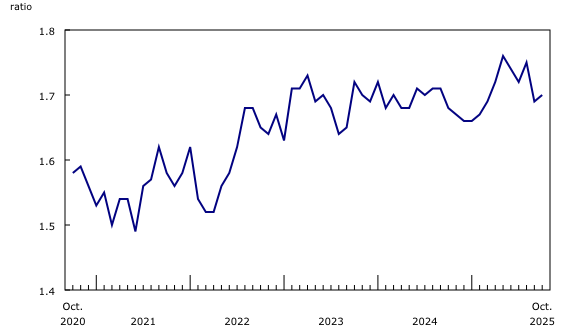
The inventory-to-sales ratio increased from 1.69 in September to 1.70 in October. This ratio measures the time, in months, required to exhaust inventories if sales remain at their current level.
Chart 3
The inventory-to-sales ratio increases in October
Unfilled orders edge up
Total unfilled orders edged up 0.1% to $112.8 billion in October, reaching the second-highest level on record. The increase was driven by a 1.4% rise in unfilled orders for aerospace product and parts.
Chart 4
Unfilled orders edge up in October

Capacity utilization rate increases
The capacity utilization rate (not seasonally adjusted) for the total manufacturing sector increased from 80.3% in September to 80.7% in October. The gains were most pronounced in the food (+1.8 percentage points), petroleum and coal (+1.3 percentage points) and transportation equipment (+0.9%) subsectors. The capacity utilization rate of wood product manufacturing declined 2.7 percentage points in October.
Chart 5
Capacity utilization rate increases in October

Focus on Canada and the United States
The United States is important for Canadian manufactured products, serving as Canada's largest export market. In 2024, Canadian manufacturers sold about half of their products to foreign customers, with roughly 80% of those exports going to the United States. The transportation equipment and food product subsectors were the top exporters. Notably, in 2024, Canadian transportation equipment manufacturers sold approximately two-thirds of their products to the United States, which accounted for roughly one-quarter of total exports of manufactured products to the United States.
For more data and insights on areas touched by the socio-economic relationship between Canada and the United States, see the Focus on Canada and the United States webpage.
Sustainable development goals
On January 1, 2016, the world officially began implementing the 2030 Agenda for Sustainable Development—the United Nations' transformative plan of action that addresses urgent global challenges over the following 15 years. The plan is based on 17 specific sustainable development goals.
The Monthly Survey of Manufacturing is an example of how Statistics Canada supports the reporting on the global sustainable development goals. This release will be used to help measure the following goal:

Note to readers
Monthly data in this release are seasonally adjusted and are expressed in current dollars, unless otherwise specified.
Seasonally adjusted data are data that have been modified to eliminate the effect of seasonal and calendar influences to allow for more meaningful comparisons of economic conditions from period to period. For more information on seasonal adjustment, see Seasonally adjusted data – Frequently asked questions.
Trend-cycle estimates are included in selected charts as a complement to the seasonally adjusted series. These data represent a smoothed version of the seasonally adjusted time series and provide information on longer-term movements, including changes in direction underlying the series. For information on trend-cycle data, see Trend-cycle estimates – Frequently asked questions.
Both seasonally adjusted data and trend-cycle estimates are subject to revision as additional observations become available. These revisions could be large and could even lead to a reversal of movement, especially for reference months near the end of the series or during periods of economic disruption.
Non-durable goods industries include food; beverage and tobacco products; textile mills; textile product mills; apparel; leather and allied products; paper; printing and related support activities; petroleum and coal products; chemicals; and plastics and rubber products.
Durable goods industries include wood products; non-metallic mineral products; primary metals; fabricated metal products; machinery; computer and electronic products; electrical equipment, appliances and components; transportation equipment; furniture and related products; and miscellaneous manufacturing.
Production-based industries
For the aerospace and shipbuilding industry groups, the value of production is used instead of the value of sales of goods manufactured. The value of production is calculated by adjusting monthly sales of goods manufactured by the monthly change in inventories of goods in process and finished products manufactured. The value of production is used because of the extended period of time that it normally takes to manufacture products in these industries.
Unfilled orders are a stock of orders that will contribute to future sales, assuming that the orders are not cancelled.
New orders are those received whether sold in the current month or not. New orders are measured as the sum of sales for the current month plus the change in unfilled orders from the previous month to the current month.
Manufacturers reporting sales, inventories and unfilled orders in US dollars
Some Canadian manufacturers report sales, inventories and unfilled orders in US dollars. These data are then converted to Canadian dollars as part of the data production cycle.
For sales, based on the assumption that they occur throughout the month, the average monthly exchange rate for the reference month established by the Bank of Canada is used for the conversion. The monthly average exchange rate is available in table 33-10-0163-01. Inventories and unfilled orders are reported at the end of the reference period. For most respondents, the daily average exchange rate on the last working day of the month is used for the conversion of these variables.
However, some manufacturers choose to report their data using a day other than the last working day of the month. In these instances, the daily average exchange rate on the day selected by the respondent is used. Note that because of exchange rate fluctuations, the daily average exchange rate on the day selected by the respondent can differ from both the exchange rate on the last working day of the month and the monthly average exchange rate. Daily average exchange rate data are available in table 33-10-0036-01.
Revision policy
Each month, the Monthly Survey of Manufacturing releases preliminary data for the reference month and revised data for the previous three months. Revisions are made to reflect new information provided by respondents and updates to administrative data.
Once a year, a revision project is undertaken to revise multiple years of data.
Real-time data tables
Real-time data tables 16-10-0014-01 and 16-10-0015-01 will be updated on December 23.
Next release
Data from the Monthly Survey of Manufacturing for November 2025 will be released on January 15, 2026.
Contact information
For more information, or to enquire about the concepts, methods or data quality of this release, contact us (toll-free 1-800-263-1136; 514-283-8300; infostats@statcan.gc.ca) or Media Relations (statcan.mediahotline-ligneinfomedias.statcan@statcan.gc.ca).
- Date modified: