
Tourism Investment Module, 1981 to 2021

Archived Content
Information identified as archived is provided for reference, research or recordkeeping purposes. It is not subject to the Government of Canada Web Standards and has not been altered or updated since it was archived. Please "contact us" to request a format other than those available.
Released: 2023-03-07
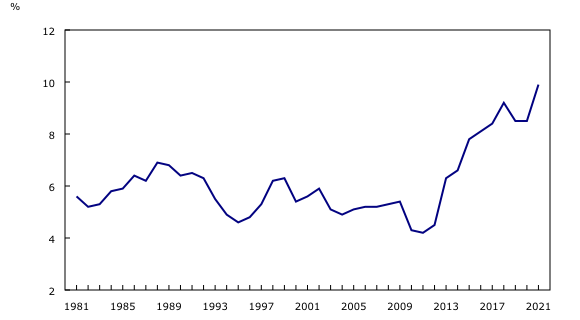
In 2021, tourism industries invested $35.0 billion in non-residential capital assets, which accounted for 9.9% of all non-residential capital investment in Canada.
This study isolates the investment in non-residential capital assets undertaken by tourism industries at a detailed industry level. Tourism industries are a subset of all industries in Canada and include those related to transportation, accommodation, food and beverage services, recreation and entertainment, and travel services that are likely to cater directly to tourists. Although these industries also serve non-tourism activities, they are considered essential for tourism activities. As such, these estimates contain investments that benefit tourists and non-tourists. For some tourism industries (e.g., urban transit), these investments mostly benefit non-tourists. The specific industries included are outlined in the Note to readers.
Non-residential assets include four broad asset categories: non-residential buildings, non-residential engineering structures, machinery and equipment, and intellectual property products.
The share of total non-residential investment by tourism industries has steadily increased from a low of 4.2% in 2011 to a high of 9.9% in 2021. These gains were primarily driven by investments in urban transit systems, which tripled in the last decade.
Chart 1

Tourism industries' share of non-residential investment, 1981 to 2021
In 2021, three industries accounted for 70% of total tourism investment: urban transit systems ($16.8 billion), passenger car rental ($4.0 billion) and scheduled air transportation ($3.7 billion).
In real terms, capital investment by tourism industries increased 18.5% in 2021, following a 4.8% decline in 2020. The scheduled air transportation and passenger car rental industries largely contributed to growth in 2021. On average, investment by tourism industries has increased 5.3% annually since 2011.
Chart 2
Investment in tourism industries, 1981 to 2021

Private sector leads investment by tourism industries, but loses share to public sector
Of the investment in capital assets by tourism industries, 41.9% originated in the private sector. However, the private sector's share of total tourism investment has been steadily declining, from a high of 74.7% in 1987 to a low of 35.2% in 2020, as all levels of government (representing the public sector) have increased their share over the years. This shift is primarily the result of increased public sector investment in urban transit systems.
Capital investment by private sector tourism industries was highest in Ontario, at $5.9 billion in 2021, representing 40.5% of total private sector capital investment by tourism industries in Canada, followed by British Columbia ($3.4 billion), Alberta ($1.9 billion) and Quebec ($1.9 billion).
About half of capital investment by public sector tourism industries was at the federal level ($10.6 billion), followed by local governments ($5.0 billion) and provincial, territorial and Aboriginal general governments ($4.7 billion). Public sector industries also include government-based enterprises.
Investment by public sector tourism industries ($10.8 billion) was highest in Ontario, representing 64.4% of all investment by tourism industries in the province.
Chart 3
Investment in tourism industries, share by sector, 2021

Note to readers
All estimates in this release are expressed in current dollars unless otherwise stated.
The industries involved in tourism industries are composed of the following six-digit North American Industry Classification System (NAICS) codes: 481110, 481214, 481215, 482114, 483115, 483116, 483213, 483214, 485110, 485310, 485320, 485210, 485410, 485510, 485990, 487110, 487210, 487990, 512130, 532111, 532120, 561510, 561520, 561590, 711111, 711112, 711120, 711130, 711190, 711211, 711213, 711218, 711311, 711319, 711321, 711322, 711329, 711511, 711512, 711513, 712111, 712115, 712119, 712120, 712130, 712190, 713110, 713120, 713210, 713291, 713299, 713910, 713920, 713930, 713950, 713990, 721111, 721112, 721113, 721114, 721120, 721191, 721192, 721198, 721211, 721212, 721213, 722410, 722511 and 722512.
A two-step procedure is used to provide the required levels of detail.
The first step is to derive a weighting based on the Capital and Repair Expenditures Survey (CAPEX) data. This weighting is calculated according to the province, the sector of activity (private, federal, provincial, territorial, local and Aboriginal) and the two-digit and six-digit levels of the NAICS classification. As CAPEX data are only available from 2015 to 2020, weights were extrapolated to earlier years (2014 to 1981) using a backward moving average of a maximum length of five. To extend the dataset to 2021, the 2021 data were estimated using the average of the weights from 2015 to 2020.
The second step consists of applying the weights obtained in the first step to the published capital investment data, thereby ensuring coherence with the stock and consumption of fixed capital program. After this step, we have detailed investment data by province, asset and sector of activity and at the six-digit level of the NAICS classification, and these data are available from 1981 to 2021.
Data are available upon request.
Products
The Economic accounts statistics portal, accessible from the Subjects module of the Statistics Canada website, features an up-to-date portrait of national and provincial economies and their structure.
The Latest Developments in the Canadian Economic Accounts (13-605-X) is available.
The User Guide: Canadian System of Macroeconomic Accounts (13-606-G) is available.
The Methodological Guide: Canadian System of Macroeconomic Accounts (13-607-X) is available.
Contact information
For more information, or to enquire about the concepts, methods or data quality of this release, contact us (toll-free 1-800-263-1136; 514-283-8300; infostats@statcan.gc.ca) or Media Relations (statcan.mediahotline-ligneinfomedias.statcan@statcan.gc.ca).
- Date modified: