
Securities statistics, fourth quarter 2021

Archived Content
Information identified as archived is provided for reference, research or recordkeeping purposes. It is not subject to the Government of Canada Web Standards and has not been altered or updated since it was archived. Please "contact us" to request a format other than those available.
Released: 2022-03-08
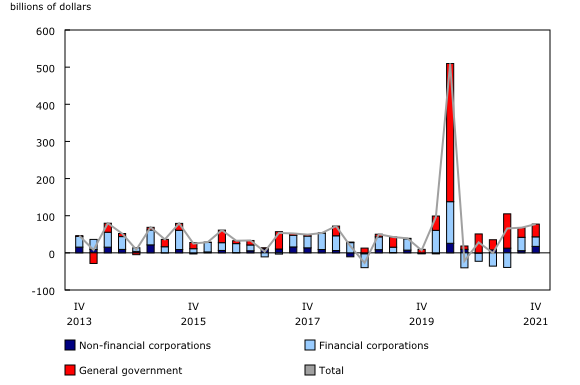
Borrowings in the form of debt securities by Canadian governments and corporations totalled $77.4 billion in the fourth quarter, the largest amount since the second quarter of 2020 and the third consecutive quarter for which new issues exceeded retirements. This financing activity was led by the federal government, financial corporations and, to a lesser extent, non-financial corporations.
Overall, the total outstanding amount of debt securities owed by Canadian entities to domestic and foreign creditors was up by $24.3 billion to reach $5,136.4 billion at the end of 2021, led by issuances. The downward revaluation resulting from the appreciation of the Canadian dollar against major foreign currencies moderated the overall increase. About one-quarter of the total stock of debt securities was denominated in foreign currencies at the end of the year. The Canadian dollar was up by 0.4 US cents against the US dollar in the fourth quarter.
Chart 1

Canadian debt securities issues by sector, net issuances
Issuances of debt securities from all sectors
Issuances of debt securities by the federal government totalled $27.6 billion in the fourth quarter, with the bulk in the form of bonds with an original maturity of more than 10 years. This borrowing activity was moderated by retirements of $5.0 billion in money market instruments. By the end of the fourth quarter, the total outstanding amount of federal government debt securities rose by $25.4 billion to reach $1,228.0 billion.
Canadian corporations were also net borrowers, raising $43.1 billion in the form of debt securities in the fourth quarter. Canadian chartered banks borrowed $18.9 billion, mainly foreign currency-denominated bonds targeting international markets. Meanwhile, non-financial corporations issued a net $17.5 billion in debt securities over the quarter. On a sector basis, firms from the transportation and warehousing industry, information and cultural industries, and the mining, quarrying, and oil and gas extraction industry contributed the most to the activity.
Largest issuances of equity securities in more than a year
Net issuances of equity securities by Canadian corporations totalled $16.1 billion in the fourth quarter, the largest amount since the third quarter of 2020. Non-financial corporations, mainly from the transportation and warehousing industry, led the activity, with issuances of $20.2 billion. The funds were raised mainly for activities related to mergers and acquisitions.
Chart 2
Canadian equity securities issues by sector, net issuances

The total outstanding market value of listed Canadian equity securities increased by $250.1 billion to reach a record of $4,137.9 billion at the end of the fourth quarter. The Standard & Poor's / Toronto Stock Exchange composite index rose by 5.7% in the fourth quarter.
Federal government borrowing activities continue in 2021
On an annual basis, Canadian entities issued a net $210.6 billion of debt securities in 2021, down from $612.7 billion in 2020. The overall borrowing needs of the federal government to support Canadians persisted in 2021. The federal government borrowed a net $114.7 billion over the year, compared with $368.9 billion in 2020. The level of activity in 2021 remained high when compared with the annual average of $12.3 billion observed in the eight years prior to the pandemic (2012 to 2019). The federal government mainly borrowed in the form of bonds in 2021, with issuances totalling $173.8 billion, used in part to repay $59.0 billion of short-term debt securities.
Chart 3
Debt securities issues by the federal government, net issuances, annual
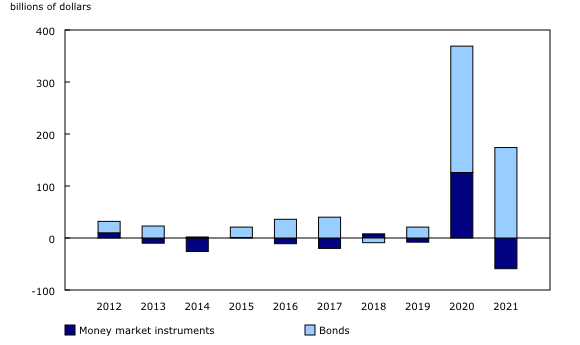
The composition of the federal government debt changed from 2020 to 2021. At the end of 2021, about two-fifths of the stock of federal government debt securities were in the form of bonds with an original maturity of more than 10 years. This proportion was much lower at the end of June 2020, at 30%. Meanwhile, nearly 30% ($359.4 billion) of all outstanding debt securities were to be repaid within one year or less, down from 45% ($485.2 billion) at the end of June 2020. In 2021, Canadian short-term interest rates were up by 9 basis points and long-term rates increased by 77 basis points.
Net retirements of debt securities by financial corporations in 2021
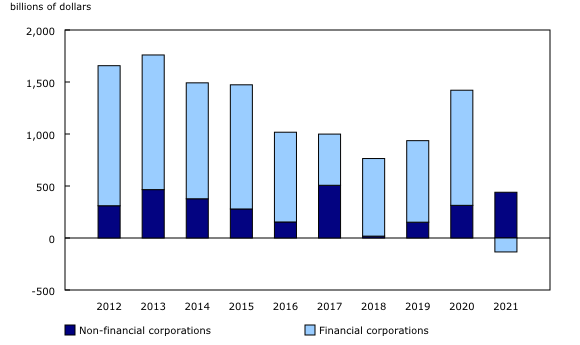
Canadian financial corporations repaid more debt securities than they issued in 2021. Their retirements exceeded issuances by $13.4 billion in the year, following net issuances of $110.7 billion in 2020. In the first half of 2021, financial corporations repaid $75.0 billion of debt securities, largely instruments originally issued on the Canadian market. The trend was reversed in the second half of the year, as they borrowed a net $61.6 billion, mainly on international markets. In comparison, issuances by non-financial corporations were $44.0 billion in 2021, with more than half issued on the Canadian market.
Chart 4
Debt securities issued by corporations, net issuances, annual
Note to readers
Statistics on Canadian portfolio investment abroad, previously released with Canada's international investment position, are now available with this release. Canadian holdings of foreign securities by type of securities, by currency of denomination, by country of issuer of these securities and by sector of non-resident issuer are available in tables 36-10-0368-01, 36-10-0581-01 and 36-10-0606-01.
This release also includes debt securities statistics in a from-whom-to-whom framework, where the economic sectors issuing debt securities are put into relation with the sectors investing in these instruments. The data can be found in table 36-10-0673-01.
Definitions
Securities statistics cover issuances and holdings of negotiable financial instruments. Securities include debt instruments designed to be traded in financial markets, such as treasury bills, commercial paper and bonds, as well as equity instruments such as listed shares.
The book value of a debt instrument reflects the value of the debt at creation, and any subsequent economic flows, such as transactions (e.g., repayment of principal), valuation changes (independent of changes in its market price) and other changes. The book value is composed of the outstanding principal amount plus any accrued interest. The market value reflects the value at which securities are acquired or disposed of in transactions between willing parties, excluding commissions, fees and taxes.
Currency valuation
The value of securities denominated in foreign currency is converted to Canadian dollars at the end of each period. When the Canadian dollar appreciates in value, the restatement of the value of these instruments in Canadian dollars lowers the recorded value. The opposite is true when the Canadian dollar depreciates.
Products
The data visualization product "Securities statistics," part of the series Statistics Canada – Data Visualization Products (71-607-X), is available online.
The document "Enhancing Canada's statistics on securities," part of Latest Developments in the Canadian Economic Accounts (13-605-X), is also available.
The Economic accounts statistics portal, accessible from the Subjects module of our website, features an up-to-date portrait of national and provincial economies and their structure.
Contact information
For more information, or to enquire about the concepts, methods or data quality of this release, contact us (toll-free 1-800-263-1136; 514-283-8300; infostats@statcan.gc.ca) or Media Relations (statcan.mediahotline-ligneinfomedias.statcan@statcan.gc.ca).
- Date modified: