
Non-bank financial intermediation, 2007 to 2020

Archived Content
Information identified as archived is provided for reference, research or recordkeeping purposes. It is not subject to the Government of Canada Web Standards and has not been altered or updated since it was archived. Please "contact us" to request a format other than those available.
Released: 2022-02-17
Non-bank financial intermediation (NBFI) is defined as financial intermediation activities, such as lending, that are outside the traditional, regulated financial system where oversight and risk assessment are well established. Because of the important role that non-bank financial intermediaries play in the financial system and the many interlinkages between them and other financial institutions, it is necessary to better measure their activities to more comprehensively monitor risk.
This release focuses on non-bank credit intermediaries (NBCIs)—a subset of NBFIs, which encompass mortgage investment corporations (MICs), mortgage finance corporations (MFCs), consumer and business transportation leasing companies, other leasing companies, and finance companies.
Impact of COVID-19 on non-bank credit intermediaries
With the arrival of COVID-19 in early 2020 and the associated upheaval in many industries and sectors, the extent to which households and businesses relied on NBCI lenders for credit was influenced by a variety of factors. Government support programs to replace income and curbed consumption had a moderating impact on the expansion of household balance sheets with respect to non-mortgage borrowing, while a strong housing market pushed up the overall demand for mortgages. Among businesses, subsidies and loans provided by the government likely reduced the immediate need to seek out other creditors.
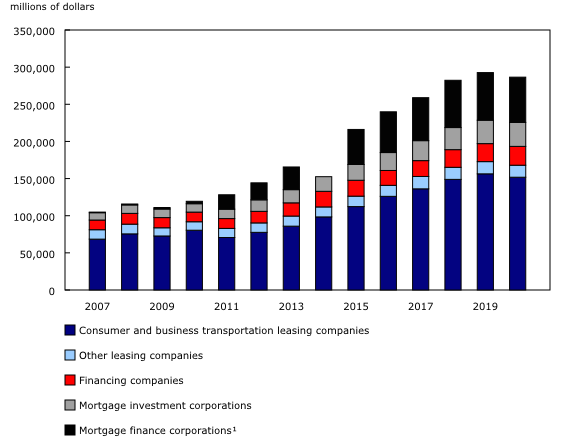
The impact of the COVID-19 pandemic on various economic and financial domains has been well documented as part of Statistics Canada's complement of monthly and quarterly releases including gross domestic product by industry, the quarterly income and expenditure accounts, and the national balance sheet accounts. In nominal terms, gross domestic product (GDP) declined 4.5% in 2020 from the year prior, while real GDP fell 5.2% as many areas of the economy faced intense pressures. NBCIs were not an exception, with the total assets of the NBCI sectors falling for the first time since 2009, when the global financial crisis froze credit markets. Since then, assets had been growing at a near or more than double digit pace. However, by 2019, this growth had moderated substantially (+3.8%) and reversed course by 2020 (-3.7%).
Total financial assets, composed predominantly of mortgage and non-mortgage loans, fell $6.1 billion to $286.5 billion by the end of 2020, with consumer and business transportation leasing companies, the largest NBCI sector by asset value, accounting for the largest share of this drop. Despite the overall decline in 2020, each of the five sectors experienced different impacts on their balance sheets, highlighting the uneven effects tied to COVID-19, the different types of credit that each sector provides, and the associated demand for these funds. Overall, the proportion of NBCI loan assets to the loan assets of all lenders fell to 5.6% in 2020, the second consecutive decline.
Chart 1

Total financial assets of non-bank credit intermediaries
Mortgage lenders, a mixed bag
Tighter underwriting standards, rising interest rates and other measures intended to calm housing markets in some jurisdictions tempered mortgage borrowing throughout late 2018 and early 2019. However, over the course of 2020 households added a near record $119.6 billion in mortgage debt, on the heels of significantly lower interest rates, strengthening demand for housing, and rising home prices. Chartered banks and credit unions, two groups that are either federally or provincially regulated and thus outside of the scope of NBFIs, were the primary providers of these funds.
Among the principal NBCI mortgage lending sectors, the mortgage assets of MICs rose 1.4% in 2020 to reach $28.2 billion. This was the second consecutive year of weaker growth, well below the frequently double digit growth rates recorded since 2010. However, strong overall demand for residential mortgages in 2020 and the continued ability of mortgage borrowers to service their debt likely buttressed growth in this sector.
MFCs recorded a decline of 4.3% in their mortgage assets to $56.8 billion in 2020, the second consecutive yearly drop, while debt security liabilities—a prominent source of funding for MFCs—mirrored this trend. MFCs, whose business model includes originating mortgages and selling these to financial institutions such as chartered banks, were nonetheless active in 2020 given the strong housing market and the growth in administration of third-party mortgages and the related servicing fees. However, insured mortgages as a proportion of overall residential mortgages and in absolute terms have been declining for a number of years; this decline was a contributing factor to the continuing reduction in the mortgage assets of MFCs.
Declines in leasing, sluggish growth in financing activities among non-bank credit intermediaries
While overall household mortgage debt rose at a considerable pace from 2019 to 2020, non-mortgage debt of households fell by a record $24.9 billion over the same period, mostly attributable to a decline in credit card debt.
Among non-mortgage NBCI lenders, the transportation leasing sector recorded a 8.1% decline to $76.2 billion in non-mortgage loan assets, which includes lease receivables. After several years of steady growth, the operating revenue of the automotive equipment rental and leasing industry group fell 17.7% in 2020 to $6.5 billion. At the same time, household vehicle leasing measured as part of the national balance sheet accounts decreased 10.9% and household final demand for both new and used motor vehicles fell 13.5%.
Finance companies recorded a relatively sluggish 1.2% increase in non-mortgage loans in 2020, following a deceleration of growth in 2019. This was accompanied by a 4.2% contraction of total household final consumption in 2020 as consumers made fewer purchases.
Continuing effects of COVID-19 on non-bank credit intermediaries
As the effects of COVID-19 continued throughout 2021, the flow of various financial supports in response to the pandemic have been reduced as the economy gained traction, notwithstanding additional waves of infection and new variants. The reliance of households and businesses on NBCI lenders over this period can be gleaned using information from the National Balance Sheet Accounts.
Non-mortgage loans of other financial intermediaries, which include mortgage lending and financing and leasing companies, rose 10.8% in the third quarter of 2021 compared with the fourth quarter of 2020, after a decline of 4.4% in the fourth quarter of 2020 compared with the same quarter of 2019. Mortgages edged up 0.6% over the same three-quarter period.
By comparison, chartered banks and quasi-banks, which include credit unions and trust and mortgage loan companies, posted an increase in their non-mortgage loans of 6.0% from the end of 2020 to the third quarter of 2021. Mortgage loans grew 8.8% over the same period, a continuation of the strong 8.5% growth recorded in 2020.
Note to readers
Non-bank financial intermediation (NBFI) is defined as financial intermediation activities, such as lending, that are outside the traditional, regulated financial system. The current iteration of the economic account of non-bank financial intermediation contains revised estimates for reference years 2007 to 2019 and preliminary estimates for 2020 covering non-bank credit intermediaries (NBCIs)—a subset of non-bank financial intermediaries.
This economic account, developed in partnership with the Bank of Canada, is an extension of the national balance sheet accounts (NBSA) and was established by reclassifying entities from existing institutional sectors in the NBSA to a set of subsectors aligned with the current classification of non-bank financial intermediaries. Additionally, it closely follows the NBSA's classification of financial instruments for assets and liabilities.
For more information on how this account is constructed, please see the article "An economic account for non-bank financial intermediation as an extension of the National Balance Sheet Accounts" (13-605-X).
NBCIs serve as an important source of funding for both businesses and households. They encompass mortgage investment corporations (MICs), mortgage finance corporations (MFCs), consumer and business transportation leasing companies, other leasing companies, and finance companies.
Mortgage investment corporations
MICs, governed by section 130.1 of the Income Tax Act, are engaged in mortgage lending. Funds are raised through the sale of shares to investors or via debt and these funds are used to provide financing. The return to investors is typically the interest earned on the MIC's portfolio of outstanding loans. Usually, a MIC has 20 or more shareholders and provides short-term loans (6 to 36 months) that are secured by real estate property. MICs offer advantages over traditional banks, as they are more flexible in their lending terms. One can have a personalized structured loan with a short turnaround time for assessing and providing funds that—when compared with other lenders—allows them to charge a higher interest rate. The structure of a MIC represents a vehicle for those with equity to generate profit from the lucrative residential mortgage loan industry.
Mortgage finance corporations
MFCs are large financial institutions that originate and service residential mortgages (usually insured). These mortgages are typically sourced from brokers, but some are sourced from clients directly. These mortgages tend to be packaged and sold to regulated financial institutions. Therefore, they must adhere to mortgage lending rules to satisfy the requirements of both their institutional buyers and the Canada Mortgage and Housing Corporation regarding the public insurance of residential mortgages. As a result of these two considerations, MFCs are often considered to be quasi-regulated. MFCs have a complex relationship with the major banks that is both cooperative and competitive. According to the Bank of Canada, some banks rely on MFCs to underwrite and service broker-originated mortgages, while MFCs also rely on banks to fund their operating capital and a significant share of their mortgage lending. At the same time, MFCs and banks compete for broker-originated mortgages (from The Rise of Mortgage Finance Companies in Canada: Benefits and Vulnerabilities [0.2 MB, in PDF format only]).
Consumer and business transportation leasing companies
A lease is a long-term contract of one or more years where the lessee pays the depreciation on a good, including an associated interest expense and is offered the option at the end of the lease to buy out the good completely or return it. This sector includes all types of transportation vehicles (planes, trains and automobiles) and fleets, but excludes rentals.
Other leasing companies
Other leasing companies adhere to the same general definition of a lease and cover all other types of leasing, such as equipment, furniture and machinery. Transportation leasing and rentals are excluded.
Finance companies
Finance companies are financial institutions that supply credit for the purchase of consumer goods and services or grant loans directly to individuals and businesses. Unlike banks, finance companies do not take deposits from the public and are not subject to strict banking regulations. Finance companies profit from interest rates charged on the loans provided to clients. These rates are generally higher than the interest rates on bank loans. Finance companies typically obtain funds from a variety of sources, such as through their own borrowing or from an affiliated corporation.
Products
The document "Trends in household non-mortgage loans: The evolution of Canadian household debt before and during COVID-19," which is part of the series Analysis in Brief (11-621-M), is now available.
The document "Trends in the Canadian mortgage market: Before and during COVID-19," which is part of the series Analysis in Brief (11-621-M), is now available.
The document "An economic account for non-bank financial intermediation as an extension of the National Balance Sheet Accounts," which is part of Latest Developments in the Canadian Economic Accounts (13-605-X), is available.
The Economic accounts statistics portal, accessible from the Subjects module of our website, features an up-to-date portrait of national and provincial economies and their structures.
The publication Latest Developments in the Canadian Economic Accounts (13-605-X) is available.
The User Guide: Canadian System of Macroeconomic Accounts (13-606-G) is available.
The Methodological Guide: Canadian System of Macroeconomic Accounts (13-607-X) is available.
Contact information
For more information, or to enquire about the concepts, methods or data quality of this release, contact us (toll-free 1-800-263-1136; 514-283-8300; infostats@statcan.gc.ca) or Media Relations (statcan.mediahotline-ligneinfomedias.statcan@statcan.gc.ca).
- Date modified: