
Aircraft movement statistics: Major airports, October 2020

Archived Content
Information identified as archived is provided for reference, research or recordkeeping purposes. It is not subject to the Government of Canada Web Standards and has not been altered or updated since it was archived. Please "contact us" to request a format other than those available.
Released: 2020-12-18
353,150
October 2020
-31.7% 
(year-over-year change)
Highlights
In October, the total number of local and itinerant aircraft movements in Canada fell 31.7% from October 2019.
With ongoing border and travel restrictions, the number of itinerant movements fell by 41.5%. Domestic traffic was down 34.2%, while movements to the United States were down 84.2% and other international traffic declined by 69.4% from the same month last year.
Boundary Bay, British Columbia was Canada's busiest airport for the sixth consecutive month, with 17,168 movements.
Travel restrictions continue to affect air traffic
Entering into the seventh full month of travel restrictions, Canadians continued to be advised against travelling abroad in October and faced mandatory quarantine for 14 days upon returning. Confirmed cases of COVID-19 were rising, further threatening any meaningful recovery.
Air traffic at Canada's major airports fell 31.7% year over year in October. There were 353,150 take-offs and landings at the 90 Canadian airports with NAV CANADA air traffic control towers and flight service stations, compared with 517,071 in October 2019. Itinerant traffic (flights from one airport to another) decreased 41.5% year over year to 206,411 movements in October, while local traffic (flights that remain in the vicinity of the airport) declined 10.7% to 146,739.
Chart 1

Total aircraft movements at major airports

Domestic movements (within Canada) were down 34.2% compared with October 2019, while transborder traffic (between Canada and the United States) dropped 84.2%. Other international traffic saw a 69.4% decrease over last year, a slight improvement from a 74.2% decline in September.
Chart 2
Year-over-year change by sector

The temptation to vacation
Canada's largest carriers added flights to popular sun destinations in October and joining this group was Swoop, which conducted its first transborder flights since March. While non-essential travel to the United States is prohibited by land until at least January 21, 2021, travelers are permitted to enter the country by air, with quarantine restrictions upon arrival that vary by state.
Canada's busiest airports
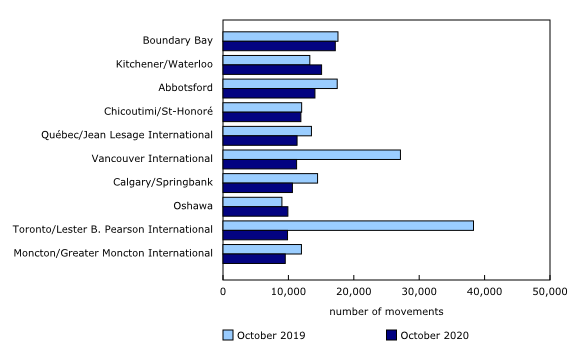
In October, Canada's 10 busiest airports accounted for just over one-third (34.2%) of total take-offs and landings. Boundary Bay, British Columbia was the most active airport for the sixth consecutive month, with 17,168 movements. Next came Kitchener/Waterloo, Ontario with 15,076 movements, followed by Abbotsford, British Columbia with 14,060.
Chart 3
Total aircraft movements at top 10 Canadian airports, October 2020
Looking ahead
Given border restrictions and accompanying quarantine requirements, the outlook remains grim for the travel industry. In Canada, some additional air traffic may result from demand for travel to sun destinations by snowbirds and others eager to escape the Canadian winter.
Several countries have now mandated a negative COVID-19 test as a prerequisite to entry. In late November for example, Canadian travelers to Hawaii, United States became exempt from quarantine requirements by providing a negative coronavirus test result 72 hours prior to departure. Further, starting December 7, Shoppers Drug Mart in Ontario, Alberta and British Columbia began providing some Air Canada passengers with pre-departure rapid COVID-19 tests.
With the resumption of service by both Sunwing and Air Canada Rouge in early November, Porter is now the only Level I carrier that remains grounded. Currently, the airline has extended its suspension of service until at least February 11, 2021.
Note to readers
This survey collects data on itinerant and local aircraft movements at major airports in Canada.
Major airports include all airports with either a NAV CANADA air traffic control tower or a NAV CANADA flight service station.
On January 30, 2020, NAV CANADA air traffic control service was re-established at Montréal/Mirabel International in Quebec for 16 hours per day. In 2008, because of a reduction in traffic levels, air traffic control service at the airport was replaced by a flight service station. As a result, effective February 1, 2020, monthly aircraft movement data for the airport reverted to tables 23-10-0002-01 to 23-10-0008-01 (airports with NAV CANADA towers). Data from December 2008 to January 2020 remain available in tables 23-10-0009-01 to 23-10-0015-01 (airports with NAV CANADA flight service stations).
An aircraft movement is defined as a take-off, landing or simulated approach by an aircraft, as defined by NAV CANADA.
Data for 2018 and 2019 may have been revised.
The data in this monthly release are not seasonally adjusted.
Contact information
For more information, or to enquire about the concepts, methods or data quality of this release, contact us (toll-free 1-800-263-1136; 514-283-8300; STATCAN.infostats-infostats.STATCAN@canada.ca) or Media Relations (613-951-4636; STATCAN.mediahotline-ligneinfomedias.STATCAN@canada.ca).
- Date modified: