
Concepts and Methods Guide
2. Survey content: concepts and questions

Archived Content
Information identified as archived is provided for reference, research or recordkeeping purposes. It is not subject to the Government of Canada Web Standards and has not been altered or updated since it was archived. Please "contact us" to request a format other than those available.
Skip to text
Text begins
2.1 Content development process
The content for the 2017 Aboriginal Peoples Survey (APS) was developed by Statistics Canada in collaboration with three federal funding departments: Crown-Indigenous Relations and Northern Affairs Canada & Indigenous Services Canada (formerly Indigenous and Northern Affairs Canada) and Employment and Social Development Canada. The content was built to meet the commitments put forward in the Treasury Board Submission entitled “Renewal of the Surveys on Aboriginal People for a fifth cycle focused on Aboriginal Participation in the Canadian Economy”, while also meeting the data needs and priorities of the funding departments. The 2017 APS also drew on many key indicators from previous cycles of the APS which were developed in collaboration with national Aboriginal organizations for historical compatibility and cross-sectional analysis.
With respect to new content requirements for 2017, relevant standardized and well-established measures used on other Statistics Canada surveys were gathered and reviewed as potential indicators. These indicators increase opportunities to compare responses between the APS and other Statistics Canada surveys. In addition, recognizing the new theme of Aboriginal participation in the Canadian economy, new APS content was sought that would allow for the measurement of a diverse range of labour market experiences among First Nations people living off reserve, Métis and Inuit. With the goal of identifying the predictive factors of employment in the Aboriginal population, the new content was developed to cover the following seven pillars: barriers and levers to economic participation; labour mobility; entrepreneurship; postsecondary education; targeted skills training; reliance on government transfers; and accumulation of wealth and financial security.
The questions in the 2017 APS were designed for a Computer Assisted Interviewing (CAI) environment, which was first introduced for the 2012 APS to replace previous cycles of this survey which had only been collected on paper. CAI incorporated many features that served to maximize the quality of data collection. A computer-assisted interview questionnaire was developed for two different modes of collection used for this survey: a Computer Assisted Telephone Interview (CATI) and a Computer Assisted Personal Interview (CAPI). Refer to section 4.6 for more details on the APS data collection.
In order to supplement data collection for this survey, variables from the census were added to the analytical file. Respondents were informed that their census data would be linked and they were able to choose not to link their census data, but the majority of them implicitly agreed.
2.2 Aboriginal identity groups
A definition of Aboriginal identity
The 2017 Aboriginal Peoples Survey identifies the Aboriginal identity population as anyone who self-reported being at least one of the following:
- an Aboriginal person, that is, First Nations (North American Indian), Métis or Inuk (Inuit);
- a Status Indian, that is, a Registered or Treaty Indian as defined by the Indian Act of Canada; and/or
- a member of a First Nation or Indian band.
The first criterion above is referred to as “Aboriginal self-reporting”. A respondent may self-report as being an Aboriginal person and/or they may see themselves as belonging to one or more of the particular Aboriginal groups mentioned: First Nations, Métis or Inuit. First Nations includes Status and Non-Status Indians. It should also be noted that some respondents use the term First Nations while others use the term North American Indian.
As the APS definition implies, a person does need not to self-report as Aboriginal (e.g., as First Nations, Métis or Inuk) in order to be considered part of the Aboriginal identity population. If a person has reported being a Status Indian and/or a member of a First Nation or Indian band, they are considered to be part of the Aboriginal identity population, regardless of their responses to the Aboriginal group questions. Individuals who are not First Nations (North American Indian), Métis or Inuk (Inuit) but who have Registered or Treaty Indian status and/or Membership in a First Nation or Indian band are considered as “Aboriginal responses not included elsewhere”.
With respect to the measurement of “Status Indian”, the 2017 APS includes everyone who said that they are a Registered or Treaty Indian as defined by the Indian Act. Registered Indians are persons who are registered under the Indian Act of Canada. Treaty Indians are persons who belong to a First Nation or Indian band that signed a treaty with the Crown.
The universe or target population for the 2017 APS are persons who meet the definition of Aboriginal identity. Although the survey data will support distinct analyses for First Nations living off reserve, Métis and Inuit, the APS was not designed to produce estimates for the group ‘Aboriginal responses not included elsewhere’. This is a very small group and caution should be used when conducting analyses for this group (see section 8).
The 2017 APS did not include First Nations people who were living in First Nations communities (on reserve). For current information on First Nations people living on reserve, please refer to the 2016 Census of Population or to a similar themed survey, the First Nations Regional Early Childhood, Education and Employment Survey (FNREEES), conducted on-reserve by the First Nations Information Governance Centre. More information on this survey is available on the First Nations Information Governance Centre website.
Questionnaire items for Aboriginal identification
Table 1 below lists the four Aboriginal identification questions asked in the 2017 APS and shows the Aboriginal identity classification derived from the answers provided to these questions. As shown, in order for someone to be part of the Aboriginal identity population, respondents needed to have a YES response to ID_Q05 (self-reported Aboriginal person), to ID_Q25 (Status Indian) or to ID_Q30 (Member of First Nation or an Indian band). Note that those who answered NO to all these questions were classified as non-Aboriginal and considered out-of-scope for the survey. Adjustments to survey weights were made accordingly.
As shown in Table 1, the measurement of Aboriginal self-reporting was divided into two parts: ID_Q05 and ID_Q10. This allowed respondents to self-report as an Aboriginal person in question ID_Q05 even if they did not self-report as a specific group as named in ID_Q10 (First Nations, Métis or Inuit). For cases where respondents said YES to ID_Q05 but did not respond to ID_Q10, census data was used to determine the identity group (including Aboriginal responses not included elsewhere). Additionally, it is important to note that individuals classified as “Aboriginal responses not included elsewhere” had their answer to ID_Q05 changed to NO if they said YES.
| Questionnaire flow | Aboriginal identity classification |
|---|---|
| ID_Q05 - Are you an Aboriginal person, that is, First Nations (North American Indian), Métis or Inuk (Inuit)? First Nations (North American Indian) includes Status and Non-Status Indians? | Not Applicable |
| Yes ... see subsequent questions | Not Applicable |
| ID_Q10 - Are you First Nations (North American Indian), Métis or Inuk (Inuit)? | Not Applicable |
| First Nations (North American Indian) | First Nations |
| Métis | Métis |
| Inuk (Inuit) | Inuit |
| No - see subsequent questions | Not Applicable |
| ID_Q25 - Are you a Status Indian, that is, a Registered or Treaty Indian as defined by the Indian Act of Canada? | Not Applicable |
| Yes, Status Indian (Registered or Treaty) | Aboriginal responses not included elsewhere |
| No - classification based on overall responses | Not Applicable |
| ID_Q30 - Are you a member of a First Nation or Indian band? | Not Applicable |
| Yes | Aboriginal responses not included elsewhere |
| No - classification based on overall responses | Not Applicable |
| No to all questions: | Not Applicable |
| ID_Q05-Q10, ID_Q25 and ID_Q30 | Non-Aboriginal (out of scope) |
Aboriginal identity variables available to data users
Data made available from the 2017 APS will provide analytical variables for each aspect of Aboriginal identity. These variables will be central to data users for conducting their analyses of subject matter themes for each group - First Nations people living off reserve, Métis, Inuit and Aboriginal responses not included elsewhere. Aboriginal identity variables will include indicators of both single and multiple identities (for example, persons who reported as being both a First Nations person and Métis). Variables on Status Indian (Registered or Treaty) will also be available for analysis. Derived variables for Aboriginal ancestry, based on data from the 2016 Census, will be provided since Aboriginal ancestry was not measured directly by the 2017 APS.
2.3 Levels of geography
The 2017 APS ensured coverage of certain core geographic domains. These included provinces and territories (with the Atlantic provinces grouped) and the four Inuit regions of Inuit Nunangat.
Inuit Nunangat is the homeland of Inuit of Canada. It includes the communities located in the four Inuit regions:
- Nunatsiavut (Northern coastal Labrador),
- Nunavik (Northern Quebec),
- the territory of Nunavut and
- the Inuvialuit region of the Northwest Territories.
These regions collectively encompass the area traditionally occupied by Inuit in Canada (see map 1).
These geographic domains were targeted by the 2017 APS to ensure that adequate data estimates would be available at these levels of geography. Other geographic variables are also available in the 2017 APS database, based on geographies from the 2016 Census of Population. These include census metropolitan areas (CMAs), census subdivisions (CSDs) and population centres, among others. In addition, geographies will include health regions across Canada which represent administrative areas or regions of interest to health authorities.
Users should note that not all APS data can be cross-tabulated or analyzed at detailed levels of geography. Some data tables will be possible for more detailed geographies but the reliability of data estimates at each level will need to be examined on a case-by-case basis.
Data users are directed to the 2017 APS Data Dictionary for a complete list of geographies available from the APS. For details on how to obtain the Data Dictionary, please contact Statistics Canada Client Services at statcan.sasdclientservices-dsseaserviceaclientele.statcan@canada.ca. The 2016 Census Dictionary also defines geographies relevant to the APS.
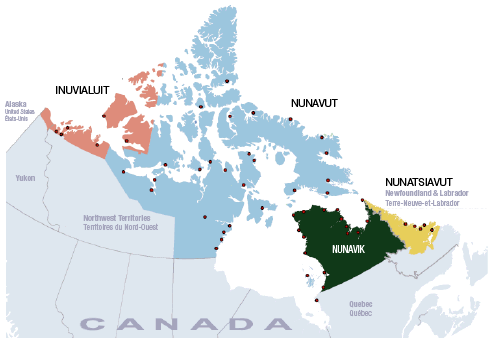
Description for Map 1
This map depicts the four Inuit Regions in Canada: The Inuvialuit Region in the Northwest Territories, the territory of Nunavut, Nunavik in northern Quebec, and Nunatsiavut in northern Labrador.
2.4 Survey content themes
Reflecting a focused thematic approach, the 2017 Aboriginal Peoples Survey collected data falling into six content areas:
- Labour
- Health
- Education
- Skills and training
- Economic well-being
- Aboriginal-specific
These blocks are placed throughout the survey, and contain questions specifically related to Aboriginal people in Canada. A comprehensive description of all the variables available from the survey data is provided in the 2017 APS Data Dictionary.
Labour
The employment component of the 2017 APS is intended to help better understand the current labour market experiences of those aged 15 years and over. It was built on the employment component of the 2012 APS, while accommodating stakeholders’ requests for additional data on this theme. These labour blocks consists of questions about the types of jobs that Aboriginal people hold, the methods they use to find work, barriers as well as their willingness to move to improve their job opportunities.
Health
The 2017 APS Health component is designed to obtain information about the health of Aboriginal people. For example, questions on general health, mental health and community support are asked in this module. These indicators provide for potential analyses of issues related to health care access, physical and mental health status and areas of health risks.
Education
The content for the education component of the 2017 APS focuses primarily on postsecondary education. The education blocks collect information about high school (or its equivalent) completion or reasons for not completing. Information is also gathered about preparedness for post-secondary education, guidance, funding, post-secondary field of study chosen and education that was desired, but not taken. The data allow for in-depth analysis of characteristics of Aboriginal people who are most likely to access and successfully complete postsecondary education; and help better understand the labour market returns to postsecondary education and types of programs that provide the best returns.
Skills and training
The skills component is a new addition for the 2017 APS. This block attempts to gather information related to respondent skill sets and allows them to self-assess their abilities. The questions also ask about training that they have taken, and whether anything is limiting them in their job.
Economic well-being
Questions asking if the respondent’s household is capable of meeting basic needs are a new addition to the 2017 APS, which were intended to measure financial security. Continued inclusion of questions measuring food security, housing and income will allow for ongoing tracking of economic well-being for First Nations people living off reserve, Métis and Inuit.
Aboriginal-specific
Topics such as residential school attendance, Aboriginal languages, other labour activities, sense of belonging, and community involvement were introduced to measure cultural connectedness and sense of belonging to First Nations living off reserve, Métis or Inuit or belonging to Canada. Continued inclusion of questions related to residential school attendance, languages, and other labour activities in the questionnaire will allow for historical compatibility and cross-sectional analysis of Aboriginal-specific variables.
2.5 Questionnaire modules
This section provides a list of the modules on the 2017 APS questionnaire. Appendix A provides a detailed list of the indicators measured in each of these modules. Appendix B lists the extra classification categories created during survey coding. Appendix C describes the standard classifications used to create indicators for open-ended survey questions.
- Demographics
- Aboriginal identification
- Household composition
- Mobility
- Labour
- Labour market activities minimal
- Labour force status
- Multiple employment
- Class of worker
- Incorporated business
- Self-employed
- Job tenure
- Availability for government employment
- Industry
- Occupation
- Usual hours of work
- Part-time employment
- Permanent work
- Job satisfaction
- Looking for work
- Labour market attachment
- Past job attachment
- Labour mobility
- Health
- General health 1
- General mental health
- Pregnancy and childbirth
- Height and weight
- Chronic conditions
- Injuries
- Eating habits
- Smoking
- Alcohol
- Drug use
- Disease screening
- Consultations about mental health
- Suicide
- General health 2
- Disability screening questions
- Education
- Elementary and high school
- Postsecondary education
- Postsecondary credentials
- Current postsecondary attendance
- Some postsecondary education
- Postsecondary preparedness and distance education
- Guidance
- Funding for postsecondary education
- Education not taken
- Skills
- Skills and training
- Information technology
- Economic well-being
- Food security
- Basic needs
- Housing
- Sources of personal income
- Total personal income
- Employment income
- Retirement income
- Aboriginal-specific
- Other labour activities
- Community involvement
- Sense of belonging
- Residential school
- Aboriginal language
2.6 Linked content from the 2016 Census of Population
The APS is a postcensal survey, with its sample drawn from Aboriginal census respondents. In 2001, 2006 and 2012, APS data were linked with each corresponding Census of Population (or National Household Survey). For 2017, the APS sample was drawn from 2016 Census of Population respondents and the final APS microdata file was linked with the 2016 Census of Population Dissemination Database.
The benefits of an APS-census record linkage are reduced response burden for the target population of the APS; the establishment of survey weights, which are crucial to providing valid estimates; and the creation of a comprehensive microdata file, which can be used by data analysts to extend their learning and to inform policy and program development for Aboriginal Peoples in Canada. Together, data from the two sources will provide a detailed statistical portrait of First Nations people living off reserve, Métis and Inuit in Canada. These data are not available from any other source.
At the time of data collection, all census respondents were informed that the information they provided might be used to support other Statistics Canada surveys. Specifically, the message on the cover of the 2016 Census questionnaire stated: “The data may also be used by Statistics Canada for other statistical and research purposes or be combined with other survey or administrative data sources.” As well, at the outset of the 2017 APS survey interview, respondents were told about the purpose of the survey, its voluntary nature and that:
“In order to reduce the number of questions, Statistics Canada plans to combine information collected during the 2016 Census of Population with the information you provide in this interview. We may also add information from other surveys or administrative data sources. All information will be kept confidential and used for statistical purposes only.”
As a note, respondents can choose not to have their data linked from the APS to other surveys or administrative data sources. All products containing linked data are disseminated in accordance with Statistics Canada’s policies, guidelines and standards. Only aggregate statistical estimates that conform to the confidentially provisions of the Statistics Act can be released outside of Statistics Canada. All data requests for APS tabulations are screened for confidentiality and the aggregate data are rounded before being released to clients.
More than 200 variables from the 2016 Census were linked to the final 2017 APS file. The list below indicates the type of census variables that have been appended to the APS analytical file. It is important to note that these census variables, having been obtained from the 2016 Census responses for 2017 APS respondents, refer to each respondent’s situation on the Census reference day, that is, as of May 10, 2016. Users should be aware that in some cases, the respondent may have moved, had a change in the composition of their household, or had a change in employment between the date of the 2016 Census and the date of the APS interview. In other words, some of the information provided by the 2016 Census may not be reflective of the respondent’s situation when the APS interview took place.
A complete list of linked census variables and their accompanying notes are provided in the 2017 APS Data Dictionary which accompanies the APS analytical file.
Household level variables
- Geography - including CMAs, CSDs and health regions
- Housing - including tenure, number of rooms in dwelling and condition of dwelling
- Family - including family status, presence of grandparents and multigenerational status of the household
Person-level variables
- First Nation or Indian band
- Labour - including, class of worker, full- or part-time weeks worked in 2015 and hours worked for pay or in self-employment
- Place of work - including province, census division or CSD
- Mobility - including place of residence 1 and 5 years ago, inter and intra CMA mobility status, and inter and intra provincial mobility status
- Income - including family income, employment income and number of earners
- Language - including first official language spoken, home language, Aboriginal home language and Inuit home language
2.7 Content input from other surveys
The 2017 APS drew on questionnaire content from multiple sources. The 2012 APS was used as a starting point and served as a key source of well-established questions for First Nations people living off reserve, Métis and Inuit. Questions were also drawn from other surveys as much as possible to enhance robustness of the data and to allow for comparability across data sources, where appropriate. Sometimes these questions were modified for a better fit with the APS. In such instances, the data are not directly comparable.
This section outlines the primary sources used for 2017 APS questionnaire development in relation to the main survey themes. It should be noted that these sources do not represent a comprehensive list of all the Statistics Canada surveys that include indicators found on the APS.
Aboriginal identification
- 2012 Aboriginal Peoples Survey (APS), 2006 APS
- 2016 Census of Population
- 2011 National Household Survey (NHS)
Labour
- 2012 APS, 2006 APS
- 2002 Aboriginal Entrepreneurs Survey (AES)
- 2012 Canadian Survey on Disability (CSD)
- 2015 Labour Force Survey (LFS) (October)
- 2014 Longitudinal and International Study of Adults (LISA)
- 2000 Survey of Self-Employment (SSE)
- 2008 Survey of Older Workers (SOW)
Health
- 2012 APS, 2006 APS
- 2009-2011 Canadian Health Measures Survey (CHMS) - Cycle 2
- 2015 Canadian Community Health Survey (CCHS), 2014 CCHS
- 2008 First Nations Regional Health Survey (RHS) (FNIGC)
Education
- 2012 APS, 2006 APS
- 1991 School Leavers Survey (SLS)
- 2006-2007 Youth in Transition Survey (YITS) - Cycle 5, 2008-2009 YITS - Cycle 6
- Class of 2009-2010 National Graduates Survey (NGS)
Skills
- 2012 APS
- 2012 Canadian Internet Use Survey (CIUS)
It is also worth noting that there are four main social surveys at Statistics Canada for which data are available by Aboriginal group: the Census of Population, the Labour Force Survey (LFS), the General Social Survey (GSS) and the Canadian Community Health Survey (CCHS).
- Date modified: