
Methodology of the Canadian Labour Force Survey
Chapter 4 Collection
4.0 Introduction
Since the Labour Force Survey (LFS) is a monthly survey, the data used to produce the various LFS estimates is obtained by contacting the sampled households each month.
The complete LFS operations schedule for a given month involves four different phases (pre-processing, collection, processing and dissemination) which last about four full weeks in total. Therefore, the collection activities must follow a strict timetable established in accordance with the requirements of the other survey processes.
Data collection for the LFS takes place during the week that follows the LFS reference week, which is usually the week containing the fifteenth day of that month. Interviews begin on the Sunday of the collection week and generally continue until Tuesday of the following week. December is an exception: to avoid conducting interviews too close to Christmas, collection is done earlier than in other months. On rare occasions, collection is extended by one day.
A team of roughly 1,300 interviewers is involved each month in collection activities. The data collected by the interviewers is transmitted to head office for processing.
This chapter describes the collection methods used and some specific survey rules related to collection.
4.1 Collection methods
For collection purposes, there are two types of households in the LFS: “births” and “subsequents”. “Births” are households that are in their first month of participation in the survey. They represent about one-sixth of the monthly sample. “Subsequents” are households that are between their second and sixth month of participation in the survey. They represent about five-sixths of the monthly sample. It should be noted that, with respect to collection, births do not always correspond to the first month of survey collection for the dwelling. In the event of a complete change in the household occupants (e.g., due to moving), nonresponse, and/or dwelling vacancy in previous months, a household is still considered a “birth” since it is the first month of response for those occupants.
Since March 2015, LFS interviews are now conducted using three collection methods: computer-assisted personal interviewing (CAPI), computer-assisted telephone interviewing (CATI) and computer-assisted web interviewing (CAWI), also referred to as Electronic Questionnaire (EQ). From March to October 2015, EQ was offered as an option to half of each rotation group. The EQ option is now offered to all eligible respondents beginning in November 2015. The collection method used for a specific case depends on several criteria linked to the type of household (birth or subsequent), the household’s eligibility for EQ and the household respondent’s preferences. Figure 4.1 at the end of this chapter provides a visual depiction of the collection method assignment process.
4.1.1 Collection methods for births
Before 2004, CAPI was used for all households in their first month of the survey, with interviewers visiting in person to conduct the interview.
CATI interviews for births were introduced in 2004 to reduce the collection costs associated with an initial personal interview. This approach, called Telephone First Contact (TFC), uses the Residential Telephone File (RTF)Note 1 to obtain a telephone number for selected households. TFC is used in areas where the information used to create the RTF is updated more regularly and where the dwelling addresses tend to have a standard form, which provides a better match between addresses and telephone numbers.
In 2015, the list of TFC strata was extended and now covers 977 of the 1,153 strata in the ten provinces. Of all households in these strata for which a telephone number is obtained, only about 3,000 (28% of births) are assigned to the CATI call-centers for CATI interviewing. This selection of the ‘most CATI-suitable’ households is based on quality indicators derived from the characteristics of the address of the household and from RTF variables. Fixing the number of households assigned to CATI each month to 3,000 helps the regional offices with respect to planning and resource management.
The TFC approach has also been extended to allow CAPI interviewers to use the landline telephone numbers linked with selected households that were not retained for CATI interviewing. This extension covers both TFC strata and non-TFC strata households. CAPI interviewers may choose, since September 2012, to establish a first contact by telephone. On a monthly basis, a telephone number is provided for about half of the households assigned to CAPI interviewers. Of those, a first contact attempt by telephone is usually made for about 60% of households, and about 25% do not require any CAPI in-person visits.
EQ is not currently available for births as there is currently no administrative list of email addresses available for selected households.
4.1.2 Collection methods for subsequents
At the end of the birth interview, a series of questions is used to determine the household’s eligibility for EQ and the household’s preferred collection method for subsequent months.
In order to be eligible for EQ, a number of conditions must be met. First, the birth interview must be considered complete. Next, the person identified as the best contact person for subsequent months must be the person the interviewer is talking to and the person who provided the information for the birth month for all the members of the household. Fictitious names must not have been provided for any of the household members. Finally, a valid ten-digit telephone number and a complete listing address must also have been recorded.
If all conditions are met, the respondent is asked if he or she would prefer to complete the survey on the internet next month or to have a Statistics Canada interviewer contact him or her directly. If internet is the preferred option, the respondent is asked to provide an email address. If an email address is provided, this household is assigned to EQ for the remaining months.
If not all the conditions are met, or if the respondent refuses to provide an email address, then an offer to proceed with CATI interviewing for next month is made. If the respondent does not have a telephone number or indicates a preference for in-person visit, then CAPI interviewing takes place the next month.
For households answering by CAPI or CATI for a subsequent month, eligibility for EQ is re-assessed on a monthly basis. If conditions are met, an offer to proceed with EQ for the next month is made. Similarly, for households answering by CAPI for a subsequent month that are not eligible for EQ, an offer to proceed with CATI for the next month is made.
Before the introduction of EQ, about 96% of subsequent interviews were conducted by CATI. With the full implementation of EQ, about 20% of subsequent interviews will be conducted by EQ, about 76% by CATI and the remaining 4% by CAPI.
4.1.3 Collection mode transfers
The LFS has some capacity to transfer a case from one collection mode to another. The following are the four situations that will trigger such a transfer.
- The contact component of the questionnaire is used to verify the address of the household. This is essential to ensure that the household contacted lives in the selected dwelling. If a confirmation is obtained that either the telephone number is invalid or that it does not lead to the selected dwelling, additional sources are searched to find a valid telephone number for the selected dwelling. If a valid number cannot be found, the CATI case will be transferred to a field interviewer who will go to the selected dwelling for CAPI interviewing.
- When a telephone number leads to no contact for two consecutive months, even if the number is not confirmed as invalid, the case will be transferred to a CAPI interviewer for its third month in the survey.
- If the respondent requests a personal interview, CATI cases can be transferred to field interviewers during collection.
- If no response has been received from a household assigned to EQ within the first four days of collection, then the case will be transferred to a CATI interviewer who will use the provided telephone number to attempt to conduct a telephone interview.
4.2 Survey rules related to collection
The LFS has several collection rules to reduce respondent burden and collection costs, while still achieving high response rates and data quality. The most significant ones are listed below.
Responses for household members are usually provided by a single, well-informed member of the household. Responses for household members obtained indirectly from the respondent is called “proxy response”. It is allowed because it would be too time-consuming and costly to make several visits or calls to obtain the information directly from each household member. Approximately 60% of the data in the LFS is obtained using this method.
During the birth interview, the interviewer collects socio-demographic and labour force information for all members of the selected household. In subsequent interviews, the interviewer will verify the list of household members, then collect current month labour information. For persons aged 70 years or over, the burden imposed on the respondent is reduced by reusing the responses on labour information provided in the birth interview for subsequent months.
Different types of letters are sent to the selected households to help maintaining a high response rate. For example, when a household is selected for the first time, an introductory letter and information brochure are mailed out prior to the first interview. Refusal letters are also sent out to convince reluctant households to participate.
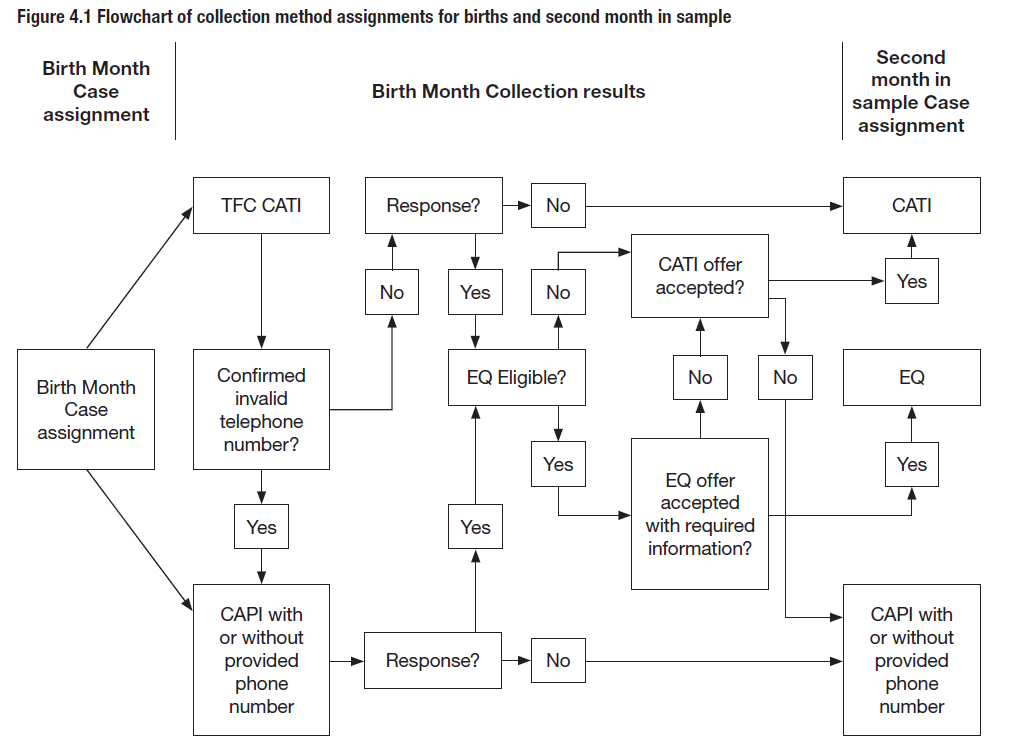
Description for Figure 4.1
This diagram shows the general flow of case assignments to a given collection method for the birth month and for the second month in sample, according to the collection results of the birth month. In the birth month, cases are either assigned to TFC CATI interviewing or CAPI interviewing (with or without a provided telephone number). Once collection starts, if the telephone number associated with a TFC CATI case is confirmed to be not valid, and a valid number cannot be found, the case will be transferred to CAPI interviewing and treated as if it was initially assigned to CAPI. During the first month collection, if a response is not obtained for a given case, the case will be assigned to the same collection method for the second month: that is TFC CATI remains CATI (unless transferred), and CAPI remains CAPI. If a response is obtained, EQ eligibility will be evaluated. The eligible households are offered the option of responding by EQ in the following month and if the offer is accepted, the case will be assigned to EQ for the second month in sample. If the household does not accept the offer or if it is not eligible for EQ, then a CATI offer will be made. Households that accept the CATI offer will be assigned to CATI for the second month in sample and households that do not accept the CATI offer will be assigned to CAPI.
Note
- Date modified: