
Ethnicity, Language and Immigration Thematic Series
Child care services in the minority official language in Canada, 2021 and 2022
Text begins
Key results
Quebec
- In Quebec, in 2022, 14% of children eligible for instruction in English who had ever attended child care in Canada attended English-language, and 39% attended bilingual child care. This latter proportion was higher in the Montréal census metropolitan area (47%).
- Eligible children in Quebec whose parents both spoke English most often at home were more likely to have attended English-language child care (20%) or bilingual child care (49%) than children whose neither parent spoke English most often at home (7% and 22%, respectively).
- In Quebec, 29% of parents of children eligible for instruction in English who attended French-language child care would have preferred their child to attend English-language child care instead. The unavailability of English-language child care was the main reason they used French-language child care (69%E).
- Quebec children eligible for instruction in English who attended English-language child care were more likely to go on to attend an English-language elementary school, including French immersion programs (82%), compared with those who attended bilingual (63%) or French-language child care (48%).
- Among all child care facilities in Quebec in 2022, English was spoken with parents or children by 44% of centre-based providers, 15% of licensed home-based child care providers and 21% of unlicensed home-based providers, most often alongside French. English was the sole language spoken in 1% of centre-based child care facilities and by 2% of licensed and unlicensed home-based child care providers.
- Some child care providers in Quebec had spaces available for full-time enrolment. This was the case for 24% of centre-based child care providers, 10% of licensed home-based child care providers and 10% of unlicensed home-based child care providers. These proportions were higher for centre-based (34%) and licensed home-based (20%) facilities where English was spoken with children or with parents, alone or in combination with other languages.
- In Quebec, 16% of child care workers used English at work at least on a regular basis in 2021. Among child care workers who did not use English at work, 28% could conduct a conversation in English.
Canada outside Quebec
- In Canada outside Quebec, in 2022, 35% of children eligible for instruction in French who attended or had ever attended child care in Canada attended French-language child care, and 12% attended bilingual child care. The proportion of eligible children who attended French-language child care was higher than average in New Brunswick (63%) and in the territory capitals (51%), that is, Whitehorse, Yellowknife and Iqaluit.
- Eligible children in families where both parents (66%) or one parent (57%) spoke French most often at home were about three times more likely to have attended French-language child care than children in families where neither parent spoke French most often at home (20%).
- In Canada outside Quebec, 40% of parents of children eligible for instruction in French who used English-language child care would have preferred their child to attend French-language child care instead. The unavailability of services in French (67%) and the distance to the facility (33%) were the main reasons for using English-language child care.
- In Canada outside Quebec, children eligible for instruction in French who attended French-language child care were more likely to go on to attend a French-language elementary school (93%) than children who attended bilingual (61%) or English-language (30%) child care.
- In child care facilities in Canada outside Quebec in 2022, French was spoken with parents or children by 19% of centre-based providers, 6% of licensed home-based providers and 8% of unlicensed home-based providers, most often alongside English. French was the sole language spoken in 2% of centre-based child care facilities and by 1% of home-based child care providers. In New Brunswick, French was the only language spoken by 23% of child care providers.
- In Canada outside Quebec, child care providers where French was spoken were less likely to have available spaces (41% in centre-based facilities and 24% in licensed home-based providers) compared with the average (46% and 39%, respectively).
- In Canada outside Quebec in 2021, 6% of child care workers used French at least on a regular basis at work. Among child care workers who did not use French at work, 5% could conduct a conversation in the language.
Acknowledgments
This report was made possible through the expertise and guidance of numerous teams and individuals, including current and former Statistics Canada staff. The authors would like to thank every one of them, especially Dominique Pépin-Filion, Martin Turcotte, Éric Caron-Malenfant, Laurent Martel, Daniel Pereira, Daphne Fernandes, Foungatrigue-Siramane Coulibaly, Ekin Sun Kiziltan, Leanne Findlay, Katarina Canaj and Shivani Sood. Special thanks are also extended to all members of the Language Statistics team for their ongoing support and encouragement throughout this project.
1 Introduction
In Canada, participation in child care is common among preschool-aged children. In fact, in 2023, over half (56%) of children aged 5 years and younger participated in child
The Government of Canada’s Action Plan for Official Languages 2023–2028 commits to investing in the development of early child care services, with a particular emphasis on French-language services in Canada outside Quebec. Central to the action plan is the promotion of an “educational continuum,” which aims to support learners in minority official language settings from early childhood through postsecondary education. Moreover, the Government of Canada is investing in the professional training of child care workers in French-language minority
From 2001 to 2016, the number of child care workers who primarily used a minority official language at work increased faster than the number of children likely to attend minority official language child care in both Quebec and the rest of Canada, meaning the overall availability of minority official language child care likely improved during that
This study uses three distinct data sources to present various aspects of minority official language child care services in Canada. The 2022 Survey on the Official Language Minority Population (SOLMP) provides insights into participation in minority official language child care services among children who are eligible for instruction in the minority official language, and on the educational trajectory of these children from child care to elementary school. The 2022 Canadian Survey on the Provision of Child Care Services provides information on the use of official languages within child care facilities. Lastly, the 2021 Census of Population is used to describe the use of official languages by child care workers. For additional information on these sources of data, see the box entitled “Data sources and methods.”
Start of text box
Data sources and methods
The 2022 Survey on the Official Language Minority Population
The Survey on the Official Language Minority Population (SOLMP) is a postcensal survey conducted among the English-speaking population in Quebec and the French-speaking population elsewhere in Canada. The survey covers a wealth of topics, including participation in child care by language and the language characteristics of children and their families.
In this study, results are presented for children aged 1 to 17 years who are eligible for instruction in the minority official language pursuant to Section 23 of the Canadian Charter of Rights and Freedoms, that is, eligible for elementary or secondary instruction in English in
This study includes current and past participation in child care in Canada. Therefore, enrolment in a child care facility may be current at the time of the survey or may have been prior to the survey. Complete details on the target population of this survey and its content can be found in the SOLMP user guide.
The 2022 Canadian Survey on the Provision of Child Care Services
The Canadian Survey on the Provision of Child Care Services (CSPCCS) was conducted among child care facilities in Canada, including centre-based child
To have a reference period similar to that of other data sources presented in this report, the section about this topic is based on the results of the 2022
The 2021 Census of Population
The Census of Population has information on workers aged 15 years and older who were employed in the child care sector during the 2021 Census reference week, based on their usual place of
In this study, workers in the child care sector include those whose occupation was early childhood educators and assistants or home child care providers, according to the 2021 National Occupational Classification, and who worked in child day-care services, based on the 2017 North American Industry Classification System.
The impact of the COVID-19 pandemic
The census and survey data used in this study were collected during the COVID-19 pandemic. Pandemic-related restrictions impacted the child care sector and demand for these services, with child care establishment closures and an increased prevalence of work from home. Although the potential influence of these challenges on the results of this study cannot be dismissed, these issues are not directly addressed in this study.
End of text box
2 Participation in child care services among children who are eligible for instruction in the minority official language
The use of minority official language child care services may be influenced by various factors, such as service availability, proximity, affordability, parental language preferences and other personal or practical considerations. Although eligibility for instruction in the minority official language criteria do not apply to child care services, this study focuses on eligible children to examine the continuity of educational pathways in the official languages from child care to elementary school. First results from the 2022
In Quebec, in 2021, 304,000 children were eligible for instruction in English, accounting for 18.1% of the population younger than
In Canada outside Quebec, in 2021, 593,000 children younger than 18 were eligible for instruction in French, accounting for 11% of this
Children eligible for instruction in French in the territorial capitals (Whitehorse, Yellowknife and Iqaluit) were more likely to attend or have attended French-language child care (51%) but were less likely to have attended bilingual child care (4%), compared with the Canadian average (outside Quebec). The provinces with the lowest rates of eligible children who attended or had attended French-language child care were Newfoundland and Labrador (16%), Alberta (17%), and British Columbia (13%).
Although results for Ontario are not significantly different from those of Canada outside Quebec overall, there are notable differences within the province. For instance, children eligible for instruction in French were more likely to have attended French-language child care in southeastern
More results on the participation of eligible children in French-language, English-language or bilingual child care by region are available in the appendix.
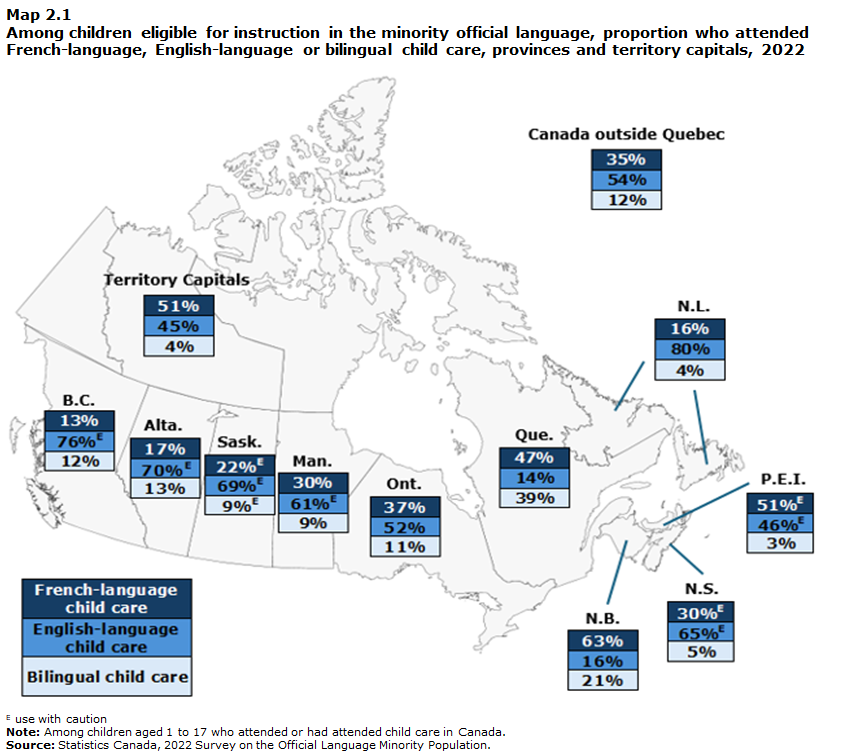
Description for Map 2.1
The title of the map is “Among children eligible for instruction in the minority official language, proportion who attended French-language, English-language or bilingual child care, provinces and territory capitals, 2022.”
This is a map of Canada featuring the provinces and territory capitals and showing the proportion of children aged 1 to 18 who were eligible for instruction in the minority official language and who attended or had attended English-language, French-language or bilingual child care in 2022.
Among children eligible for instruction in English in Quebec, 47% attended French-language child care, 14% attended English-language child care and 39% attended bilingual child care.
Among children eligible for instruction in French in Canada outside Quebec, 35% attended French-language child care, 54% attended English-language child care and 12% attended bilingual child care.
Among children eligible for instruction in French in Newfoundland and Labrador, 16% attended French-language child care, 80% attended English-language child care and 4% attended bilingual child care.
Among children eligible for instruction in French in Prince Edward Island, 51% (use with caution) attended French-language child care, 46% (use with caution) attended English-language child care and 3% attended bilingual child care.
Among children eligible for instruction in French in Nova Scotia, 30% (use with caution) attended French-language child care, 65% (use with caution) attended English-language child care and 5% attended bilingual child care.
Among children eligible for instruction in French in New Brunswick, 63% attended French-language child care, 16% attended English-language child care and 21% attended bilingual child care.
Among children eligible for instruction in French in Ontario, 37% attended French-language child care, 52% attended English-language child care and 11% attended bilingual child care.
Among children eligible for instruction in French in Manitoba, 30% attended French-language child care, 61% (use with caution) attended English-language child care and 9% attended bilingual child care.
Among children eligible for instruction in French in Saskatchewan, 22% (use with caution) attended French-language child care, 69% (use with caution) attended English-language child care and 9% (use with caution) attended bilingual child care.
Among children eligible for instruction in French in Alberta, 17% attended French-language child care, 70% (use with caution) attended English-language child care and 13% attended bilingual child care.
Among children eligible for instruction in French in British Columbia, 13% attended French-language child care, 76% (use with caution) attended English-language child care and 12% attended bilingual child care.
Among children eligible for instruction in French in the combined territory capitals (Whitehorse, Yellowknife and Iqaluit), 51% attended French-language child care, 45% attended English-language child care and 4% attended bilingual child care.
Note: Among children aged 1 to 17 who attended or had attended child care in Canada.
Source: Statistics Canada, 2022 Survey on the Official Language Minority Population.
| French-language child care | English-language child care | Bilingual child care | |||||||
|---|---|---|---|---|---|---|---|---|---|
| Percent | 95% confidence interval | Percent | 95% confidence interval | Percent | 95% confidence interval | ||||
| lower bound | upper bound | lower bound | upper bound | lower bound | upper bound | ||||
Source: Statistics Canada, 2022 Survey on the Official Language Minority Population. |
|||||||||
| Quebec | 47 | 43.9 | 49.8 | 14 | 12.7 | 16.4 | 39 | 35.9 | 41.6 |
| Canada outside Quebec | 35 | 32.5 | 36.9 | 54 | 51.1 | 55.8 | 12 | 10.7 | 13.2 |
| Newfoundland and Labrador | 16 | 12.5 | 21.2 | 80 | 74.5 | 84.2 | 4 | 1.9 | 7.6 |
| Prince Edward Island | 51 E use with caution | 43.2 | 59.0 | 46 E use with caution | 38.2 | 54.1 | 3 | 1.5 | 5.1 |
| Nova Scotia | 30 E use with caution | 20.5 | 41.4 | 65 E use with caution | 53.6 | 74.5 | 5 | 3.7 | 7.4 |
| New Brunswick | 63 | 59.5 | 65.8 | 16 | 13.9 | 19.2 | 21 | 17.9 | 23.9 |
| Ontario | 37 | 33.7 | 40.2 | 52 | 48.5 | 55.4 | 11 | 9.6 | 12.8 |
| Manitoba | 30 | 23.5 | 36.3 | 61 E use with caution | 53.6 | 68.1 | 9 | 6.6 | 13.2 |
| Saskatchewan | 22 E use with caution | 16.1 | 30.3 | 69 E use with caution | 58.2 | 77.2 | 9 E use with caution | 3.8 | 20.4 |
| Alberta | 17 | 12.5 | 22.8 | 70 | 62.5 | 77.2 | 13 | 7.9 | 19.4 |
| British Columbia | 13 | 8.6 | 19.0 | 76 E use with caution | 67.7 | 81.9 | 12 | 7.6 | 17.6 |
| Territory capitals | 51 | 45.8 | 56.4 | 45 | 39.3 | 49.9 | 4 | 2.6 | 7.1 |
Parents who speak a minority official language most often at home are more likely to enrol their children in a minority official language
In Quebec, children eligible for instruction in English were more likely to attend bilingual child care (49%) or English-language child care (20%) when both parents spoke English most often at home compared to the average (39% and 14%, respectively). In contrast, eligible children were more likely than average (47%) to attend or have attended French-language child care when only one of their parents (57%) or neither parent (70%) spoke English most often at home.
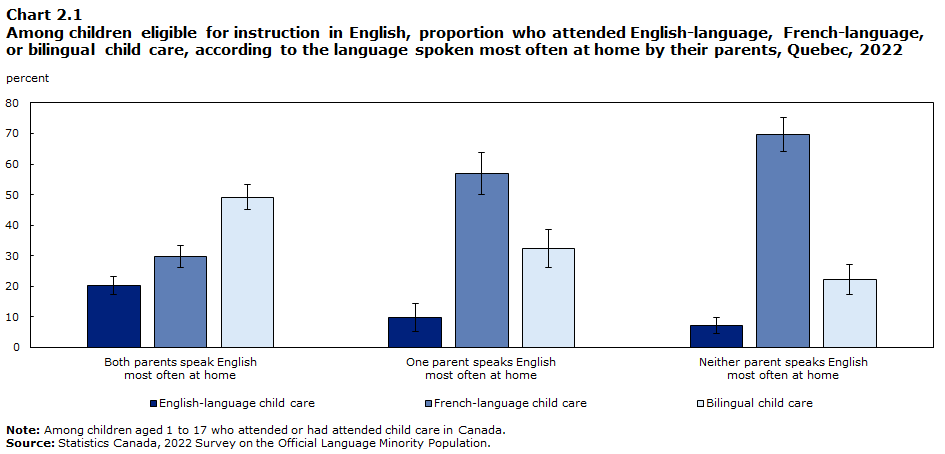
Data table for Chart 2.1
| Both parents speak English most often at home | One parent speaks English most often at home | Neither parent speaks English most often at home | |||||||
|---|---|---|---|---|---|---|---|---|---|
| Percent | 95% confidence interval | Percent | 95% confidence interval | Percent | 95% confidence interval | ||||
| lower bound | upper bound | lower bound | upper bound | lower bound | upper bound | ||||
| Note: Among children aged 1 to 17 who attended or had attended child care in Canada.
Source: Statistics Canada, 2022 Survey on the Official Language Minority Population. |
|||||||||
| English-language child care | 20 | 17.2 | 23.2 | 10 | 5.1 | 14.2 | 7 | 4.5 | 9.8 |
| French-language child care | 30 | 26.1 | 33.5 | 57 | 50.2 | 63.8 | 70 | 64.1 | 75.2 |
| Bilingual child care | 49 | 45.2 | 53.2 | 32 | 26.1 | 38.4 | 22 | 17.2 | 27.3 |
In Canada outside Quebec, children eligible for instruction in French were more likely than average (35%) to attend French-language child care when both their parents (66%) or only one parent (57%) spoke French most often at home. Conversely, over two-thirds of eligible children from families in which neither parent spoke French most often at home attended English-language child care (69%).
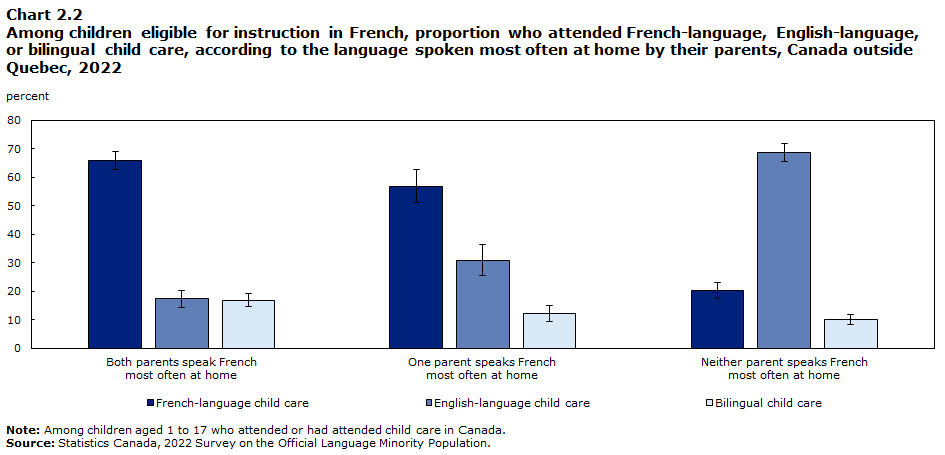
Data table for Chart 2.2
| Both parents speak French most often at home | One parent speaks French most often at home | Neither parent speaks French most often at home | |||||||
|---|---|---|---|---|---|---|---|---|---|
| Percent | 95% confidence interval | Percent | 95% confidence interval | Percent | 95% confidence interval | ||||
| lower bound | upper bound | lower bound | upper bound | lower bound | upper bound | ||||
| Note: Among children aged 1 to 17 who attended or had attended child care in Canada.
Source: Statistics Canada, 2022 Survey on the Official Language Minority Population. |
|||||||||
| French-language child care | 66 | 62.6 | 69.0 | 57 | 51.0 | 62.5 | 20 | 17.6 | 23.1 |
| English-language child care | 17 | 14.4 | 20.2 | 31 | 25.6 | 36.2 | 69 | 65.6 | 71.9 |
| Bilingual child care | 17 | 14.5 | 19.1 | 12 | 9.4 | 15.0 | 10 | 8.4 | 11.8 |
Start of text box
Participation in minority official language child care services among the general population
Children eligible for instruction in the minority official language are not the only ones who attended child care services where the minority official language was used. The 2023 Canadian Survey on Early Learning and Child Care provides information on the languages used in child care services attended by children aged 0 to 5 at the time of the survey, regardless of the linguistic situation of the children and their families.
In Quebec, 18% of children attended a child care
End of text box
3 Reasons for using child care service in a minority official language
The concept of choice in child care services comes with significant limitations because it depends on the availability of child care services that meet parents’ needs. The language spoken most often at home does not solely explain parents’ use of child care in a specific official language. In fact, parents consider multiple factors when making decisions about whether to use a minority official language child care
Among Quebec families in 2022, parents of children eligible for instruction in English were equally likely to use an English-language child care provider because of service availability (42%E), identity (37%E), proximity (35%), English being the only language the child knows (30%) and the perceived quality of child care in English
In Quebec, 29% of parents of children eligible for instruction in English who attended French-language child care would have preferred their child to attend English-language child care instead. Among these parents, the main reason for using French-language child care was that the child care service was not available in English (69%E), followed by distance to the facility (23%).
Outside Quebec, in families where parents of children eligible for instruction in French both spoke French most often at home, identity (68%) was a key reason for using French-language child care. In families where only one parent spoke French most often at home, the importance of receiving services in French was the most frequent reason for using French-language child care (78%), along with identity (64%). In contrast, in families where neither parent spoke French most often at home, the most common reason for using French-language child care was the desire for the child to become bilingual (73%).
In Canada outside Quebec, 40% of parents of children eligible for instruction in French who used English-language child care would have preferred their child to attend French-language child care instead. Among these parents, the main reasons for using English-language child care were the unavailability of services in French (67%) and the distance to the facility (33%).
4 Educational pathways after attending child care in the minority official language
Child care services may be the first step in the continuum of education in the minority official language. However, among eligible school-aged children, is participation in minority official language child care associated with enrolment in minority official language elementary schools?
In Quebec, close to 3 in 5 school-aged children eligible for instruction in English who had started elementary
In Canada outside Quebec, among school-aged children eligible for instruction in French who had started elementary school, more than half (56%) attended a regular French-language program, 14% attended a French immersion program and nearly one-third (30%) attended an English-language program. The vast majority (93%) of eligible children who attended French-language child care continued their schooling in a regular French program at the elementary level. This proportion was significantly lower among eligible children who attended bilingual child care (61%) or English-language child care (30%).
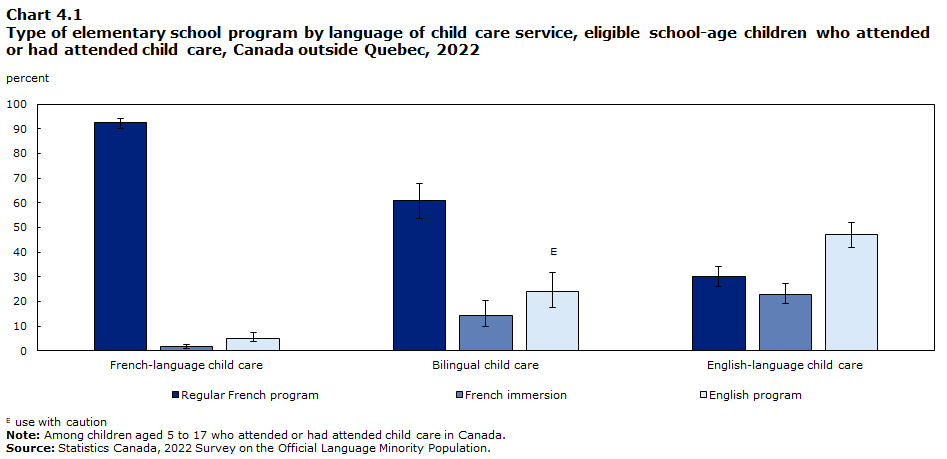
Data table for Chart 4.1
| French-language child care | Bilingual child care | English-language child care | |||||||
|---|---|---|---|---|---|---|---|---|---|
| Percent | 95% confidence interval | Percent | 95% confidence interval | Percent | 95% confidence interval | ||||
| lower bound | upper bound | lower bound | upper bound | lower bound | upper bound | ||||
Source: Statistics Canada, 2022 Survey on the Official Language Minority Population. |
|||||||||
| Regular French program | 93 | 90.9 | 94.9 | 61 | 53.8 | 67.8 | 30 | 26.2 | 34,5 |
| French immersion | 2 | 1.2 | 2.6 | 14 | 9.9 | 20.7 | 23 | 18.8 | 27.1 |
| English program | 5 | 3.4 | 7.3 | 24 E use with caution | 17.7 | 32.0 | 47 | 41.8 | 52.0 |
5 Official languages used by child care providers
The availability of child care services in the minority official language depends on the presence of child care facilities that offer services in that language, among other things. Given this context, the 2022 Canadian Survey on the Provision of Child Care Services collected data on the distribution of centre-based and home-based child care facilities according to the languages spoken with parents or
In Quebec, there were 14,525 child care facilities in 2022, including 3,400 centre-based, 7,634 licensed home-based and 3,490 unlicensed home-based
Some child care providers in Quebec had spaces available for full-time enrolment. This was the case for 24% of centre-based child care providers and 10% of licensed home-based child care providers. These proportions were higher in centre-based (34%) and licensed home-based (20%) facilities where English was spoken with children or with parents alone or in combination with other
In Canada outside Quebec, there were 30,841 child care facilities in 2022, including 10,529 centre-based, 7,291 licensed home-based and 13,022 unlicensed home-based
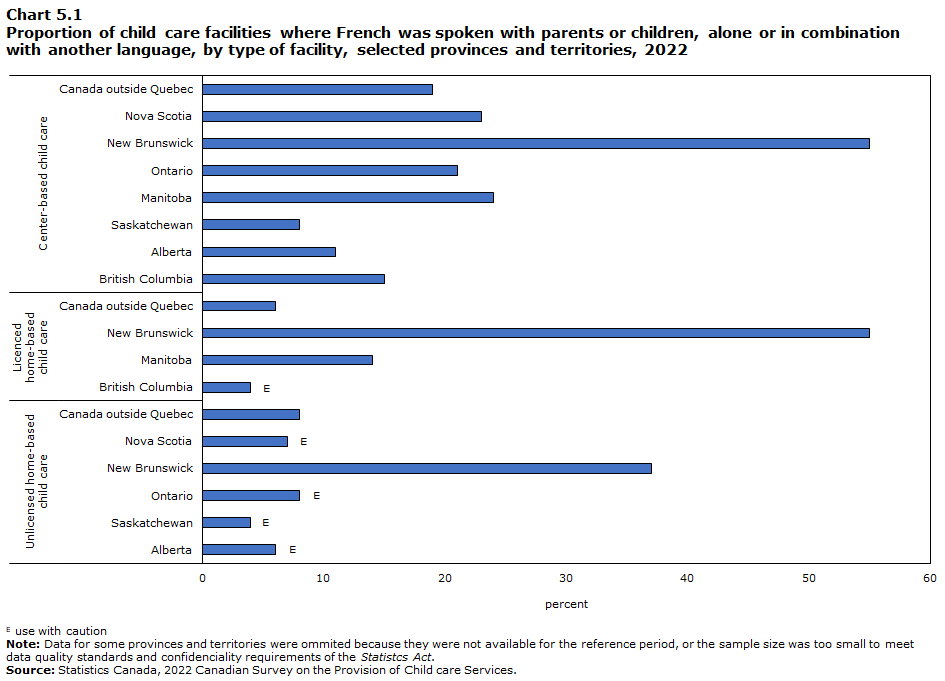
Data table for Chart 5.1
| Center-based child care | Licenced home-based child care | Unlicensed home-based child care | |
|---|---|---|---|
| percent | |||
Source: Statistics Canada, 2022 Canadian Survey on the Provision of Child care Services. |
|||
| Canada outside Quebec | 19 | 6 | 8 |
| Nova Scotia | 23 | F too unreliable to be published | 7 E use with caution |
| New Brunswick | 55 | 55 | 37 |
| Ontario | 21 | F too unreliable to be published | 8 E use with caution |
| Manitoba | 24 | 14 | F too unreliable to be published |
| Saskatchewan | 8 | F too unreliable to be published | 4 E use with caution |
| Alberta | 11 | F too unreliable to be published | 6 E use with caution |
| British Columbia | 15 | 4 E use with caution | F too unreliable to be published |
Outside Quebec, there were spaces available for full-time enrolment in 46% of centre-based child care services, 39% of licensed home-based child care services and 21% of unlicensed home-based child care services. The proportions among facilities that offered services in French exclusively or in combination with other languages were 41% for centre-based, 24% for licensed home-based and 20% for unlicensed home-based providers.
6 Languages used by child care workers
Another aspect of the provision of minority official language child care services is the availability of child care workers who use the language in their workplace. Based on results from the 2021 Census of Population, this section presents a comparative analysis of child care workers who reported using the minority official language at work at least on a regular basis, versus those who did not.
In 2021, there were 170,495 child care workers in Canada. Of these, 1 in 10 (10%) reported that they used the minority official language at least regularly at work.
In Quebec, 16% of the province’s 60,430 child care workers used English at work at least on a regular basis in 2021. More specifically, 7% worked predominantly in English, 3% worked in English and French equally often, and 6% worked predominantly in French and used English as a secondary language. Among Quebec child care workers who did not use English at least on a regular basis at work, 28% could conduct a conversation in English, hinting that they could potentially provide child care services in the minority official language.
Among the 110,060 child care workers in Canada outside Quebec, 6% reported using French at least on a regular basis in their workplace. In particular, 4% worked predominantly in French, 1% worked predominantly in English and used French as a secondary language, and less than half a percent used English and French equally often. The proportion of child care workers who used French at least on a regular basis at work was higher in New Brunswick (34%) than in any other province in Canada outside Quebec.

Description for Map 6.1
The title of the map is “Number and proportion of child care workers who used the minority official language at work at least on a regular basis, provinces and territories, 2021.”
This is a map of Canada featuring the provinces and territories and showing the number and the percentage of child care workers who used the minority official language at work at least on a regular basis in 2021.
In Quebec, 9,670 child care workers used English at work at least regularly, representing 16% of all child care workers in the province.
In Canada outside Quebec, 6,615 child care workers used French at work at least regularly, representing 6% of all child care workers outside Quebec.
In Newfoundland and Labrador, 35 child care workers used French at work at least regularly, representing 2% of all child care workers in the province.
In Prince Edward Island, 45 child care workers used French at work at least regularly, representing 5% of all child care workers in the province.
In Nova Scotia, 160 child care workers used French at work at least regularly, representing 5% of all child care workers in the province.
In New Brunswick, 1,420 child care workers used French at work at least regularly, representing 34% of all child care workers in the province.
In Ontario, 3,695 child care workers used French at work at least regularly, representing 8% of all child care workers in the province.
In Manitoba, 370 child care workers used French at work at least regularly, representing 5% of all child care workers in the province.
In Saskatchewan, 85 child care workers used French at work at least regularly, representing 2% of all child care workers in the province.
In Alberta, 370 child care workers used French at work at least regularly, representing 2% of all child care workers in the province.
In British Columbia, 390 child care workers used French at work at least regularly, representing 2% of all child care workers in the province.
In the combined territories (Yukon, the Northwest Territories and Nunavut), 40 child care workers used French at work at least regularly, representing 7% of all child care workers in the territories.
Source: Statistics Canada, 2021 Census of Population.
| Number | Percent | |
|---|---|---|
| Source: Statistics Canada, 2021 Census of Population. | ||
| Quebec | 9,670 | 16 |
| Canada outside Quebec | 6,615 | 6 |
| Newfoundland and Labrador | 35 | 2 |
| Prince Edward Island | 45 | 5 |
| Nova Scotia | 160 | 5 |
| New Brunswick | 1,420 | 34 |
| Ontario | 3,695 | 8 |
| Manitoba | 370 | 5 |
| Saskatchewan | 85 | 2 |
| Alberta | 370 | 2 |
| British Columbia | 390 | 2 |
| Territories | 40 | 7 |
Outside Quebec, 5% of child care workers who did not use French on a regular basis at work could conduct a conversation in French. Among those who did not use it in the workplace, the provinces with the highest proportion of workers who knew French were New Brunswick (17%) and Prince Edward Island (9%).
In several respects, child care workers who used the minority official language at work had similar characteristics to those who did not, in both Quebec and Canada outside Quebec. For instance, only negligible differences were observed in the distribution of workers by
For example, in Quebec, child care workers aged 15 to 34 years represented 35% of those who used English at least regularly at work and 27% of those who did not. This higher proportion of younger child care workers using English at work may indicate a greater potential for growth in providers able to offer child care services in the minority language. In contrast, workers approaching retirement age (55 to 64) accounted for 13% of those who used English at least regularly at work and 16% of those who did not. These figures may suggest that a larger share of workers who do not provide services in English are nearing retirement.
In Canada outside Quebec, child care workers aged 15 to 34 years accounted for 44% of those who used French at least regularly at work and 39% of those who did not. This difference was not identified among workers aged 55 to 64 years who are approaching retirement age. In line with the previous results, the higher proportion of younger child care workers using the minority language at work may point to a greater potential for growth in providers able to offer child care services in French.
In Quebec, child care workers who used English at work at least regularly were more likely to be immigrants (41%) or to have at least a bachelor’s degree (24%) compared with child care workers who did not use English at work (23% were immigrants and 11% held at least a bachelor’s degree).
In contrast, in Canada outside Quebec, child care workers who used French at work at least on a regular basis were less likely to be immigrants (28%) or to hold at least a bachelor’s degree (16%) compared with those who did not use French at work (33% were immigrants and 25% held at least a bachelor’s degree).
7 Conclusion
Building on previous research that examined trends in minority official language child care availability and
Certain groups of children eligible for instruction in the minority official language were more likely to attend minority official language child care. For example, in Quebec, eligible children whose parents both spoke English most often at home were more likely than average to have attended child care in the minority official language, as were children with at least one parent who primarily spoke French at home in Canada outside Quebec. Outside Quebec, families where neither parent spoke French most often at home often used French-language child care because they wanted their child to become bilingual. When the minority official language is not spoken most often at home, child care can play a key role in fostering knowledge of that language.
Most parents who enrolled their children in a majority language child care setting, despite preferring an official minority language option, did so for practical reasons, primarily the distance to or lack of availability of official minority language services in their area.
Once they entered elementary school, eligible school-age children who had attended minority official language child care were more likely than average to attend a minority official language elementary school. This shows the importance of minority official language child care services as the first step in the educational continuum in that language.
In child care facilities, the minority official language is spoken with parents or children in a higher proportion of centre-based child care services than in licensed or unlicensed home-based services. Unlike home-based settings, child care centres generally have several employees, whose language practices may differ, and may offer a more varied range of programs. Across all types of facilities, the minority official language was the only language spoken with parents or children in a small proportion of child care facilities, both in Quebec and in Canada outside Quebec.
In Quebec, centre-based child care providers and home-based licensed child care facilities offering services in English were more likely than average to have spaces available for full-time enrolment. Conversely, in Canada outside Quebec, centre-based child care providers and home-based licensed child care facilities providing services in French were less likely than average to have full-time spaces available.
The possibility of using a minority official language child care service is in part constrained by the local availability of the service. Some child care workers have knowledge of the minority official language but did not use it at work, hinting at the potential for more child care facilities to provide services in the minority official language where there is demand for it.
This study presents certain limitations that point to opportunities for further research, particularly given the challenges of reconciling results from multiple data sources. For instance, parents and child care providers may hold different views on what constitutes a minority official language child care setting, especially in establishments where both English and French are used with parents or children. It is also important to acknowledge that some parents whose children are not eligible for instruction in the minority official language may prefer enrolling their children in minority official language child care. Furthermore, because any child can attend minority- official language child care, collecting additional data on the linguistic characteristics of all children in these settings would provide a more comprehensive understanding of the population served. In the SOLMP, data on current and past participation in child care services for children aged 1 to 18 may reflect varying contexts depending on the year; however, the data for children aged 1 to 5 were insufficient for an extensive standalone analysis. Finally, although minority official language child care is available in some areas, access may be constrained by factors such as geographic location, limited capacity for specific age groups or other barriers, which fall outside the scope of this report.
Appendix

Data table for Chart A.1
| Quebec | Estrie and southern Quebec | Eastern Quebec | Montréal | Western Quebec | City of Québec and surrounding area | Central Quebec | |||||||||||||||
|---|---|---|---|---|---|---|---|---|---|---|---|---|---|---|---|---|---|---|---|---|---|
| Percent | 95% confidence interval | Percent | 95% confidence interval | Percent | 95% confidence interval | Percent | 95% confidence interval | Percent | 95% confidence interval | Percent | 95% confidence interval | Percent | 95% confidence interval | ||||||||
| lower bound | upper bound | lower bound | upper bound | lower bound | upper bound | lower bound | upper bound | lower bound | upper bound | lower bound | upper bound | lower bound | upper bound | ||||||||
Source: Statistics Canada, 2022 Survey on the Official Language Minority Population. |
|||||||||||||||||||||
| French-language child care | 47 | 43.9 | 49.8 | 60 E use with caution | 51.9 | 67.4 | 76 | 69.8 | 80.7 | 36 | 32.1 | 40.1 | 51 | 44.4 | 57.6 | 86 | 78.1 | 91.0 | 70 E use with caution | 62.2 | 77.4 |
| English-language child care | 14 | 12.7 | 16.4 | 10 | 6.0 | 14.8 | 17 | 12.6 | 22.3 | 17 | 14.3 | 19.8 | 20 | 15.2 | 24.6 | 2 | 1.4 | 4.3 | 7 | 4.1 | 11.0 |
| Bilingual child care | 39 | 35.9 | 41.6 | 31 E use with caution | 23.7 | 38.3 | 7 | 4.8 | 11.3 | 47 | 43.2 | 51.0 | 30 | 24.3 | 35.5 | 12 | 6.8 | 19.8 | 23 E use with caution | 16.3 | 31.1 |
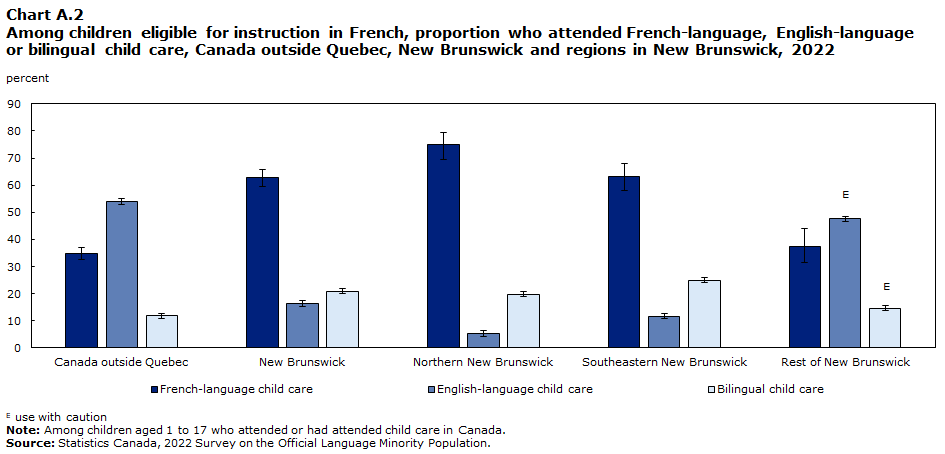
Data table for Chart A.2
| Canada outside Quebec | New Brunswick | Northern New Brunswick | Southeastern New Brunswick | Rest of New Brunswick | |||||||||||
|---|---|---|---|---|---|---|---|---|---|---|---|---|---|---|---|
| Percent | 95% confidence interval | Percent | 95% confidence interval | Percent | 95% confidence interval | Percent | 95% confidence interval | Percent | 95% confidence interval | ||||||
| lower bound | upper bound | lower bound | upper bound | lower bound | upper bound | lower bound | upper bound | lower bound | upper bound | ||||||
Source: Statistics Canada, 2022 Survey on the Official Language Minority Population. |
|||||||||||||||
| French-language child care | 35 | 32.5 | 36.9 | 63 | 59.5 | 65.8 | 75 | 69.6 | 79.5 | 63 | 58.1 | 68.1 | 38 | 31.7 | 44.0 |
| English-language child care | 54 | 51.1 | 55.8 | 16 | 13.9 | 19.2 | 5 | 3.0 | 9.4 | 12 | 8.5 | 16.0 | 48 E use with caution | 40.3 | 55.3 |
| Bilingual child care | 12 | 10.7 | 13.2 | 21 | 17.9 | 23.9 | 20 | 15.6 | 24.9 | 25 | 20.6 | 29.9 | 15 E use with caution | 8.6 | 23.7 |
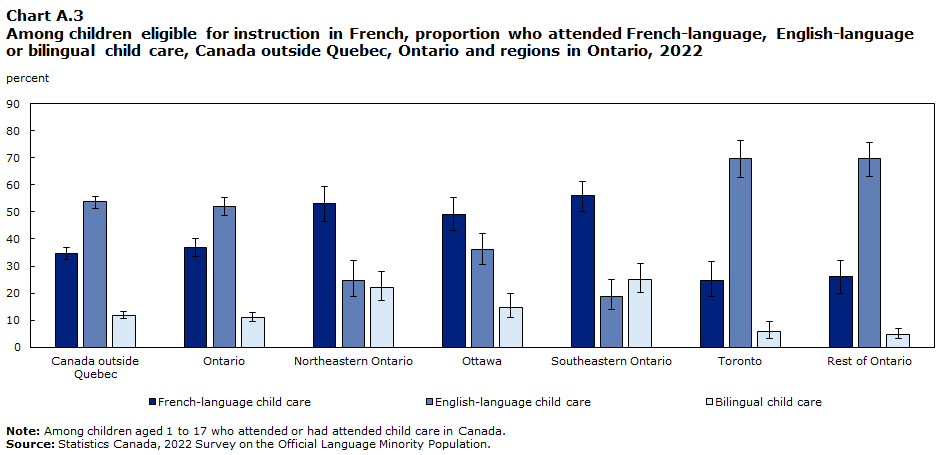
Data table for Chart A.3
| Canada outside Quebec | Ontario | Northeastern Ontario | Ottawa | Southeastern Ontario | Toronto | Rest of Ontario | |||||||||||||||
|---|---|---|---|---|---|---|---|---|---|---|---|---|---|---|---|---|---|---|---|---|---|
| Percent | 95% confidence interval | Percent | 95% confidence interval | Percent | 95% confidence interval | Percent | 95% confidence interval | Percent | 95% confidence interval | Percent | 95% confidence interval | Percent | 95% confidence interval | ||||||||
| lower bound | upper bound | lower bound | upper bound | lower bound | upper bound | lower bound | upper bound | lower bound | upper bound | lower bound | upper bound | lower bound | upper bound | ||||||||
| Note: Among children aged 1 to 17 who attended or had attended child care in Canada.
Source: Statistics Canada, 2022 Survey on the Official Language Minority Population. |
|||||||||||||||||||||
| French-language child care | 35 | 32.5 | 36.9 | 37 | 33.7 | 40.2 | 53 | 46.3 | 59.5 | 49 | 43.2 | 55.1 | 56 | 50.3 | 61.4 | 25 | 18.6 | 31.6 | 26 | 19.8 | 32.1 |
| English-language child care | 54 | 51.1 | 55.8 | 52 | 48.5 | 55.4 | 25 | 18.8 | 32.0 | 36 | 30.5 | 42.0 | 19 | 13.9 | 25.1 | 70 | 62.6 | 76.2 | 70 | 63.1 | 75.7 |
| Bilingual child care | 12 | 10.7 | 13.2 | 11 | 9.6 | 12.8 | 22 | 17.3 | 28.1 | 15 | 10.9 | 19.8 | 25 | 20.3 | 30.8 | 6 | 3.4 | 9.4 | 5 | 3.2 | 7.0 |
- Date modified: