


|
|
| |
Information identified as archived is provided for reference, research or recordkeeping purposes. It is not subject to the Government of Canada Web Standards and has not been altered or updated since it was archived. Please "contact us" to request a format other than those available.
| Analysis of income in Canada
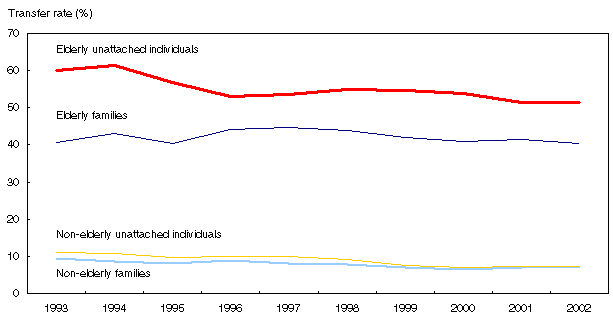
2002 Chapter III : Government transfers Government transfers cover a range of programs. For example, Employment Insurance provides temporary income assistance to those who lose their job or are absent for reasons of illness or the birth of a child. The Canada Pension Plan and the Quebec Pension Plan are the two public pension plans in Canada. Old Age Security, including the Guaranteed Income Supplement, provides financial support to seniors. Child tax benefits and other child credits or allowances are aimed at families with children. Other government transfers include social assistance from provincial and municipal programs, Workers' compensation benefits, the GST/HST Credit and provincial refundable tax credits such as the Quebec and Newfoundland and Labrador sales tax credits. The implicit transfer rate shows the amount received from all these sources as a proportion of total income (before tax). Unless otherwise specified, the average amounts of transfers are calculated for the total population (both recipients and non-recipients); they would be higher if non-recipients were excluded. In addition to what is provided in this chapter, Chapter 4 and Chapter 7 include data on government transfers. Average government transfers were stable in 2002 as compared to 2001 Average government transfers remained relatively constant in 2002. Those paid to all families of two or more people stood at $7,300 while those paid to unattached individuals were $5,300. However, average government transfers to families were 7.6% below the 1996 level of $7,900. The average transfers remained stable for most family types, for example average transfers to all two-parent families with children and to female lone-parent families respectively were both virtually unchanged in 2002 at $4,900 and $8,200 respectively. In contrast, average transfers to two-parent families with two earners grew by 9.8% in 2002 from $4,100 to $4,500. The growth for this group was almost entirely driven by a growth in the amount of Employment Insurance benefits received. Employment insurance benefits had second year of strong growth The number of families receiving Employment Insurance (EI) benefits rose by 8.4% in 2002 after rising 11.2% in 2001. The average EI benefits paid to such families was substantially higher as well: $5,900 in 2002 as compared to $5,500 in 2001 and $5,000 in 2000. This increase brought the average benefits paid back to the 1996 level. As in 2001, part of the increase is attributable to policy changes that became effective December 31st 2000 for persons seeking parental leave: aggregate EI payments for parental leave more than doubled in 2002. This increase was equal to 56% of the change in total benefits that year 1. A second substantial part of the change is most likely due to the higher amount of regular benefits paid out. While the number of unattached individuals receiving EI benefits was relatively stable at 393,000 recipients, the average amount received increased by 27%, from $4,100 in 2001 to $5,200 in 2002. This might be explained by more frequent unemployment spells or spells of longer duration because of the higher average unemployment rate: 7.7% in 2002 as compared to 7.2% in 2001. Transfers were higher for seniors than for people of working age Elderly families received an estimated $20,200, on average, in government transfers in 2002, compared to an average $5,300 for non-elderly families. These amounts can also be expressed as a proportion of total income, called the implicit transfer rate. In 2002, elderly families and elderly unattached individuals received 41% and 51%, respectively, of their total income before tax in the form of transfers, while non-elderly families and non-elderly unattached individuals had corresponding implicit transfer rates of 6.9% and 7.3%. The trend over the past two decades in government transfers to elderly families has been less variable than transfers to non-elderly families. Since most seniors are retired, government transfers to this group are less tied to labour market conditions than transfers to families with children or other people of working age. Two of the main transfers to seniors are the Canada and Quebec pension plan benefits and the Old Age Security Pension, both of which are relatively independent of a person's or family's income level. The Guaranteed Income supplement — the needs-based portion of Old Age Security — provides an additional low-income supplement if necessary. Chart 3.1
The 20% lowest-income families received 30% of government transfers Some, but not all, government transfers are needs-based, meaning they are designed to supplement the incomes of lower-income families and individuals. This is evident in the distribution of transfers over the population when ranked from lowest to highest after-tax income. The share of transfers paid to families in the lowest after-tax income quintile is typically the highest — it was 30% in 2002. The share to the second lowest quintile was the second highest, at 25%, and so on. The families in the highest income quintile received 11.5% of all transfers paid to families. Chart 3.2

Share of transfers to lowest income families was stable In the late 1990s, the share of all government transfers going to families in the lowest income quintile had generally been rising. It rose from 28% in 1996 to a peak of 31% in 2000, and was closer to 30% in 2002. At least some of the change is likely related to changes made to government programs, rather than changes in labour market conditions. Among all recipients of child tax benefits, the average amount each family received from federal and provincial sources rose from an estimated $1,800 on average in 1996 to $2,300 in 2002 — an increase of about 28%. The share of all government transfers going to the highest income quintile inched back up in 2002 to 11.5%, but was still below the 1996 level of 12.1%. Transfers to families with children in the absence of earnings Two-parent families with no earnings for the whole year received on average $16,800 in government transfers in 2002, or 67% of their total income in the form of transfers. Among female lone-parent families without earnings, 86% of their total income came from government transfers; the remainder came mostly from other income, which includes support payments from ex-spouses. Chart 3.3

|

|
|


