
Insights on Canadian Society
Dwelling satisfaction among older adults: Dwelling characteristics and their influence on satisfaction

Skip to text
Text begins
Overview of the study
Housing choices and requirements often shift as individuals approach and enter retirement, based on personal preferences, proximity to services, functional impairments, and financial considerations. These housing needs, coupled with the overall desire of older Canadians to ‘age-in-place’, are increasingly at the forefront of housing discussions at the national, provincial and municipal government levels. Using the 2021 Canadian Housing Survey, this study examines dwelling satisfaction as a key indicator of housing needs for older adults aged 55 years and older. It explores the associations between overall dwelling satisfaction and various dwelling characteristics, including tenure type, dwelling type, and specific dwelling aspects.
- In 2021, about two-thirds (66%) of Canadian households rated their dwelling satisfaction 8 and above on a 0-to-10 scale. Older adults were the most satisfied with their dwellings, with three-quarters (74%) rating their satisfaction as 8 or higher.
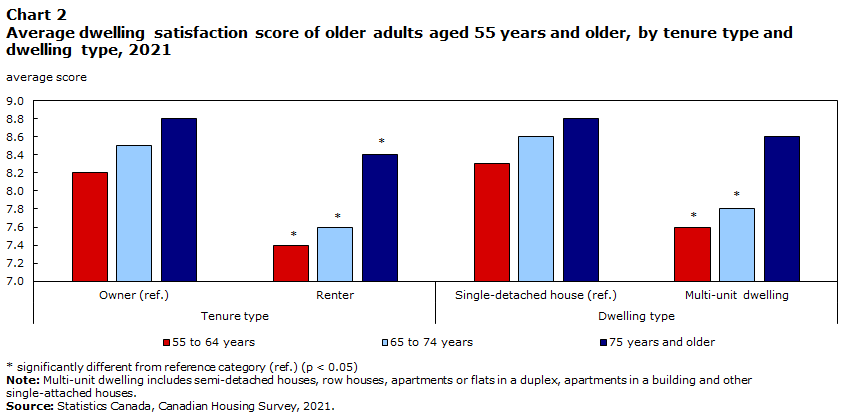
- While homeownership was generally associated with higher levels of dwelling satisfaction among older adults, the owner-renter difference largely disappeared for seniors aged 75 years and older (score of 8.8 versus 8.4).
- The gap in dwelling satisfaction score between dwellers in single-detached houses and multi-unit dwellings also disappeared for the oldest cohort of older adults, with a difference of 0.2 in satisfaction scores for seniors aged 75 years and older, compared to a difference of 0.7 among pre-seniors (aged 55 to 64) and 0.8 among young seniors (aged 65 to 74).
- Overall, older adults who had trouble meeting their financial needs had a lower satisfaction score (7.2 out of 10), compared to their counterparts who had little or no difficulty (8.9 out of 10). This lower level of satisfaction was seen across all age groups of older adults, from pre-seniors, young seniors and oldest seniors.
- Of the ten dwelling aspects included in the survey, older adults aged 55 and older were most satisfied with having enough bedrooms and dwelling security, and were least satisfied with dwelling accessibility.
- When looking at the relative importance of dwelling aspects to overall dwelling satisfaction, housing condition explained the most variation in overall dwelling satisfaction among older adults. Accessibility and having enough bedrooms contributed the least to explaining the variations in overall satisfaction.
Introduction
In Canada, access to adequate housing is considered a fundamental human right, codified in international law and entrenched in the National Housing Strategy Act.Note Throughout the life course, housing needs of individuals and families often change. As people age, their dwelling needs vary in size, quality, affordability, and accessibility, reflecting changes in family structure, employment status, mobility, capabilities and/or health.
In particular, as individuals approach and enter retirement, housing choices and requirements can shift, based on personal preferences (downsizing), proximity to services (health care), functional impairments (housing accessibility), and financial considerations (fixed income and affordability). These housing needs, coupled with the overall desire of older Canadians to ‘age in place’,Note are increasingly at the forefront of housing discussions at the national, provincial and municipal government levels,Note particularly given Canada’s rapidly aging population. In 2021, almost one in five (19%) Canadians were aged 65 years and over.Note The proportion is estimated to increase to 23% in 2043 and 26% in 2068 in a medium-growth scenario.Note
The complexity of older adults’ housing needs is further heightened when considering the broad spectrum of ages and respective accommodation needs. Older adults, defined here as 55 years and older, include “pre-seniors” (aged 55-64), “younger seniors” (aged 65-74), and “older seniors” (aged 75 and over).
This study uses data from the 2021 Canadian Housing Survey (CHS) to examine the dwelling satisfaction of older adults in Canada, acknowledging the full spectrum of ages covered.Note Dwelling satisfaction is a valuable housing indicator to understand individuals’ housing needs, along with other housing outcomes that have been widely used, such as housing affordability, suitability, adequacy, and core housing need. Dwelling satisfaction has been used in previous literature to measure the gap between households’ housing expectations and the reality.Note
The study begins with an overview of dwelling satisfaction among older adults. The latter part of study looks into older adults’ satisfaction with select dwelling aspects included in the CHS. The relative importance of these aspects to the overall dwelling satisfaction is also presented. Since the CHS was conducted in private dwellings, older adults residing in institutions, such as nursing homes and long-term care facilities, are not included.Note
Dwelling satisfaction increases with age
In 2021, Canadian households were generally satisfied with their current dwellings, a finding consistent with earlier studies from the 2018 CHS.Note The average dwelling satisfaction score stood at 7.9 on a 0-to-10 scale, based on responses from those responsible for housing decisions.
Indeed, most Canadian households – two-thirds (66%) – had a dwelling satisfaction score of 8 or above. Another 22% were somewhat satisfied, with scores between 6 and 7, and the remaining 12% had a relatively low level of satisfaction with their dwelling, meaning a rating of 5 and below.
When looking at the age dimension, the share of individuals rating their dwelling satisfaction as 8 or above consistently increases with age. Just over half (55%) of adults under the age of 35 had high levels of satisfaction with their dwelling, increasing to 61% among middle-aged adults aged 35 to 54, and to 74% among adults aged 55 and older (Chart 1).
This proportional distribution mirrors the actual scores, with the average satisfaction score being 8.3 among older adults, higher than the score for middle-aged adults (7.7) and young adults (7.5). Levels of satisfaction are successively higher in the later years of life, going from an average score of 8.0 among pre-seniors, those aged 55 to 64 years old, to a high of 8.7 for the oldest seniors, those 75 years and older.Note

Data table for Chart 1
| Age group | Average | Distribution | ||
|---|---|---|---|---|
| Low satisfaction (0-5) |
Medium satisfaction (6-7) |
High satisfaction (8-10) |
||
| average score | percentage | |||
| Young adults (15-34 years) |
7.5 | 15.5 | 29.6 | 54.9 |
| Middle-aged adults (35-54 years) |
7.7 | 13.2 | 25.5 | 61.4 |
| Older adults (55 years and older) |
8.3 | 9.9 | 15.9 | 74.2 |
| Source: Statistics Canada, Canadian Housing Survey, 2021. | ||||
Unlike the drop in older adults’ life satisfaction during the pandemic, along with decreasing levels of social participation and increasing loneliness, dwelling satisfaction did not substantially change during this period.Note In 2021, 5% of adults aged 55 and older indicated that their dwelling satisfaction decreased during the pandemic, with most (85%) saying their satisfaction remained the same and 10% saying it increased. In comparison, middle-aged adults were twice as likely as older adults to say their dwelling satisfaction dropped (10% versus 5%) and young adults under the age of 35 were three times as likely as older adults to say the same (16%).
Difference between owners’ and renters’ dwelling satisfaction smaller among older seniors
Housing-related dimensions, including tenure type and type of dwelling, can be important considerations in a discussion of dwelling satisfaction. Generally speaking, homeowners have more control over their dwellings and more freedom to renovate and improve housing condition to meet their evolving needs. In terms of dwelling type, single-detached houses generally provide more spaceNote and privacy than multi-unit dwellings.
Homeownership is an important factor in dwelling satisfaction among older adults, though its importance dwindles among older seniors. For pre-seniors (aged 55 to 64), the average dwelling satisfaction score for homeowners stood at 8.2, almost a full point higher than renters (7.4). The same owner-renter gap was seen for young seniors aged 65 to 74 (8.5 versus 7.6) (Chart 2). At age 75 years and older, however, the owner-renter difference diminished to 0.4 (8.8 versus 8.4).
Similarly, the gap in dwelling satisfaction score between dwellers in single-detached houses and multi-unit dwellings was only 0.2 among older seniors aged 75 years and older, smaller than the 0.7 difference among pre-seniors and the 0.8 difference among young seniors.Note
These findings are consistent with previous studiesNote and reflect the unique housing needs of the oldest Canadians. Older seniors are more likely than younger adults to live on fixed incomes and as such, apartments that generally have fewer bedrooms are a more affordable option. Moreover, older seniors’ lower physical activity and long-term health issues may limit their ability to maintain a house they own, such as replacing light bulbs, mowing the lawn and shoveling the driveway. Renting also offers more flexibility for older adults to move. As such, renting and multi-unit dwellings provide additional benefits of affordability and comfort to the oldest population.
Data table for Chart 2
| Age group | Tenure type | Dwelling type | ||
|---|---|---|---|---|
| Owner (ref.) | Renter | Single-detached house (ref.) | Multi-unit dwelling | |
| average score | ||||
| 55 to 64 years | 8.2 | 7.4Note * | 8.3 | 7.6Note * |
| 65 to 74 years | 8.5 | 7.6Note * | 8.6 | 7.8Note * |
| 75 years and older | 8.8 | 8.4Note * | 8.8 | 8.6 |
Source: Statistics Canada, Canadian Housing Survey, 2021. |
||||
Older adults with financial difficulties are less satisfied with their dwellings
For adults living on fixed incomes, it may be difficult to keep up with the rising costs of living, including increases in rent, mortgages, property taxes, and maintenance costs. According to the CHS, 16% of older adults aged 55 and older had difficulty making ends meet, with renters being almost twice as likely as homeowners to financially struggle (25% versus 13%).
Facing financial difficulties often translated into lower levels of dwelling satisfaction. In 2021, older adults who had trouble meeting their financial needs had a satisfaction score of 7.2, compared to 8.9 of their counterparts who had little or no difficulty. The largest difference was observed among young seniors, aged 65 to 74 years old, where the dwelling satisfaction score was 7.1 for those financially struggling versus 8.9 for those with little or no difficulties (Chart 3). Young seniors are more likely to be in the transition period to retirement and the loss of employment income may have affected their ability to handle economic hardship.

Data table for Chart 3
| Age group | Level of difficulty meeting financial needs | ||
|---|---|---|---|
| Easy or very easy (ref.) | Neither difficult nor easy | Difficult or very difficult | |
| average score | |||
| 55 to 64 years | 8.7 | 7.8Note * | 7.1Note * |
| 65 to 74 years | 8.9 | 8.1Note * | 7.1Note * |
| 75 years and older | 9.1 | 8.4Note * | 7.6Note * |
|
|||
Older adults least satisfied with the accessibility of their homes; most satisfied with bedroom number and security
To better understand the drivers of dwelling satisfaction, the study examines the ten dwelling aspects included in the 2021 CHS. These include: overall space, number of bedrooms, affordability, housing condition, soundproofing, accessibility, safety and security, energy efficiency, thermal comfort in winter and in summer. Many of the dwelling features are related to health and well-being which are important to older adults.Note For example, overcrowding due to bedroom shortage can increase infection risk and stress levels and inability to control home temperature may lead to cardiovascular and respiratory diseases.
Among the ten aspects, older adults were most satisfied with having enough bedrooms, as well as the safety and security of their dwelling (Chart 4).Note In particular, 90% of older adults reported being satisfied or very satisfied with having enough bedrooms, identical to the share (90%) who were satisfied with the safety and security of their dwelling. Also topping the list was having enough space in their dwelling (86%). Having a sufficient number of bedrooms and space can reflect living arrangements. In 2021, the most prevalent household structure for older adults was living alone (39%), followed closely by couples (married or common-law) without children (36%).

Data table for Chart 4
| Satisfied or very satisfied | Neither satisfied nor dissatisfied | Dissatisfied or very dissatisfied | |
|---|---|---|---|
| percent | |||
| Accessibility | 49.7 | 31.5 | 18.8 |
| Energy efficiency | 67.8 | 20.4 | 11.8 |
| Soundproofing | 75.4 | 13.8 | 10.8 |
| Affordability | 77.0 | 15.8 | 7.2 |
| Thermal comfort in summer | 77.7 | 13.1 | 9.3 |
| Housing condition | 79.0 | 13.3 | 7.7 |
| Thermal comfort in winter | 80.3 | 10.7 | 9.0 |
| Having enough space | 85.9 | 8.1 | 6.0 |
| Safety and security | 89.7 | 7.8 | 2.5 |
| Having enough bedrooms | 90.3 | 5.5 | 4.2 |
|
Note: Reference persons were asked to select their satisfaction with each dwelling aspect from “very dissatisfied”, “dissatisfied”, “neither dissatisfied nor satisfied”, “satisfied” and “very satisfied”. Source: Statistics Canada, Canadian Housing Survey, 2021. |
|||
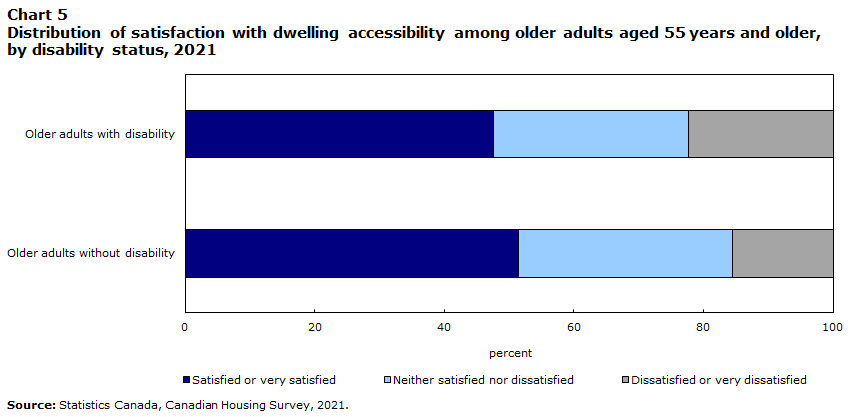
Accessibility, which has been identified as a key component of aging in place, allowing for independence and mobility, ranked lowest in terms of older adults’ satisfaction. Half (50%) of older adults said that they were satisfied or very satisfied that their dwelling was accessible to someone with a physical limitation. A sizable share (32%) were neither satisfied nor dissatisfied and another 19% were dissatisfied or very dissatisfied with their home accessibility. The levels of dissatisfaction were even higher among older adults aged 55 and older with a disability (Chart 5). Almost one-quarter (22%) were dissatisfied, compared to 16% with no disability. The second least satisfying dwelling aspect was energy efficiency, with 68% feeling either satisfied or very satisfied.
Data table for Chart 5
| Disability status | Satisfied or very satisfied | Neither satisfied nor dissatisfied | Dissatisfied or very dissatisfied |
|---|---|---|---|
| percent | |||
| Older adults without disability | 51.5 | 32.9 | 15.6 |
| Older adults with disability | 47.6 | 30.0 | 22.4 |
| Source: Statistics Canada, Canadian Housing Survey, 2021. | |||
Housing condition is the main driver of overall satisfaction
The next section examines the relative importance of dwelling aspects to overall satisfaction. That is, how important are the different dwelling aspects to older adults’ overall satisfaction with their home? In this section, dominance analysis was used to identify how each dwelling aspect explains the variance in the overall satisfaction (See box “Data sources, methods and definitions”).
Together, satisfaction with the ten dwelling aspects contributed to 28.2% of the variance of overall dwelling satisfaction (Table 1). The remaining portion (71.8%) could not be explained by the ten dwelling aspects and relate to other unobserved factors. These factors could be satisfaction with other specific dwelling aspects, such as lighting, number of bathrooms, aesthetic quality, indoor air quality and dwelling layout; personal characteristics; and social and psychological characteristics that are relevant to dwelling satisfaction but not measured by CHS, such as interaction with neighbours and sense of attachment to home.Note
Among the ten dwelling aspects, satisfaction with housing condition was ranked as the most important component, explaining 8.7% of the variance in overall dwelling satisfaction. The importance of housing condition on overall satisfaction is reinforced when looking at the interplay between housing condition and overall dwelling satisfaction. For older adults who were dissatisfied or very dissatisfied with housing condition, their overall dwelling satisfaction was 5.8. This compares to an overall score of 8.7 among older adults who were satisfied or very satisfied with housing condition.
| Satisfaction with... | Relative importance to overall dwelling satisfaction | |
|---|---|---|
| General dominance statistics | Rank | |
| percentage | ||
| Dwelling condition | 8.7 | 1 |
| Energy efficiency | 3.5 | 2 |
| Enough space overall | 3.0 | 3 |
| Blocking regular noise from outside or from neighbours | 2.9 | 4 |
| Comfortable temperature in summer | 2.4 | 5 |
| Comfortable temperature in winter | 2.2 | 6 |
| Affordability | 2.0 | 7 |
| Safety and security | 1.7 | 8 |
| Enough bedrooms | 0.9 | 9 |
| Accessibility to someone with a physical limitation | 0.9 | 9 |
| Overall fit | 28.2 | Note ...: not applicable |
|
... not applicable Source: Statistics Canada, Canadian Housing Survey, 2021. |
||
Some results of the dominance analysis may seem paradoxical. For instance, while energy efficiency had the second lowest levels of satisfaction (68%) among older adults, it stood out as the second most important component to overall dwelling satisfaction. Energy efficiency, which may be related in some ways to housing condition (such as older and leaky windows and doors), accounted for 3.5% of the variance in overall satisfaction. The finding suggests more assistance with energy costs may be needed to increase dwelling satisfaction, including energy bill support or home retrofit programs, such as better insulation, usage of smart thermostat and switch to energy-efficient appliances.
Contrary to the energy efficiency finding, even though having enough bedrooms was the most satisfactory aspect, it was not as important as other dwelling features to overall satisfaction. It accounted for 0.9% of the variance in overall dwelling satisfaction. It is not surprising given the smaller household size in older adults’ household in general.
Another finding is that while accessibility was reported as the lowest satisfactory aspect, its satisfaction was one of the least important components in explaining the variance in dwelling satisfaction (0.9%). In fact, the change in average overall satisfaction score was comparatively small between those who were dissatisfied or very dissatisfied with the accessibility aspect (7.5) and those who reported satisfied or very satisfied (8.6).
Conclusion
As older adults continue to account for an increasingly large portion of the Canadian population, providing housing that accommodates their needs is of greater importance. Dwelling satisfaction is a housing indicator that assesses the gap between households’ housing needs and the housing reality. The subjective measures of housing can be an important complement to other well-researched housing outcomes, such as housing affordability, suitability, adequacy and core housing need.
The study found that Canadian households were generally satisfied with their dwellings. In 2021, the average dwelling satisfaction was 7.9 from a scale of 0 to 10, with 66% households rated their dwelling satisfaction 8 and above. Dwelling satisfaction increased as people aged.
Overall, owners and households living in single-detached houses have a higher dwelling satisfaction than renters and those living in multi-unit dwellings. However, given the evolving housing needs of older adults related to the changes in financial condition and health status, the same cannot be said for older seniors. The difference in dwelling satisfaction between owners and renters diminished when older adults reached aged 75 years and over. The difference between single-detached and multi-unit dwellings followed a similar pattern.
Economic hardship could make it challenging for older adults to find housing that meet their needs. Older adults who had difficulties meeting their financial needs reported lower dwelling satisfaction than those who did not have financial difficulty. The gap persisted through all older age groups.
In terms of satisfaction with the ten dwelling aspects asked in the 2021 CHS, having enough bedrooms and dwelling being secure were the two aspects that older adults were most satisfied with, whereas accessibility was the least satisfactory aspect.
The study contributes to the existing body of research by ranking the relative importance of each of the ten dwelling aspects to the overall dwelling satisfaction. The results showed that satisfaction with housing condition explained the most variance in overall dwelling satisfaction, far ahead of other dwelling aspects. Satisfaction with energy efficiency was the second most important component. In contrast, satisfaction with having enough bedrooms and accessibility contributed the least to the variance in overall dwelling satisfaction.
A large portion of the dwelling satisfaction remain unexplained. Further research should be conducted to better understand these unobserved factors, such as additional physical aspects of the dwellings, the sociodemographic characteristics of the older adults and intangible meanings of home to them. These answers will better help policy makers, urban planners, and other stakeholders to deliver the right type of housing for older adults to age independently and live a high quality of life.
Stephanie Cheng is a research analyst at the Centre for Social Data Insights and Innovation at Statistics Canada.
Start of text box
Data sources, methods and definitions
Data Sources
The paper used the 2021 Canadian Housing Survey (CHS). Sponsored by CMHC, the CHS provides information on how Canadians feel about their housing and how housing affects them.
The target population is the population of Canada's ten provinces and capitals of three territories, excluding residents of institutions, members of the Canadian Forces living in military camps and people living on reserves and other Indigenous settlements.
The CHS asked that the survey be completed by the household member aged 15 years and older with the most knowledge of the household's housing situation. The responses on dwelling satisfaction questions only reflects the subjective assessment of the reference person. Therefore, the results do not represent the satisfaction levels of other members within the same household. Moreover, only the personal characteristics of the reference person are used in the analyses. In the study, household as a unit will be used to present the results on dwelling satisfaction of the reference persons in the household for simplicity.
Reference persons were asked several questions about their satisfaction of the dwelling and the dwelling aspects:
- Using a scale of 0 to 10, where 0 means "Very dissatisfied" and 10 means "Very satisfied, how satisfied are you with your dwelling?
- Compared to before the COVID-19 pandemic, has your satisfaction with your dwelling increased, decreased or remained about the same?
- How satisfied are you with the following aspects of your dwelling? (Very satisfied, satisfied, neither satisfied nor dissatisfied, dissatisfied, very dissatisfied)
- Having enough space overall in your home
- Having enough bedrooms
- Being affordable
- Its condition
- Blocking regular noise from outside or from neighbours
- Being accessible to someone with a physical limitation
- Being safe and secure within the home
- Being energy efficient
- Being able to maintain a comfortable temperature in the winter
- Being able to maintain a comfortable temperature in the summer
Methodology
The study primarily used descriptive statistics to examine the relationships between the sociodemographic, family, housing characteristics and dwelling satisfaction outcomes, including the overall satisfaction and impacts of COVID-19.
Dominance analysis was used to determine the relative importance of satisfaction of the ten dwelling aspects to the overall dwelling satisfaction.Note The dominance analysis package in Stata statistical software was used to conduct the dominance analysis.Note
Prior to dominance analysis, a linear regression model has been run, with satisfaction with the ten dwelling aspects as the independent variables and overall dwelling satisfaction as the dependent variable. Satisfaction with the dwelling aspects were collapsed into three categories: 1 – dissatisfied or very dissatisfied, 2 – neither satisfied nor dissatisfied, 3 – satisfied or very satisfied.
In the linear regression model, survey design method which includes both survey weights and bootstrap weights were applied to make sure point estimates were correctly centered and variability of the point estimates were properly measured. For dominance analysis, since survey design method is not supported by the dominance analysis package, only survey weights were applied.
Dominance analysis estimates a dwelling aspect’s relative importance by determining the incremental R2 contribution of the dwelling aspect to all possible subset models. General dominance statistics, the average of the overall additional contribution of R2, were used to rank the order of relative importance of the ten dwelling aspects.
Compared with linear regression analysis, dominance analysis is a better statistical tool when independent variables are correlated with one another.Note
- Date modified: