
Analysis in Brief
Multinational enterprises in Canada

Archived Content
Information identified as archived is provided for reference, research or recordkeeping purposes. It is not subject to the Government of Canada Web Standards and has not been altered or updated since it was archived. Please "contact us" to request a format other than those available.
by Claire Schaffter and Alexandre Fortier-Labonte
Introduction
Globalization refers to the economic integration between countries as a result of increasing cross-border trade and capital movements.
Multinational enterprises (MNEs) have been drivers of globalization. These enterprises have taken advantage of innovations in logistics and communications technology over the past four decades to diversify their supply chains and expand into new markets.
MNEs are also an important source of investment in innovation, technology and skilled labour in Canada. The involvement of MNEs in these aspects of the Canadian economy was discussed in a prior Statistics Canada studyNote .
This analytical study describes the characteristics of MNEsNote in Canada and abroad, and how their activities in Canada differ from those of Canadian domestic enterprises that do not control businesses outside the country.
The data for the study come from various sources, including Statistics Canada’s 2016Note Annual Financial and Taxation Statistics (AFTS) program. The AFTS collects and aggregates data from the financial statements of all enterprises in Canada.
An indicatorNote that distinguishes MNEs from domestic enterprises in the AFTS data is used in this study to compare size, industry involvement and financial performance for both groups. Data collected by the Canada Revenue Agency (CRA) also provide details about subsidiaries of Canadian enterprises abroad.
MNEs in Canada
At the end of 2016 (see Chart 1), 99.2% of enterprises in Canada were domestic.Note Of these, 0.8% were part of an enterprise group, while 98.5% were Canadian non-group enterprises. Only 0.8% of all enterprises operating in Canada were MNEs. Half of MNEs were Canadian majority-owned, with foreign affiliates (MOFAs) and half were foreign majority- owned, with Canadian affiliates (FMOCAs).
Altough less than 1% of all enterprises were MNEs, they held 67% of all assets in the Canadian economy. MOFAs owned more assets than FMOCAs, with 49% of the total.
Data table for Chart 1
| Type | Enterprise count |
|---|---|
| percent | |
| Canadian enterprises in groups | 0.80 |
| Canadian non-group enterprises | 98.50 |
| FMOCA | 0.40 |
| MOFA | 0.40 |
|
Note: Numbers might not add up to 100% due to rounding. Source: Statistics Canada, author's calculations based on data from the Annual Financial and Taxation Statistics (AFTS). |
|
| Type | Assets share |
|---|---|
| percent | |
| Domestic | 33 |
| Canadian enterprises in groups | 21 |
| Canadian non-group enterprises | 13 |
| MNEs | 67 |
| Foreign majority- owned, with Canadian affiliates | 18 |
| Canadian majority-owned, with foreign affiliates | 49 |
|
Note: Numbers might not add up to 100% due to rounding. Source: Statistics Canada, author's calculations based on data from the Annual Financial and Taxation Statistics (AFTS). |
|
Charts 2 and 3 show the distribution of assets for MNEs and domestic enterprises across industries included in the AFTSNote for 2016.
Most MNE's assets in non-financial industries (Chart 2) were held in manufacturing, distributive trades and extraction, while a higher share of domestic enterprise’s assets were held in real estate and construction. Overall, domestic enterprises owned 83.6% of all assets in construction and 70.7% in real estate. The local knowledge required to operate in both industries could account for high share of assets held by domestic enterprises.

Data table for Chart 2
| Industry | Domestic | MNE |
|---|---|---|
| percent | ||
| Utilities | 8.3 | 9.5 |
| Transportation and warehousing | 5.9 | 10.1 |
| Real estate and rental leasing | 20.8 | 10.3 |
| Other | 27.9 | 18.4 |
| Manufacturing | 6.1 | 39.3 |
| Extraction | 5.8 | 33.4 |
| Distributive trades | 12.8 | 20.0 |
| Construction | 12.4 | 2.8 |
| Source: Statistics Canada, author's calculations based on data from the Annual Financial and Taxation Statistics (AFTS). | ||
Chart 3 shows the distribution of assets across financial industries. MNEs held more assets in depository credit intermediation than domestic enterprises. Generally, large banks have operations abroad while local credit unions do not.
In general, the financial industries were dominated by MNEs, which held 72.1% of total assets (Table 1). The only financial industry with more assets owned by domestic enterprises than MNEs was securities, commodity contracts and other financial Investment and related activities, where domestic enterprises owned 57% of total assets.
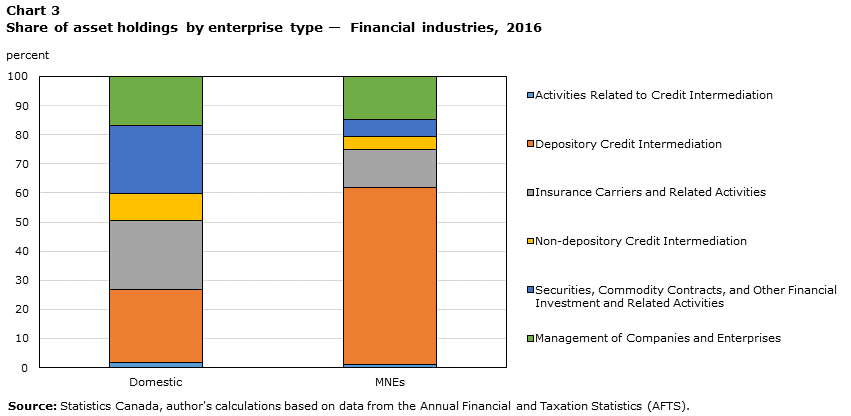
Data table for Chart 3
| Industry | Domestic | MNEs |
|---|---|---|
| percent | ||
| Management of Companies and Enterprises | 17.0 | 14.8 |
| Securities, Commodity Contracts, and Other Financial Investment and Related Activities | 23.1 | 5.9 |
| Non-depository Credit Intermediation | 9.2 | 4.3 |
| Insurance Carriers and Related Activities | 23.9 | 13.1 |
| Depository Credit Intermediation | 25.1 | 60.8 |
| Activities Related to Credit Intermediation | 1.7 | 1.0 |
| Source: Statistics Canada, author's calculations based on data from the Annual Financial and Taxation Statistics (AFTS). | ||
There was also a large discrepancy between the size of MNEs and domestic enterprises in capital intensive industries such as extraction and utilities. In the extraction industry, the medianNote value of assets held by MNEs was $14.4 million, versus $0.16 million for domestic enterprises. In the utilities industry, the median value of assets held by MNEs was $17.34 million, versus $0.29 million for domestic enterprises. Earlier work also showed that MNEs were more likely to operate in large-firm industries with significant economies of scale and capital intensityNote .
| Industry | MNEs’ share of assets | Type | Assets (median) |
|---|---|---|---|
| % | $ millions | ||
| Construction | 18.6 | MNEs | 3.80 |
| domestic enterprises | 0.13 | ||
| Distributive trade | 60.8 | MNEs | 6.90 |
| domestic enterprises | 0.22 | ||
| Extraction | 85.2 | MNEs | 14.40 |
| domestic enterprises | 0.16 | ||
| Finance | 72.8 | MNEs | 3.41 |
| domestic enterprises | 0.57 | ||
| Manufacturing | 86.5 | MNEs | 19.52 |
| domestic enterprises | 0.24 | ||
| Real estate | 33.0 | MNEs | 3.27 |
| domestic enterprises | 0.54 | ||
| Transportation and warehousing | 62.3 | MNEs | 6.43 |
| domestic enterprises | 0.05 | ||
| Utilities | 53.2 | MNEs | 17.34 |
| domestic enterprises | 0.29 | ||
| Source: Source: Statistics Canada, author's calculations based on data from the Annual Financial and Taxation Statistics (AFTS). | |||
MNEs had higher operating revenues for the industries where they owned more assets. Chart 4 displays the proportion of operating revenue generated by MNEs in selected industries.
MNEs in the extraction and manufacturing industries had the highest share of operating revenue of all industries (80.8% and 75.4%, respectively). MNEs in construction and real estate had the lowest share of operating revenue (17.3% and 27.8%, respectively).

Data table for Chart 4
| Industry | MNEs market share |
|---|---|
| percent | |
| Extraction | 81.2 |
| Manufacturing | 76.1 |
| Finance | 66.9 |
| Utilities | 53.4 |
| Transportation and warehousing | 50.2 |
| Distributive | 48.8 |
| Real estate | 27.8 |
| Construction | 17.3 |
| Source: Statistics Canada, author's calculations based on data from the Annual Financial and Taxation Statistics (AFTS). | |
Overall, one in four employees in the Canadian economyNote worked for MNEs in 2016. The employment share of MNEs was the largest for the extraction industry (65.5%) and lowest for construction (12.3%) (Chart 5).

Data table for Chart 5
| Industry | MNEs employment share |
|---|---|
| percent | |
| Extraction | 65.5 |
| Finance | 62.6 |
| Manufacturing | 50.8 |
| Transportation and warehousing | 41.4 |
| Distributive | 37.1 |
| Utilities | 34.4 |
| Real estate | 21.0 |
| Construction | 12.3 |
| Source: Statistics Canada, author's calculations based on data from the Annual Financial and Taxation Statistics (AFTS) and Survey of Employment, Payrolls and Hours (SEPH). | |
MNE affiliates abroad
The United States had the most corporate ownership connections with Canada in 2016.
The United States had more parent enterprises for FMOCAs than any other country (58.3%), followed by the United Kingdom and Germany (Chart 6).
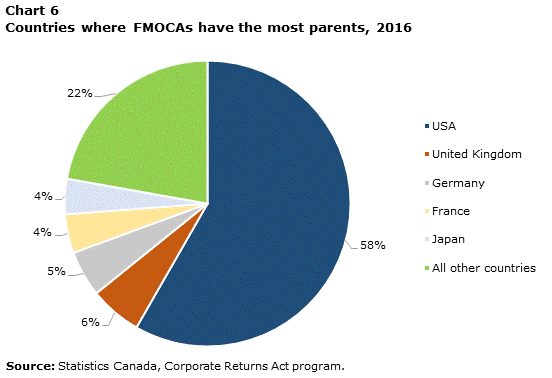
Data table for Chart 6
| Country | Share of foreign parents |
|---|---|
| percent | |
| USA | 58.3 |
| United Kingdom | 5.9 |
| Germany | 5.2 |
| France | 4.4 |
| Japan | 4.0 |
| All other countries | 22.2 |
| Source: Statistics Canada, Corporate Returns Act program. | |
MOFAsNote reported that most of their subsidiaries (49.9%) were located in the United States. The number of subsidiaries located in the United States was nearly seven times higher than the number of subsidiaries located in the United Kingdom, which had the second highest number of subsidiaries (Chart 7).
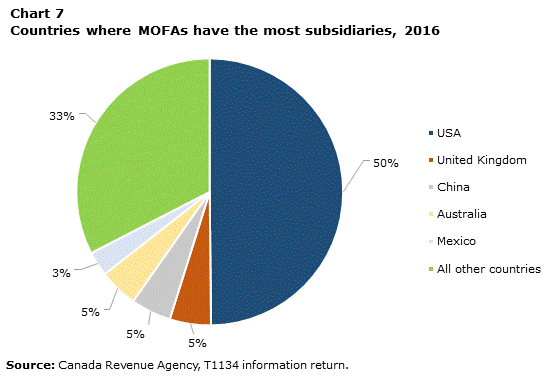
Data table for Chart 7
| Country | Share of subsidiaries |
|---|---|
| percent | |
| USA | 49.9 |
| United Kingdom | 5.0 |
| China | 4.9 |
| Australia | 4.7 |
| Mexico | 3.0 |
| All other countries | 32.6 |
| Source: Canada Revenue Agency, T1134 information return. | |
On average, MOFAs directly controlled subsidiaries in only one other country. However, about 10% of MOFAs controlled subsidiaries in more than four countries in 2016 (Chart 8).

Data table for Chart 8
| Number of countries | Share of countries |
|---|---|
| percent | |
| 2 | 79.7 |
| 3 | 11.2 |
| 4 | 4.3 |
| 5 or more | 4.7 |
| Source: Canada Revenue Agency, T1134 information return. | |
MOFAs had a higher proportion of foreign subsidiaries than Canadian subsidiaries (Chart 9). However, it was most common for a Canadian enterprise without Canadian subsidiaries to control one foreign subsidiary. Over 50% of MOFAs had this simple structure.
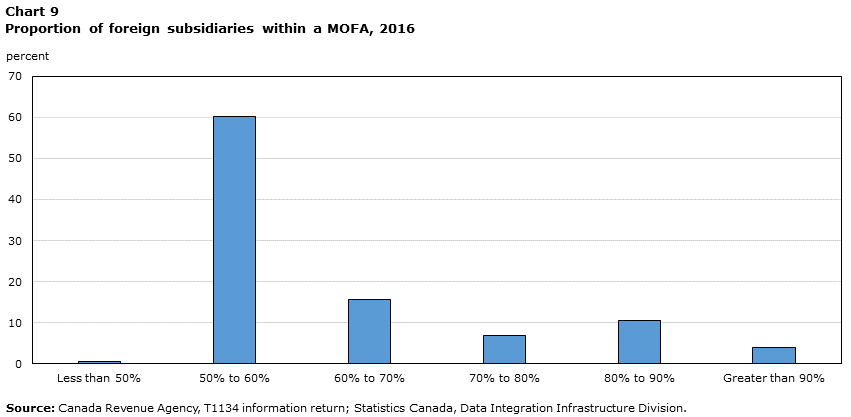
Data table for Chart 9
| Percentage of foreign affiliates | Proportion |
|---|---|
| percent | |
| Less than 50% | 0.5 |
| 50% to 60% | 60.1 |
| 60% to 70% | 15.7 |
| 70% to 80% | 7.0 |
| 80% to 90% | 10.7 |
| Greater than 90% | 4.1 |
| Source: Canada Revenue Agency, T1134 information return; Statistics Canada, Data Integration Infrastructure Division. | |
Most MOFAs operated in more than one industry,Note either in Canada or abroad (Chart 10).
Among enterprises that operated in two industries, the most common pairing was Securities, commodity contracts, and other financial Investment and related activities with Real Estate and Rental and Leasing (7.3%). Oil producers were also involved in mining activities (6.5%), and manufacturers were involved in wholesale trade (5.3%). No other pairings comprised over 5% of the total.
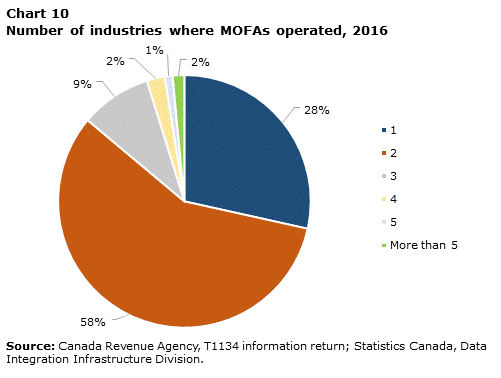
Data table for Chart 10
| Number of industries | Share of enterprises |
|---|---|
| percent | |
| 1 | 28.5 |
| 2 | 57.7 |
| 3 | 9.1 |
| 4 | 2.3 |
| 5 | 1.0 |
| More than 5 | 1.5 |
| Source: Canada Revenue Agency, T1134 information return; Statistics Canada, Data Integration Infrastructure Division. | |
Financial performance
This section compares the profitability, efficiency and leverage of MNEs and domestic enterprises in 2016.Note
The analysis includes only non-financial industries because the selected ratios are better suited for those industries. All ratios have been controlled for enterprise size.
Data table for Chart 11
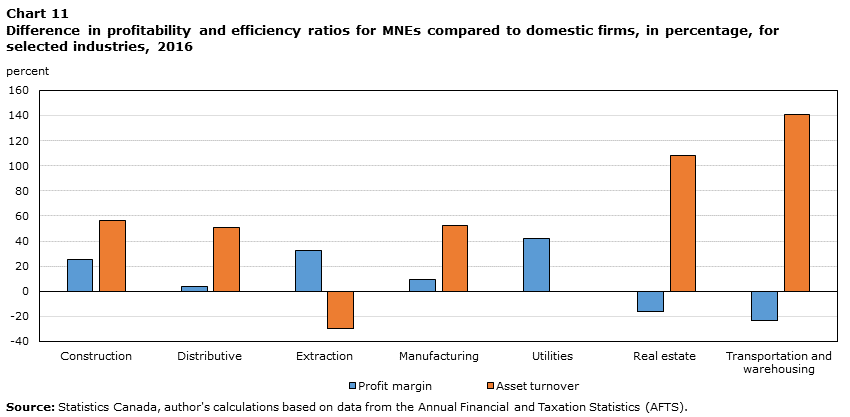
[an error occurred while processing this directive]Chart 11 represents the percentage difference in profit margin and asset turnover ratios between MNEs and domestic firms. A positive difference represents an advantage for MNEs over domestic firms.
Profit margin is an indicator of profitability and measures the before-tax profit on each dollar of sales. Asset turnover is an indicator of efficiency and measures the sales generated per dollar of investment in assets.
In the distributive trade and manufacturing industries, MNEs had a slightly higher profit margin than domestic enterprises (3.7% and 9.2%, respectively). These two industries contain a large number of firms that make up a competitive market. This could explain why MNEs could not attain a high profit margin, as competition puts a downward pressure on their profit margin. However, it seems that MNEs were more profitable in terms of their asset turnover in these industries, since MNEs were able to generate more sales than their domestic enterprise counterparts with the same level of assets.
The Canadian utilities industry can be described as an oligopoly, as there are relatively few enterprises in this industry. Furthermore, there are significant barriers to entry, with high fixed costs required to operate in this industry. This could explain why, of all the industries, the difference in profit margin percentage between MNEs and domestic enterprises in 2016 was at its highest (42.1%). MNEs seemed to use this oligopoly to increase their profit margin. Despite this, MNEs had no efficiency advantage, as there was no difference in asset turnover between MNEs and domestic enterprises.

Data table for Chart 12
| Industry | Debt to equity |
|---|---|
| percent | |
| Construction | 0.0 |
| Distributive | -32.8 |
| Extraction | -39.0 |
| Manufacturing | -19.7 |
| Utilities | 0.0 |
| Real estate | -76.4 |
| Transportation and warehousing | 0.0 |
| Source: Statistics Canada, author's calculations based on data from the Annual Financial and Taxation Statistics (AFTS). | |
The debt-to-equity ratio measures an enterprise’s debt relative to the value of its shareholder equity. It describes the extent to which an enterprise has taken on debt. A high ratio is associated with a high risk, meaning that an enterprise has been aggressive in financing its growth or operations with debt.
The debt-to-equity ratio of MNEs in construction, utilities and transportation and warehousing was the same as domestic enterprises (Chart 12). However, the ratio was lower for MNEs than domestic enterprises in the remaining industries. Since MNEs are larger firms, they are more likely to have access to public equity. This could explain why MNEs financed their operations with less debt.
Conclusion
In 2016, less than one percent of enterprises in Canada were MNEs. Though they were a small share of total enterprises, MNEs had a significant impact on the Canadian economy. These enterprises employed one of four Canadians, and owned 67% of total assets in the financial and non-financial sectors. MNEs also earned more revenue and held more assets than domestic enterprises in nearly every Canadian industry, and, taking into account their size were generally more profitable than domestic enterprises.
The majority of Canadian MNEs affiliates are in the United States, where 58.3% of all parents and 49.9% of all subsidiaries are located.
Appendix A
| North American Industry Classification System (NAICs) codes for 24- level industry classification | Industry groups for Chart 9 | Industry groups for Chart 2 (Financial industries) & Chart 3 (non-financial industries) | Selected industry groups for all other charts |
|---|---|---|---|
| 212 | Mining and Quarrying (except Oil and Gas) | Extraction | Extraction |
| 21C | Oil and Gas Extraction and Support Activities | Extraction | Extraction |
| 22 | Utilities | Utilities | Utilities |
| 23 | Construction | Construction | Construction |
| 31-33 | Manufacturing | Manufacturing | Manufacturing |
| 41 | Wholesale Trade | Distributive trades | Distributive trades |
| 44-45 | Retail Trade | Distributive trades | Distributive trades |
| 48-49 | Transportation and Warehousing | Transportation and Warehousing | Transportation and Warehousing |
| 53 | Real Estate and Rental and Leasing | Real Estate and Rental and Leasing | Real Estate and Rental and Leasing |
| 5221 | Depository Credit Intermediation | Depository Credit Intermediation | Financial industries |
| 5222 | Non-Depository Credit Intermediation | Non-Depository Credit Intermediation | Financial industries |
| 5223 | Activities Related to Credit Intermediation | Activities Related to Credit Intermediation | Financial industries |
| 523 | Securities, Commodity Contracts, and Other Financial Investment and Related Activities | Securities, Commodity Contracts, and Other Financial Investment and Related Activities | Financial industries |
| 524 | Insurance Carriers and Related Actvities | Insurance Carriers and Related Actvities | Financial industries |
| 55 | Management of Companies and Enterprises | Management of Companies and Enterprises | Financial industries |
| 51 | Information and Cultural Industries | Other | N/A |
| 54 | Professional, Scientific and Technical Services | Other | N/A |
| 56 | Administrative and Support, Waste Management and Remediation Services | Other | N/A |
| 61-62 | Educational, Health Care and Social Assistance Services | Other | N/A |
| 71 | Arts, Entertainment and Recreation | Other | N/A |
| 72 | Accommodation and Food Services | Other | N/A |
| 81A | Repair, Maintenance and Personal Services | Other | N/A |
| 11 | Agriculture, Forestry, Fishing and Hunting | Other | N/A |
- Date modified: