
Chart 2
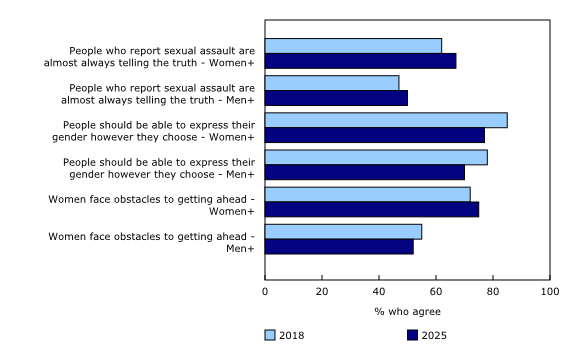
Perceptions of gender-based violence, gender expression and gender equality, by gender, Canada, 2018 and 2025
Note(s):
All differences between estimates for women+ and men+ and between 2018 and 2025 are statistically significant (p < 0.05). Respondents were asked to indicate their level of agreement with these statements. Possible responses were "strongly agree," "agree," "neither agree nor disagree," "disagree," or "strongly disagree." For analysis, answers of "strongly agree" and "agree" were combined and referred to simply as "agree." The category "women+" includes women, as well as some non-binary respondents and some respondents who did not state their gender, while the category "men+" includes men, as well as some non-binary persons and some respondents who did not state their gender. In 2025, responses from respondents who had indicated their gender as non-binary and those who did not state their gender were combined with responses from those who had indicated their gender as women or men, in order to safeguard confidentiality and data quality in line with Statistics Canada standards. To enable trend comparisons with the 2018 survey, the same process was applied retroactively to responses received in 2018. For this reason, proportions for 2018 reported in this chart will not match those in reports published previously. Percent calculations include missing responses.
Source(s):
Survey of Safety in Public and Private Spaces (5256), 2018 and 2025.
Chart description
This is a bar clustered chart.
| 2018 | 2025 | |
|---|---|---|
| People who report sexual assault are almost always telling the truth - Women+ | 62 | 67 |
| People who report sexual assault are almost always telling the truth - Men+ | 47 | 50 |
| People should be able to express their gender however they choose - Women+ | 85 | 77 |
| People should be able to express their gender however they choose - Men+ | 78 | 70 |
| Women face obstacles to getting ahead - Women+ | 72 | 75 |
| Women face obstacles to getting ahead - Men+ | 55 | 52 |
Note(s):
All differences between estimates for women+ and men+ and between 2018 and 2025 are statistically significant (p < 0.05). Respondents were asked to indicate their level of agreement with these statements. Possible responses were "strongly agree," "agree," "neither agree nor disagree," "disagree," or "strongly disagree." For analysis, answers of "strongly agree" and "agree" were combined and referred to simply as "agree." The category "women+" includes women, as well as some non-binary respondents and some respondents who did not state their gender, while the category "men+" includes men, as well as some non-binary persons and some respondents who did not state their gender. In 2025, responses from respondents who had indicated their gender as non-binary and those who did not state their gender were combined with responses from those who had indicated their gender as women or men, in order to safeguard confidentiality and data quality in line with Statistics Canada standards. To enable trend comparisons with the 2018 survey, the same process was applied retroactively to responses received in 2018. For this reason, proportions for 2018 reported in this chart will not match those in reports published previously. Percent calculations include missing responses.
Source(s):
Survey of Safety in Public and Private Spaces (5256), 2018 and 2025.
- Date modified: