
Consumer Price Index, February 2026
Released: 2026-03-16


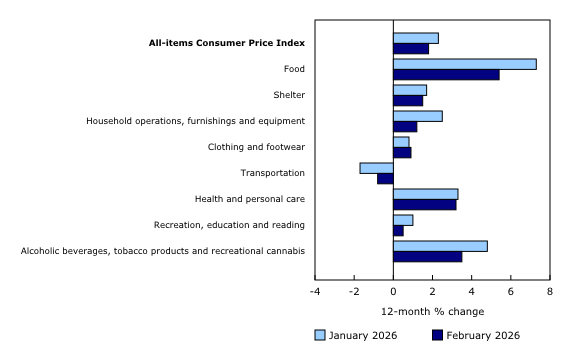
The Consumer Price Index (CPI) rose 1.8% on a year-over-year basis in February, following a 2.3% increase in January.
The slowdown in the all-items CPI on a year-over-year basis was largely driven by a monthly increase in prices in February 2025, when the GST/HST break ended partway through the month, and as a result, consumers paid more for affected products. This month-over-month increase fell out of the 12-month price movement in February 2026, resulting in a decelerating base-year effect on headline inflation.
The most notable index impacted by the base-year effect in February 2026 was food purchased from restaurants, in addition to smaller impacts from alcoholic beverages and toys.
On a year-over-year basis, there was downward pressure in February from a range of indexes including gasoline (-14.2%), natural gas (-17.1%), homeowners' replacement cost (-2.1%), other owned accommodation expenses (-2.6%) and travel tours (-3.1%).
Excluding the effect of indirect taxes, the CPI rose 1.9% year over year in February, decelerating each month since December 2025 (+2.5%).
The CPI was up 0.5% month over month in February 2026. On a seasonally adjusted monthly basis, the CPI increased 0.1%.
Chart 1

The 12-month change in the Consumer Price Index (CPI) and CPI excluding the effect of indirect taxes
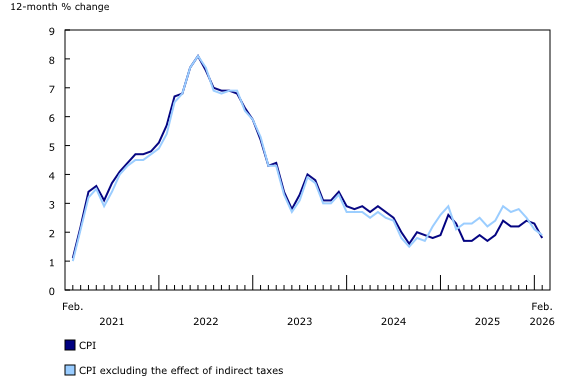
Chart 2
Food prices decelerate most among major components
Downward pressure on growth in Consumer Price Index with GST/HST break ending in February 2025
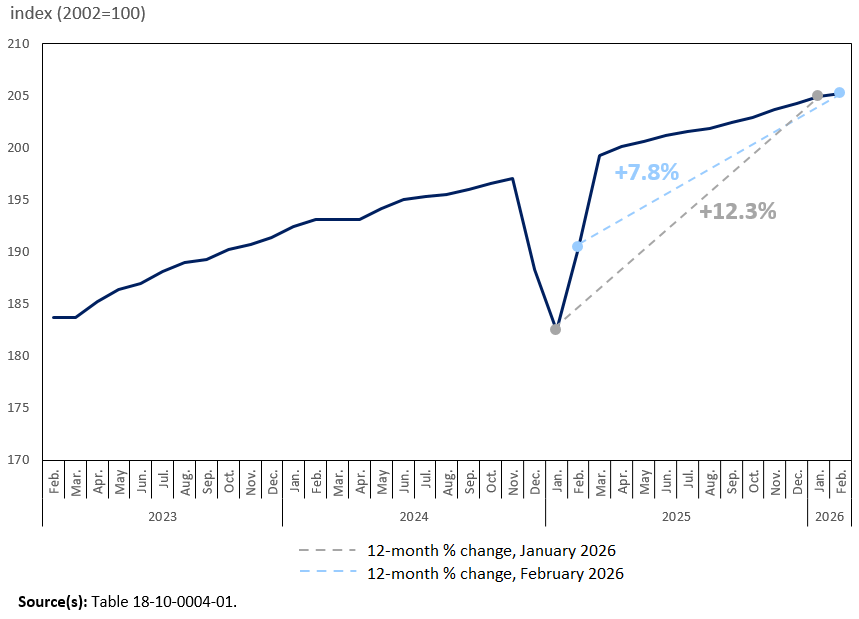
The end of the GST/HST break on February 15, 2025, resulted in monthly price increases for affected products in that month, which put downward pressure on year-over-year price change in February 2026.
Most notably, this affected prices for food purchased from restaurants. Even with this deceleration, prices rose 7.8% year over year in February 2026.
Similarly, this put downward pressure on year-over-year price growth for alcoholic beverages purchased from stores (+5.6%), toys, games (excluding video games) and hobby supplies (+5.4%) and alcoholic beverages served in licensed establishments (+6.8%).
Infographic 1
Deceleration in restaurant prices due to base-year effect from end of tax break
The GST/HST break
The prices included in the Consumer Price Index (CPI) are final prices, inclusive of all excise and other taxes paid by consumers. In particular, prices include the Goods and Services Tax (GST), provincial retail sales taxes (PST) or the Harmonized Sales Tax (HST), as well as any environmental, liquor and tobacco taxes if applicable. This means that the CPI can change as a result of changes in any of these taxes.
The tax exemption began on December 14, 2024, and ended on February 15, 2025, affecting approximately 10% of the CPI basket.
Resulting base-year effect
The headline consumer inflation is measured as the percentage change between the CPI in the current month (February 2026) and the CPI in a base month or the same calendar month of the previous year (February 2025). A base-year effect refers to the impact that price movements from 12 months earlier have on the current month's headline consumer inflation. When a large 1-month upward price change in the base month stops influencing—or falls out of—the 12-month price movement, this has a downward effect on headline CPI in the current month. Conversely, when a large 1-month downward price change in the base month falls out, this creates upward pressure on the current month's 12-month figure.
March 2026 will be the final month affected by a base-year effect due to the GST/HST break.
Broad-based year-over-year deceleration in grocery prices led by beef products
On a year-over-year basis, prices for food purchased from stores rose 4.1% in February following a 4.8% increase in January. While downward pressure was broad-based, the deceleration was modest, and led by prices for fresh or frozen beef, which rose 13.9% in February following an 18.8% increase in January.
Although growth in grocery prices slowed in February, they have risen 30.1% since February 2021.
Slower price growth for cellular services
Cellular service prices rose less year over year in February (+1.5%) than in January (+4.9%). The deceleration was driven by a 3.3% month-over-month decline in February due to lower-priced plans from multiple wireless service providers.
Smaller year-over-year decline in prices for gasoline
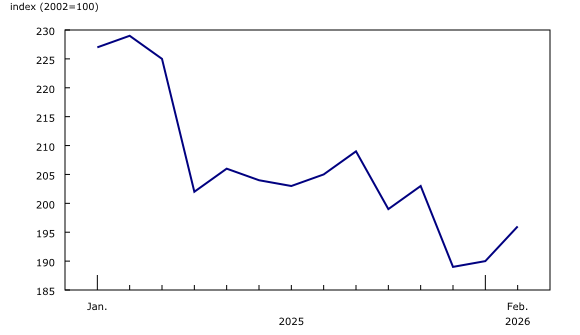
Gasoline prices moderated the slowdown in the CPI, declining 14.2% in February after a 16.7% decline in January. The smaller year-over-year decline was due to a 3.6% monthly increase largely resulting from higher crude oil prices in the lead-up to the conflict in the Middle East, as well as oil supply disruptions in some producer countries.
On a month-over-month basis, consumers paid 9.6% more for gasoline in British Columbia in February, the largest increase among the provinces, primarily due to lower supply amid refinery maintenance and closures in the Pacific Northwest.
Chart 3
Gasoline prices rise month over month and decline year over year
Explore the Consumer Price Index tools
Check out the Personal Inflation Calculator. This interactive calculator allows you to enter dollar amounts in the common expense categories to produce a personalized inflation rate, which you can compare with the official measure of inflation for the average Canadian household—the Consumer Price Index (CPI).
Browse the Consumer Price Index Data Visualization Tool to access current (Latest Snapshot of the CPI) and historical (Price trends: 1914 to today) CPI data in a customizable visual format.
Regional highlights
On an annual basis in February, prices rose at a slower pace in all provinces compared with January. Provinces that have HST, such as Ontario and those in Atlantic Canada, were more impacted by the base-year effect from the 2025 tax break. Conversely, prices in the other provinces where federal and provincial sales taxes are not combined were less impacted, as PST was not included in the tax break.
Chart 4
The Consumer Price Index increases at a slower pace in all provinces

Note to readers
Visit the Consumer Price Index portal to find all Consumer Price Index (CPI) data, publications, interactive tools and announcements highlighting new products and upcoming changes to the CPI in one convenient location.
Real-time data tables
Real-time data table 18-10-0259-01 will be updated on March 30. For more information, consult the document, "Real-time data tables."
Next release
The Consumer Price Index for March will be released on Monday, April 20.
Products
The "Consumer Price Index Data Visualization Tool" is available on the Statistics Canada website.
More information on the concepts and use of the Consumer Price Index (CPI) is available in The Canadian Consumer Price Index Reference Paper (62-553-X).
For information on the history of the CPI in Canada, consult the publication Exploring the first century of Canada's Consumer Price Index (62-604-X).
Two videos, "An Overview of Canada's Consumer Price Index (CPI)" and "The Consumer Price Index (CPI) and Your Experience of Price Change," are available on Statistics Canada's YouTube channel.
The podcast ''Eh Sayers Episode 18 - Why Food Inflation Is Such A Hard Nut To Crack'' is also available.
Find out answers to the most common questions posed about the CPI in the context of the COVID-19 pandemic and beyond.
Contact information
For more information, or to enquire about the concepts, methods or data quality of this release, contact us (toll-free 1-800-263-1136; 514-283-8300; infostats@statcan.gc.ca) or Media Relations (statcan.mediahotline-ligneinfomedias.statcan@statcan.gc.ca).
- Date modified: