
International trade in environmental and clean technology products by origin and destination, 2024
Released: 2026-02-17
Canada exported $20.2 billion of environmental and clean technology (ECT) products in 2024, down 5.2% from 2023. The imports value of ECT products reached $35.8 billion in 2024, up 2.8% from the previous year. In 2024, ECT products accounted for 2.0% of Canada's total imports and 3.5% of its total exports.
The trade deficit in ECT products reached $15.6 billion in 2024, which was substantially larger than the $5.7 billion annual trade deficit for the entire Canadian economy. It was also the largest trade deficit (in absolute value) for ECT products in the last decade. A trade deficit occurs when the total value of a country's exports is less than the total value of its imports.
Looking for more information?
Check out Statistic Canada's data in the Environment Statistics portal and in the International trade in environmental and clean technology products, by trading partner visualization tool.
Chart 1

Canadian trade in environmental and clean technology products by selected regions and countries, 2024

Three-quarters of the environmental and clean technology product exports are destined for the United States
North America was Canada's top trading region in 2024, accounting for 76.2% ($15.4 billion) of all Canadian ECT product exports, almost all of which went to the United States ($15.3 billion). Clean technology products, (primarily composed of manufactured goods) represented 54.6% of ECT exports to the United States, surpassing environmental products (including clean electricity) which accounted for 45.4%.
Clean electricity exports to the United States—Canada's sole export market for electricity—saw an overall decline in 2024 (-26.1%), driven by drought conditions and growing electricity demands within Canada. Among provinces, British Columbia (31.8%), Ontario (28.9%) and Quebec (17.8%) were responsible for the largest shares of clean electricity exports to the United States in 2024. However, clean electricity exports from Quebec (-42.5%), British Columbia (-23.6%) and Ontario (-7.1%) all decreased compared with 2023.
Canada exported $1.8 billion of ECT products to Asia in 2024, or almost one-tenth (9.1%) of all Canadian ECT exports, making Asia Canada's second-largest export market. The largest share of Canadian exports destined for Asia went to China (25.1%; $464.5 million), followed by India (20.2%; $373.3 million). Top ECT exports to China included passenger cars as well as commercial and service industry machinery and equipment. Meanwhile, fans, blowers and air purification instruments, and ammonia and chemical fertilizers were among the top ECT exports to India.
Chart 2
Canadian trade in environmental and clean technology products by province or territory, 2024
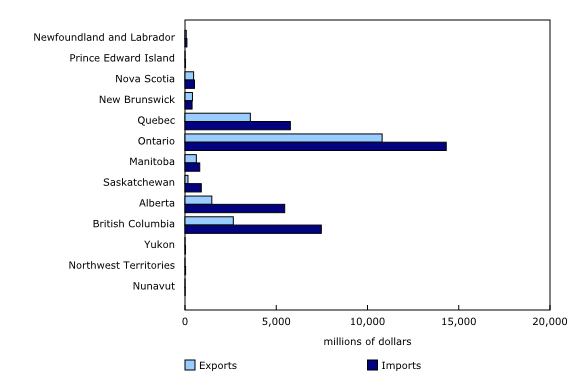
Three-fifths of Canadian environmental and clean technology products are imported from the United States
In 2024, Canada imported $21.5 billion of ECT products from the United States, accounting for three-fifths (60.1%) of all ECT product imports in Canada. Almost two-thirds (64.9%) of these imports were clean technology products, while the remaining share (35.1%) was environmental products (mostly composed of biofuels and primary goods, and waste and scrap goods).
Ontario (39.9%) had the highest share of import value among provinces in 2024, followed by British Columbia (20.8%) and Quebec (16.1%). This pattern differed from the overall economy in 2024, where Ontario led in total imports, followed by Quebec and Alberta.
In 2024, clean technology manufactured goods represented a majority of ECT imports to British Columbia (85.6%), Quebec (75.8%), and Ontario (56.2%). The second most imported product varied by province: biofuels and primary goods in Ontario (25.1%), clean electricity in British Columbia (8.4%), and waste and scrap goods in Quebec (7.5%).
Note to readers
The Environmental and Clean Technology Products Economic Account (ECTPEA) measures the economic contribution of environmental and clean technology (ECT) products in terms of output, gross domestic product, employment (number of jobs) and other economic variables. Estimates are directly comparable with national results for the Canadian economy. The trade estimates released today provide details on the country of origin and destination of the export and import values already released in table 36-10-0629-01.
Estimates for 2023 and 2024 are preliminary and will be revised when updated data become available, including the supply and use tables for those reference years.
ECT products are defined as any process, product or service that reduces environmental impacts through any of the following three strategies:
- environmental protection activities that prevent, reduce or eliminate pollution or any other degradation of the environment;
- resource management activities that result in the more efficient use of natural resources, thus safeguarding against their depletion;
- the use of products that have been adapted to be significantly less energy or resource intensive than the industry standard.
Two broad categories of ECT products are traded: environmental goods and services (including clean electricity, biofuels and primary goods, waste goods, and waste management and remediation services) and clean technology goods and services (including manufactured goods, scientific and research and development services, construction services, and support services). The products follow the Supply and Use Product Classification used in the Canadian System of Macroeconomic Accounts.
As part of the Government of Canada's initiative to develop the Clean Technology Data Strategy, the ECTPEA provides comprehensive measures of the supply and use of environmental and clean technology products in the Canadian economy. The ECTPEA has a broader scope than the Survey of Environmental Goods and Services (SEGS) because it captures all economy-wide transactions in the ECT products sector, including elements such as clean energy and scrap goods. The government and non-profit sectors are also fully covered in the ECTPEA.
The compilation of the ECTPEA draws on a variety of data sources, including Statistics Canada's supply and use tables, detailed import and export statistics released in Canada's balance of international payments, and the SEGS.
Examples of environmental goods and services and clean technologies are available in the publication Clean technologies and the Survey of Environmental Goods and Services: A technical reference guide (16-511-X).
Contact information
For more information, or to enquire about the concepts, methods or data quality of this release, contact us (toll-free 1-800-263-1136; 514-283-8300; infostats@statcan.gc.ca) or Media Relations (statcan.mediahotline-ligneinfomedias.statcan@statcan.gc.ca).
- Date modified: