 |
All
releases > Canadian farm operations >
Canadian farm operations in the 21st century
Farm numbers decline in all provinces
Changing land use practices increase productivity
Farm numbers decline in all provinces
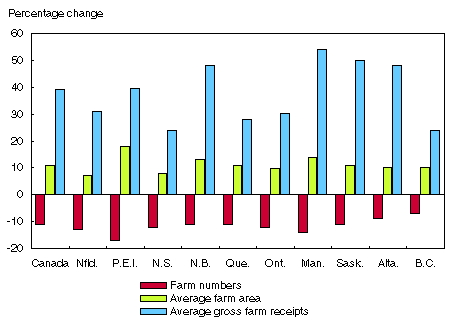
Between 1996 and 2001, the number of farms declined by at least 10% in
all provinces, except for Alberta and British Columbia, which had slower
rates of decline. The decrease represents 29,625 fewer farms across Canada
since 1996.
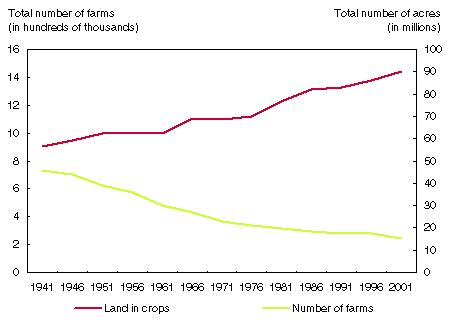
Farm numbers have been falling for the last five decades, reflecting
rapid changes in technology and increasing productivity. The largest-ever
decline was between the 1956 and 1961 Censuses, when farm numbers fell
by 94,116, or 16.4%. Another 15.0% of farms were lost between 1966 and
1971. The rate of decline had slowed between 1991 and 1996.
Provincially, Prince Edward Island had the biggest percentage drop in
farm numbers. Manitoba was second.
| |
2001 |
1996 |
Absolute change |
Percentage change |
|
Canada
|
246,923 |
276,548 |
-29,625 |
-10.7 % |
| Newfoundland and Labrador |
643 |
742 |
-99 |
-13.3% |
| Prince Edward Island |
1,845 |
2,217 |
-372 |
-16.8% |
| Nova Scotia |
3,923 |
4,453 |
-530 |
-11.9% |
| New Brunswick |
3,034 |
3,405 |
-371 |
-10.9% |
| Quebec |
32,139 |
35,991 |
-3,852 |
-10.7% |
| Ontario |
59,728 |
67,520 |
-7,792 |
-11.5% |
| Manitoba |
21,071 |
24,383 |
-3,312 |
-13.6% |
| Saskatchewan |
50,598 |
56,995 |
-6,397 |
-11.2% |
| Alberta |
53,652 |
59,007 |
-5,355 |
-9.1% |
| British Columbia |
20,290 |
21,835 |
-1,545 |
-7.1% |
Seven of every 10 farm operations that had been counted in 1996 remained
in 2001, and three had left agriculture. Yet another 50,000 — or
one-fifth of all farms —were new since 1996. This entry rate of new
farm operations is consistent with longer-term trends.
Prince Edward Island had the largest relative decline in farm numbers
since 1996 and also had the smallest share of new farms of any province.
Just 16.6% of its farms were new since the last census. Farms in P.E.I.
were 18.2% bigger on average since 1996, the largest relative increase
of any province. Prince Edward Island's farms now average 350 acres, compared
with 296 acres in 1996. Manitoba's increase in average farm size was second
largest, at 13.6%. The average farm in Manitoba is now 891 acres compared
with 784 acres in 1996.
British Columbia was at the other end of the spectrum — over one-third
(35.7%) of the farms counted in British Columbia on Census Day were new.
For both crop and livestock farms, particularly hog farms, those who
left agriculture between censuses were smaller in average area or herd
size than those who remained or began their farm business since 1996.
Just under half of farms with less than $25,000 in receipts
that were counted in 1996 had left by 2001. In the larger receipts classes,
one-quarter of farms with receipts between $25,000 and $100,000 had left.
Farms with $250,000 or more in gross farm receipts (at
2000 prices) represented 13.8% of all farms in 2001, double the proportion
in 1991. Their share had more than doubled between 1981 and 1991 as well.
This is the only receipts class to show increases at the Canada level.
Farm numbers down, average gross farm receipts and average farm area
up in all provinces (at 2000 prices) (1996-2001)
Changing land use practices increase productivity
Nationally, farmers reported that they had 89.9 million
acres in crops in 2001, up 4.2% from the previous census. The average
Canadian farm got 11.2% larger, increasing from 608 acres to 676 acres.
Much of the increase in productive cropland is explained
by the 25.2% decline in summerfallow. Land in summerfallow continues to
decline partly because of farmers' increasing use of innovative land practices
such as "no-till seeding" that retain the soil's moisture — reducing
the need to leave land fallow for a year. Summerfallow is mostly a Prairie
practice.
As the number of grazing animals increases, farmers are
reporting more improved pastureland. Unimproved pastureland declined by
half a million acres, some of which would have been converted to improved
pastureland to make it more productive.
Consecutive years of drought have encouraged farmers
to increase pasture and fodder crop area to meet the feed requirements
of their livestock. Improved pasture was up 10.5% in 2001, alfalfa increased
25.2%, and other tame hay was grown on 7.6% more area than it had been
in 1996.
Area under crops rises while number of farms continues to decline
Next page >
|


