
Firearms and intimate partner violence in Canada, 2009 to 2024
by Adam Cotter
Highlights
- In 2024, there were 1,096 victims of police-reported intimate partner violence where a firearm was present during the incident. This represented 0.9% of all victims of intimate partner violence and 10% of all victims of firearm-related violent crime.
- Rates of firearm-related intimate partner violence were fairly stable between 2020 and 2024. However, the average rate from 2020 to 2024 (3.1 per 100,000 population) was 31% higher than the rate from 2015 to 2019 (2.4), and 58% higher than 2010 to 2014 (2.0).
- Since 2009, 85% of victims of firearm-related intimate partner violence have been women and girls aged 12 and older.
- Rifles and shotguns were the most common type of firearm present in firearm-related intimate partner violence each year from 2010 to 2019. Since 2020, handguns have been the most common type. In 2024, 39% of all victims of firearm-related intimate partner violence were involved in a handgun-related incident.
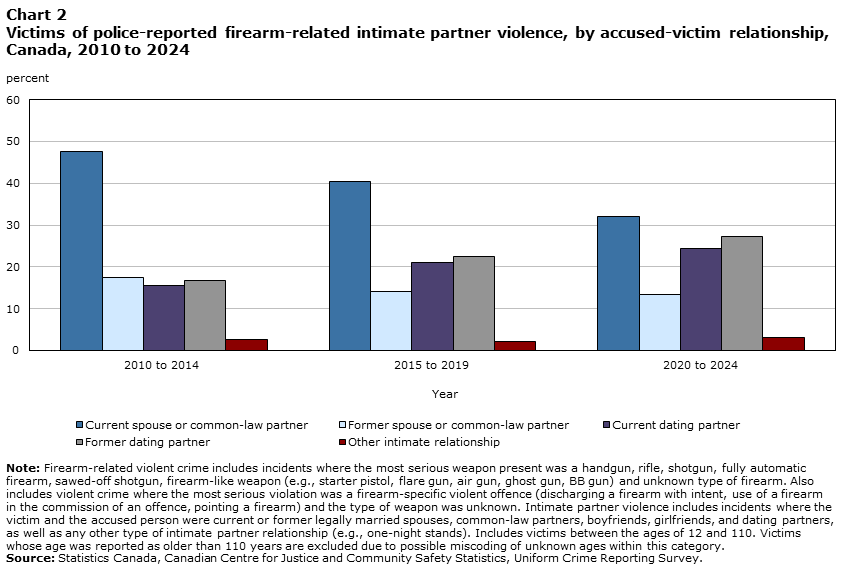
- The accused person was a current or former dating partner for half (51%) of all victims of firearm-related intimate partner violence between 2020 and 2024. In earlier years, current or former legally married or common-law spouses or partners made up a larger proportion of victims: 65% from 2010 to 2014, and 54% from 2015 to 2019.
- Of all persons accused of firearm-related intimate partner violence in 2024, 56% had previously been accused of a violent crime. This was higher than what was seen for those who were accused of intimate partner violence in general.
- Shooting was the cause of death for 294 victims of intimate partner homicide between 2009 and 2024, nine in ten (91%) of whom were women and girls. This represents one in five (22%) intimate partner homicides over this period, an average of 18 deaths per year.
- In just over half (51%) of firearm-related intimate partner homicides since 2009, the accused person subsequently died by suicide. In contrast, the accused person died by suicide in 13% of intimate partner homicides that did not involve firearms, and in 9% of solved firearm homicides that did not involve intimate partner violence.
Police-reported data in Canada have consistently shown that about 3% of all violent crimesNote involve the presence or use of a firearm (Perreault, 2026). A large proportion of victims of firearm-related violent crime are men and boys, who are often victimized by strangers. However, firearms are also present and used in other contexts, such as intimate partner violence (IPV), which disproportionately affects women and girls.
Though most IPV reported by police is not firearm-related, research suggests that the involvement of firearms in IPV is associated with lower levels of perceived safety among victims, increased emotional and psychological violence, and increases the risk of more severe forms of IPV, including homicide (Folkes et al., 2012; Lynch & Jackson, 2021).
Recent amendments to legislation such as the Criminal Code and the Firearms Act have included elements related to the risk of firearm-related IPV. For example, former Bill C-71 expanded background checks for license eligibility to the applicant’s lifetime, as opposed to the past five years (Royal Canadian Mounted Police, 2024). Former Bill C-21 introduced “red flag” laws allowing emergency prohibition orders to remove firearms in instances where there is a safety risk, including instances of self-harm, domestic, and intimate partner violence (Public Safety Canada, 2025). Former Bill C-21 also created provisions which came into force in April 2025, making anyone who has been convicted of an offence involving use, attempts, or threat of violence against a family member or intimate partner ineligible for a firearms licence, and requiring the revocation of a licence if a Chief Firearms Officer has reasonable grounds to suspect the licence holder may have engaged in acts of domestic violence or stalking (Public Safety Canada, 2025).
At the same time, the rise of “ghost guns” or “privately manufactured firearms”—unlawfully manufactured firearms—is a growing safety concern (Royal Canadian Mounted Police, 2023). These firearms are unmarked, untraceable, and untested, meaning that steps taken to address licensing requirements or the capacity to possess firearms in general may not address all forms of firearm-related violence.Note
Using data from the Uniform Crime Reporting (UCR) Survey from 2009 to 2024, this Juristat examines trends in firearm-related IPV, including characteristics of incidents, victims, and accused persons. Data from the Homicide Survey are also included to examine the prevalence and nature of firearm-related intimate partner homicides.Note In some cases, data are grouped into five-year periods (2010 to 2014, 2015 to 2019, and 2020 to 2024) to permit more detailed disaggregation of characteristics over time.
This Juristat was produced with funding support from Public Safety Canada.
Start of text box 1
Text box 1
Key terms and recent trends in intimate partner violence and firearm-related violent crime
This Juristat focuses on a subset of victims of violent crime: those who were victims of firearm-related intimate partner violence (IPV). In order to situate this subset within the broader context of IPV and firearm-related violent crime, some brief highlights and key concepts are presented here.
Intimate partner violence (IPV) refers to all victims of police-reported violent crime where an intimate partner relationship exists between the accused and the victim. This includes current and former legally married spouses, common-law partners, boyfriends, girlfriends, and dating partners, as well as any other type of intimate partner relationship (e.g., one-night stands). All counts, rates, and comparisons are based on victims 12 years of age and older.
In 2024, the rate of IPV was stable compared to the previous year, following several years of gradual increase. Victims of IPV accounted for 28% of all victims of police-reported violent crime. For more information, see Trends in police-reported family violence and intimate partner violence in Canada, 2024 (Statistics Canada, 2025).
It is also important to note that police-reported IPV underestimates the true scope of IPV, as a large proportion is never reported to police (Conroy, 2021). Police-reported data also captures only those incidents that are violations of the Criminal Code, meaning that many emotional, psychological, or economic forms of IPV are not captured.Note
Firearm-related violent crime refers to all incidents and victims where a firearm was present during the commission of the offence, and where police deemed that the firearm was relevant to the offence, regardless of whether it was used (e.g., discharged, used as a threat).Note Note In this article, firearm-related violent crime refers specifically to a count of victims, and does not include incidents of firearm-related violent crime (e.g., shootings) where no specific accused-victim relationship information was provided by police.
In 2024, the rate of firearm-related violent crime was 36.0 per 100,000 population, down from 37.6 in 2023. Consistent with previous years, about 3% of all violent crimes reported by police were firearm-related. For more information, see Firearms and violent crime in Canada, 2024 (Perreault, 2026).
End of text box 1
Firearm-related intimate partner violence accounts for a small proportion of violent crime
In 2024, there were 1,096 victims of police-reported firearm-related intimate partner violence in Canada. This includes incidents where there was a firearm present and relevant to the offence, and where there was an intimate partner relationship between the victim and accused person (see Text box 1).Note This represented a rate of 3.1 victims of firearm-related intimate partner violence (IPV) for every 100,000 population 12 years of age and older (Table 1).
Firearm-related IPV accounted for a relatively small proportion of police-reported violent crime in 2024. For instance, 0.9% of all victims of IPV were victims in an incident involving a firearm. Likewise, for one in ten (10%) victims of firearm-related violent crime, the incident involved IPV.Note
Despite representing a relatively small proportion of firearm-related crime and of IPV in general, firearm-related IPV has nevertheless increased in the past 15 years (Chart 1). While rates have been fairly stable since 2020, the average annual rate from 2020 to 2024 (3.1 per 100,000 population aged 12 and older) was 31% higher than the rate from 2015 to 2019 (2.4), and 58% higher than 2010 to 2014 (2.0) (Table 1).
Chart 1 start

Data table for Chart 1
| Year | Firearm-related intimate partner violence | Total intimate partner violence |
|---|---|---|
| rate per 100,000 population aged 12 years and older | ||
| Note: Firearm-related violent crime includes incidents where the most serious weapon present was a handgun, rifle, shotgun, fully automatic firearm, sawed-off shotgun, firearm-like weapon (e.g., starter pistol, flare gun, air gun, ghost gun, BB gun) and unknown type of firearm. Also includes violent crime where the most serious violation was a firearm-specific violent offence (discharging a firearm with intent, use of a firearm in the commission of an offence, pointing a firearm) and the type of weapon was unknown. Intimate partner violence includes incidents where the victim and the accused person were current or former legally married spouses, common-law partners, boyfriends, girlfriends, and dating partners, as well as any other type of intimate partner relationship (e.g., one-night stands). Includes victims between the ages of 12 and 110. Victims whose age was reported as older than 110 years are excluded due to possible miscoding of unknown ages within this category. Rates are calculated on the basis of 100,000 population. Populations are based on July 1 estimates from Statistics Canada, Centre for Demography.
Source: Statistics Canada, Canadian Centre for Justice and Community Safety Statistics, Uniform Crime Reporting Survey. |
||
| 2010 | 2.0 | 352 |
| 2011 | 2.0 | 333 |
| 2012 | 2.0 | 319 |
| 2013 | 1.8 | 300 |
| 2014 | 2.0 | 291 |
| 2015 | 2.1 | 297 |
| 2016 | 2.3 | 299 |
| 2017 | 2.4 | 304 |
| 2018 | 2.4 | 311 |
| 2019 | 2.7 | 332 |
| 2020 | 3.0 | 338 |
| 2021 | 3.2 | 346 |
| 2022 | 3.1 | 347 |
| 2023 | 3.2 | 355 |
| 2024 | 3.1 | 355 |
Chart 1 end
The rate of IPV overall was also higher between 2020 and 2024 than it was from 2015 to 2019 (348 per 100,000 versus 309; 13% higher) or 2010 to 2014 (348 versus 319; 9% higher), but to a lesser degree.
Dating partners account for an increasingly large share of firearm-related intimate partner violence
The concept of IPV encompasses a wide range of different types of relationships, including current and former spousal relationships, common-law partnerships, dating relationships, and other forms of intimate relationships. Between 2020 and 2024, one-third (32%) of all victims of firearm-related IPV were victimized by their current spouse or common-law partner (Table 2; Chart 2).Note Consistent with past years, this was the most common accused-victim relationship among firearm-related IPV. However, the proportion of incidents that involved a current spouse or common-law partner from 2020 to 2024 was notably lower than that from 2010 to 2014 (48%) or 2015 to 2019 (40%).
Chart 2 start
Data table for Chart 2
| Year | Current spouse or common-law partner | Former spouse or common-law partner | Current dating partner | Former dating partner | Other intimate relationship |
|---|---|---|---|---|---|
| percent | |||||
| Note: Firearm-related violent crime includes incidents where the most serious weapon present was a handgun, rifle, shotgun, fully automatic firearm, sawed-off shotgun, firearm-like weapon (e.g., starter pistol, flare gun, air gun, ghost gun, BB gun) and unknown type of firearm. Also includes violent crime where the most serious violation was a firearm-specific violent offence (discharging a firearm with intent, use of a firearm in the commission of an offence, pointing a firearm) and the type of weapon was unknown. Intimate partner violence includes incidents where the victim and the accused person were current or former legally married spouses, common-law partners, boyfriends, girlfriends, and dating partners, as well as any other type of intimate partner relationship (e.g., one-night stands). Includes victims between the ages of 12 and 110. Victims whose age was reported as older than 110 years are excluded due to possible miscoding of unknown ages within this category.
Source: Statistics Canada, Canadian Centre for Justice and Community Safety Statistics, Uniform Crime Reporting Survey. |
|||||
| 2010 to 2014 | 48 | 17 | 16 | 17 | 3 |
| 2015 to 2019 | 40 | 14 | 21 | 22 | 2 |
| 2020 to 2024 | 32 | 13 | 24 | 27 | 3 |
Chart 2 end
As the proportion of firearm-related IPV committed by current spouses or common-law partners has declined, the proportion committed by dating partners has increased. Just over half of all victims of firearm-related IPV between 2020 and 2024 were victimized by a current (24%) or former (27%) dating partner. From 2010 and 2014, by comparison, fewer accused persons were current (16%) or former (17%) dating partners of the victim.
Current partners account for the majority of firearm-related intimate partner violence
A current partner, regardless of the type of relationship, was the accused person for the majority (56%) of victims of firearm-related IPV between 2020 and 2024, while an ex-partner was accused for 41%.Note This was slightly different than what was seen in previous years. For example, between 2010 and 2014, the proportions were 63% and 34%, respectively.
Research suggests that the end of a relationship and the subsequent period of separation is a time of elevated risk for IPV, where it may begin or escalate in terms of frequency or severity (Brownridge, 2006). Between 2020 and 2024, as noted, 41% of victims of firearm-related IPV were victims in an incident where a former spouse or common-law partner (13%) or former dating partner (27%) was the accused. These proportions were higher than for victims of IPV where another weapon or physical force was present (24%; 7% involving a former spouse or common-law partner; and 17% involving a former dating partner).
Women and girls account for the majority of victims of firearm-related intimate partner violence
As with IPV in general, since 2009, the majority (85%) of victims of police-reported firearm-related IPV were women and girls (Table 2).Note This is in contrast to firearm-related violent crime more generally, where men and boys account for a larger proportion of victims (Perreault, 2026); 66% of all victims of firearm-related violent crime 12 years of age and older since 2009 were men and boys.
For violent crime in general, victimization rates tend to be higher among younger people, before declining with age. This is also the case for firearm-related IPV, where rates are highest among those aged 18 to 24 years (Table 2). More specifically, rates are consistently highest among women aged 18 to 24 years (Chart 3). Between 2020 and 2024, the average annual rate was 13 per 100,000 population—11 times higher than among men aged 18 to 24 (1.2 per 100,000 population) and 24% higher than the rate between 2015 and 2019 (10 per 100,000 women aged 18 to 24).
Chart 3 start

Data table for Chart 3
| Gender and age group (years) of victim | 2010 to 2014 | 2015 to 2019 | 2020 to 2024 |
|---|---|---|---|
| rate per 100,000 population | |||
| Note: Firearm-related violent crime includes incidents where the most serious weapon present was a handgun, rifle, shotgun, fully automatic firearm, sawed-off shotgun, firearm-like weapon (e.g., starter pistol, flare gun, air gun, ghost gun, BB gun) and unknown type of firearm. Also includes violent crime where the most serious violation was a firearm-specific violent offence (discharging a firearm with intent, use of a firearm in the commission of an offence, pointing a firearm) and the type of weapon was unknown. Intimate partner violence includes incidents where the victim and the accused person were current or former legally married spouses, common-law partners, boyfriends, girlfriends, and dating partners, as well as any other type of intimate partner relationship (e.g., one-night stands). Includes victims between the ages of 12 and 110. Victims whose age was reported as older than 110 years are excluded due to possible miscoding of unknown ages within this category. Victims whose gender was reported by police as unknown are excluded from this chart. Rates are calculated on the basis of 100,000 population. Populations are based on July 1 estimates from Statistics Canada, Centre for Demography.
Source: Statistics Canada, Canadian Centre for Justice and Community Safety Statistics, Uniform Crime Reporting Survey. |
|||
| Women and girls | |||
| 12 to 17 | 2.4 | 3.1 | 5.5 |
| 18 to 24 | 7.2 | 10.4 | 12.9 |
| 25 to 54 | 4.4 | 5.5 | 7.6 |
| 55 and older | 0.6 | 0.6 | 0.6 |
| Men and boys | |||
| 12 to 17 | 0.2 | 0.3 | 0.3 |
| 18 to 24 | 1.1 | 0.9 | 1.2 |
| 25 to 54 | 0.8 | 1.1 | 1.5 |
| 55 and older | 0.2 | 0.2 | 0.2 |
Chart 3 end
While rates of firearm-related IPV were higher among women and girls than men and boys regardless of age group, the difference was particularly notable for youth. Between 2020 and 2024, among those aged 12 to 17, the rate of firearm-related violence was 16 times higher among girls (5.5 victims of IPV per 100,000) than boys (0.3 per 100,000). Youth accounted for 7% of all victims of firearm-related IPV between 2020 and 2024.Note
Start of text box 2
Text box 2
Multiple-victim incidents of firearm-related intimate partner violence
This analysis focuses specifically on victims of violent crime where a firearm was present, and the accused person was a current or former intimate partner of the victim. However, intimate partner violence is not necessarily limited to the direct victim, as others—such as children, other family members, acquaintances, and strangers—can also be victims of violence as part of the same incident, and intimate partner violence can escalate beyond the immediate context or event of intimate partner violence. For instance, 15% of mass casualty eventsNote between 2010 and 2024 in Canada involved intimate partner violence (Savage & Conroy, 2026).
Incidents of firearm-related IPV more often involve multiple victims, when compared with IPV that does not involve firearms. In 2024, there were 1,066 incidents of firearm-related IPV, involving a total of 1,462 victims (1,096 who shared an intimate partner relationship with the accused, and 366 who did not). Just over one in five (22%) incidents involved multiple victims.Note In contrast, of the 123,110 incidents of IPV that did not involve a firearm, 7% involved more than one victim.Note
The characteristics of the 366 victims in firearm-related IPV incidents who were not intimate partners of the accused varied. A higher proportion (63%) were men and boys, when compared with direct victims of firearm-related IPV. One in ten (9%) were under the age of 12.
Of the non-partner victims in firearm-related IPV incidents, about one-quarter (27%) were family members of the accused; more specifically, for 11%, the accused was their parent. Another quarter (27%) were strangers to the accused. The remainder (46%) were known to the accused in some other fashion, most commonly as a casual acquaintance.
In contrast, non-partner victims in IPV incidents that did not involve firearms were more often family members of the accused (44%), driven by a larger proportion whose parent was the accused person (28%). A further 40% were known to the accused in some way, and 15% were strangers.
End of text box 2
Rates of firearm-related intimate partner violence vary by province and territory
As with crime in general, there are variations in the rate of firearm-related IPV across the provinces and territories. In keeping with patterns observed with violent crime, rates of firearm-related IPV are highest in the territories.Note Among the provinces, the rate of firearm-related IPV between 2020 and 2024 was highest in Saskatchewan (10.6 per 100,000 population), followed by Manitoba (5.2) and Alberta (4.7) (Table 3). These are also the three provinces with the highest rates of firearm-related violent crime in general (Perreault, 2026).
In nearly all provinces and territories, the average annual rate of firearm-related IPV from 2020 to 2024 was stable or higher when compared to the previous five-year period (2015 to 2019). The exception was Nunavut, where the rate decreased (from 52 per 100,000 population to 42).
Rates of firearm-related intimate partner violence higher in rural areas
As with firearm-related violent crime in general, rates of IPV vary substantially by urban and rural and Northern and Southern geography. For instance, recent analysis of women and girls who were victims of firearm-related IPV between 2009 and 2024 found that rates were consistently highest in the territories and the rural Northern areas of the provinces (43 and 31 per 100,000 population, respectively, in 2024) (Perreault, 2026). There is generally little variation in the rate of firearm-related IPV between the urban North and the rural South of the provinces, and rates have consistently been lowest in the provincial urban South (Perreault, 2026).
Between 2020 and 2024, the rate was nearly three times higher outside of census metropolitan areas (CMAs) (5.9 per 100,000) when compared with CMAs (2.1) (Table 4). Regina, which recorded the highest rate among CMAs (6.3), was the only CMA to record a higher rate than what was observed in non-CMA areas (5.9). Regina was followed by Thunder Bay (5.2) and Drummondville (5.1). In contrast, rates of firearm-related IPV were lowest in Kamloops (0.5), Guelph (0.7), Victoria (1.2), and Vancouver (1.2). Regina also recorded the highest rate of firearm-related violent crime in general among CMAs in 2024, while Vancouver and Victoria were the lowest (Perreault, 2026).
While non-CMAs (+36%) and CMAs (+34%) recorded similar increases between 2020 and 2024 when compared with 2015 to 2019, rates of firearm-related IPV have consistently been about three times higher outside of CMAs over each five-year grouping since 2010.
Relative to the 2015 to 2019 period, all but 5 CMAs had higher rates of firearm-related IPV between 2020 and 2024. Those that recorded decreases were generally the relatively smaller CMAs with fewer than 20 victims of firearm-related IPV over each five-year period: Saguenay, Sherbrooke, Guelph, and Barrie. Winnipeg, where there was a slight decrease in the rate (-4%, from 2.9 to 2.8) between 2015 and 2019 and 2020 and 2024 despite recording 4 more victims (from 101 to 105), was the only larger CMA where the rate declined.Note
The most common type of firearm present in intimate partner violence has shifted since 2019
Handguns have been the most common type of firearm involved in violent crime in general each year since 2009 (Perreault, 2026). Before 2020, however, this was not the case for firearm-related IPV. Each year from 2010 to 2019, rifles and shotguns accounted for the largest share of firearms present. Since 2020, however, handguns have surpassed rifles and shotguns to become the most common type (Table 5; Chart 4). In 2024, 39% of all victims of firearm-related IPV were involved in a handgun-related incident.
Chart 4 start

Data table for Chart 4
| Year | Handgun | Rifle or shotgun | Other firearm Data table for Chart 4 Note 1 | Firearm-like weapon or unknown firearm Data table for Chart 4 Note 2 |
|---|---|---|---|---|
| percent | ||||
Source: Statistics Canada, Canadian Centre for Justice and Community Safety Statistics, Uniform Crime Reporting Survey. |
||||
| 2010 | 30 | 36 | 14 | 21 |
| 2011 | 26 | 33 | 13 | 27 |
| 2012 | 29 | 36 | 11 | 24 |
| 2013 | 28 | 35 | 12 | 26 |
| 2014 | 33 | 35 | 8 | 24 |
| 2015 | 29 | 35 | 12 | 24 |
| 2016 | 29 | 36 | 10 | 24 |
| 2017 | 31 | 34 | 10 | 25 |
| 2018 | 35 | 35 | 10 | 20 |
| 2019 | 34 | 35 | 8 | 24 |
| 2020 | 38 | 31 | 7 | 24 |
| 2021 | 38 | 30 | 6 | 26 |
| 2022 | 39 | 28 | 7 | 26 |
| 2023 | 37 | 27 | 7 | 30 |
| 2024 | 39 | 24 | 6 | 30 |
Chart 4 end
While both the number and proportion of handgun-related incidents have increased, the number of incidents of IPV involving rifles and shotguns has declined. In 2024, one-quarter (24%) of victims of firearm-related IPV were victims in an incident involving a rifle or shotgun, the lowest proportion since comparable data became available in 2009. In 2023 and 2024, there were more victims of IPV where a firearm-like weapon or unknown type of firearmNote was present than there were rifle or shotgun-related incidents.
Incidents of firearm-related intimate partner violence more often result in major injury or death
Physical injury is not the only marker of the impact of violent crime. In many cases of IPV, firearms may be used as an explicit or implicit threat or as part of a broader pattern of abuse (Adhia et al., 2021), and the psychological and emotional consequences stemming from these experiences can have considerable negative impacts on victims of crime. In particular, the use or presence of firearms in incidents of IPV can exacerbate the psychological and emotional impact of an incident (Folkes et al., 2012; Lynch & Jackson, 2021). Even in incidents of firearm-related IPV where no physical injury is reported, the presence or threat of a firearm is associated with heightened fear and elevated post-traumatic stress disorder symptom severity among those who are victims (Sullivan & Weiss, 2017). However, these types of consequence are not captured by UCR data. Information on physical injury at the time of the incident is collected and can be separated into injuries that are minorNote , majorNote , or that result in the death of the victim.Note
Between 2020 and 2024, police reported that there was no evidence of physical injury for 57% of victims of firearm-related IPV. About one-third (35%) of victims sustained a minor injury, while the remainder (8%) experienced a major injury or were killed as a result of the violence (Table 2).
Among victims of IPV where a weapon other than a firearm was present, 32% were not physically injured, 62% sustained minor injuries, and 6% had major injuries or were killed. When no weapon was involved in an incident, 51% of victims were not injured, 48% had minor injuries, and 1% resulted in major injury or death.Note
In other words, victims of firearm-related IPV suffered physical injury of any sort less often, relative to victims of IPV involving another type of weapon or physical force. However, when physical injury was sustained, it was more likely to cause major injury or death if a firearm was present as opposed to another weapon or physical force.
Not all injuries sustained by a victim of firearm-related IPV are necessarily inflicted by the firearm that is present. In 2024, there were 166 victims of firearm-related IPV who were physically injured by a firearm, representing 21% of all victims of firearm-related IPV and 47% of victims who were injured.Note About half of victims who were injured in an incident of firearm-related IPV were injured by physical force (37%) or a weapon other than a firearm (16%).
That said, when a firearm was the weapon causing physical injury, the injury tended to be more serious: 27% of injuries were major or resulted in the death of the victim. These proportions were 12% when another weapon caused injury, and 5% when only physical force was used.
Most incidents of firearm-related intimate partner violence result in charges
In most (77%) instances of police-reported firearm-related IPV between 2020 and 2024, charges were laid or recommendedNote against the accused person (Table 2). This proportion has been relatively consistent over the past 15 years (75% from 2010 to 2014 and 79% from 2015 to 2019). A further 4% were cleared otherwise (e.g., charges were not laid or recommended for a particular reason, such as the suicide or death of the accused or a reason beyond the control of the department).
For the remaining (19%) victims, the incident was not cleared. Of these, 67% were classified as having insufficient evidence to proceed, 18% were uncleared as the victim declined to proceed or actively participate in the investigation, and 14% were considered open and still under investigation.Note
In general, clearance rates tend to be higher for IPV than for other types of violent crime (e.g., Cotter, 2024). This may be influenced by the existence of mandatory or pro-charging policies across the country (Brown, 2002). From 2020 to 2024, clearance rates were notably lower among victims of firearm-related violent crime that was not IPV: 52% resulted in the laying or recommendation of charges, 5% were cleared otherwise, and 42% were not cleared.
Nine in ten persons accused of firearm-related intimate partner violence are men and boys
In 2024, men and boys accounted for nine in ten (89%) persons accused in an incident of firearm-related IPV, a proportion that has been very consistent over time.Note In contrast, women and girls accounted for one in five (21%) accused of IPV when a firearm was not involved in 2024.
Similar to the age breakdown seen among victims, two-thirds (67%) of persons accused in an incident of firearm-related IPV were between the ages of 25 and 54, with smaller proportions being young adults (19%), older adults (9%), or youth (6%).
Start of text box 3
Text box 3
Prior contact with police among persons accused of firearm-related intimate
partner violence
For 923 persons accused of crime in 2024, the most recent incident in which they were accused involved firearm-related intimate partner violence (IPV).Note Using a linked file containing all persons accused of crime between 2018 and 2024, it is possible to examine patterns of contact with police leading up to the incident in 2024—including whether any previous contact also involved firearms, IPV, or both.
Persons accused of firearm-related intimate partner violence more often have previous contact with police than those accused of non-firearm-related intimate partner violence
Of the 923 people accused in an incident involving firearm-related IPV in 2024, two-thirds (66%) had previously been accused of a criminal offence since 2018. More specifically, 56% had previously been accused of a violent crime. Several had previously been accused by police of IPV (36%) or in firearm-related incidents (11%). In all cases, these proportions were higher than what was seen among those who were accused in an incident of non-firearm-related IPV in 2024 (Chart 5).
Chart 5 start

Data table for Chart 5
| Type of prior contact with police as an accused person | Accused of firearm-related intimate partner violence in 2024 (n=923) | Accused of non-firearm-related intimate partner violence in 2024 (n=61,812) | Accused of non-intimate partner firearm-related violent crime in 2024 (n=5,111) |
|---|---|---|---|
| percent | |||
| Note: Based on the number of unique accused persons in 2024 and any contact with police as a person accused of a criminal incident since 2018, but prior to their first contact with police in 2024. Previous incidents of intimate partner violence did not necessarily involve the same partner as in the incident in 2024. Categories are not mutually exclusive (e.g., all those who were previously accused in an incident of intimate partner violence are also included in the category "previously accused in a violent incident"). Incidents that occurred the same day as the most recent contact are not included as previous contact. The category non-intimate partner firearm-related violent crime excludes incidents where there was no victim record provided by police.
Source: Statistics Canada, Canadian Centre for Justice and Community Safety Statistics, Uniform Crime Reporting Survey. |
|||
| Previously accused in any incident | 65.9 | 48.5 | 72.3 |
| Previously accused in a violent incident | 55.7 | 38.8 | 58.0 |
| Previously accused in an incident of IPV | 35.6 | 28.3 | 21.9 |
| Previously accused in a firearm-related incident | 10.9 | 1.4 | 15.1 |
| Previously accused in a firearm-related IPV incident | 3.4 | 0.3 | 1.3 |
Chart 5 end
Overall, 31 persons accused of firearm-related IPV in 2024 (or 3.4%) had previously been accused of firearm-related IPV since 2018.Note These 31 individuals—all of whom were men or boys—were accused in 419 total incidents during this period.Note Of these incidents, one-quarter (24%) were related to IPV and one in ten (11%) were firearm-related.
For more information on previous contact with police among persons accused of firearm-related violent crime in general, see Perreault (2026).
End of text box 3
Firearm-related intimate partner homicide in Canada
In addition to the UCR Survey, which collects information on all types of violent crime, data on homicides are also collected via the Homicide Survey. It collects more detailed data on all incidents, victims, and persons accused of homicide that come to the attention of police, therefore permitting additional analysis of the most extreme manifestations of IPV: murder and manslaughter.Note Note
One in five intimate partner homicides are committed by shooting
From 2009 to 2024, there were 294 victims of firearm-related intimate partner homicide, an average of 18 deaths per year.Note Shooting homicides have accounted for one in five (22%) intimate partner homicides over this period, the second leading cause of death among intimate partner homicide victims, behind only stabbing (42%).Note Note
Of all shooting homicides since 2009 where the relationship between the victim and the accused was known, intimate partner shootings represent 15%.
Since 2009, most (79%) victims of intimate partner homicide were women and girls, regardless of the method causing death. However, women and girls are particularly overrepresented as victims of intimate partner shootings. Specifically, nine in ten (91%) victims of firearm-related intimate partner homicide have been women and girls, compared to three-quarters (75%) of victims of intimate partner homicide committed by any other method.
Indigenous people are overrepresented as victims of homicide in general, and that is also the case when it comes to firearm-related intimate partner homicide. Between 2009 and 2024, 15% of all victims of firearm-related intimate partner homicide were Indigenous, despite representing 5% of the population in general. Notably, however, Indigenous people were even more overrepresented in intimate partner homicides that did not involve firearms, accounting for more than one-quarter (27%) of victims.
More specifically, 38 Indigenous women were victims of firearm-related intimate partner homicide between 2009 and 2024. About one in five (18%) Indigenous women who were victims of intimate partner homicide were killed by a firearm, compared with 27% of non-Indigenous women who were killed by an intimate partner.
Rifles and shotguns are used in the majority of firearm-related intimate partner homicides
Of the 294 victims of firearm intimate partner homicide since 2009, 171 (58%) were killed with a rifle or shotgun, while 116 (39%) were killed with a handgun.Note In contrast, in shooting homicides that did not involve intimate partner relationships, handguns were the most commonly used type of firearm (51%), followed by rifles or shotguns (42%).
Start of text box 4
Text box 4
Status and ownership of firearms used to commit intimate partner homicide
In 2019, the Homicide Survey was redesigned. Among the changes were a number of revisions and additions related to the firearms used to commit homicide in Canada, including their legal status, ownership, and origin. This text box summarizes some key characteristics of firearms used to commit intimate partner homicide between 2019 and 2024. Over this period, there were 107 victims of firearm-related intimate partner homicide, compared with 754 victims of firearm-related non-intimate partner homicide and 907 victims of firearm homicide where the incident was unsolved or the relationship was not known.
Unlike the analysis elsewhere in the article, percent calculations in this text box include responses of “don’t know” and “unknown”, given the relatively high proportion of such answers for many firearm-related variables.
Since 2019, 56% (n=60) of firearm-related intimate partner homicides were committed with a rifle or shotgun, while 38% (n=41) were committed with a handgun. The proportions were reversed for non-intimate partner firearm homicides, where 50% of victims were killed by a handgun and 41% by a rifle or shotgun.
That said, part of the difference is also due to the fact that, between 2019 and 2024, 29% of non-intimate partner firearm homicides were gang-related. Two-thirds (64%) of solved gang-related homicides where a firearm was used involved a handgun, while 28% involved a rifle or shotgun. Of non-intimate partner firearm homicides that were not gang-related, 46% involved a rifle or shotgun and 45%, a handgun.
Consistent with the most common type of firearm, the classification of the weapon used also differed between intimate partner and non-intimate partner homicide. Firearms used in intimate partner homicides were most commonly non-restricted (45%, n=48), followed by restricted (27%, n=30) or prohibited (19%, n=20). In contrast, 21% of firearms used in non-intimate partner homicides were non-restricted, while 29% were restricted and 27% were prohibited. The remainder were reported as unknown.
A minority of solved firearm-related homicides were committed by licensed owners in legal possession of a firearm. Of the 107 firearm-related intimate partner homicides between 2019 and 2024, the accused person was in legal possession of the firearm causing death and had a valid firearms license in 27 of them (25%). In 58% of firearm-related intimate partner homicides, the accused person did not have a valid firearms license, had a valid license but was not in legal possession of the firearm used to commit homicide, or had neither a valid license nor legal possession. Information on either the licensing status or legal possession was unknown in the remaining 17%.
In non-intimate partner firearm homicides, 9% (69 of 754) were committed by an accused person who was in legal possession of the firearm and had a valid firearms license at the time of the homicide.Note
End of text box 4
Fewer firearm-related intimate partner homicides involve a known history of family or intimate partner violence
Recent amendments to Canada’s firearm laws aim to address situations where there is a history of IPV, or a concern that an individual is a threat to commit IPV. For example, upon a conviction for a violent offence against an intimate partner or family member, an individual will be denied a firearms license, and a license can be revoked if there are reasonable grounds to suspect intimate partner violence or stalking. Concern that an individual is a threat to themselves or others can also result in an emergency prohibition order (“red flag” law) being issued, requiring the owner to turn in any firearms and relevant documentation for up to 30 days (Public Safety Canada, 2024).
As part of the Homicide Survey, police are asked if there was a history of family or IPV involving the victim and the accused person. This information should be used with caution; as noted, a considerable proportion of IPV is not reported to police or may not reach the criminal threshold.Note It is therefore possible that a history of violence or abusive behaviour exists but is not known to police. It is also limited in that it is not possible to determine the direction of any previous violence or distinguish any additional context beyond whether a known history exists.Note
With these limitations in mind, information provided by police shows that, for 44% of victims of intimate partner shootings since 2009, there was a known history of violence between the victim and the accused. In contrast, there was a known history of violence for 60% of victims of intimate partner homicides that were committed with other means.Note
Since 2019, the Homicide Survey has also asked if there was an active order preventing contact between the accused and the victim at the time of the incident, such as a peace bond, restraining order, or protection order. When the information was known, an active order was in place for 7% of victims of firearm intimate partner homicide, compared with 14% of victims of intimate partner homicide that did not involve firearms.Note
Frustration, anger, or despair most common motive for firearm-related intimate partner homicide
Information on the apparent motivation for the incident is also available from the Homicide Survey. Police record the primary apparent motive of an incident based on their investigation and available information, which may not reflect longer-term underlying causes or risk factors and may not coincide with motives that emerge later in the criminal justice process. Since 2009, the most common apparent motive in intimate partner shooting homicides has been a sense of frustration, anger, or despair (39%), followed by an argument or quarrel (20%) and jealousy or envy (18%).
These have also been the most common perceived motives for intimate partner homicides that were not committed via shooting, albeit in a different order: an argument or quarrel was most common (43%), followed by frustration, anger, or despair (23%) and jealousy or envy (16%).
The use of alcohol or drugs has been identified as a risk factor for homicide in general, and for intimate partner homicide more specifically. The Homicide Survey asks police to record whether the victim or the accused person had consumed alcohol, drugs, or another intoxicating substance during the period leading up to the incident. For a considerable proportion of victims and accused persons, this information is reported as unknown,Note and as a result, findings should be interpreted with caution.
When this information was known, however, firearm-related intimate partner homicides appeared to involve drugs or alcohol less frequently than non-firearm intimate partner homicides. Between 2009 and 2024, 39% of victims and 57% of persons accused of firearm-related intimate partner homicide had consumed alcohol or drugs leading up to the incident. In contrast, this was the case for 57% of victims and 68% of persons accused of intimate partner homicide where a firearm was not involved.
In shooting homicides between 2009 and 2024 that did not involve intimate partner violence, 58% of victims and 68% of accused persons had consumed alcohol or drugs, according to police. However, this excludes 43% of victims and 48% of accused persons for whom this information was reported as unknown.
The accused person died by suicide in about half of all firearm-related intimate partner homicides
Compared with other solved homicides since 2009, a considerably higher proportion of firearm-related intimate partner homicides have been cleared due to the death of the accused person by suicide. Just over half (51%) of all firearm-related intimate partner homicides since 2009 were cleared by the suicide of the accused, while 47% resulted in charges being laid or recommended.Note
In firearm-related intimate partner homicides where the accused person died by suicide, nearly all victims (96%) were women, and nearly all accused persons (97%) were men.
In comparison, for intimate partner homicides that did not involve firearms, 85% resulted in charges being laid or recommended, while the accused person died by suicide in 13%. Similarly, of solved shooting homicides that did not involve intimate partners, 88% were cleared by charge and 9% were cleared due to the suicide of the accused.
Summary
Firearm-related violent crime accounts for approximately 3% of all police-reported violent crime; most intimate partner violence does not involve firearms. However, firearm-related intimate partner violence has increased in recent years, and women and girls are victims of this type of violence at a disproportionate rate.
The rate of firearm-related intimate partner violence varies across the country, but in keeping with trends in firearm-related violent crime in general, tends to be higher in rural and Northern regions.
Notably, since 2020, handguns have been the most common type of weapon involved in firearm-related intimate partner violence, marking a shift from earlier years (2010 to 2019), when rifles and shotguns were more common.
In addition, since 2009, 294 people have been killed in incidents of firearm intimate partner homicide, 91% of whom were women and girls. Unlike non-intimate partner firearm homicide, which most commonly involved handguns (51%), the majority (58%) of victims of firearm-related intimate partner homicide were killed by an accused person using a rifle or shotgun.
Detailed data tables
Table 1 Victims of intimate partner violence, by most serious weapon present, Canada, 2010 to 2024
Data sources
Uniform Crime Reporting Survey
The Uniform Crime Reporting (UCR) Survey was established in 1962 with the co-operation and assistance of the Canadian Association of Chiefs of Police. The UCR Survey is a compilation of police-reported crimes that have been reported to federal, provincial and municipal police services in Canada.
One incident can involve multiple offences. To ensure comparability, data presented in this article are based on the most serious violation in the incident. Police determine the most serious violation according to standardized classification rules in the UCR Survey that consider, for instance, whether the offence is violent as well as the maximum penalty imposed by the Criminal Code.
For the purposes of this analysis, a firearm-related violent crime refers to a crime where a firearm was present during the commission of the offence and where police determined that the firearm was relevant to the crime, regardless of whether it was used. Firearms include handguns, rifles or shotguns, fully automatic or sawed-off firearms, and firearm-like weapons, such as starter pistols, flare guns, air guns, ghost guns and BB guns. Firearm-specific offences—including discharging a firearm with intent, using a firearm in the commission of an offence and pointing a firearm—are included in firearm-related violent crime, regardless of the most serious weapon present.
Incident-based Uniform Crime Reporting Survey, Trend Database
The Incident-based Uniform Crime Reporting (UCR2) Survey, Trend Database, is a microdata survey that captures detailed information on crimes reported to police, including the characteristics of incidents, victims and accused persons. UCR2 coverage between 2009 and 2024 is estimated at 99% of the population of Canada. UCR2 includes only the police services that have consistently responded to allow for comparisons over time.
In Quebec, the information management system used by most police services produces a relatively high proportion of unknown values for the variable “most serious weapon present.” Although incidents of firearm-related crime are likely correctly recorded in the vast majority of cases, undercounting remains possible. Therefore, caution should be used when comparing data from Quebec to data from other provinces and territories.
This analysis excludes data from the Québec City Police Service due to data quality concerns for the variable “most serious weapon present.” Data for the Saint John Police Service (SJPS) are also excluded. The Canadian Centre for Justice and Community Safety Statistics, in communication with the SJPS, decided to remove SJPS data from the 2016, 2017, 2018, 2019 and 2023 research files due to concerns with data quality in these years. As a result, SJPS data have also been removed from the trend file, which includes only those police services who have consistently reported data every year between 2009 and 2023.
Homicide Survey
The Homicide Survey collects police-reported data on the characteristics of all homicide victims, accused persons and incidents in Canada. The Homicide Survey began collecting information on all homicides in 1961.
Whenever a homicide becomes known to police, the investigating police service completes the survey questionnaires, which are then sent to Statistics Canada. There are cases where homicides become known to police months or years after they occurred. These incidents are counted in the year in which they become known to police. Information on persons accused of homicide is only available for solved incidents (i.e., where at least one accused has been identified). Accused characteristics are updated as homicide cases are solved and new information is submitted to the Homicide Survey. Information collected through the victim and incident questionnaires are also updated accordingly when cases are solved.
Types of firearms
For the purposes of the UCR Survey and the Homicide Survey, a firearm is any barrelled weapon from which any shot, bullet or other missile can be discharged and can cause serious bodily injury or death to a person. Different types of firearms are distinguished as such by the two surveys (presented in descending order of seriousness according to the hierarchy for determining most serious weapon):
- Fully automatic firearm: Any firearm that allows continuous and rapid fire of bullets with one pull of the trigger.
- Sawed-off rifle or shotgun: Any rifle or shotgun with a barrel length that has been altered to less than 457 millimetres, or with an overall weapon length of less than 660 millimetres.
- Handgun: Any firearm designed to be held and fired by the action of one hand.
- Rifle or shotgun: Any long-barrelled firearm with a barrel length of 660 millimetres or more.
- Firearm-like weapon: Any firearm-like weapon capable of propelling any object through a barrel by means of gunpowder, compressed carbon dioxide, pumped air, etc. Includes, for example, starter pistols, flare guns, air guns, ghost guns and BB guns. This category also includes unknown types of firearms.
References
Adhia, A., Lyons, V.H., Moe, C.A., Rowhani-Rahbar, A., & Rivara, F. (2021). Nonfatal use of firearms in intimate partner violence: Results of a national survey. Preventative Medicine, 147.
Brown, T. (2002). Charging and prosecution policies in cases of spousal assault: A synthesis of research, academic, and judicial responses. Department of Justice Canada.
Brownridge, D.A. (2006). Violence against women post-separation. Aggression and Violent Behaviour, 11(5).
Conroy, S. (2021). Spousal violence in Canada, 2019. Juristat. Statistics Canada Catalogue no. 85-002-X.
Cotter, A. (2024). Criminal justice outcomes of sexual assault in Canada, 2015 to 2019. Juristat. Statistics Canada Catalogue no. 85-002-X.
Cotter, A. (2021). Intimate partner violence in Canada, 2018: An overview. Juristat. Statistics Canada Catalogue no. 85-002-X.
Cotter, A. & Burczycka, M. (2026). Gender differences in experiences of violence and unwanted sexual behaviour in Canada, 2025. Juristat. Statistics Canada Catalogue no. 85-002-X.
Folkes, S.E.F., Hilton, N.Z., & Harris, G.T. (2012). Weapon use increases the severity of domestic violence but neither weapon use nor firearm access increases the risk or severity of recidivism. Journal of Interpersonal Violence.
Government of Canada. (2025). Protecting Victims Act: Proposed legislation to protect victims and keep kids safe from predators: Backgrounder.
Lynch, K.R. & Jackson, D.B. (2021). Firearm exposure and the health of high-risk intimate partner violence victims. Social Science and Medicine, 270.
Perreault, S. (2026). Firearms and violent crime in Canada, 2024. Juristat. Statistics Canada Catalogue no. 85-002-X.
Public Safety Canada. (2025). Former Bill C-21: Keeping Canadians safe from gun crime.
Public Safety Canada. (2024). "Red Flag" Laws and Preventing Firearm-related Harm.
Royal Canadian Mounted Police. (2024). Former Bill C-71 - What you need to know.
Royal Canadian Mounted Police. (2023). RCMP warn the public on the dangers of 3D printed firearms.
Savage, L. & Conroy, S. (2026). Police-reported mass casualty events in Canada, 2010 to 2024. Juristat. Statistics Canada Catalogue no. 85-002-X.
Statistics Canada. (2025). Trends in police-reported family violence and intimate partner violence in Canada, 2024. The Daily. Statistics Canada Catalogue no. 11-001-X.
Sullivan, T.P. & Weiss, N.H. (2017). Is firearm threat in intimate relationships associated with posttraumatic stress disorder symptoms among women? Violence and Gender, 4(2).
- Date modified: