


Statistics Canada
www.statcan.gc.ca
Common menu bar links
Labour productivity, hourly compensation and unit labour cost

Archived Content
Information identified as archived is provided for reference, research or recordkeeping purposes. It is not subject to the Government of Canada Web Standards and has not been altered or updated since it was archived. Please "contact us" to request a format other than those available.
Third quarter 2007
Labour productivity note to readers
Labour productivity of Canadian businesses rose 0.2% in the third quarter, the same growth rate as recorded in the previous quarter. This pace remains below that of the first three months of the year, which saw growth of 0.6%.
Chart F.1 Productivity growth in Canada's
business sector remains weak

Meanwhile, productivity growth in the United States climbed sharply to 1.6% in the third quarter due mainly to a substantial growth in production.
In the third quarter, the services sector was solely responsible for the overall rise in productivity of Canadian businesses, while productivity in the goods sector fell. In particular, productivity in manufacturing declined for the first time since the third quarter of 2006.
The modest productivity performance in the third quarter, combined with the strength of the Canadian dollar, again drove up the unit cost of Canadian labour expressed in U.S. dollars, although to a lesser degree than in the second quarter. This continues to impact negatively on the competitiveness of Canadian businesses compared to their American counterparts.

Productivity growth remains moderate in Canada while accelerating sharply in the United States
While GDP in Canada rose slightly less than in the second quarter, the growth in GDP in the United States accelerated sharply in the third quarter.
Chart F.2 Output growth twice as high in American
businesses
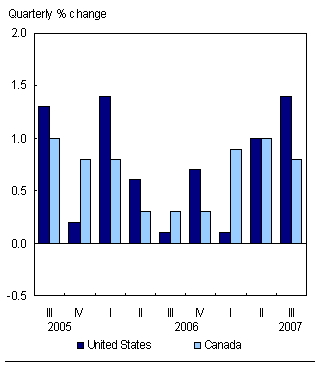
After posting the same rate in the second quarter in both countries (+1.0%), GDP south of the border rose at a pace almost twice that of Canada. In the third quarter, GDP growth in Canadian businesses was 0.8% compared with a gain of 1.4% in the United States.
In the United States, productivity climbed sharply to 1.6% in the third quarter, a clear improvement over the 0.9% increase in the second quarter after almost no improvement (+0.1%) in the first three months of the year. This is the best performance since the third quarter of 2003 (+2.3%).
Chart F.3 U.S. productivity growth accelerates

The gap in terms of productivity growth between Canada and the United-States stems also from differences in labour market performance.
Hours worked devoted to production in Canadian businesses grew 0.6% in the third quarter, slightly less than the 0.7% rise recorded in the previous quarter. Full-time work was the main component in the increase in hours worked in the third quarter.
Chart F.4 Growth in hours worked slows in
both countries, but was negative in the U.S.

By comparison, hours worked in American companies edged down 0.2% in the third quarter after increasing by 0.2% in the second quarter. This is the first decline after a series of 16 straight quarters of increases or stability. The pace of growth in hours worked has been slowing gradually since the third quarter of 2006.
Unit labour cost continues to slow
Labour cost per unit of production, a measure of inflationary pressures from wages, slowed in Canadian businesses in the third quarter, rising only 0.3% compared with the 0.7% posted in the previous quarter. This is gradually slowing down since the fourth quarter of 2006.
This situation reflects a slowdown in the growth of hourly compensation from the second quarter, given the small gains in productivity posted in the last two quarters. In the previous four quarters, hourly compensation in Canada had experienced quarterly increases of 0.9% or higher.
Chart F.5 Canadian unit labour costs in U.S. dollars decelerates slightly

For U.S. businesses, labour cost per unit of production fell 0.5% in the third quarter after posting a small decrease of 0.2% in the previous quarter. In these past two quarters, the increase in hourly compensation was less than that of productivity, thereby creating a second straight quarterly reduction in unit labour cost in the United States.
In light of the strong rise in the Canadian dollar in the third quarter, the growth in Canada's unit labour cost expressed in U.S. dollars was up 5.4% in the quarter, following a sharp increase of 7.4% in the second quarter.
Industry analysis
While productivity in the goods sector continue to decline...
In the third quarter of 2007, labour productivity fell by 0.8% in the goods producing sector compared to a 0.2% decline in the second quarter. All industries from this sector contributed to the overall decline. Manufacturing, the largest industry of this sector, records its first decline in productivity since the third quarter of 2006.
In manufacturing, productivity decreased by 0.6% in the third quarter. This was the first decline after three straight quarters of growth.
Hours worked in manufacturing decreased 0.1% in the third quarter, the sixth straight quarter of decline, reflecting continued adjustment in this sector. Meanwhile, production in manufacturing declined 0.7% in the third quarter after two straight quarterly increases.
Chart F.6 Productivity in manufacturing
declined for the first time in one year

Manufacturing output continues to be hampered by the sharp appreciation of the Canadian dollar. Manufacturers have had to cope with a 4.9% appreciation of the Canadian dollar against its U.S. counterpart in the third quarter, following a 6.3% appreciation in the second quarter.
... it continues to improve in the services
In contrast, with a gain of 0.4%, the services producing sector has recorded a third consecutive productivity increase. This rate of growth was the same as in the second quarter, but higher than the growth of 0.2% in the first quarter. With the exception of information and cultural industries, all other service industries improved or maintained their productivity level over the third quarter. Once again, wholesale trade has been one of the leaders of this sector with strong productivity growth in the third quarter, based largely on the strength of sales by merchants of machinery and equipment, and motor vehicles.
Although it experienced a very small productivity gain in the third quarter, the finance, real estate and company management industry registered positive growth for the seventh consecutive quarter.
Less upward pressure on hourly compensation in both sectors
After accelerating in the latter part of 2006 and in the first quarter of 2007 (+1.5%), hourly compensation growth in the business sector has been gradually slowing, recording increases of 0.9% in the second and 0.4% in the third quarter of 2007. Both goods and services producing sectors have registered a deceleration in hourly compensation in the third quarter.
In the goods producing sector, hourly compensation growth continues to attenuate recording an increase of 0.2% compared to 0.4% in the second quarter. These rates are well below the growth of 2.1% recorded in each of the two previous quarters. This deceleration is attributable to all goods producing industries with the exception of agriculture, forestry, fishing and hunting.
In the service sector, the growth in hourly compensation decelerated in the third quarter (+0.6%) after remaining at about the same pace over the three previous quarters (+1.2%). The main contributors to this deceleration were administrative and support, waste management and remediation services as well as other private services which recorded declines.
In contrast, retail trade and professional, scientific and technical services experienced relatively higher growth in hourly compensation for a second consecutive quarter.
Slight acceleration in unit labour costs in the goods sector...
The 0.2% growth in hourly compensation, combined with a productivity decline of -0.8% in the third quarter, led to a 0.9% increase in the unit labour costs of Canadian businesses operating in goods producing industries compared to 0.6% in the second quarter. Unit labour costs are used to monitor inflationary pressures by comparing relative differences between changes in hourly wages and productivity.
In the third quarter of 2007, the unit labour costs accelerated in the goods producing sector, reflecting increases in most industries with the exception of manufacturing. Unit labour cost in manufacturing declined for the third consecutive quarter.
... but a net improvement in the services
The gradual deceleration in unit labour cost in Canadian businesses started in the fourth quarter 2006 is mainly attributable to the services sector. Unit labour costs in this sector edge up 0.1% in the third quarter compared to 0.8% in the second quarter. This deceleration is mainly attributable to wholesale trade, transportation and warehousing, administration and support, waste management and remediation services and other private industries. On the other hand, these improvements were offset by an acceleration of the unit labour costs in retail trade in the third quarter.
Statistical tables
- Table F.1 Business sector - Labour productivity and related variables for Canada and the United States, quarterly
- Table F.2 Business sector - Some related variables for labour markets
- Table F.3 Indexes of labour productivity by industry
- Table F.4 Indexes of unit labour cost by industry
Information on methods and data quality available in the Integrated Meta Data Base: 5042.
