
Safe Cities profile series: Key indicators by census metropolitan area
Windsor, Ontario

Satisfaction with safety

Windsor 93%, Ontario 89%, Canada 88%*
proportion of people who reported being satisfied with their personal safety from crime in 2014
* significantly different from Windsor (p < 0.05)
Police-reported violent crime rate in 2018

Windsor 783, Ontario 899, Canada 1,143
rate per 100,000 population
Ten-year change in police-reported crime rate (2008 to 2018)

Windsor +1%, Ontario -16%, Canada, -17%
Population and demographics

Windsor, Ontario
Windsor was home to 349,718 people in 2018, and it had a population density of 342 residents per square kilometre. Three in ten (31%) residents were aged 24 and younger, on par with the distribution in Ontario (29%) and across Canada (28%).
About 2.6% of Windsor residents were part of the Indigenous population (First Nations, Métis and Inuit) in 2016, similar to Ontario (2.8%) but lower than Canada (4.9%). Immigrants represented about one in four (23%) residents, lower than Ontario (29%) but similar to Canada (22%). One in seven (14%) immigrants in Windsor were recent immigrants (since 2011), similar to Ontario (12%) and Canada (16%). While there was a notably smaller proportion of people who identified as a visible minority in Windsor (20%) than Ontario (29%), it was similar to the proportion in Canada overall (22%).
Education, employment and income
In 2016, six in ten (61%) Windsor residents aged 25 to 64 had completed some form of postsecondary education, three in ten (29%) had completed high school (or equivalent) as their highest level of education, and one in ten (10%) had completed neither.
In 2018, the unemployment rate in Windsor (6.0%) was slightly higher than in Ontario (5.6%) and similar to Canada's provinces (5.8%). Households in Windsor earned a median after-tax annual income of $51,630 in 2017, slightly lower than in Ontario ($53,850) and Canada ($52,090). The percentage of families considered low-income in Windsor (18%) was on par with Ontario (17%) and Canada (17%).
Housing and families
On average, there were 2.4 persons per household in Windsor in 2016, similar to Ontario (2.6) and Canada (2.4). Most (72%) households in Windsor owned their homes, on par with Ontario (70%) and Canada (68%). When a household spends 30% or more of its income on shelter costs, it is considered to live in unaffordable housing: this was the case for just over one in five (22%) Windsor households, lower than in Ontario (28%) but close to Canada (24%). A small proportion (6.7%) of occupied private dwellings in Windsor were in need of major repairs, similar to Ontario (6.1%) and Canada (6.5%). One-fifth (19%) of Windsor families were lone-parent families, slightly higher than in Ontario (17%) and Canada (16%). In 2018, there were an estimated 192 individuals in Windsor living in unsheltered areas, in sheltered or transitional housing, or in other accommodations that were not their own.
Community safety and sense of belonging
- In 2014, two in five (39%) Windsor residents aged 15 and older were very satisfied with their personal safety from crime, on par with Ontario residents (40%) and Canadians living in the provinces overall (38%).
- Nearly three in five (58%) Windsor residents felt very safe when walking alone after dark, which was not significantly different from Ontario (51%) or Canada's provinces (52%).
- Women who lived in Windsor were significantly less likely than men to feel very safe when walking alone after dark (46% versus 67%), similar to Ontario and Canada's provinces.
- About one in seven (14%E) Windsor residents thought social disorder was a big or moderate problem in their neighbourhood, significantly lower than in Ontario (21%) and Canada's provinces (22%).
- More than one in four (28%) Windsor residents said they had a very strong sense of belonging to their community, similar to Ontario (25%) and Canada's provinces (25%).
- Over a six-year period (2009 to 2014), 12%E of Windsor residents experienced discrimination, similar to Ontario (15%) and Canada's provinces (13%).
- About 26% of Windsor residents said they knew most people in their neighbourhood in 2014, which was not significantly different from Ontario (20%) or Canada's provinces (21%).
- The large majority (81%) of Windsor residents thought crime levels in their neighbourhood were lower than the rest of Canada, which was not significantly different from Ontario (76%) but was significantly higher than Canada's provinces (74%).
- The vast majority (93%) of Windsor residents reported having confidence in police in 2014, which was similar to the proportion in Ontario (91%) and Canada's provinces (91%).
Self-reported experiences of victimization
- In 2018, more than one in five (22%) Windsor residents aged 15 and older experienced unwanted sexual behaviour in public, similar to Ontario (25%) and Canada's provinces (23%).
Police-reported crime
- In 2018, Windsor police reported an overall crime rate of 5,427 incidents per 100,000 population, 32% higher than in Ontario (4,113) but 1% lower than in Canada (5,488).
- Over the past decade (2008 to 2018), police-reported crime increased by 1% in Windsor, while a decline was seen in Ontario (-16%) and Canada (-17%).
- The severity of crime in Windsor increased by 21% between 2017 and 2018, mostly due to an increase in breaking and entering, fraud, homicide and theft of $5,000 or under (non-shoplifting). Over the past decade (2008 to 2018), the severity of crime in Windsor increased by 13%, compared with a 15% decline in Ontario and a 17% decline in Canada.
Property crime
- Police-reported: There were 3,913 property crimes per 100,000 population reported by police in Windsor in 2018, 49% higher than in Ontario (2,621) and 17% higher than Canada (3,339).
Violent crime
- In 2018, there were 783 incidents of violent crime per 100,000 population reported by police in Windsor, 13% lower than Ontario (899) and 31% lower than Canada overall (1,143).
- More than half of victims of violent crime were female in Windsor (56%), Ontario (53%) and Canada (53%).
- Between 2008 and 2018:
- The violent crime rate in Windsor declined by 22%, while a smaller decline was seen in Ontario (-14%) and Canada (-14%).
- The severity of violent crime in Windsor declined by 4%, which was smaller than the decline in Ontario (-11%) and Canada (-13%).
- Violent crime against girls and women in Windsor between 2009 and 2018 declined to a smaller extent than violent crime against boys and men (-21% versus -29%).
Hate crime
- The police-reported hate crime rate—which depends on police services' level of expertise in identifying crimes motivated by hate—was far lower in Windsor (1.7 incidents per 100,000 population) than in Ontario (5.3) and Canada (4.9) in 2018.
- Between 2014 and 2018, the rate of police-reported hate crime in Windsor declined by 57%, while there was an increase in Ontario (+10%) and Canada (+33%).
Intimate partner violence
- There were 302 victims of intimate partner violence per 100,000 population aged 15 and older reported by police in Windsor in 2018, 24% higher than Ontario (243) but 6% lower than Canada (323).
- The large majority (82%) of victims of police-reported intimate partner violence in Windsor were female, similar to Ontario (81%) and Canada (79%).
- Same-sex partners accounted for 2.5% of police-reported intimate partner violence in Windsor between 2009 and 2018, lower than in Ontario (4.2%) and Canada (3.4%).
Homicide
- In 2018, Windsor had 10 homicides—a rate of 2.86 per 100,000 population—higher than Ontario (1.86) and Canada (1.76).
- Of the 10 homicide victims in Windsor, 1 was female (10%). This was a lower proportion than in Ontario (27%) and Canada (25%).
- The number of homicides in Windsor increased from 7 victims in 2008 to 10 victims in 2018.
Charts and tables
Chart 1 start

Data table for Chart 1
| Year | Violent Crime Severity Index | Non-violent Crime Severity Index | ||||
|---|---|---|---|---|---|---|
| Windsor | Ontario | Canada | Windsor | Ontario | Canada | |
| index | ||||||
| 1998 | 84 | 85 | 98 | 109 | 107 | 127 |
| 1999 | 68 | 83 | 99 | 90 | 96 | 116 |
| 2000 | 62 | 85 | 98 | 95 | 91 | 110 |
| 2001 | 66 | 85 | 97 | 93 | 87 | 108 |
| 2002 | 70 | 82 | 96 | 91 | 85 | 107 |
| 2003 | 74 | 81 | 98 | 101 | 84 | 110 |
| 2004 | 74 | 79 | 96 | 112 | 78 | 107 |
| 2005 | 73 | 83 | 99 | 93 | 74 | 102 |
| 2006 | 76 | 87 | 100 | 95 | 75 | 100 |
| 2007 | 67 | 86 | 98 | 88 | 70 | 94 |
| 2008 | 78 | 82 | 95 | 75 | 67 | 89 |
| 2009 | 75 | 82 | 94 | 70 | 64 | 85 |
| 2010 | 65 | 78 | 89 | 67 | 61 | 81 |
| 2011 | 60 | 73 | 86 | 64 | 57 | 75 |
| 2012 | 67 | 70 | 82 | 67 | 55 | 73 |
| 2013 | 61 | 62 | 74 | 60 | 49 | 67 |
| 2014 | 57 | 58 | 71 | 57 | 47 | 65 |
| 2015 | 66 | 60 | 75 | 60 | 48 | 68 |
| 2016 | 57 | 65 | 77 | 69 | 49 | 70 |
| 2017 | 63 | 70 | 81 | 73 | 51 | 71 |
| 2018 | 74 | 73 | 82 | 89 | 55 | 72 |
|
Note: Crime Severity Indexes are based on Criminal Code incidents, including traffic offences, as well as other federal statute violations. The base index was set at 100 for 2006 for Canada. Data on the Crime Severity Indexes are available as of 1998. Populations are based on July 1 estimates from Statistics Canada, Centre for Demography. Source: Statistics Canada, Canadian Centre for Justice and Community Safety Statistics, Uniform Crime Reporting Survey, Aggregate Database. |
||||||
Chart 1 end
Chart 2 start
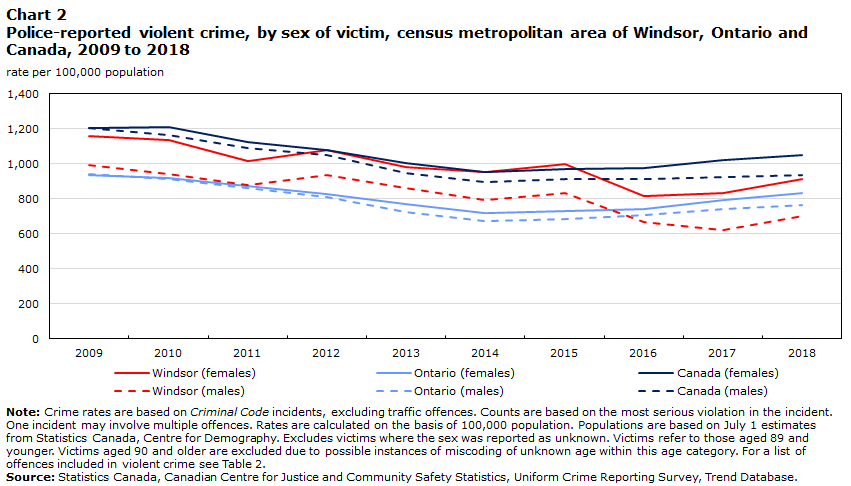
Data table for Chart 2
| Year | Female victims | Male victims | ||||
|---|---|---|---|---|---|---|
| Windsor | Ontario | Canada | Windsor | Ontario | Canada | |
| rate per 100,000 population | ||||||
| 2009 | 1,155 | 937 | 1,206 | 995 | 940 | 1,202 |
| 2010 | 1,133 | 917 | 1,209 | 943 | 913 | 1,162 |
| 2011 | 1,015 | 872 | 1,124 | 877 | 859 | 1,087 |
| 2012 | 1,080 | 824 | 1,079 | 933 | 809 | 1,048 |
| 2013 | 983 | 771 | 1,004 | 861 | 726 | 947 |
| 2014 | 952 | 721 | 952 | 791 | 675 | 898 |
| 2015 | 1,000 | 729 | 970 | 831 | 687 | 914 |
| 2016 | 818 | 741 | 978 | 667 | 708 | 910 |
| 2017 | 834 | 790 | 1,019 | 620 | 739 | 926 |
| 2018 | 911 | 834 | 1,048 | 703 | 766 | 936 |
|
Note: Crime rates are based on Criminal Code incidents, excluding traffic offences. Counts are based on the most serious violation in the incident. One incident may involve multiple offences. Rates are calculated on the basis of 100,000 population. Populations are based on July 1 estimates from Statistics Canada, Centre for Demography. Excludes victims where the sex was reported as unknown. Victims refer to those aged 89 and younger. Victims aged 90 and older are excluded due to possible instances of miscoding of unknown age within this age category. For a list of offences included in violent crime see Table 2. Source: Statistics Canada, Canadian Centre for Justice and Community Safety Statistics, Uniform Crime Reporting Survey, Trend Database. |
||||||
Chart 2 end
Chart 3 start

Data table for Chart 3
| Year | Windsor | Ontario | Canada |
|---|---|---|---|
| rate per 100,000 population | |||
| 2009 | 3,550 | 3,193 | 4,122 |
| 2010 | 3,437 | 2,968 | 3,838 |
| 2011 | 3,113 | 2,760 | 3,536 |
| 2012 | 3,260 | 2,648 | 3,438 |
| 2013 | 2,938 | 2,365 | 3,154 |
| 2014 | 2,863 | 2,281 | 3,100 |
| 2015 | 2,999 | 2,290 | 3,231 |
| 2016 | 3,059 | 2,315 | 3,239 |
| 2017 | 3,276 | 2,428 | 3,266 |
| 2018 | 3,913 | 2,621 | 3,339 |
|
Note: Crime rates are based on Criminal Code incidents, excluding traffic offences. Counts are based on the most serious violation in the incident. One incident may involve multiple offences. Rates are calculated on the basis of 100,000 population. Populations are based on July 1 estimates from Statistics Canada, Centre for Demography. For a list of offences included in property crime see Table 3. Source: Statistics Canada, Canadian Centre for Justice and Community Safety Statistics, Uniform Crime Reporting Survey, Aggregate Database. |
|||
Chart 3 end
Table 1 start
| Type of offence | Windsor | Ontario | Canada | Percent difference between Windsor and Ontario | Percent difference between Windsor and Canada |
|---|---|---|---|---|---|
| rate | |||||
| Total crime (excluding traffic) | 5,427 | 4,113 | 5,488 | 32 | -1 |
| Total violent crime | 783 | 899 | 1,143 | -13 | -31 |
| Violations causing death and attempted murder | 6 | 5 | 4 | 26 | 41 |
| Sexual assault and sexual violations against childrenTable 1 Note 1 | 84 | 91 | 101 | -8 | -17 |
| AssaultsTable 1 Note 2 | 437 | 500 | 649 | -13 | -33 |
| Other violent offences | 256 | 303 | 389 | -16 | -34 |
| Total property crime | 3,913 | 2,621 | 3,339 | 49 | 17 |
| Breaking and entering | 664 | 319 | 431 | 108 | 54 |
| TheftTable 1 Note 3 | 2,253 | 1,506 | 1,720 | 50 | 31 |
| Fraud | 491 | 381 | 402 | 29 | 22 |
| MischiefTable 1 Note 4 | 437 | 372 | 699 | 17 | -38 |
| Other property crime offences | 68 | 43 | 86 | 56 | -21 |
| Total other Criminal Code offences | 731 | 593 | 1,006 | 23 | -27 |
| Total Criminal Code traffic offences | 122 | 199 | 339 | -39 | -64 |
| Total alcohol-impaired drivingTable 1 Note 5 | 73 | 92 | 178 | -21 | -59 |
| Total drug-impaired drivingTable 1 Note 6 | 5 | 6 | 12 | -13 | -55 |
| Alcohol and drug-impaired drivingTable 1 Note 7 | 2 | 0.6 | 0.7 | 207 | 154 |
| Impaired driving (not specified)Table 1 Note 7 | 0.6 | 0.4 | 0.3 | 49 | 125 |
| Other Criminal Code traffic offences | 41 | 99 | 148 | -58 | -72 |
| Total drug offences | 224 | 146 | 225 | 54 | -0.4 |
| Total other federal statute offences | 21 | 29 | 70 | -30 | -71 |
| Total all offences | 5,794 | 4,487 | 6,123 | 29 | -5 |
Source: Statistics Canada, Canadian Centre for Justice and Community Safety Statistics, Uniform Crime Reporting Survey, Aggregate Database. |
|||||
Table 1 end
Table 2 start
| Type of offence | Windsor | Ontario | Canada | |||
|---|---|---|---|---|---|---|
| Female victims | Male victims | Female victims | Male victims | Female victims | Male victims | |
| rate | ||||||
| Total violent crime | 911 | 703 | 834 | 766 | 1,048 | 936 |
| Violations causing death and attempted murder | 3 | 11 | 3 | 7 | 2 | 6 |
| Homicide | 0.6 | 6 | 1 | 3 | 0.9 | 3 |
| Other violations causing deathTable 2 Note 1 | 0.6 | 0.6 | 0.3 | 0.4 | 0.3 | 0.3 |
| Attempted murder | 1 | 4 | 1 | 4 | 1 | 3 |
| Sexual offences | 147 | 25 | 152 | 22 | 170 | 23 |
| Sexual assault | 121 | 19 | 130 | 17 | 134 | 16 |
| Sexual assault – level 3 – aggravated | 2 | 0.6 | 0.4 | 0.1 | 0.7 | 0.1 |
| Sexual assault – level 2 – weapon or bodily harm | 3 | 0.6 | 2 | 0.5 | 2 | 0.4 |
| Sexual assault – level 1 | 116 | 18 | 128 | 17 | 131 | 16 |
| Sexual violations against childrenTable 2 Note 2 | 26 | 6 | 22 | 5 | 36 | 7 |
| Assaults | 515 | 449 | 467 | 510 | 613 | 644 |
| Physical assault | 502 | 414 | 456 | 463 | 599 | 590 |
| Assault – level 3 – aggravated | 1 | 13 | 4 | 10 | 6 | 13 |
| Assault – level 2 – weapon or bodily harm | 94 | 147 | 83 | 126 | 111 | 173 |
| Assault – level 1 | 408 | 254 | 369 | 327 | 483 | 404 |
| Assault against a peace officer | 7 | 21 | 7 | 37 | 10 | 48 |
| Other assaults | 5 | 14 | 4 | 10 | 4 | 7 |
| Other violent offences | 247 | 218 | 213 | 227 | 263 | 262 |
| Firearms – use of, discharge, pointing | 2 | 6 | 2 | 6 | 2 | 6 |
| Robbery | 32 | 91 | 27 | 83 | 31 | 75 |
| Forcible confinement or kidnapping | 23 | 3 | 12 | 2 | 15 | 3 |
| Trafficking in personsTable 2 Note 3 | 1 | 0 | 2 | 0sNote: value rounded to 0 (zero) where there is a meaningful distinction between true zero and the value that was rounded. A “0” represents a true zero value. | 1 | 0sNote: value rounded to 0 (zero) where there is a meaningful distinction between true zero and the value that was rounded. A “0” represents a true zero value. |
| Extortion | 2 | 3 | 4 | 7 | 6 | 9 |
| Criminal harassment | 50 | 11 | 52 | 16 | 53 | 17 |
| Uttering threats | 123 | 93 | 85 | 102 | 114 | 134 |
| Indecent or harassing communications | 4 | 2 | 16 | 8 | 22 | 9 |
| Non-consensual distribution of intimate images | 3 | 1 | 5 | 0.8 | 7 | 1 |
| Commodification of sexual activityTable 2 Note 4 | 0 | 0 | 0.6 | 0sNote: value rounded to 0 (zero) where there is a meaningful distinction between true zero and the value that was rounded. A “0” represents a true zero value. | 1 | 0.1 |
| Other violent offences | 8 | 7 | 6 | 3 | 10 | 8 |
| Total traffic offences | 1 | 1 | 2 | 3 | 16 | 21 |
| Traffic violations causing death | 0 | 1 | 0.3 | 0.7 | 0.4 | 0.9 |
| Traffic violations causing bodily harm | 1 | 0 | 2 | 3 | 6 | 7 |
| Traffic violations – injury unspecified or unknownTable 2 Note 5 | 0 | 0 | 0.1 | 0 | 9 | 12 |
0s value rounded to 0 (zero) where there is a meaningful distinction between true zero and the value that was rounded. A “0” represents a true zero value.
Source: Statistics Canada, Canadian Centre for Justice and Community Safety Statistics, Uniform Crime Reporting Survey, Trend Database. |
||||||
Table 2 end
Table 3 start
| Type of offence | Windsor | Ontario | Canada | |||
|---|---|---|---|---|---|---|
| number | rate | number | rate | number | rate | |
| Total non-violent crime | 17,525 | 5,010 | 513,941 | 3,588 | 1,845,269 | 4,979 |
| Total property crime | 13,686 | 3,913 | 375,402 | 2,621 | 1,237,324 | 3,339 |
| Breaking and entering | 2,324 | 664 | 45,736 | 319 | 159,812 | 431 |
| Possess stolen propertyTable 3 Note 1 | 198 | 57 | 4,854 | 34 | 23,898 | 64 |
| Theft of motor vehicle | 1,042 | 298 | 23,952 | 167 | 86,132 | 232 |
| Theft over $5,000 (non-motor vehicle) | 110 | 31 | 5,887 | 41 | 20,113 | 54 |
| Theft of $5,000 or under (non-motor vehicle) | 6,728 | 1,923 | 185,837 | 1,297 | 531,312 | 1,434 |
| Fraud | 1,661 | 475 | 49,193 | 343 | 129,409 | 349 |
| Identity theft | 8 | 2 | 426 | 3 | 3,745 | 10 |
| Identity fraud | 48 | 14 | 4,907 | 34 | 15,839 | 43 |
| MischiefTable 3 Note 2 | 1,527 | 437 | 53,236 | 372 | 259,064 | 699 |
| Arson | 40 | 11 | 1,374 | 10 | 8,000 | 22 |
| Total other offences | 2,556 | 731 | 84,959 | 593 | 372,834 | 1,006 |
| Weapons violations | 110 | 31 | 4,415 | 31 | 16,610 | 45 |
| Child pornographyTable 3 Note 3 | 35 | 10 | 1,669 | 12 | 5,843 | 16 |
| ProstitutionTable 3 Note 4 | 2 | 0.6 | 29 | 0.2 | 110 | 0.3 |
| Terrorism | 1 | 0.3 | 58 | 0.4 | 102 | 0.3 |
| Disturb the peace | 45 | 13 | 5,075 | 35 | 94,378 | 255 |
| Administration of justice offences | 2,142 | 612 | 66,876 | 467 | 226,864 | 612 |
| Other offences | 221 | 63 | 6,837 | 48 | 28,927 | 78 |
| Total Criminal Code traffic offences | 426 | 122 | 28,446 | 199 | 125,544 | 339 |
| Total alcohol-impaired drivingTable 3 Note 5 | 255 | 73 | 13,216 | 92 | 65,820 | 178 |
| Total drug-impaired drivingTable 3 Note 6 | 19 | 5 | 894 | 6 | 4,429 | 12 |
| Alcohol and drug-impaired drivingTable 3 Note 7 | 6 | 2 | 80 | 0.6 | 250 | 0.7 |
| Impaired driving (not specified)Table 3 Note 7 | 2 | 0.6 | 55 | 0.4 | 94 | 0.3 |
| Other Criminal Code traffic offences | 144 | 41 | 14,201 | 99 | 54,951 | 148 |
| Total drug offences | 785 | 224 | 20,937 | 146 | 83,483 | 225 |
| Total other federal statute offences | 72 | 21 | 4,197 | 29 | 26,084 | 70 |
| Human traffickingTable 3 Note 8 | 6 | 2 | 94 | 0.7 | 112 | 0.3 |
| Youth Criminal Justice Act | 13 | 4 | 1,076 | 8 | 4,823 | 13 |
| Other federal statute offences | 53 | 15 | 3,027 | 21 | 21,149 | 57 |
Source: Statistics Canada, Canadian Centre for Justice and Community Safety Statistics, Uniform Crime Reporting Survey, Aggregate Database. |
||||||
Table 3 end
Table 4 start
| Year | Violent crime | Property crime | Total crime | ||||||
|---|---|---|---|---|---|---|---|---|---|
| number | rate | percent change in rate from previous year | number | rate | percent change in rate from previous year | number | rate | percent change in rate from previous year | |
| 2008 | 3,324 | 1,004 | -4 | 11,916 | 3,599 | -14 | 17,755 | 5,362 | -12 |
| 2009 | 3,381 | 1,028 | 2 | 11,677 | 3,550 | -1 | 17,095 | 5,198 | -3 |
| 2010 | 3,267 | 995 | -3 | 11,290 | 3,437 | -3 | 16,591 | 5,051 | -3 |
| 2011 | 3,013 | 918 | -8 | 10,222 | 3,113 | -9 | 15,259 | 4,647 | -8 |
| 2012 | 3,225 | 978 | 7 | 10,754 | 3,260 | 5 | 15,811 | 4,793 | 3 |
| 2013 | 2,957 | 887 | -9 | 9,795 | 2,938 | -10 | 14,524 | 4,356 | -9 |
| 2014 | 2,773 | 829 | -7 | 9,582 | 2,863 | -3 | 14,062 | 4,202 | -4 |
| 2015 | 2,932 | 872 | 5 | 10,077 | 2,999 | 5 | 14,789 | 4,401 | 5 |
| 2016 | 2,418 | 711 | -18 | 10,400 | 3,059 | 2 | 14,822 | 4,359 | -1 |
| 2017 | 2,421 | 706 | -0.8 | 11,240 | 3,276 | 7 | 15,927 | 4,642 | 6 |
| 2018 | 2,740 | 783 | 11 | 13,686 | 3,913 | 19 | 18,982 | 5,427 | 17 |
| Percent change from 2008 to 2018 | -18 | -22 | Note ...: not applicable | 15 | 9 | Note ...: not applicable | 7 | 1 | Note ...: not applicable |
|
... not applicable Note: Crime rates are based on Criminal Code incidents, excluding traffic offences. Counts are based on the most serious violation in the incident. One incident may involve multiple offences. Rates are calculated on the basis of 100,000 population. Populations are based on July 1 estimates from Statistics Canada, Centre for Demography. Percent changes are based on unrounded rates. For a list of offences included in violent crime see Table 2 and for a list of offences included in property crime see Table 3. Total crime includes violent, property and other types of crimes. Source: Statistics Canada, Canadian Centre for Justice and Community Safety Statistics, Uniform Crime Reporting Survey, Aggregate Database. |
|||||||||
Table 4 end
E use with caution
Note: This fact sheet contains data that come from multiple sources across multiple reference years. Some figures may be presented differently than in other Statistics Canada publications due to rounding. For detailed information on data definitions and sources, please refer to the Safe Cities profile series: Definitions and data sources document.
- Date modified: