


Statistics Canada
www.statcan.gc.ca
Common menu bar links

Third quarter 2007

Archived Content
Information identified as archived is provided for reference, research or recordkeeping purposes. It is not subject to the Government of Canada Web Standards and has not been altered or updated since it was archived. Please "contact us" to request a format other than those available.
Analysis — Third quarter 2007
Canada's net liabilities to non-residents increased $12.2 billion in the third quarter, mainly reflecting the appreciation of the Canadian dollar.
International assets and liabilities both continued to decline in the third quarter of 2007, though the drop in assets was greater. As a result, Canada's overall net international liabilities (the difference between Canada's financial assets abroad and liabilities to non-residents) rose for a third straight quarter, although at a slower rate than in the previous quarter.
Net liabilities to non-residents increased $12.2 billion in the third quarter to $145.3 billion. Net external liabilities now represent 9.4% of Canada's gross domestic product, up from 8.1% the previous quarter, but down significantly from its historical high of 44.3% in 1994.
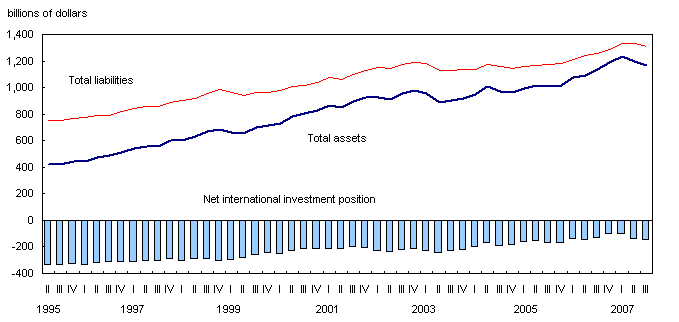
Canadian dollar continues to drive increase in net international liabilities
The increase in net liabilities to non-residents was mainly due to the continued appreciation of the Canadian dollar during the third quarter, which had a larger impact on assets than it did on liabilities. The Canadian dollar continued to make gains against most major foreign currencies in the third quarter, albeit at a reduced rate of increase. It gained 7.1% against the US dollar, 5.1% against the pound sterling, 1.65% against the Euro and lost 0.08% against the Japanese yen.
The larger net foreign indebtedness also reflected a slower pace of international investment activity in the third quarter, even though asset transactions exceeded liability flows. Non-resident divestment in Canadian stocks and a sharp drop in Canadian investors' foreign money market holdings were the main contributors to the weakness of financial transactions in assets and liabilities.
Foreign assets decline more than international liabilities
Holdings of international assets fell to $1,164.4 billion, a drop of $31.4 billion from the second quarter. The currency effect reduced the Canadian dollar value of these assets by $53.9 billion, while divestment of foreign money market instruments contributed to an additional decline in assets. The overall decrease was only slightly offset by an increase in deposit assets.
Currency valuation
The value of assets and liabilities denominated in foreign currency are converted to Canadian dollars at the end of each period for which a balance sheet is calculated. Most of Canada's foreign assets are denominated in foreign currencies while less than half of our international liabilities are in foreign currencies.
When the Canadian dollar is appreciating in value, the restatement of the value of these assets and liabilities in Canadian dollars lowers the recorded value. The opposite is true when the dollar is depreciating.
At the same time, Canada's international liabilities declined $19.2 billion to $1,309.7 billion. Although foreign acquisitions of Canadian firms remained strong in the third quarter, these increased liabilities were more than offset by the exchange rate effect in foreign holdings of Canadian bonds and deposits.
Canadian assets: Substantial decrease in foreign securities and direct investment holdings
The strong Canadian dollar continued to have a large impact on the value of Canadian investors' foreign securities holdings and on Canadian direct investment abroad. Almost all of these assets are denominated in foreign currency.
The currency effect on the holdings of foreign securities during the third quarter led to a reduction of $17.4 billion in assets. In addition to the substantial currency effect there was a $10.4-billion divestment in the holdings of foreign money market instruments. This reduced Canadian holdings to $9.0 billion, under half of what it was in the previous quarter, a level not seen since the second quarter of 2003.
Moreover, there was a reduction in holdings of foreign bonds, and transactions in foreign stocks decelerated in the quarter.
The appreciation of the Canadian dollar in the third quarter continued to have a large impact on the value of Canadian direct investment abroad, which fell by $17.2 billion to $491.3 billion. Direct investment transactions with foreign affiliates were weaker than usual and the stronger dollar removed $25.4 billion from the value of Canadian direct investment abroad.
Canadian direct investment in the United States fell by $11.2 billion to $209.4 billion, while Canadian direct investment in all other countries decreased by $6.0 billion to $281.8 billion.
Canadian liabilities: Increase in foreign direct investment in Canada
Foreign direct investment holdings increased $19.1 billion during the third quarter despite the continued appreciation in the Canadian dollar, which made Canadian companies more expensive to acquire. The value of acquisitions of Canadian firms was $18.8 billion in the quarter, of which 39% was in the mining industry. Foreign direct investment in Canada reached $495.3 billion at the end of September.
Non-resident holdings of Canadian bonds, stocks, and money market paper declined $19.3 billion during the quarter. This reduction was explained by a divestment in Canadian stocks of $8.5 billion and a negative currency effect of $12.8 billion on Canadian bonds (more than one-half of the outstanding Canadian bonds held by non-residents are issued in foreign currencies).
Net direct investment position turns negative
For the first time in more than 10 years, Canada's net position on direct investment—the difference between Canadian direct investment abroad and foreign direct investment in Canada—was negative. Foreign direct investment in Canada surpassed Canadian direct investment abroad by a narrow margin.
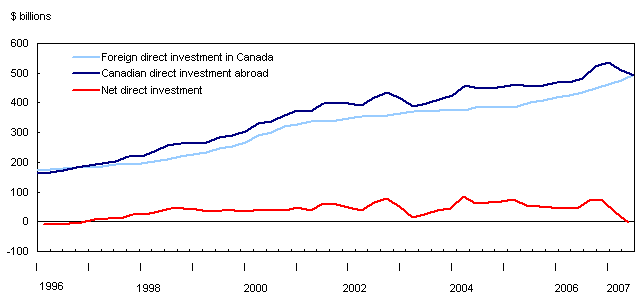
The year-to-date effect on the net direct investment position is a decrease of $78.5 billion, of which $57.6 billion is attributable to the currency effect. Changes in the Canadian dollar have an affect on direct investment assets but have no effect on direct investment liabilities.
Canada has a net liability position in direct investment vis-à-vis the United States, and it was the largest contributor to the drop in net direct investment in the third quarter. Canada has a net asset position in direct investment with all other countries as a group.
Increase in net international indebtedness sharper with portfolio investment at market value
Canada's overall net international liabilities can also be calculated with asset and liability holdings of tradable portfolio securities valued at market prices. In this instance, net foreign indebtedness grows more sharply, up $39.9 billion to reach $108 billion. This is partly accounted for by the downward re-valuation to the holdings of foreign equity by Canadian investors, and reflects the correction in the major world stock markets in the third quarter.

