


Statistics Canada
www.statcan.gc.ca
Common menu bar links

October 2008

Archived Content
Information identified as archived is provided for reference, research or recordkeeping purposes. It is not subject to the Government of Canada Web Standards and has not been altered or updated since it was archived. Please "contact us" to request a format other than those available.
Analysis
Consumer prices rose 2.6% in the 12 months to October 2008, a sharply slower pace than the 3.4% increase recorded in September. While October’s slowdown was due primarily to slower price increases for gasoline, prices for food exerted stronger upward pressure on consumer prices. On a seasonally adjusted monthly basis, consumer prices fell 0.5% from September to October.
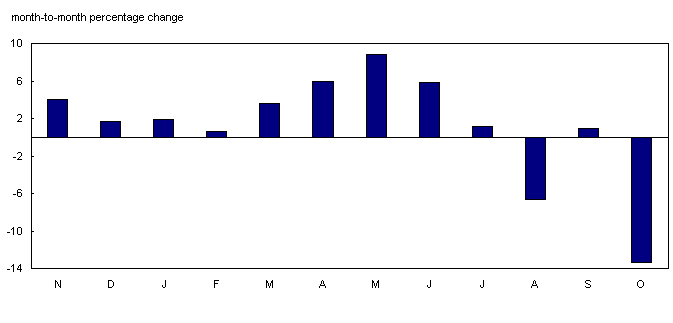
Although the growth in gasoline prices eased in the 12 months to October, they were still the most significant upward contributor to the overall growth in the Consumer Price Index (CPI). Prices at the pump increased 13.3%, compared with a 12-month change of 26.5% in September. On a monthly basis, gasoline prices fell 13.4% from September to October 2008.
Excluding gasoline, the CPI rose 2.0% in the 12 months to October. Excluding all energy components, the CPI advanced only 1.8%.
Similarly, the CPI excluding food rose 1.9%. Stripping out food and energy components, consumer prices softened to 0.9% in October, the lowest rate of growth since February 1999.
Increasing mortgage interest costs were the second major contributor to October’s rise. Other energy products, such as natural gas and fuel oil and other fuels, also continued to push up consumer prices, as did price increases for various food items, namely bakery and cereal products.
Helping to mitigate the rise in the CPI in October were continuing price declines for purchasing and leasing passenger vehicles, women’s clothing and computer equipment and supplies.
On a month-to-month seasonally unadjusted basis, consumer prices fell 1.0% from September to October, the largest drop since June 1959. The 13.4% decline in gasoline prices was the primarily contributor to this drop.
12-month change: Food costs match shelter costs as major contributor to the growth in the CPI
Of the eight major components in the CPI, seven recorded increases in the 12 months to October. The largest upward contributors were costs for shelter and food, followed by transportation and household operations, furnishings and equipment. Also recording increases in prices were health and personal care, alcoholic beverages and tobacco products and recreation, education and reading components.
The clothing and footwear price index remained the only major component that declined.
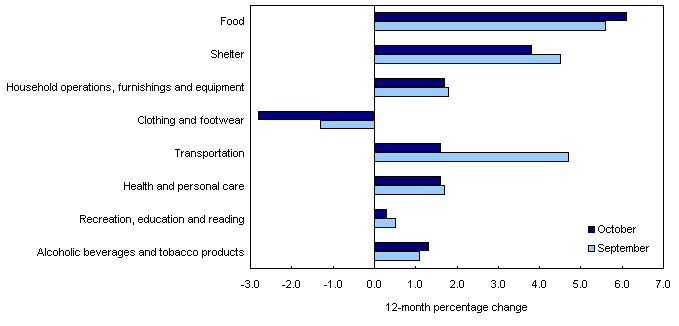
Shelter costs rose 3.8% in October, slower than the 4.5% rise posted in September. Price increases for mortgage interest costs (+7.2%), natural gas (+11.1%) and fuel oil and other fuels (+30.1%) were the largest upward contributors to the increase in the shelter component. However, the increase for all three of these items was slower than it was in September, thereby mitigating the rise in shelter costs for October.
As the global economy has weakened, prices for natural gas and fuel oil and other fuels have softened. As a result, the 12-month price increases in these two components are due to lower price levels observed during this period last year. On a month-to-month basis, prices for these energy components have actually declined from September to October. Similarly, a slowing economy has resulted in smaller increases in new housing prices, resulting in a slowdown in costs for mortgage interest.
Increasing property taxes also contributed to rising shelter costs in October. Property taxes rose by an average of 3.2% across Canada, ranging from a high of 6.1% in Alberta to a low of 0.3% in Newfoundland and Labrador and Manitoba.
Food prices continued to gain momentum, increasing 6.1% in October, after a 5.6% rise in September. This was the eighth consecutive month in which food prices accelerated.
A 7.3% rise in prices for food purchased from stores primarily accounted for this increase. Price increases for grain related products, mainly bakery (+14.2%) and cereal (+19.2%), continued to be the primary driver of rising costs for food purchased from stores. A 17.7% climb in prices for bread products and a 37.1% rise in prices for pasta products primarily accounted for the growth in the bakery and cereal price indexes, respectively. Other main contributors were price increases for dairy products (+5.4%) and fresh fruit (+13.7%) and fresh vegetables (+12.3%).
Owing to slower price increases for gasoline, transportation costs advanced 1.6% in October, a slowdown from the 4.7% rise recorded in September. Prices at the pump rose 13.3% in October on a year-over-year basis, compared with the 26.5% increase recorded in September. Despite this slowdown, gasoline continued to be the primary upward contributor for transportation costs.
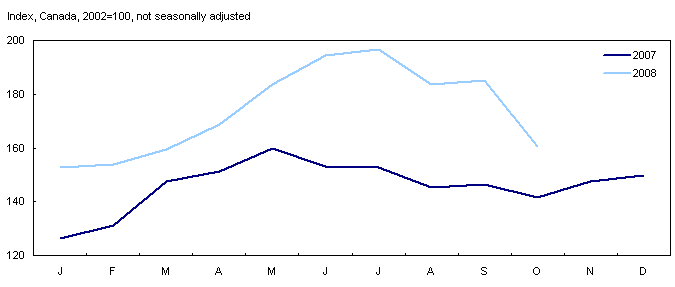
A slowing global economy also impacted the price of oil, as the West Texas Intermediate Crude Oil Price averaged US$76.65 per barrel in October, down from the US$103.90 in September. While gasoline prices fell on a monthly basis in October, the increase in the 12-month gasoline price index was due to lower gasoline prices during the same period last year.
Increasing prices for passenger vehicle insurance and air transportation also contributed to the rise in transportation costs in October.
A 9.0% decline in prices to purchase and lease passenger vehicles was the most significant downward contributor for transportation costs. The latest decline comes on the heels of the 9.3% drop recorded in September, the largest decline since February 1956.
Upward price movements were also recorded in the major components for the household operations, furnishings and equipment (+1.7%), health and personal care (+1.6%) and alcoholic beverages and tobacco products (+1.3%).
The recreation, education and reading price index showed little change in October, advancing 0.3%. The most significant upward contributor was tuition fees (+4.0%). However, a 12.0% drop in prices for computer equipment and supplies helped to partially offset increasing fees for tuition.
Clothing and footwear prices fell in October for the tenth consecutive month. Although both clothing and footwear prices fell, it was a 5.8% drop in prices for women’s clothing that primarily contributed to the 2.8% decline in the clothing and footwear price index.
The provinces: Growth in consumer prices slowed in eight of the ten provinces
The growth in consumer prices slowed across most provinces in the 12 months to October. Only two provinces—Manitoba and Saskatchewan—did not report a slowdown.
Consumers in Prince Edward Island realized the greatest slowdown in consumer prices, from 5.5% in September to 3.9% in October. The rise in consumer prices in New Brunswick remained the most subdued, advancing only 1.8% in October.
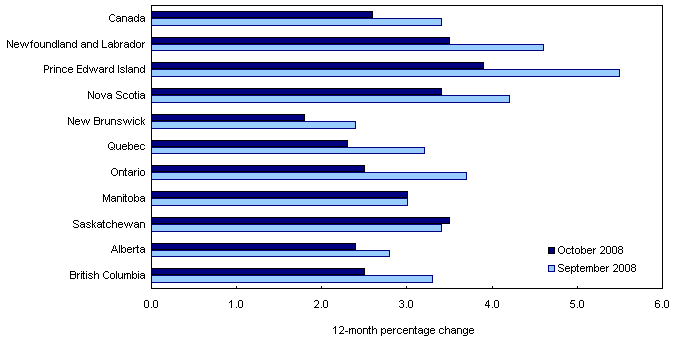
The slowdown in the 12-month price change for gasoline between September and October largely contributed to easing consumer prices in all provinces. Quebec and Ontario posted the largest slowdowns in gasoline prices.
Although gasoline prices eased across the country, they remained the primary upward contributor of consumer prices for most provinces. In Central (Quebec and Ontario) and Western Canada (Manitoba, Saskatchewan, Alberta, and British Columbia), mortgage interest costs also pushed up consumer prices. While in the East (Newfoundland and Labrador, Prince Edward Island, Nova Scotia and New Brunswick), it was fuel oil and other fuels, in addition to gasoline, that primarily accounted for consumer price increases.
Price declines for purchasing and leasing passenger vehicles remained the largest downward contributor to the change in consumer prices in all provinces.
Month-to-month change: Consumer prices drop by largest amount since June 1959
Consumer prices fell by a sharp 1.0% from September to October, the largest monthly decline since June 1959. This was a reversal from the 0.1% rate of growth recorded in September.
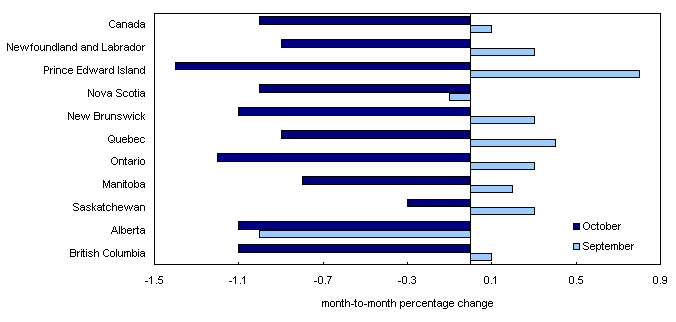
Several components, particularly those associated with energy, posted large price drops. The most significant downward contributor was prices for gasoline, which fell 13.4%. Prices for natural gas (-6.1%) and fuel oil and other fuels (-5.6%) also fell in October.
A 7.0% price decline for traveller’s accommodation and continual price declines for the purchasing and leasing of passenger vehicles (-1.1%) and women’s clothing (-3.9%) also contributed to October’s decline.
The most significant upward contributor came from prices for property taxes, which rose 3.2%. Changes in property taxes are reflected in the CPI once a year, in October.
On a seasonally adjusted monthly basis, consumer prices fell 0.5% from September to October, down from the 0.1% rise posted in the previous period. A 4.4% seasonally adjusted monthly drop in costs for transportation largely accounted for the decline, while price increases for food (+0.4%) continued to remain the primary upward contributor.
The 12-month change in the Bank of Canada’s core index holds steady
The Bank of Canada's core index 1 advanced 1.7% over the 12 months to October, identical to the rate posted in the previous two periods. Rising costs for bakery and cereal products and passenger vehicle insurance were the primary upward contributors to October’s increase. Price declines to purchase and lease passenger vehicles remained the most significant downward contributor.
On a seasonally unadjusted monthly basis, the core index fell 0.2% from September to October, a reversal from the 0.4% rise posted in the previous period.
The seasonally adjusted monthly core index posted no growth from September to October, after increasing 0.2% from August to September.

