|
||||||
|
|
|
|
|
|
|
|
|
|
|
|
|
|
|
||||||
Information identified as archived is provided for reference, research or recordkeeping purposes. It is not subject to the Government of Canada Web Standards and has not been altered or updated since it was archived. Please "contact us" to request a format other than those available.

|
|
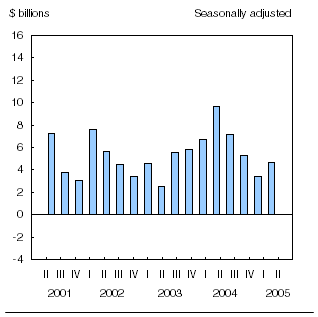
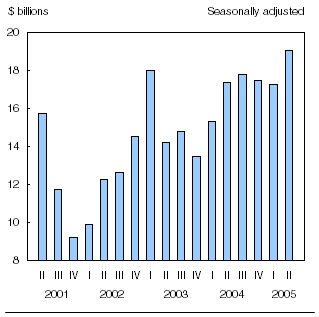
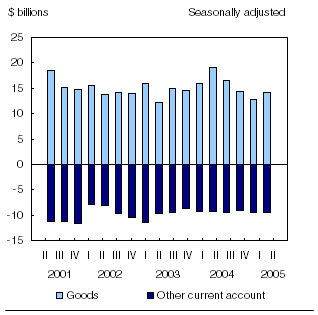
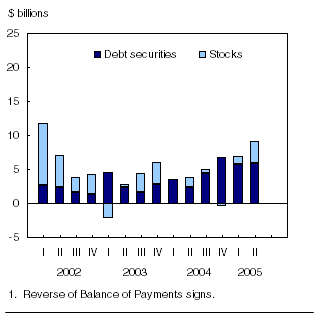
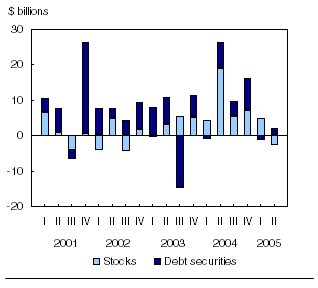
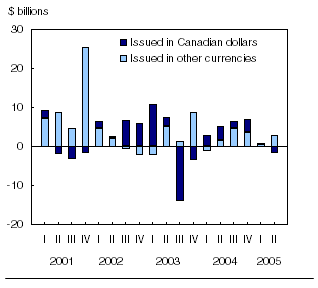
Balance of international paymentsSecond quarter 2005HighlightsCanada's current account surplus with the rest of the world, on a seasonally adjusted basis, increased $1.3 billion in the second quarter of 2005 to $4.7 billion. This increase followed three consecutive declines in the current account surplus. Higher exports of goods were the main contributor to this increase. In the capital and financial account (not seasonally adjusted), Canada’s assets abroad again grew more than its international liabilities. Growth in foreign assets came predominantly from portfolio investment in foreign debt securities and stocks. Canadian liabilities to the rest of the world continued to grow despite a halt to the strong foreign portfolio investment observed over the past six quarters. Current account rebounds after three declines Current accountGoods surplus reboundsThe surplus on trade in goods rose $1.3 billion to $14.1 billion in the second quarter as the value of exports increased more than imports. The surplus on goods had declined in each of the previous three quarters. The largest gain in exports occurred in energy products which reached the highest value since the first quarter of 2001. Higher prices for most of these products were again the dominant factor. An increase in demand for coal products also contributed to the higher exports values for energy products. Value of energy exports at a four-year high For a second consecutive quarter, exports of machinery and equipment increased substantially. Television, telecommunication and related equipment reached its highest level in 4 years but remains at only half of the peak level at the end of 2000. On the other hand, export values of automotive products continued to decline, notably for the passenger autos and chassis which were at the lowest level since the second quarter of 1998. Most of the large increase for machinery and equipment imports came from aircraft, engines and parts, which were at the highest level since 2002, and from other communication and related equipment. Prices were also responsible for most of the eighth consecutive increase in the value of imports for energy products. As with exports, higher demand for coal and other related products also contributed to the higher energy import values. Goods surplus leads the way Services deficit increased slightly againAs in the previous two quarters, the deficit on services increased slightly, up $0.2 billion, this time led by higher deficits for travel and commercial services. For these two services categories, payments rose faster than receipts. Canadians continued to increase their travel spending in countries other than United States. The number of Canadians visiting such countries has risen by 12% in the last year. More tourists from countries other than the US visited Canada in the quarter, resulting in higher receipts while there were virtually no changes in cross-border travel between Canada and United States. Deficit on investment income up slightlyThe deficit on investment income increased $0.2 billion to $6.0 billion. The deficit has remained around this level over the last two years. Both receipts and payments increased in the second quarter. Dividends paid to foreign investors on their direct investment in Canada rebounded partially after the large reduction of the first quarter. Most of the gain was in the chemical products sector. However, foreign direct investors saw the reinvested earnings of their Canadian holdings fall during the quarter. For the third consecutive quarter, payments on portfolio interest on Canadian bonds remained unchanged at $5.9 billion. Financial accountStrong Canadian demand continues for foreign securitiesOver the second quarter, Canadians purchased $9.1 billion in foreign securities, the highest quarterly amount in over three years. Thus far in 2005, Canadian investors have bought $16.0 billion worth of foreign securities, compared to less than half that over the same period last year. It should be noted that foreign content limits for tax-deferred Canadian investment vehicles were eliminated late in the quarter. Three year high for Canadian portfolio assets abroad1 About two-thirds of the investment went to foreign debt securities with the remainder going to foreign stocks. The investment of $3.3 billion into foreign equities was the largest since the second quarter of 2002. The current quarter’s investment was centred on US shares as Canadian investors sold some of their holdings of overseas shares. Turning to foreign debt securities, strong Canadian demand for foreign bonds continued for a third straight quarter. A further acquisition of $4.8 billion worth brought the total investment over the three quarters to $16.9 billion. The second quarter saw almost 90% go to US bonds, with US government treasuries the security of choice. After two quarters of lower investments, demand for foreign money market instruments jumped to $1.1 billion. This investment saw a move to overseas paper as Canadian investors sold some of their holdings of US paper. Direct investment abroad again moderateCanadian direct investment abroad was again moderate at $7.7 billion. The investment for the quarter came largely from increases in working capital as acquisitions were negative. That is, Canadian investors sold some of their holdings abroad. Investment in the financial sector once again led the quarter. While most of the investment went to the United States, the negative acquisitions led to a significant divestment from continental Europe. Foreign direct investment in Canada subdued after big first quarterForeign direct investment came in at $4.8 billion during the second quarter, about half that of the first. Again this quarter net acquisitions accounted for about half of the investment following two years which saw foreign investors sell some of their holdings back to Canadian residents causing net acquisitions to be negative. For the quarter, about four-fifths of the investment came from Europe and the United States while industrially it was well spread, led by investment in energy and metallic minerals. Foreign holdings of Canadian securities unchangedForeign investors bought $2.2 billion worth of Canadian debt securities but sold slightly more in Canadian equities leaving their overall holdings little changed for the quarter. This followed a series of robust investments in Canadian securities beginning in the fourth quarter of 2003 that totalled $70 billion. Strong portfolio investment in Canadian securities ends During the quarter, foreign investors reduced their holdings of Canadian equities by $2.5 billion – the first quarterly divestment since the opening quarter of 2003. The entire divestment occurred in trading of outstanding issues with reduced foreign holdings in equities across a broad range of industrial sectors. Foreign investors acquired just $1.2 billion in Canadian bonds in the second quarter, a lower amount for a second straight quarter. Viewed from a currency perspective, non-residents bought Canadian bonds denominated in foreign currencies ($2.9 billion) but sold bonds denominated in Canadian dollars ($1.7 billion). This was a switch from the previous five quarters where they acquired almost $12 billion of bonds in Canadian dollars. Foreign investment in Canadian bonds mixed Over the year thus far, foreign investors have acquired only $1.9 billion in Canadian bonds, compared to $16.1 billion and $6.7 billion purchased over the same period in 2003 and 2004 respectively. The composition of these holdings continues to shift away from federal government bonds which have declined by $4.7 billion since the beginning of the year. Meanwhile foreign investors continue to purchase bonds issued by other sectors of the Canadian economy. Over the same period of time, long-term interest rates in Canada have dipped below those in the United States for the first time in over four years while the Canadian dollar fell by 1.59 US cents. Foreign investors increased their overall holdings of Canadian money market paper over the second quarter of 2005 with a $1.0 billion purchase, partially offsetting first quarter sales of $1.9 billion. Investment over the second quarter was largely in federal enterprise paper with the bulk of it by European investors. Loans lead inflow on other investmentA net inflow of $4 billion was recorded in the other investment account, led by loan transactions. Non-residents repaid some of their loans held in Canada, while Canadian residents took on additional liabilities in non-resident loans. Transactions in deposits were large but mostly offsetting as the deposit assets of Canadians grew slightly faster than Canadian deposit liabilities to non-residents. The Canadian dollar continued its slide against the US dollar over the second quarter, losing more then a cent to close at 81.61 US cents. However, for the second straight quarter, the Canadian dollar did well against other major currencies, particularly the Swiss franc, the Euro and the Pound. Statistical tablesInformation on methods and data quality available in the Integrated Meta Data Base: 1533, 1534, 1535 and 1536. |
|
|