5 Discussion
Jan de Haan and Rens Hendriks
Previous | Next
5.1 Comparing GREG to
SPAR
The most interesting question arising from Section 4 is:
why are the GREG and SPAR index numbers so similar in spite of their very
different construction methods? It is not remarkable that the trends are
similar: although the GREG index does not rely on the matched-model
methodology, this index does aim at the same target as the SPAR index. If the
sample sizes and would approach the population size which in reality will of course never happen then both price indexes approach the value
change of the fixed housing stock. Put differently, the two methods are both
asymptotically unbiased or 'consistent'.
What may come as a surprise
is that the GREG index exhibits roughly the same amount of volatility over time
as the SPAR index. To understand the reason why, recall that, with OLS, the
regression residuals sum to zero in every time period. This implies and For the basic regression models (3.1) and (3.5),
the SPAR index can thus alternatively be written as
using (3.2) and (3.6) for and respectively, where and for short. There is a striking similarity
between the last expression on the right-hand sides of (5.1) and (3.10). The
only difference is that the SPAR index (5.1) divides the coefficients and by the sample means of appraisals, and whereas the GREG index (3.10) divides them
both by the fixed, non-stochastic population mean Essentially, the SPAR index is a fully
sample-based estimator of the GREG index.
Compared with the SPAR method, the GREG approach
eliminates one source of sampling error, i.e.,
the sampling variability of the mean appraisals. In accordance with generalized
regression theory, we would intuitively expect the GREG method to reduce the
sampling error of the price index and produce a less volatile time series
(under the reasonable assumption that and are uncorrelated across periods Put differently, while the GREG method has
been designed as an improvement over the ratio of sample means, we might have
expected it to work as a smoothing procedure for the SPAR index also. But, as
was shown in Section 4, in
practice this is hardly the case. This result can be explained as follows.
The variance reduction of
the GREG index relative to the SPAR depends on the value of the intercept terms
from the regressions in periods 0 and If the regression lines passed exactly through
the origin then the GREG index and SPAR index would both
be equal to the ratio of the slope coefficients and no reduction in variance would be
achieved. In the less extreme case, when and are close to 0 and the ratios and in (3.10) and (5.2) are very small compared to
and the GREG and SPAR indexes will differ only
slightly and the variance reduction will be marginal; see also the Appendix.
The latter is indeed what happens in practice, as can be
seen from Figures 5.1 and 5.2 where the values of and and those of are plotted over time. The ratios and are remarkably similar and small as compared
to the Although we cannot ignore those ratios, it is
the change in that mainly drives the GREG and SPAR indexes.
The SPAR index is not only a fully sample-based estimator of the GREG index, as
mentioned above, it appears to be almost as efficient.
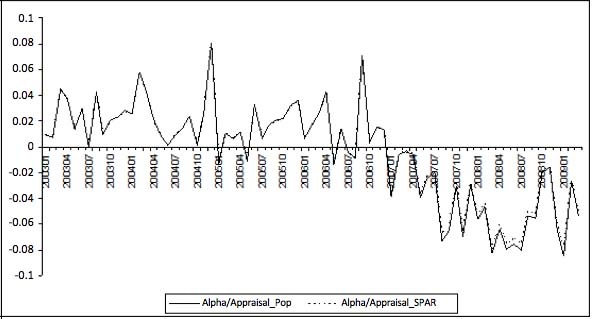
Description for figure 5.1
Figure 5.1
Intercepts divided by appraisal means
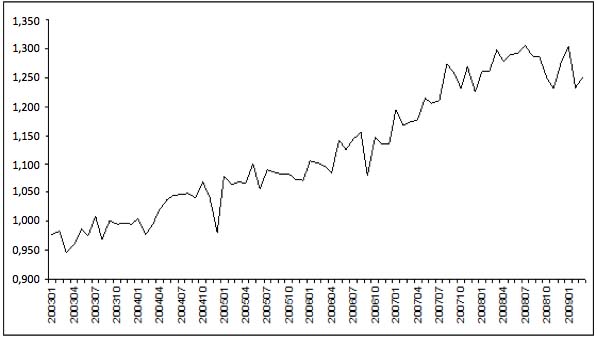
Description for figure 5.2
Figure 5.2 Slope
coefficients
5.2 The volatility of
the slope coefficient
Several factors may have contributed to the volatility
of the slope coefficients in our regressions of selling prices on
appraisals and hence of the GREG and SPAR indexes. We will briefly discuss
three of these factors: sample mix change, heteroskedasticity and outliers.
A sample of houses can be viewed as a sample of
locations, or addresses, since houses are attached to the land they are built
on. A change in the sample mix is nothing else than a change in the observed
mix of locations at the lowest level. A location
mix change affects the sample composition in terms of the average quality
characteristics of the properties, such as the number of rooms, surface area, etc. In our simple framework, where we
observe only one (non-physical) characteristic, namely the appraised value, a
location mix change boils down to a change in the sample distribution of the
appraisals. This, together with any varying price changes across market
segments, induces a change in the sample distribution of the ratios which in turn leads to a change in in the two-variable regression model (3.5).
Other than by stratification there is little we can do
about the effect of changes in the sample mix of locations (but stratifying by
province and type of dwelling did not help much), so the volatility of
and therefore of the GREG and SPAR indexes,
will be difficult to reduce. Controlling for location at the address level is
also impossible in hedonic imputation methods. Here, the effect of (location)
mix change is mitigated by controlling for region plus a range of physical
characteristics. However, this does not necessarily mean that hedonic
imputation will produce more stable index series than the GREG or SPAR methods.
Most standard hedonic models fit the cross sectional data less well than our
model does, and the characteristics' coefficients typically exhibit a great
deal of variability over time. So maybe it is not surprising that Bourassa,
et al. (2006)
find that "the
SPAR index [….] reliably tracks house price changes, but exhibits less volatility
than index methods that require more parameter estimates.�
We can alternatively look at the variability of the
slope coefficient from a purely statistical perspective. It is well known that
in a two-variable model the OLS estimator can be written as
where denotes the sample correlation coefficient in
period between selling prices and appraisals, which
is equal to the square root of and are the corresponding sample standard
deviations. A comparison of Figures 4.1 and 5.2 suggests that sudden changes in
are largely responsible for the volatility of In December 2004 for example, a substantial
drop in coincides with a significant decrease of (and with a decrease in the GREG and SPAR
indexes, as shown by Figure 4.4).
Least squares regression can either be weighted or
unweighted. In the absence of heteroskedasticity,
i.e., when the variance of the errors
is constant, OLS should be used. Weighted Least Squares (WLS) is preferred if
there is evidence of heteroskedasticity; using appropriate weights, WLS will
lead to more stable coefficients than OLS. In this case the unweighted sample
sum of the residuals differs from zero so the estimator (3.9) has to be applied.
To facilitate the interpretation of the GREG index and the comparison with the
SPAR index, in Section 3 we assumed away the problem of heteroskedasticity and
restricted ourselves to OLS.
Note that the (OLS) GREG estimator (3.10) remains asymptotically design
unbiased if heteroskedasticity is present.
The most interesting form of (classical)
heteroskedasticity and, given our data set, the only form we
would have been able to reduce would arise if the variance of the errors of
our regression model (3.5) depended on the appraisal value, being the only
regressor. However, the residuals from our OLS regressions do not point to
substantial heteroskedasticity of this type. This is illustrated in Figure 5.3
for three months, including the base period (January 2003), where the sale
prices are plotted against the appraisals; the regression lines are also given. To be sure, we also performed the
White (1980) test. This test did not point towards the presence of this form of
heteroskedasticity either.
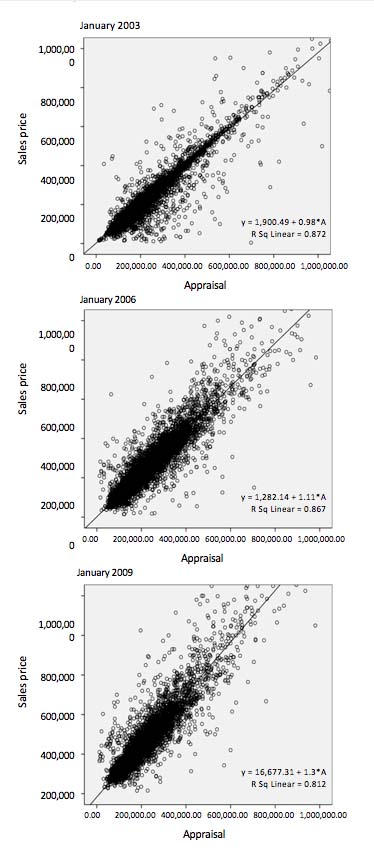
Description for figure 5.3
Figure 5.3
Scatter plots and regression lines
Our initial data set of sale prices and appraisals
included some obvious outliers. To
estimate the GREG index we therefore made use of a cleaned data set that has
been prepared to compute the official Dutch house price index. Statistics Netherlands
applies several data cleaning procedures. Houses that were sold more than once
in a month are excluded from the data set. To delete entry errors and outliers
that may unduly affect the results, properties with sale prices or appraisals
below 10,000
or above 5,000,000
and properties with 'unrealistic' sale price-appraisal ratios are also removed. The removal of 'unrealistic'
observations is done by looking at the distribution of the logarithm of the
sale price-appraisal ratios; all observations are deleted for which the log
ratio differs more than 5 standard deviations from the mean. For more
information, see Statistics Netherlands (2008).
These procedures are rather arbitrary. For
regression-based estimators such as the GREG it is more appropriate to delete
observations with high leverage, i.e.,
to delete those sample units that have a big impact on the regression
coefficients when they are excluded from the sample. A well-known measure in
this context is the DFBETA of a sample unit (Cook and Weisberg 1982). Since the
SPAR can be written as a regression-based index, this measure could be used
here as well to detect and delete outliers. The scatter plots in Figure 5.3
show that the cleaned data set still contains some big outliers. Whether these
have high leverage, and whether removing them will reduce the volatility of the
and the GREG and SPAR indexes, remains to be
seen.
5.3 Some further
points
The GREG method is based on the premise of a fixed
housing stock. That is, we have assumed that there are no entries (e.g., newly-built houses) or exits
(discarded houses) and that housing quality remains fixed over time. Our approach is non-symmetric in
that we condition on the base period
stock. From an index number point of view we estimate a Laspeyres price index
for the housing stock where the quantities are all equal to 1 because every
house is treated as a unique property. An equally justifiable approach would be
to measure the price change of the current period stock, which includes
additions to the stock in each period, using a Paasche index. Taking the
geometric mean of both indexes would lead to the Fisher index. The Fisher index
is a preferred measure of price change due to its symmetric form. The
construction of a Fisher-type GREG index is, however, infeasible since the
Paasche component requires real time assessed values for houses that are new to
the stock, which are obviously not available.
The assumption of a fixed (base period) housing stock
can be relaxed through annual chaining, provided that the housing stock is
re-assessed annually. This is the current state of affairs in the Netherlands; in
the past, assessments were undertaken once every three or four years. Annual
updating of the appraisals might also adjust for quality changes of the
properties, to some extent at least, because the updated appraisals likely
account for major repairs, remodelling and depreciation.
One final remark is in order. For some purposes it is
desirable to decompose the overall house price index into two components: a
component that measures the change in the price of the structure and a
component that measures the change in the price of the land. Neither our GREG
method nor SPAR and repeat sales methods are fit for that purpose. Hedonic
imputation methods might work, notwithstanding practical problems like
multicollinearity; see
Diewert, de Haan and Hendriks (2012) for a first attempt. If data on
structure size, plot size and other price-determining attributes became
available for all properties in the housing stock, then we would be able to
estimate a "hedonic imputation GREG index�, including the land-structure split.
The chances of getting such data in the Netherlands are unfortunately
negligible.
Previous | Next
