
Analytical Studies Branch Research Paper Series
Estimating Markups Using Firm-Level Data: A Comparative Analysis
DOI: https://doi.org/10.25318/11f0019m2025001-eng
Text begins
Acknowledgements
The author would like to thank Matthew Strathearn from the Competition Bureau Canada and Nina Stegnjaic from Finance Canada for their helpful comments and feedback.
Abstract
Markups, the ratio of price over marginal cost of a product, can be used as a measure of market power. The increase in markups is associated with lower consumer welfare, increased inefficiency and fewer firm dynamics in an economy. Therefore, it is important to know the dynamic of markups over time. Recently, a wave of “production function” approaches has been used to estimate markups using accounting data at the firm level. However, the literature on firm-level markup estimation suffers from two problems: the lack of a reliable measure of variable input cost and the sample selection bias due to the use of only publicly traded firms. To address these issues, this paper uses firm-level accounting data from the National Accounts Longitudinal Microdata File (NALMF) maintained by Statistics Canada. The NALMF dataset contains the universe of Canadian firms (both publicly traded and non-publicly traded) and the record of various variable input costs, including the cost of goods sold, operating expenses and wage bills. Wage bills, which some studies call a more reliable measure of variable input cost, is not available in most databases. The result indicates that the average gross output markups, when the wage bill is considered as a measure of variable costs, increased by around 5.3% over the study period, from 1.12 in 2001 to 1.18 in 2019. By comparison, markups increased by 6.7%, from 1.07 to 1.15, when the bundle of operating expenses was used as a measure of variable input costs and they increased by 13.3%, from 1.38 to 1.56, when the cost of goods sold was used as a measure over the same period. The study also finds that, along with the increase in markups, firm dynamics declined and the average profit shares increased, which implies a rise of market power in the Canadian economy, especially in the period after the recession of 2008.
Keywords: markups, market power, profit share, accounting data, variable costs, wage bills, the cost of goods sold, operating expenses
1 Introduction
Markups, the ratio of price over marginal costs, are often used as one of the indicators of market power. The rise of markups is associated with lower consumer welfare, increased inefficiency and fewer firm dynamics in an economy. Therefore, it is important to know the dynamic of markups over time as well as their estimate at any point in time. In recent years, using firm-level data, studies find that markups have increased for some countries in the past decades (for the United States, see Barkai [2017], Hall [2018] and De Loecker et al. [2020]; for France, see Hong [2018a]; for Australia, see Hambur [2021]; and for the global markups, see Diez et al. [2018], and De Loecker and Eeckhout [2018]). However, there are few papers that estimate markups in Canada and they mainly use industry level data (For example, see Martins et al. [1996], Leung [2008], and Khan and Kim [2013]).
Using firm-level data instead of industry level data is a key advantage in estimating markups. On the one hand, using firm-level data allows for a more rigorous estimate when the “production function” approach is applied (see Berry, Gaynor and Scott Morton [2019]). On the other hand, it enables researchers to capture the heterogeneity across firms by using firm-level data rather than industry level data. De Loecker and Eeckhout (2018) emphasize that the dispersion of markups across firms and their evolution over time are significantly different. Despite these advantages, the current literature on firm-level markup estimation suffers from two problems.
First, it does not use a reliable measure of a variable input cost (hereafter variable cost) for production functions. The firm-level markup using the “production function” approach can be derived as , where is the output elasticity of a variable input. The estimated markup using the “production function” approach depends significantly on measuring the variable cost in the denominator of the markup definition. So, the main challenge is how to measure a variable cost from accounting data at the firm level. The literature mainly measures the variable costs by the cost of goods sold (COGS) (see De Loecker et al. [2020]) or by the bundle of operating expenses (OpEx) (see Faryaar et al. [2023]; Traina [2018]). However, some studies highlight that the COGS and operating expenses may not provide a reliable measure of variable costs (see Basu [2019] and Syverson [2019]). In particular, the COGS may undervalue variable costs because it excludes some of them, such as salaried workers and also it may not be consistent across goods- and services-producing sectors (Basu, 2019). On the other hand, the OpEx may overvalue the measure of variable costs because it contains some semi-fixed inputs such as marketing costs. Therefore, using the COGS may lead to overestimating the markups, while using the OpEx may result in underestimating them.
Second, the literature usually focuses on publicly traded firms because of data availability constraints (see Bilyk et al. [2023], De Loecker and Eeckhout [2018], Traina [2018], and De Loecker et al. [2020]). However, Van Reenen (2018) argues that generalization from publicly traded firms can suffer from the sample selection bias and thus, their macroeconomic implications may be misleading. The distribution of non-publicly traded firms across industries is notably different from that of publicly traded ones. Including non-publicly traded firms will change the represented shares of industries in the economy remarkably. The selection bias from using only publicly traded firms that usually have a larger size and potentially higher market power tends to overestimate the average of firm-level markups (see also Traina [2018]). Considering both publicly traded and non-publicly traded firms resolves the problem of sample selection bias and provides more precise average markups.
This paper contributes to the literature on firm-level markup estimation by addressing these issues using the novel database of the National Accounts Longitudinal Microdata File (NALMF). The database has two notable advantages over databases that are widely used in the literature, such as Compustat. First, in addition to the COGS and OpEx, NALMF provides a separate report for the wage bill for all firms. Second, NALMF contains information of financial statements on the universe of firms, i.e., both publicly traded and non-publicly traded firms. Considering these advantages, this paper contributes to the literature in the following three dimensions.
First, the paper uses wage bills as an alternative measure of variable costs, which some studies consider more reliable than other variables used in the literature (see Basu [2019]). As mentioned, the convention in the literature is to measure variable costs by the COGS or OpEx. However, this paper sheds light on the literature by examining the alternative measure of variable costs. The paper does not claim that estimating markups using wage bills as a measure of variable costs results in estimating markups without any measurement issues. Instead, it provides a comparative analysis by comparing the results of markups using wage bills with the alternative measures of variable costs in the literature, i.e., the COGS and OpEx.
Second, the use of NALMF allows the paper to include the universe of Canadian firms, i.e., both publicly traded and non-publicly traded firms, so the result may not suffer from the selection bias of using only publicly traded firms.
Third, the use of firm-level data allows the author to capture the heterogeneity of firms. There are only a few papers that estimate markups in Canada. They mostly use industry level data and do not cover the period after the recession of 2008 (for example, see Martins et al. [1996], Leung [2008], and Khan and Kim [2013]).Note Capturing the heterogeneity of firms are important because studies in the US shows that the rise of superstar firms are the main drivers of market power in the United States (see De Loecker and Eeckhout [2018] and Autor et al. [2020]).
The result shows that markups increased by 5.3%, from 1.12 in 2001 to 1.18 in 2019, when the wage bill is considered a variable cost. By comparison, markups increased by 6.7%, from 1.07 to 1.15, when the OpEx is used as a measure of variable costs and they increased by 13.3%, from 1.38 to 1.56, when the COGS is used as a measure over the same period. The study also finds that, especially in the post-recession of 2008, the firm dynamics declined while the average profit share of firms increased, indicating a rising market power in the Canadian economy.
The rest of this paper is organized as follows. Section 2 explains the challenges in measuring a variable input using accounting data. Section 3 discusses the concept of markups and how it differs from profit. Section 4 contains the methodology of the baseline model, where the wage bill is considered as the measure of the variable cost. Section 5 briefly introduces the data. Section 6 shows the results, which discuss the estimate of markups using the wage bill and its comparison with the COGS and OpEx. It also illustrates the dispersion of markups, the profit share and the market power of the Canadian economy. Finally, Section 7 concludes the study.
2 The challenges of measuring a variable input
As discussed earlier, the estimated markup using the “production function” approach is highly dependent on the defined measure of the variable cost in the denominator of the markup definition. A common challenge in the literature on firm-level markups is to correctly measure the variable costs using information from the financial statements of firms. In particular, there is a need to derive measures of the variable and the fixed costs of production from the financial statements. The categories used in the financial statements, however, do not necessarily correspond to the inputs in the production function. The inputs in the financial statements are not defined as fixed vs. variable costs; instead, they are categorized as direct and indirect costs.
In general, the total costs of production and sales of firms will be recorded in the financial statements as OpEx, which is divided into two main categories: the COGS and the selling, general and administrative (SG&A) expenses. Theoretically, if expenses have been used directly in the production process, such as materials or salaries of technicians in the production line, they should be recorded as COGS or direct costs. Other expenses that are used for selling and administrative purposes should be recorded as SG&A or indirect costs. For instance, the purchased price of office supplies for a marketing department or the salaries of salespersons should be recorded as SG&A expenses. See below for more details.
Sample Income Statement
Revenues
XXX
Operating expenses
Cost of goods sold
Direct labour salaries
Direct materials
Depreciation of direct capital
Amortization of direct intangible capital
XXX
XXX
XXX
XXX
Selling, general and administrative expenses
Salesperson salaries
Administrative staff salaries
Marketing expenses
Depreciation of buildings for marketing and administrative department
Amortization of patents, goodwill, etc.
XXX
XXX
XXX
XXX
XXX
(XXX)
Net income
XXX
However, if the firm purchases a fixed capital, such as a building, its depreciation can be recorded in both forms of costs, depending on the purpose of purchase. In the balance sheet of firms, the purchased building will be recorded in the plant, property and equipment account and the annual depreciation of this capitalized asset will be reported in the financial statement of the firm either as COGS or SG&A expenses, depending on the purpose of the purchase. If the building is used for the production department, its depreciation will be recorded as the COGS, while if the building is used for the marketing and administrative department, it will be part of the SG&A. Purchases of intangible capital such as software will be treated in the same way. The amortization of intangible capital will be recorded as either COGS or OpEx.
However, the bundle of SG&A expenses is neither a purely fixed or purely variable cost but a combination of both. For example, payments to salespersons or admin staff (in SG&A) can be even more variable than the salaries of production line technicians (in COGS). On the other hand, marketing costs (in SG&A) are more likely to be fixed than variable. Hence, considering the SG&A as either fixed costs or variable costs may result in a measurement error.
Basu (2019) states that labour costs can be a more reliable measure of variable costs. He also advocates for the use of a more comprehensive measure of variable costs, such as OpEx (SG&A + COGS) instead of the COGS if labour cost is not available. He highlights that “the underlying theory does not require that all of the input on the examined margin be variable. It requires only that there be some variable inputs in the input bundle under consideration, and that the bundle be defined consistently over time"(p. 18). Further, he indicates that the possibility of measurement error is higher when the COGS is used as a measure of variable costs. For example, he says that payment to salaried workers is classified as SG&A, while payment to hourly workers is recorded as COGS by convention, regardless of whether they work in the production line or administrative and selling departments. Moreover, Basu (2019) highlights that the COGS mainly reflects the cost of changes in the inventory of goods-producing sectors and that the concept is less meaningful in studying the services-producing sectors, so it may not be consistent across sectors.
The NALMF dataset defines variables as in the General Index of Financial Information (GIFI). According to the GIFI, the COGS is obtained by summing up items 8300 to 8503, which include the opening inventory, cost of materials, direct wages, the benefit of direct wages, trades and subcontracts, production cost other than a resource, other direct costs, and closing inventory. The SG&A costs, on the other hand, are calculated by summing up items 8520 to 9286, which include advertising and promotion, amortization of intangible assets, goodwill impairment loss, bad debt expense, employee benefits, amortization of tangible assets, interest and bank charges, business taxes, licences and memberships, office expenses, professional fees, rentals, repairs and maintenance, salaries and wages, subcontracts, supplies, property taxes, travel expenses, utilities, computer-related expenses, property taxes, and other expenses. It should be noted that NALMF uses slightly different terminology than what is typical in the literature. NALMF uses the term “operating expenses” for SG&A costs and “total expenses” for “SG&A + COGS” costs. The literature uses “operating expenses” for “SG&A + COGS” costs. This paper follows the terminology used in the literature.
3 Some insights on the concept of markups
In a perfectly competitive market, prices are set by the market and the production decisions of any single firm do not have an impact on the market price. In other words, businesses face a horizontal demand curve and, regardless of their production decision, the price of their product will be the same as the market price. A business in a perfectly competitive market produces at the point where the price of its product is equal to the marginal cost of the product and the quantity of its products will not impact the market price. However, when the economy deviates from perfect competition, an individual business has some pricing power. A business may have market power because it sells a differentiated product or because there are barriers that prevent competitors from entering the market. In those cases, a business faces a downward-sloping demand curve and, therefore, can set its price above the marginal cost of its product. For instance, Figure 1 illustrates the supply (), demand () and marginal revenue () curves of a typical monopolistic competitive firm. The objective of the monopolistic competitive firm is to maximize its profit, so it sets and produces numbers of a product at the price . The markup of the typical firm can be obtained by dividing the price, , over the marginal cost, , shown on the vertical axis. Therefore, markups are greater than one when the firm sets its price above the marginal cost of its product. For example, a firm that faces a marginal cost of $100 and charges a price of $112 for its product has a markup of 1.12.
A markup of greater than one does not necessarily imply that the firm has positive profits. For instance, a firm with a significant fixed cost (capital) may charge a higher price than the marginal cost to cover its fixed costs. A firm can have a positive profit when its average cost is below price. For example, in Figure 1, if the firm’s average cost is located somewhere between price, , and marginal cost, , the firm would have a positive profit. In other words, the profit per unit of output is the difference between the price and average cost of the product. Theoretically, when there is a positive profit and no entry barriers, new firms will enter the market and push down the price and markups.
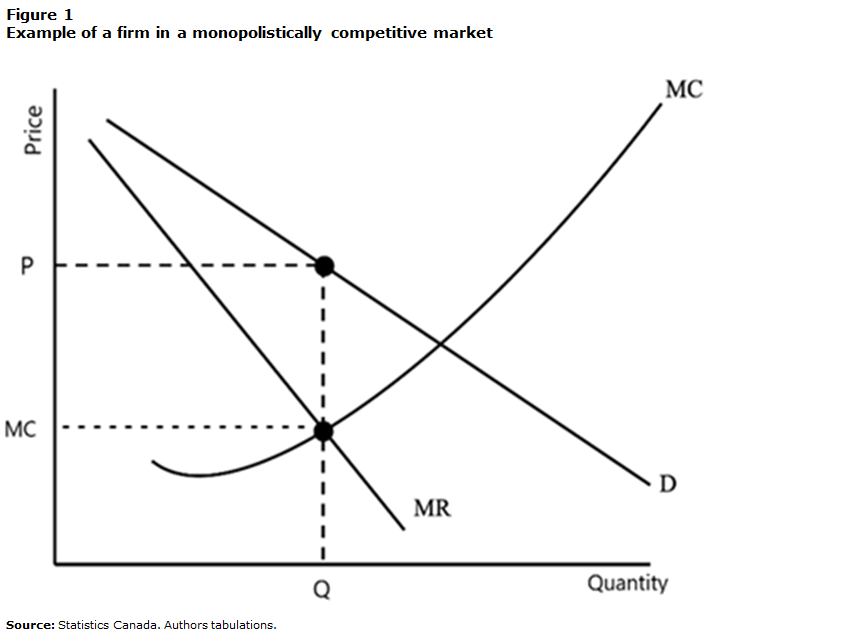
Description for Figure 1
The figure shows the supply (MC), demand (D) and marginal revenue (MR) curves of a typical firm in a monopolistically competitive market. The monopolistic competitive firm sets MR=MC and produces Q number of a product at the price P. The markup for the business is obtained by dividing P over MC, shown on the vertical axes.
4 Methodology
In terms of methodology, this study closely follows the work of De Loecker and Warzynski (2012), which was inspired by Hall (1988). Particularly, in each period, firm of industry minimizes its costs
, (1)
subject to
, (2)
where , , , and are the costs of the variable inputs (labour costs), the cost of fixed input (capital), output technology and Hicks-neutral productivity, respectively. By rearranging the first order conditions of the optimization problem, one can obtain the following equation for the markup:
. (3)
Where and are value-added output and the cost of the variable input (labour cost), respectively, obtained directly from the dataset. However, output elasticity of the variable input, , needs to be estimated. Even though firms in the same industry have different productivity, they have access to similar technology. Therefore, it is assumed that firms inside each industry have the same output elasticity of input () that is not firm specific and does not vary over time.Note Although the assumption of constant elasticity over time and across firms within the same industry is typically used in the literature, it can be a strong assumption. To obtain the output elasticity, following the work of Ackerberg et al. (2015), the following value-added production function is estimated for each industry:
, (4)
where , , , and are the logs of deflated firm-level value added, variable labour cost, capital and productivity, respectively, and is an measurement error. Because the above equation is in log-log form, the estimated coefficients will be interpreted as elasticity. In particular, the estimated coefficient of the variable input, , is the output elasticity of the variable input.
Productivity () captures factors that affect the production process, which are unobservable by econometricians but observable by firms when they make input decisions. Therefore, is likely to be correlated with inputs—omitting it will result in biased estimates of the elasticities. Similar to De Loecker and Warzynski (2012), the paper relies on the two-stage estimation method developed by Ackerberg et al. (2015) to tackle this problem.
For the problem of unobservable productivity, following the literature, the paper relies on an intermediate input bundle to proxy for productivity. In particular, it is assumed that the firm’s intermediate demand is given by
. (5)
Through the assumption of monotonicity, productivity can be defined as follows:
.
Given the function of productivity, one can estimate the above equation using a two-stage process where, in the first stage, the following specification is estimated:
, (6)
where the estimated value-added output ( ) is given by
. (7)
The functional form of is unknown and, therefore, the paper relies on a non-parametric regression (higher-order polynomial) to obtain in Equation 6. Then, productivity can be obtained for any value of as follows:
.
In the second stage, it is assumed that productivity follows an AR(1) process, , where is the AR parameter and is an innovation term. The key idea behind constructing the moment conditions is that the shock to the productivity should be orthogonal to the input decisions made in the previous period ( and ). In other words, the key parameters that determine the value-added elasticity with respect to labour and capital are estimated to satisfy
, (8)
where .Note By plugging back into equation (3), the markups for firm at time can be obtained. The estimated markups in equation (3) are value-added markups. However, the literature reports gross-output markups. Hall, Blanchard and Hubbard (1986) state that the exclusion of intermediate inputs from gross output may lead to an overestimate of the markups (see Rotemberg and Woodford [1993], Basu and Fernald [1997], and Basu and Fernald [2002]). To compute gross markups, the paper follows the above literature and assumes the gross production function is proportional to intermediate inputs and firms are price takers in intermediate input markets. In other words, the gross production function is Leontief in intermediate inputs:
, (9)
where is gross output, is the amount of intermediate inputs, is the value-added production function with labour () and capital () as the inputs, and is the weight of intermediate input in one unit of output. Given the definition of the marginal cost of production in gross and value-added output, the following relationship can be obtained between the gross-output markups and the estimated value-added markups. Note
, (10)
where is the ratio of intermediate input costs over total revenue, and is the gross markup that determines the price of a product over its marginal cost.
5 Data
The study uses firm-level administrative data from the NALMF dataset, which has two notable advantages over databases that are widely used in the literature, such as Compustat dataset. First, NALMF provides a separate report for the wage bill of all firms. Second, NALMF contains the information of financial statements on the universe of firms, i.e., both publicly traded and non-publicly traded firms.
The frequency of data in this study is annual, covering from 2001 to 2019. The regression variables (valued-added output, revenue, intermediate output, capital and wage bills) are deflated at the industry level, which is categorized into 15 sectors based on 2-digit North American Industry Classification System (NAICS) codes. The study drops the utilities sector (NAICS 22) because it is highly regulated and the educational services (NAICS 61) and health care and social services (NAICS 62) sectors because they are mainly owned by the public sector. To eliminate the distortions caused by mergers and acquisitions, the study removes any firms if they experienced more than a 25% change in their asset growth and more than 50% in their revenue growth. Also, to mitigate the effect of outliers, the top and bottom 3% of the variables used in the regression (i.e., value-added output, revenue, wage bill and capital) are winzorized with replacement. The result is robust to winzorizing as low as 2% and as high as 5%. Moreover, the study drops any observation if the firm’s labour share of income is outside the range of .Note Value added is defined as in the production approach, i.e., total revenue minus intermediate inputs, where intermediation inputs are defined as total revenue minus total wage bills (labour costs) and capital depreciation (capital costs). Wage bill is defined as the total cost of labour, which is calculated as T4 payroll plus employee benefits.Note To construct the measure of capital, the study applies the perpetual inventory method. To generate the initial level of capital, the accumulated depreciation is dropped from the firms’ first-year stock of capital and then added the flow of depreciation for that specific year. After the first year, capital accumulates as where and are the capital and investment of a firm at time .
6 Results
6.1 Wage bill as measure of variable costs
Chart 1 shows the average gross markups when the wage bill is considered a variable cost. The measure of markups using the wage bill is defined as a baseline, and in the following subsections, the results will be compared with the other two variable costs, i.e., the COGS and OpEx. The average markups are weighted based on the value added of each firm. The result shows that the average gross markups increased by about 5.3%, from 1.12 in 2001 to 1.18 in 2019, when the wage bill is considered as a measure of variable costs. In other words, on average, the ratio of price over marginal costs increased from 1.12 in 2001 to 1.18 in 2019 in the Canadian economy. For example, suppose that the marginal cost of a typical firm is $100 and constant over time. In 2001, the firm charged $112 for a unit of its product and increased the price to $118 in 2019. The study finds that although markups fluctuated in the period before the recession of 2008, they had no upward trend. However, they have gradually increased since the recession. Studies also find that markups increased during the recession in the United States because low-productive firms exited the market and the remaining firms gained more market share, raising markups (Hong, 2018b).
As mentioned earlier, an increase in markups could be associated with lower firm dynamics. Chart 2 illustrates the dynamics of Canadian firms. The chart displays the growth rates of active firms and the entry rates (the percentage of entrants to active firms) over the study period. The focus of the study is on the long-term trend, so the rates are calculated based on the three years of moving average to mitigate any temporary effects of shocks.Note The chart shows that the growth rates of active firms declined from around 6.3% in 2004 to about 2.0% in 2019. The decrease in the growth of active rates was mainly driven by the decline in entry rates, as they dropped from about 14.0% in 2002 to around 12.8% in 2019. Gu (2024) also indicates that the decline in entry rates can account for about 30% of the decrease in the investment of Canadian firms, which coincides with an increase in market concentration. By comparing the movements of markups with entry rates, it can be determined that the two curves move in opposite directions; as the entry rate declines, markup increase, especially in the post-recession of 2008.

Data table for Chart 1
| Wage markups | |
|---|---|
| percent | |
| Notes: The chart displays the estimates of gross markups in Canada using the wage bill as the measure of the variable cost. The average markups are weighted by the value-added output of firms.
Source: Statistics Canada, author's calculations using microdata. |
|
| 2001 | 1.121 |
| 2002 | 1.133 |
| 2003 | 1.154 |
| 2004 | 1.123 |
| 2005 | 1.152 |
| 2006 | 1.131 |
| 2007 | 1.143 |
| 2008 | 1.121 |
| 2009 | 1.144 |
| 2010 | 1.174 |
| 2011 | 1.152 |
| 2012 | 1.147 |
| 2013 | 1.157 |
| 2014 | 1.172 |
| 2015 | 1.165 |
| 2016 | 1.174 |
| 2017 | 1.167 |
| 2018 | 1.164 |
| 2019 | 1.181 |
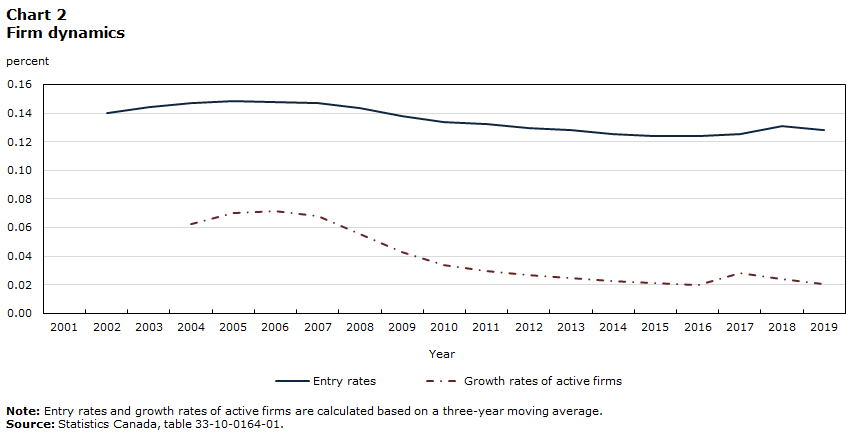
Data table for Chart 2
| Average of entry rates | ||
|---|---|---|
| Entry rates | Growth rates of active firms | |
| percent | ||
Source: Statistics Canada, table 33-10-0164-01. |
||
| 2001 | ... not applicable | ... not applicable |
| 2002 | 0.140 | ... not applicable |
| 2003 | 0.144 | ... not applicable |
| 2004 | 0.147 | 0.063 |
| 2005 | 0.148 | 0.070 |
| 2006 | 0.148 | 0.071 |
| 2007 | 0.147 | 0.068 |
| 2008 | 0.143 | 0.055 |
| 2009 | 0.138 | 0.043 |
| 2010 | 0.133 | 0.034 |
| 2011 | 0.132 | 0.030 |
| 2012 | 0.130 | 0.027 |
| 2013 | 0.128 | 0.025 |
| 2014 | 0.126 | 0.022 |
| 2015 | 0.124 | 0.021 |
| 2016 | 0.124 | 0.020 |
| 2017 | 0.125 | 0.028 |
| 2018 | 0.131 | 0.024 |
| 2019 | 0.128 | 0.020 |
6.2 Changing the measure of variable costs
In this subsection, the paper re-estimates the gross markups using the more conventional measure of variable costs, i.e., the OpEx and the COGS, the two widely used variable costs in the literature. Then, the results are compared with the baseline model, where the wage bill is considered as the measure of variable cost. To estimate gross markups directly using the COGS and OpEx, the paper follows the works of De Loecker and Eeckhout (2017) and De Loecker et al. (2020). The result, displayed in Chart 4, shows that the gross markups have increased by 6.7%, from 1.07 in 2001 to 1.15 in 2019, using OpEx as a measure of variable costs. However, they increased by 13.3%, from 1.38 to 1.56, over the same time, using the COGS as a measure of variable cost. The findings indicate that the slopes and levels of estimated markups using wage bills and OpEx are quite similar. However, using COGS will result in a higher slope and level of markups than the ones using wage bills and OpEx. Using limited data, De Loecker and Eeckhout (2018) study the rise of global markups where Canada is also included in their sample. They use the COGS as a measure of variable cost and state that the gross markups in Canada increased by more than 60%, from around 0.92 in the early 1980s to about 1.53 in 2016. However, this paper uses the universe of Canadian firms obtained from the NALMF dataset and shows that, although the level of markups in recent years is similar to those of De Loecker and Eeckhout (2018), the growth of markups, i.e., the slope, is considerably smaller than what they estimate.
As discussed in the introduction, estimating markups is sensitive to the measure of variable cost in the ratio of output to variable costs.Note Therefore, any mismeasurement of variable costs in the denominator of the markup equation will result in a biased estimation of markups. Basu (2019) emphasizes that the COGS undervalues variable costs because it excludes some variable costs, such as salaried workers. Hence, it may result in a higher level of markup compared with OpEx. On the other hand, the bundle of OpEx may overvalue variable costs because it includes some semi-fixed costs, such as marketing expenses, resulting in an underestimation of the markups. By comparing the values of estimated markups using the three variable costs, it can be determined that, although the growth of markups (i.e., the slope of the curves) is relatively similar, the estimated level of wage markups is much closer to the OpEx than COGS markups. The findings of this paper can confirm the argument of Basu (2019) that the use of a more comprehensive measure of variable costs, such as OpEx, is better than COGS when a reliable measure of variable input is not available.

Data table for Chart 3
| COGS markups | Wage markups | OpEx markups | |
|---|---|---|---|
| percent | |||
| Notes: COGS = cost of goods sold and OpEx = operating expenses.
Source: Statistics Canada, author's calculations using microdata. |
|||
| 2001 | 1.377 | 1.121 | 1.075 |
| 2002 | 1.368 | 1.133 | 1.072 |
| 2003 | 1.370 | 1.154 | 1.097 |
| 2004 | 1.396 | 1.123 | 1.085 |
| 2005 | 1.420 | 1.152 | 1.106 |
| 2006 | 1.431 | 1.131 | 1.106 |
| 2007 | 1.450 | 1.143 | 1.114 |
| 2008 | 1.414 | 1.121 | 1.075 |
| 2009 | 1.383 | 1.144 | 1.083 |
| 2010 | 1.426 | 1.174 | 1.126 |
| 2011 | 1.377 | 1.152 | 1.132 |
| 2012 | 1.401 | 1.147 | 1.128 |
| 2013 | 1.412 | 1.157 | 1.126 |
| 2014 | 1.421 | 1.172 | 1.137 |
| 2015 | 1.482 | 1.165 | 1.130 |
| 2016 | 1.471 | 1.174 | 1.148 |
| 2017 | 1.497 | 1.167 | 1.141 |
| 2018 | 1.508 | 1.164 | 1.146 |
| 2019 | 1.560 | 1.181 | 1.147 |
6.3 The dispersion of markups
Having firm-level markups allows for tracking the distribution of markups over time. To study the dispersion of markups across firms, the author sorts the firms according to their markups and finds the 50th, 75th and 90th percentiles of markups. To obtain the percentiles, the markups of each firm are weighted by their share of value added. The result, which is exhibited in Chart 4, shows a notable divergence in the distribution across firms over the study period, regardless of how to estimate markups. The median of markups is below the average and relatively flat over the study period. In other words, firms whose markups are at the 50th percentile of the markup distribution did not experience any increase in their markups during the study period. Markups for the 75th percentile are above and almost parallel to the average markups. Those in the 90th percentile increased significantly more than the average markups. For example, considering the dispersion of wage markups shown in Chart 4, those in the 90th percentile increased by 16.1%, from 1.23 to 1.43, which is more than double the increase in average wage markups. The dispersion of markups indicates that first, there is heterogeneity among firms at a point in time, and second, the dispersion over time increased significantly across the distribution, especially in the period after the recession of 2008. For instance, considering the wage markups, the difference between the medians and 90th percentiles almost tripled over the study period. In 2001, the wage markups of a firm at the 90th percentile of the distribution were 11.1% more than those in the median, but the difference increased to 29.1% in 2019.

Data table for Chart 4
| Average markups | Median | 75th percentile | 90th percentile | |
|---|---|---|---|---|
| percent | ||||
| Source: Calculated by the author using microdata. | ||||
| Dispersion of wage markups | ||||
| 2001 | 1.12 | 1.11 | 1.16 | 1.23 |
| 2002 | 1.13 | 1.11 | 1.19 | 1.27 |
| 2003 | 1.15 | 1.12 | 1.23 | 1.32 |
| 2004 | 1.12 | 1.10 | 1.18 | 1.26 |
| 2005 | 1.15 | 1.10 | 1.20 | 1.38 |
| 2006 | 1.13 | 1.09 | 1.18 | 1.29 |
| 2007 | 1.14 | 1.10 | 1.19 | 1.36 |
| 2008 | 1.12 | 1.08 | 1.16 | 1.27 |
| 2009 | 1.14 | 1.08 | 1.20 | 1.35 |
| 2010 | 1.17 | 1.10 | 1.24 | 1.37 |
| 2011 | 1.15 | 1.10 | 1.21 | 1.37 |
| 2012 | 1.15 | 1.10 | 1.23 | 1.35 |
| 2013 | 1.16 | 1.10 | 1.25 | 1.44 |
| 2014 | 1.17 | 1.11 | 1.25 | 1.46 |
| 2015 | 1.16 | 1.10 | 1.25 | 1.44 |
| 2016 | 1.17 | 1.11 | 1.26 | 1.47 |
| 2017 | 1.17 | 1.12 | 1.27 | 1.40 |
| 2018 | 1.16 | 1.10 | 1.26 | 1.41 |
| 2019 | 1.18 | 1.11 | 1.23 | 1.43 |
| Dispersion of operating expenses markups | ||||
| 2001 | 1.07 | 1.04 | 1.14 | 1.25 |
| 2002 | 1.07 | 1.04 | 1.13 | 1.25 |
| 2003 | 1.10 | 1.05 | 1.19 | 1.31 |
| 2004 | 1.08 | 1.05 | 1.14 | 1.26 |
| 2005 | 1.11 | 1.05 | 1.17 | 1.28 |
| 2006 | 1.11 | 1.04 | 1.15 | 1.27 |
| 2007 | 1.11 | 1.05 | 1.17 | 1.30 |
| 2008 | 1.07 | 1.03 | 1.13 | 1.27 |
| 2009 | 1.08 | 1.03 | 1.12 | 1.28 |
| 2010 | 1.13 | 1.04 | 1.19 | 1.38 |
| 2011 | 1.13 | 1.06 | 1.19 | 1.45 |
| 2012 | 1.13 | 1.05 | 1.21 | 1.43 |
| 2013 | 1.13 | 1.04 | 1.22 | 1.45 |
| 2014 | 1.14 | 1.05 | 1.20 | 1.51 |
| 2015 | 1.13 | 1.04 | 1.21 | 1.49 |
| 2016 | 1.15 | 1.05 | 1.23 | 1.57 |
| 2017 | 1.14 | 1.06 | 1.22 | 1.43 |
| 2018 | 1.15 | 1.06 | 1.22 | 1.41 |
| 2019 | 1.15 | 1.05 | 1.19 | 1.41 |
| Dispersion of cost of goods sold markups | ||||
| 2001 | 1.38 | 1.21 | 1.46 | 2.10 |
| 2002 | 1.37 | 1.19 | 1.46 | 1.96 |
| 2003 | 1.37 | 1.21 | 1.44 | 2.04 |
| 2004 | 1.40 | 1.20 | 1.52 | 2.10 |
| 2005 | 1.42 | 1.22 | 1.52 | 2.16 |
| 2006 | 1.43 | 1.20 | 1.54 | 2.22 |
| 2007 | 1.45 | 1.25 | 1.50 | 2.50 |
| 2008 | 1.41 | 1.24 | 1.48 | 2.16 |
| 2009 | 1.38 | 1.20 | 1.50 | 2.06 |
| 2010 | 1.43 | 1.23 | 1.60 | 2.21 |
| 2011 | 1.38 | 1.22 | 1.52 | 1.94 |
| 2012 | 1.40 | 1.22 | 1.54 | 2.04 |
| 2013 | 1.41 | 1.24 | 1.54 | 2.06 |
| 2014 | 1.42 | 1.26 | 1.54 | 2.17 |
| 2015 | 1.48 | 1.24 | 1.62 | 2.43 |
| 2016 | 1.47 | 1.25 | 1.61 | 2.47 |
| 2017 | 1.50 | 1.24 | 1.63 | 2.46 |
| 2018 | 1.51 | 1.26 | 1.68 | 2.53 |
| 2019 | 1.56 | 1.27 | 1.74 | 2.56 |
6.4 Markups, profit shares and the market power
The rise in markups does not necessarily mean higher profits for firms. For example, suppose a firm invests significant amounts in capital (fixed input cost), which results in higher production. In that case, its markups may increase, at least in the short term, because of the declining share of variable inputs in the production. However, the profit may or may not change, depending on the investment cost. In other words, the profit per unit of output is the difference between the price and average cost of the product, while markups are the difference between price and the marginal costs of production. Therefore, an increase in markups alone may not explain the rise of market power if it does not increase the profitability of firms.
To study the profitability of firms, the paper calculates the profit share of output across firms. Profit share is defined as the share of profits (i.e., revenue minus total expenses) in a firm’s revenue. Chart 5 displays the average profit shares of firms over the study period. The average profits are weighted by the value added of firms. The result indicates that, on average, profit shares increased by 4 percentage points, from 9.2% in 2001 to 13.2% in 2019. An increase in both the profitability and markups, regardless of how to measure them, indicates the rise of market power in the Canadian economy. This result aligns with the recent studies of the Competition Bureau Canada (2023), which, using various indexes, finds that the market competition declined in Canada. Among other indexes, they state that industry concentration and markups in Canada have increased in recent years. In particular, they find that markups increased by 6.7% from 2001 to 2018, which is similar to the increase found in this paper. Gu (2024) also finds that the increase in industry concentration in Canada coincides with a decline in firm entry rates and a decrease in investments.

Data table for Chart 5
| Average profit share | |
|---|---|
| percent | |
| Notes: The profit share of a business is defined as the share of profits in the business's revenue. Profits are calculated as revenue minus total expenses. The average profit shares are weighted by the value added of businesses.
Source: Statistics Canada, authors' calculations using microdata |
|
| 2001 | 0.09 |
| 2002 | 0.09 |
| 2003 | 0.11 |
| 2004 | 0.10 |
| 2005 | 0.11 |
| 2006 | 0.11 |
| 2007 | 0.12 |
| 2008 | 0.09 |
| 2009 | 0.10 |
| 2010 | 0.12 |
| 2011 | 0.13 |
| 2012 | 0.13 |
| 2013 | 0.12 |
| 2014 | 0.13 |
| 2015 | 0.13 |
| 2016 | 0.14 |
| 2017 | 0.13 |
| 2018 | 0.13 |
| 2019 | 0.13 |
7 Conclusion
An increase in markups can be associated with lower welfare, higher inefficiency and fewer firm dynamics. Therefore, it is important to know the dynamics of markups over time, as well as their estimates at a point in time. Although the literature on firm-level markups has some advantages, it presents some challenges, too. The two main challenges are the sample selection bias due to using only publicly traded firms and the measurement errors in the commonly used measures of variable costs. This paper addresses these challenges by using the novel and rich database of the National Accounts Longitudinal Microdata File (NALMF). In particular, both publicly traded and non-publicly traded firms are considered to address the selection bias of using only publicly traded firms. The paper also defines the wage bill as an alternative measure of variable costs and compares the results with markups using the cost of goods sold (COGS) and operating expenses (OpEx) measures. In general, the COGS may undervalue the measure of variable costs, which could lead to overestimating markups (Basu, 2019). On the other hand, OpEx may overvalue variable costs because it includes fixed variable costs such as marketing expenses, resulting in underestimating markups. Using the NALMF database allows the study to define the wage bill as an alternative measure of the variable cost, which some studies refer to as a clearer measure of variable cost than those widely used in the literature (see Basu [2019]).
The result shows that the average gross markups increased by about 5.3%, from 1.12 in 2001 to 1.18 in 2019, when using wage bill as a measure of variable costs. By comparison, using OpEx as a measure of variable cost results in an increase of around 6.7%, from 1.07 to 1.15, while using the COGS leads to about a 13.3% increase in markups, from 1.38 to 1.56 over the same study period. By comparing the results of the three measures of variable costs, one can conclude that the slopes and levels of estimated markups using wage bills and OpEx are quite similar. However, using COGS will result in a higher slope and level of markups than using wage bills and OpEx. This paper’s findings indicate uncertainty about the exact estimates of markups, which depend on how variable costs are measured. Regardless of how variable costs are measured, the paper shows that markups have increased in Canada in the past two decades. The rise in markups coincides with lower firm dynamics and higher profit shares, which could imply a rise in market power in the Canadian economy, especially in the period after the recession of 2008.
References
Ackerberg, D. A., Caves, K. and Frazer, G. (2015). Identification properties of recent production function estimators, Econometrica 83(6), 2411–2451.
Autor, D., Dorn, D., Katz, L. F., Patterson, C., & Van Reenen, J. (2020). The fall of the labor share and the rise of superstar firms. The Quarterly Journal of Economics, 135(2), 645-709.
Barkai, S. (2017). Declining labor and capital shares, Working paper, University of Chicago.
Basu, S. (2019). Are price-cost markups rising in the United States? A discussion of the evidence, Journal of Economic Perspectives 33(3), 3–22.
Basu, S. and Fernald, J. G. (1997). Returns to scale in us production: Estimates and implications, Journal of Political Economy 105(2), 249–283.
Basu, S. and Fernald, J. G. (2002). Aggregate productivity and aggregate technology, European Economic Review 46(6), 963–991.
Berry, S., Gaynor, M. and Scott Morton, F. (2019). Do increasing markups matter? lessons from empirical industrial organization, Journal of Economic Perspectives 33(3), 44–68.
Bilyk, O., Grieder, T., and Khan, M. (2023). Markups and inflation during the COVID-19 pandemic (No. 2023-8). Bank of Canada.
Bond, S., Hashemi, A., Kaplan, G. and Zoch, P. (2020). Some unpleasant markup arithmetic: Production function elasticities and their estimation from production data, Working Paper 27002, National Bureau of Economic Research.
Competition Bureau Canada (2023). Competition in Canada from 2000 to 2020: An Economy at a Crossroads, Ottawa
De Loecker, J., and Eeckhout, J. (2017). The Rise of Market Power and the Macroeconomic Implications, Working Paper 23687. National Bureau of Economic Research.
De Loecker, J. and Eeckhout, J. (2018). Global market power, Working Paper 24768, National Bureau of Economic Research.
De Loecker, J., Eeckhout, J. and Unger, G. (2020). The rise of market power and the macroeconomic implications, The Quarterly Journal of Economics 135(2), 561– 644.
De Loecker, J. and Warzynski, F. (2012). Markups and firm-level export status, American Economic Review 102(6), 2437–71.
Diez, F., Leigh, D. and Tambunlertchai, S. (2018). Global market power and its 111 macroeconomic implications, Working Paper WP/18/137, International Monetary Fund.
Faryaar H., D. Leung, and A. Fortier-Labonte (2023). Markups and inflation, evidence from firm-level data, Statistics Canada Economic and Social Reports, 3(6), 1-11.
Gu, W. (2024). Investment Slowdown in Canada After the Mid-2000s: The Role of Competition and Intangibles, Analytical Studies Branch Research Paper Series, Statistics Canada, Catalogue no. 11F0019M — No. 474.
Hall, R. E. (1988). The relation between price and marginal cost in us industry, Journal of Political Economy 96(5), 921–947.
Hall, R. E. (2018). New evidence on the markup of prices over marginal costs and the role of mega-firms in the us economy, Working Paper 24574, National Bureau of Economic Research.
Hall, R. E., Blanchard, O. J. and Hubbard, R. G. (1986). Market structure and macroeconomic fluctuations, Brookings Papers on Economic Activity 1986(2), 285–338.
Hambur, J. (2021). Product market power and its implications for the Australian economy. Working paper No. 2021-03, Treasury Working Paper.
Hong, S. (2018a). Price markups for small and large firms over the business cycle, Economic Synopses (17), 1-3.
Hong, S. (2018b). Firms’ Price-Markup Dynamics During the Great Recession. Economic Synopses, (20), 1-2.
Khan, H. and Kim, B.-G. (2013). Markups and oil prices in Canada, Economic Modelling 30, 799–813.
Leung, D. (2008). Markups in Canada: Have they changed and why?, Working Paper 2008-7, Bank of Canada.
Martins, J. O., Scarpetta, S. and Pilat, D. (1996). Mark-up pricing, market structure and the business cycle, OECD Economic Studies (27), 71-106.
Rotemberg, J. J. and Woodford, M. (1993). Dynamic general equilibrium models with imperfectly competitive product markets, Working Paper 4502, National Bureau of Economic Research.
Stewart, N. (2015). Benefits benchmarking 2015, https://www.conferenceboard. ca/e-library/abstract.aspx?did=7364.
Syverson, C. (2019). Macroeconomics and market power: Context, implications, and open questions, Journal of Economic Perspectives 33(3), 23-43.
Traina, J. (2018). “Is Aggregate Market Power Increasing? Production Trends Using Financial Statements.” Stigler Center New Working Paper Series 17.
Van Reenen, J. (2018). Increasing differences between firms: market power and the macro-economy, Discussion Paper CEPDP1576, London School of Economics and Political Science.
- Date modified: