Feature article
Terms of Trade, GDP and the Exchange Rate
by F. Roy*
Introduction
The terms of our international trade – the ratio of our export
to import prices – have a major effect on Canada’s
economic performance. They directly affect our nominal trade balance,
which reflects not only the volume of trade flows but also their
prices. Indirectly, changes in the terms of trade also influence
the composition of domestic demand through their impact on prices
and profits in different sectors.
This paper looks at the reasons for the recent sharp shift in
Canada’s terms of trade and its impact on different sectors
of the economy. We also look to the recent American experience
with a sharply rising dollar as a guide to how different sectors
of the economy could gain or lose from these changes. The focus
of this article is not on the overall net effect, which is likely
to be small,1 but on the distributional effects, which have already
been considerable.
Our dollar had a sharp turnaround in 2003. Driven by a 10.8% gain against the
US dollar, the effective exchange rate 2 of the Canadian dollar rose 10.5% on
average in 2003. Among OECD countries, only Australia, New Zealand and the
Euro-zone countries posted slightly faster increases. The increase from December
2002 to December 2003 was more striking, at nearly 20%. Still, the dollar remains
well below its 1991 peak.
Terms of Trade and the Dollar
Figure 1 shows the long-run relationship of Canada’s terms of trade
3 and our exchange rate with the US. Broadly speaking, the two move together,
with the terms of trade often shifting slightly in advance of the dollar.
But there are important exceptions, including much of the 1960s (when the
exchange rate was fixed) and 1973-74 when commodity prices surged. Most recently,
the terms of trade have improved noticeably on two occasions in the last
eight years (including California’s energy crisis in 2001) without
a commensurate rise in the exchange rate until 2003.
Figure 1

Interestingly, the terms of trade have usually changed for
Canada because of export prices for commodities, especially energy.
This supports the findings in the literature that on balance
causality flows from the terms of trade to the exchange rate.
But in 2003, the reverse happened: a rise in the dollar caused
import prices to drop faster than the associated decline in export
prices, raising our terms of trade.
Figure 2 shows that the terms of trade for Canada and the US are virtually the
mirror image of each other, reflecting the importance of both the exchange rate
and our commodity prices in their determination. Canada’s terms of trade
fluctuate more. In the US, the sharp rise in its currency before 2003 had a smaller
impact on its terms of trade because both export and import prices fell in unison.
Moreover, the external sector of the US is small (relative to its GDP) compared
with most other trading nations. Conversely, the appreciation of our dollar helped
lower import prices for goods across the board, down 12% in the past year. Meanwhile,
export prices have dipped in fewer areas than imports, with an overall retreat
of 7%.
Figure 2

The appreciation of our dollar has been reflected in large and widespread
declines in import prices (Figure 3). Machinery and equipment and consumer
goods, which accounted for 42% of imports in 2003, saw import prices fall
by 15.2% and 12.6% respectively. These two sectors also posted by far the
sharpest rise in the terms of trade, as their export prices did not decline
nearly as much: the terms of trade rose 13.6% for consumer goods and 10.1%
for investment goods (Figure 4). As a result, despite a sharp increase in
the volume of imports, the trade deficit for capital goods varied little
in current dollars as prices fell (Table 1). Similarly, the nominal trade
deficit for consumer goods was little changed at $29 billion, as consumers
bought more imports at lower prices.
Figure 3
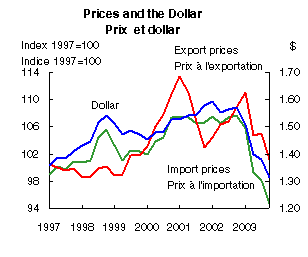
Figure 4

Table 1: Nominal Trade Balance and Terms of Trade by Sector
| |
Total |
Agricultural and fish products |
Energy |
Forestry |
Industrial goods |
Machinery and equipment |
Autos |
Consumer goods |
| Terms of trade* |
|
|
|
|
|
|
|
|
| 1997 |
100.0 |
100.0 |
100.0 |
100.0 |
100.0 |
100.0 |
100.0 |
100.0 |
| 1998 |
96.5 |
98.5 |
99.0 |
100.0 |
94.2 |
97.5 |
100.8 |
94.9 |
| 1999 |
98.1 |
99.6 |
106.5 |
100.2 |
94.0 |
98.2 |
100.2 |
95.9 |
| 2000 |
102.5 |
100.8 |
116.1 |
98.6 |
96.7 |
99.2 |
100.9 |
96.1 |
| 2001 |
101.5 |
103.1 |
123.1 |
100.4 |
92.1 |
98.1 |
101.8 |
93.6 |
| 2002 |
99.4 |
102.3 |
103.7 |
95.1 |
92.5 |
98.6 |
102.5 |
93.9 |
| 2003 |
106.1 |
101.9 |
117.8 |
94.0 |
98.3 |
106.0 |
103.4 |
102.1 |
| Current dollars |
|
|
|
|
|
|
|
|
| 1997 |
25,652 |
9,121 |
16,550 |
32,719 |
2,074 |
-22,405 |
8,644 |
-19,039 |
| 1998 |
23,765 |
7,786 |
15,179 |
32,938 |
-1,125 |
-20,419 |
11,673 |
-22,009 |
| 1999 |
42,011 |
7,957 |
19,168 |
37,340 |
-2,322 |
-19,571 |
21,358 |
-23,016 |
| 2000 |
67,827 |
9,118 |
35,305 |
39,690 |
-1,118 |
-12,509 |
20,677 |
-24,890 |
| 2001 |
70,886 |
10,757 |
38,004 |
37,308 |
-435 |
-9,548 |
20,286 |
-26,624 |
| 2002 |
57,845 |
9,135 |
33,015 |
34,062 |
1,357 |
-8,563 |
15,580 |
-28,749 |
| 2003 |
60,206 |
7,800 |
41,359 |
31,480 |
1,470 |
-8,924 |
11,584 |
-29,073 |
| * The data in this table are annual versus the quarterly
data in Figure 4. |
While import prices have fallen sharply across the board, only two of the
seven export categories saw prices tumble in line with the rise in the dollar.
These sectors – autos and agriculture products — represent less
than one-third of our exports: as well, autos have the highest import content
of any export, and the cost of imported auto products fell more (12.2%) than
exports (-10.4%), easing the pressure on profit margins in this industry.
Agriculture prices were depressed by mad cow disease. Machinery also fell,
although not as fast as these two sectors. Exports of energy and industrial
materials, which are almost as large as autos and agriculture, saw Canadian
dollar prices cushioned by rising prices on world commodity markets, which
offset the effect of the exchange rate (the falling US dollar means every
US dollar earned in exports buys fewer Canadian dollar). Prices for consumer
goods held steady.
The increase in the terms of trade opens the door for GDP to rise as the dollar
appreciates. This is because the drop in import prices allows Canadians to buy
imports at lower prices, freeing up money to purchase other products, or allowing
firms to invest more. Meanwhile, some exporters have suffered from a loss of
export earnings, but this trend is not universal, especially for resource products.
Shipments and Profits
This is borne out by the recent data on manufacturing shipments. Because
of its large export orientation and competition from imports, this sector
is the most exposed to rapid shifts in the terms of trade. Even then, not
all manufacturing industries have been adversely affected.
The exchange rate and shipments are closely related for 9 of the 22 manufacturing
industries 4, accounting for just over half of all shipments (Figure 5). ‘Dollar-sensitive’ shipments
are those where profits have moved in tandem with the exchange rate over
the last 30 years.5 Most of the nine industries are export-oriented, including
autos, chemicals and machinery. But some may make the list because of a susceptibility
to import competition. Industries less affected by the dollar are in the
resource sector (notably petroleum, primary metals and forestry products)
where shipments are more dependent on commodity prices than the dollar. As
well, ‘soft’ goods such as tobacco, leather, textiles and clothing
are in this group, along with information technology (which largely explains
the surge in shipments of these goods in 2000 and subsequent slump).
Figure 5

Shipments of industries responsive to the dollar rose 26% between 1997
and 2002, before edging down last year. Other industries saw only half
this gain over this period. Interestingly, those industries whose profits
are most affected by the exchange rate include those where direct investment
abroad increased the most in the 1990s (notably transportation equipment
and machinery). More investment abroad heightens the effect of the exchange
rate on profits; for example, when remittances from abroad are converted
into Canadian dollars at a lower exchange rate, this boosts profits in
Canada. The reverse occurs when the exchange rate is rising – profits
are depressed.
Manufacturing led the recovery of corporate profits after the 1990-92 recession
in Canada, helped by the falling dollar. But industrial profits in 2003 were
already being squeezed by the dollar’s rise. Non-manufacturing profits
in Canada hit a decade-high as the dollar rose. This is exactly what happened
in the US until last year, as manufacturing profits were cut in half as the
dollar hit its peak, while non-manufacturing profits doubled (Figures 6a
and 6b).
Figure 6a

Figure 6b

This dichotomy was reflected in employment, where the goods-producing
sector contributed twice as much to job growth in Canada as in
the US in the 1990s. Already in 2003, employment in Canada diverged
sharply between steady gains outside manufacturing and a slowdown
in manufacturing.
Sectoral spending
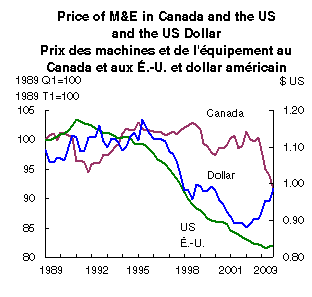
The American experience with a sharp rise in their dollar
before 2002 was strong growth in sectors that benefit from
the lower
prices resulting from a strong currency (mostly tradable goods
6 sectors such as consumer goods and business machinery and
equipment).
Figures 7a and 7b show how prices of these goods closely followed
the trend of the US dollar (inverted), falling about 20% between
1995 and 2002. Meanwhile, prices for these goods were little
changed in Canada during this period.
Figure 7a

Figure 7b
Americans took advantage of these lower prices by substantially
increasing the volume of outlays for consumer goods and machinery
and equipment, which contributed about half of the growth of
aggregate demand between 1989 and 2003. Over the same period
in Canada, these ‘high-dollar’ sectors accounted
for only about one-third of growth. The much faster growth of
US investment in machinery and equipment contributed to their
faster rising productivity.
Conversely, the contribution to growth from the rest of the
economy, including sectors that benefit from a lower exchange
rate (mostly net exports) as well as non-tradables such as services
and construction accounted for a larger share of GDP growth in
Canada than in the US. Most of this reflected the higher contribution
of net exports. These results are little changed if government
services are included. Table 2 shows the contribution of each
sector to overall growth from 1989 to 2003. Figures 8a and 8b
present the contribution of ‘high-dollar’ and other
sectors to cumulative output growth.
Table 2: Contribution to Real GDP Growth, 1989-2003*
| |
Share of GDP growth |
| |
Canada |
United States |
| |
|
|
| GDP |
100.0 |
100.0 |
| |
|
|
| Sectors benefiting from a strong dollar: |
|
|
| Total |
34.8 |
53.3 |
| Consumer goods |
21.8 |
34.9 |
| Business Machinery and equipment |
13.0 |
18.4 |
| |
|
|
| Other sectors |
|
|
| Total |
46.5 |
34.4 |
| Consumer services |
33.8 |
39.3 |
| Business residential and non-residential construction |
3.5 |
3.7 |
| Net exports |
9.2 |
-8.6 |
| |
|
|
| Government (Current and capital) |
15.9 |
11.2 |
| * Without inventories. |
Figure 8a
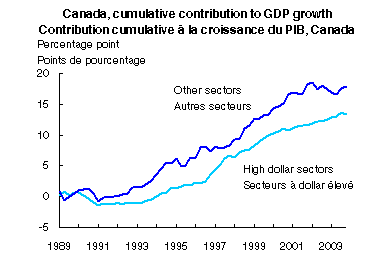
Figure 8b

Helped by a low dollar, net exports played a larger role in
Canada than in the US in boosting growth. But this only counter-balanced
the larger contribution from domestic demand in the US, which
was stimulated in part by lower import prices. Recall that in
the US the rising dollar accompanied sharp declines in both export
and import prices. Exports are a relatively larger factor in
the Canadian economy, but the smaller drop in their prices in
2003 compared with import prices may cause profits and incomes
of exporters to have less of an effect on potential disinflation
in key areas of domestic demand.
At first glance, it is surprising that even spending on services
was stronger in the US than in Canada. However, this is due to
larger increases in health care spending, which accounted for
nearly a third of nominal personal expenditure growth south of
the border between 1988 and 2002. In Canada, outlays for health
care contributed only marginally (7%) to overall consumer services
growth, largely because it is provided mostly by the public sector.
Tourism in Canada is one sector that usually suffers when the exchange rate
rises. But the events of September 11 had already put a brusque end to the
upward trend of international travel 7, with tighter security measures also
affecting travel to Canada. Thus, despite a higher US dollar in 2001 and
into early 2002, the number of Americans traveling abroad fell from 60.9
to 56.4 million, while foreigners visiting the US fell from 50.9 to 41.9
million. The most recent data for Canada show some response of travel flows
to the rise of the loonie, notably our travel overseas. As a result, Canada’s
travel deficit doubled last year to a 10-year high.
Command GDP
One summary measure of the influence of the terms of trade
on aggregate purchasing power is the so-called ‘command-basis’ (or
terms of trade adjusted) measure of GDP, a variant regularly
published by the US. Command GDP differs from real GDP in that
exports are deflated with import prices (instead of export
prices). This is done as a proxy of the ‘command’ over
economic resources arising from shifts in the terms of trade.
It proxies the quantity of goods and services a nation could
buy in the world market, whereas conventional GDP measures
what it produces. If the terms of trade shift in Canada’s
favour, command GDP will rise faster than conventional GDP,
because falling import prices increase our purchasing power
in the world market. Conversely, when our terms of trade worsen
due to import prices rising faster than export prices, this
reduces our purchasing power and lowers command GDP (as occurred
in 1998 and 2001), because we sell our products more cheaply
and pay more for what we buy 8.
Figure 9 shows that the adjustment for command-based GDP makes almost no difference
for the US. While the adjustment does closely track shifts in their terms
of trade, the external sector is so small relative to the US economy that
the overall effect on GDP is minimal. While the command-based GDP has a similar
relationship with the terms of trade in Canada, our much larger exposure
to foreign trade amplifies the effect on GDP. Since reaching its low late
in 2001, the terms of trade have risen 10.6%: as a consequence, we can export
10.6% less to pay for a given quantity of imports than in late 2001. Command
GDP was 9.6% higher than two years ago.
Figure 9

Conclusion
Producers have felt the negative fall-out from our rising exchange
rate almost immediately: the terms of trade shifted in favor
of importers at the expense of exporters, employment fell in
factories, and investment income from abroad contracted when
converted into Canadian dollars. However, the recent experience
of the US suggests that a rising dollar also has positive effects,
partly by putting downward pressure on prices and hence interest
rates. It deflates the import bill for consumer and investment
goods, freeing up income for more spending and stimulating
investment in high-tech and other productivity enhancing goods.
Recent feature articles
Note
* Current Analysis (613) 951-3627
or ceo@statcan.ca.
1. The vast majority of economic research shows that improvements
in the terms of trade lend a small net stimulus to the economy.
For example, a review by the NBER concluded that “positive
terms of trade shocks will always (ceteris paribus) raise GDP,
and the empirical issue is only how much,” p. 21 in “Terms
of Trade Shocks and Economic Performance 1870-1940: Prebisch and
Singer Revisited” by Y. Hadass and J. Williamson, NBER Working
Paper 8188, Cambridge MA, 2001.
2. This is the Canadian dollar measured against other OECD currencies
weighted by their share in trade.
3. All data on trade and prices in this study come from the National
Accounts, which include Balance of Payments adjustments.
4. Transportation equipment was split into autos and other, partly
to facilitate the comparison with profits.
5. Three databases on corporate before-tax profits were linked
over time: the NAICS-based classification from 1998 to 2001; the
1980 SIC classification from 1988 to 1997; and the 1960 SIC classification
from 1972 to 1987. Dollar-sensitive industries are defined as having
a correlation coefficient of over 0.5 between profits and the exchange
rate over the whole period.
6. For more on the distinction between tradable and non-tradable
goods, see J. Greenwood, “Non-Traded Goods, the Trade Balance
and the Balance of Payments” in The Canadian Journal of
Economics, Vol. 17 No. 4, November 1984.
7. From 1992 to 2000, nearly 20 million more Americans made trips
abroad every year, an increase of nearly 50%, while visitors to
the US rose by only 5 million or about 10%.
8. See also p. 10-11 P. Krugman and R. Lawrence, “Trade,
Jobs and Wages”. NBER Working Paper No. 4478, Cambridge MA,
1993. |


