
Infographic 1
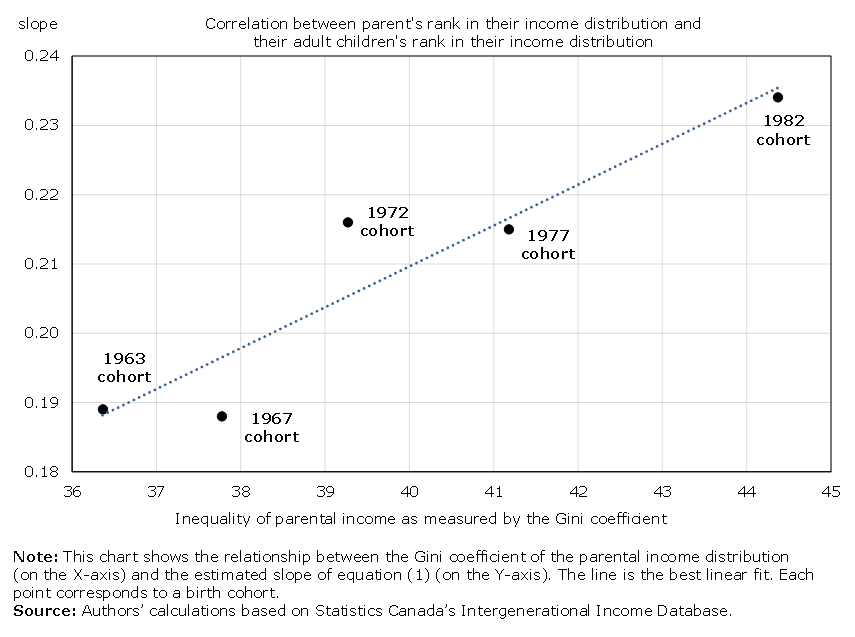
Canada moving up the Great Gatsby Curve over the span of five birth cohorts
Infographic description
The title of the infographic is "Canada moving up the Great Gatsby Curve over the span of five birth cohorts"
The infographic shows five dots on a grid. Each dot represents one birth cohort. The five birth cohorts shown on the grid are the 1963 cohort, the 1967 cohort, the 1972 cohort, the 1977 cohort and the 1982 cohort.
The horizontal axis of the grid shows the level of income inequality observed among the parents, as measured by the Gini coefficient. The horizontal scale ranges from 36 on the left, representing a lower level of income inequality, to 45 on the right, representing a higher level in income inequality.
The vertical axis shows the correlation between parent's rank in their income distribution and their adult children's rank in their income distribution. The vertical scale ranges from 0.18 at the bottom to 0.24 at the top. A higher score means that an individual's rank is more strongly determined by the rank of their parent and that income mobility is lower.
The 1963 cohort has an inequality of parent income score of 36 on the horizontal axis and an income mobility score of 0.18 on the vertical axis, placing this cohort in the bottom left corner of the grid. The 1982 cohort has an inequality of parent income score of almost 45 on the horizontal axis and an income mobility score of 0.23 on the vertical axis. This places the 1982 cohort in the top right corner of the grid. The 1967, 1972 and 1977 cohorts are each positioned successively further to the right and higher up on the grid. This indicates that, over the span of the five cohorts, inequality of parental income increased and children's income mobility decreased.
Note: This infographic shows the relationship between the Gini coefficient of the parental income distribution (on the X-axis) and the estimated slope of equation (1) (on the Y-axis). The line is the best linear fit. Each point corresponds to a birth cohort.
Source: Authors' calculations based on Statistics Canada's Intergenerational Income Database.
- Date modified: