|
82-221-XIE
| Health
Indicators |
| December
2000 |
Overview
(pdf - print format)
Background
In 1998, over 500 people - health administrators, researchers,
caregivers, government officials, health advocacy groups, and consumers
– were brought together to identify health information needs. One
of their priorities was comparable quality data on key health indicators
for health and health services.
In response to the consultations, Statistics Canada and
the Canadian Institute for Health Information (CIHI) have launched a collaborative
process to identify what measures should be used to report on health and
the health system – and then to share this information with Canadians
from coast to coast.
Health indicators are:
- relevant to established health goals
- based on standard (comparable) definitions and methods
- broadly available – disseminated electronically
across Canada at the regional, provincial and national level
The primary goal of the Health Indicators project is to
support health regions in monitoring progress in improving and maintaining
the health of the population and the functioning of the health system
for which they are responsible through the provision of quality, comparative
information on:
- The overall health of the population served, how it
compares to other regions in the province and country and how it is
changing over time;
- The major non-medical determinants of health in the
region;
- The health services received by the region’s residents;
and
- Characteristics of the community or the health system
that provide useful contextual information.
Consultations continue with provincial and regional health
authorities to refine and expand the initial list of indicators confirmed
at the consensus conference of May 1999. As data are compiled, the provincial
and regional authorities are also involved in the verification process.
This collaborative process is intended to ensure relevant data and consistent
methods.
Regional health indicators
The core list of health indicators is presented in the
following table, within the Indicators Framework. The indicators included
in this publication (underlined) are available at the health region level
and represent a subset of this core list of indicators. Subsequent releases
will add indicators and time series as these data are developed at the
regional level, and new health data are collected.
|
Health Status
|
|
Well-Being
|
Health Conditions
|
Human
Function
|
Deaths
|
- Self-rated health
- Self-rated ‘excellent’ health for
two consecutive survey cycles
- Self-esteem
- Mastery
|
|
- Functional health
- Disability-days
- Activity limitation
|
|
|
Non-Medical Determinants
of Health
|
|
Health
Behaviours
|
Living and Working
Conditions
|
Personal Resources
|
Environmental Factors
|
- Smoking rate
- Youth smoking rate
- Smoking initiation
(average age)
- Quitting smoking
- Regular heavy
drinking
- Physical activity
- Breastfeeding
|
|
- School readiness
- Social support
- Life stress
|
|
|
Health System Performance
|
|
Acceptability
|
Accessibility
|
Appropriateness
|
Competence
|
|
|
- Influenza
immunization, 65+
- Screening
mammography,
women age 50-69
- Pap smears, age 18-69
- Childhood immunizations
|
|
|
|
Continuity
|
Effectiveness
|
Efficiency
|
Safety
|
|
|
|
|
|
|
Community and Health
System Characteristics
|
|
|
|
Health Regions
Health regions are defined by provincial governments as
the areas of responsibility for regional health boards (i.e., legislated)
or as regions of interest to health care authorities.
The following table presents an overview of health regions
in Canada, by province and territory and links to maps (jpeg or pdf) for
viewing current boundaries.
Health regions in Canada
|
Province
|
Health regions1
|
Units
|
Map
|
|
Newfoundland
|
Community Health Regions
|
6
|
jpeg
|
pdf
|
|
Prince Edward Island
|
Health Regions (Health Survey)
|
2
|
jpeg
|
pdf
|
|
Nova Scotia
|
Health Regions (Zones)
|
6
|
jpeg
|
pdf
|
|
New Brunswick
|
Health (Hospital) Regions
|
7
|
jpeg
|
pdf
|
|
Quebec
|
Régions socio-sanitaires (RSS)
|
18
|
jpeg
|
pdf
|
|
Ontario2
|
Public Health Units (PHU)
District Health Councils (DHC)
|
37
16
|
jpeg jpeg
jpeg
|
pdf pdf
pdf
|
|
Manitoba
|
Health Regions
|
12
|
jpeg
|
pdf
|
|
Saskatchewan
|
Service Areas
|
11
|
jpeg
|
pdf
|
|
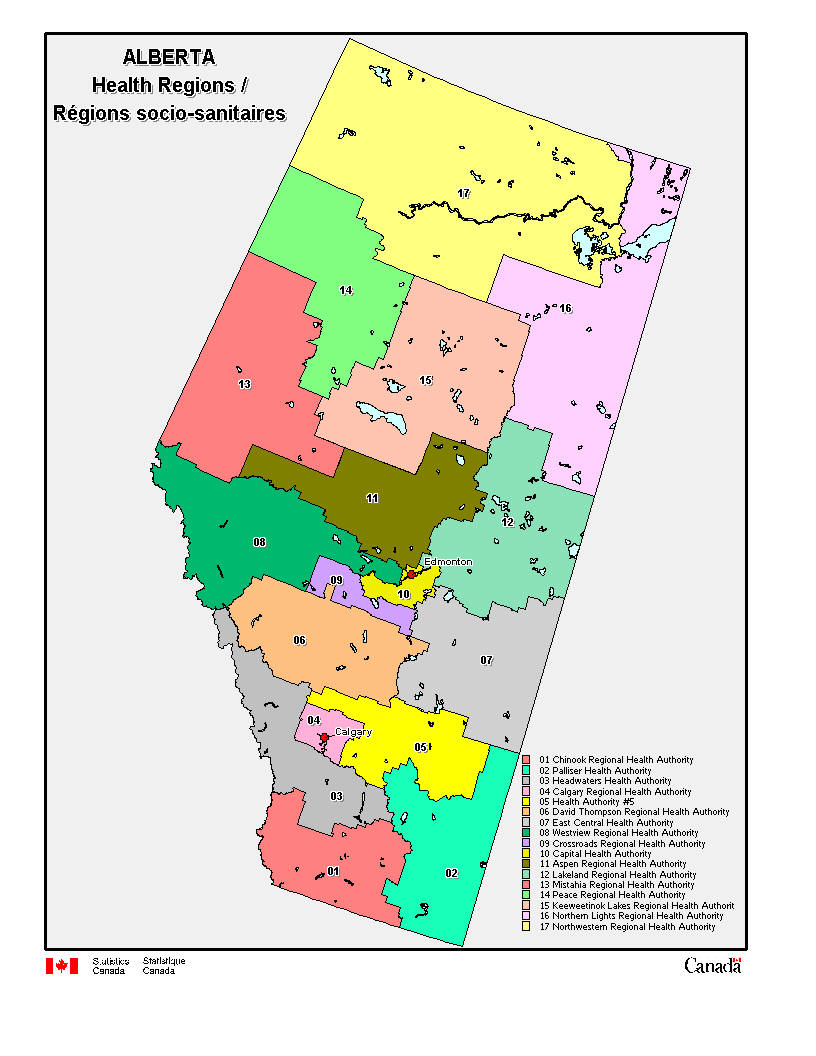
Alberta
|
Health Regions
|
17
|
jpeg
|
pdf
|
|
British Columbia
|
Health Regions
|
20
|
jpeg
|
pdf
|
|
Yukon Territory
|
Entire territory
|
1
|
jpeg
|
pdf
|
|
Northwest Territories
|
Entire territory
|
1
|
jpeg
|
pdf
|
|
Nunavut
|
Entire territory
|
1
|
jpeg
|
pdf
|
(1)
In PEI, Nova Scotia and Saskatchewan, the legislated health regions have
relatively small populations. In order to produce reliable and comparable
health indicators, these provinces have defined health regions for statistical
purposes. In PEI, the two health regions divide the province into an 'urban'
and 'rural' component. In Nova Scotia, these are known as 'health zones'
and relate to the province's administrative health region boundaries.
In Saskatchewan, 'service areas' have been created from groupings of the
33 health districts.
(2)
Public health units (PHU) administer health promotion and disease prevention
programs. District health councils (DHC) are advisory, health planning
organizations that make recommendations on resource distribution and provide
advice on integration of health services in their community.
[Home
| Health status
| Determinants of health
| Health system performance
| Community and system
characteristics |
Definitions |
Technical notes | Related
products | Français]
© Statistics Canada - Conditions of Use
|