|
|
| |
Information identified as archived is provided for reference, research or recordkeeping purposes. It is not subject to the Government of Canada Web Standards and has not been altered or updated since it was archived. Please "contact us" to request a format other than those available.
 |
11-010-XIB |
|
Current economic conditions
Summary table - key indicators Overview* Output slumped again in February, after recovering in January from a steep decline in December. Labour market conditions softened perceptibly in the spring, after a strong start to the year. Several factors have contributed to the recent weakness in real GDP. The new Family Day holiday in Ontario shortened work hours in February for many firms. Weather also has been erratic, with record snow this winter in much of eastern Canada and the coldest weather in years in western Canada. Meanwhile, the US economy remained sluggish in the first quarter, as the worsening state of its housing market offset higher exports. But mostly, growth in Canada has been restrained by large drops in auto assemblies. The recent volatility of auto production in Canada is in marked contrast with the US. Auto output in Canada tumbled 23% in December, about two-thirds due to model changeovers and one-third to weaker sales in the US. Output rebounded by 8% in both January and February, as the retooling of some plants was not completed until spring, but remained 14% below its November level. Meanwhile, output in the US dipped only 5% over the same period. The strike at a US parts manufacturer further disrupted auto production on both sides of the border in March, with US auto assemblies down 5%, and continued into April. As well, autoworkers are negotiating new contracts in Canada, while the US auto industry reached a deal last year.
It is unclear at the moment whether the economy is in a cyclical slowdown like 2001 that will last several months, or is traversing an extended period when irregular events depress output, as occurred in 2003. At that time, a series of mishaps ranging from the outbreak of SARS, mad cow disease and the Iraq war, as well as the electricity blackout in Ontario and bad weather, kept real GDP growth below 1% for the year ending in August 2003. Once these events passed, however, growth quickly resumed, rising 1.8% for all of 2003. Comparing the pattern of GDP recently with 2001 and 2003 (Figure 2) sheds little light on which course the economy has taken. One encouraging sign is that employment growth continued. However, job growth itself does not always distinguish between cyclical slowdowns and irregular events: employment stalled in mid-2003, but rose slowly in 2001. Still, cyclical slowdowns are not usually assoicated with the ongoing strength seen in commodity and stock markets and strong sales of autos and housing in Canada. The leading indicator remains neutral about the direction the economy is taking.
It remains unclear whether the US was in recession. Real GDP eked out another 0.1% gain, while industrial production and retail sales were unchanged in the first quarter. However, payrolls shrank slowly for the fourth straight month in April, with continued heavy losses in construction. Labour marketsThe labour market also slowed in the spring. Employment rose 0.1% for a second straight month, not enough to prevent a growing labour force from pushing up the unemployment rate from 5.8% in February to 6.1% in April. Hours worked also fell on balance between February and April, mostly in manufacturing. This softening in labour market conditions helped slow the year-over-year increase in average hourly earnings from 4.9% to 4.3% so far this year. All of April’s job increase was in full-time positions, and was concentrated in the self-employed. Job growth remained concentrated in construction and services. Construction added 1.3% more workers, and its 10% gain in the past year was the most of any industry. Services were driven by education and accommodation and food, after a weak start to the year for both industries. Professional services slowed, after leading growth early in the year. The recent losses in natural resources came to an end, while manufacturing continued to trend down. Western Canada continued to lead the growth of jobs. Manitoba moved to the forefront in April, reflecting widespread gains that reduced its unemployment rate to 3.8%, the second lowest behind Alberta. Services buttressed BC against more losses in manufacturing, which has cut payrolls by far the most of any province in the past year (-14%) due to the slump in forestry products. While manufacturing continued to contract in Ontario (down 5% in the past year), its employment growth remained slightly above the national average at 2.2%, thanks to gains in construction and services (especially business services). Ontario’s unemployment rate dipped to 6.3%, despite an influx of youths into the labour market. Quebec posted the only significant drop in employment (mostly services) after a slow first quarter, raising its unemployment rate to 7.6%. Leading IndicatorsThe composite leading index was unchanged in March, after a decline in February followed an increase in January. Six of the ten components rose in March, up from four the month before, as both housing and new orders for durable goods rebounded from large declines. Overall, household spending continued to lead growth, while the stock market replaced manufacturing as the weakest sector of the economy (before it rebounded in April). All the components related to household spending advanced. Outlays for durable goods posted a third straight gain, as auto sales remained on an upward trend. The housing index rebounded 0.2% after five straight declines. Housing starts advanced sharply, despite heavy snow which dampened existing home sales. Manufacturing remained mixed. Export demand continued to reel from declines in the United States, which was reflected in a seventh straight decline in its leading index. However, new orders rebounded 0.6%, helped by gains for investment goods and a partial recovery for autos. This gain in orders was not reflected in higher shipments, and this lowered the ratio of shipments to inventories for a second straight month. OutputReal GDP fell by 0.2% in February, after see-sawing up 0.6% in January and down 0.7% in December. Trade and manufacturing led the decline, especially companies in Ontario where a new holiday was introduced in February. Manufacturing output retrenched by 0.7%, despite the continuing slow recovery of autos from a large drop in December. Resource-based manufacturers led the drop, with losses in wood, metals and oil refining. Capital goods industries also slumped, including aerospace and machinery, which have been on a strong upward trend. Manufacturers processed less output from the primary sector, notably mining and forestry. As a result of larger drops in autos in Canada, manufacturing production has been weaker here than in the United States. One by-product has been that manufacturing inventories have not risen as fast in Canada as in the United States.
Despite record-setting snows in Ontario, weather appeared to play a minor role in February’s decline. Transportation fell 0.5% due to declines in surface transportation, with was probably disrupted by snow, but air and rail operations overall were unaffected. Utilities output dipped 0.1% as temperatures were relatively mild in eastern Canada. The coldest weather in years in Alberta and BC did not stop crude oil output from rising, despite shutdowns in the oilsands. Overall, construction activity rose, largely due to the surge in housing starts in the first quarter. Most services posted modest gains. Consumer spending rose for recreation and accommodation and food, which suggests weather played only a small role in the drop in retail sales. Business and government services grew slowly. Finance was an exception, declining as a result of lower trading in financial and real estate markets. Household demandRetail sales volume retreated 0.7% in February, after four straight gains averaging nearly 1% a month. Nearly two-thirds of the drop in nominal outlays occurred in Ontario. Demand fell for most goods. Autos recorded the largest decline, after sales of new vehicles jumped nearly 10% following the GST cut in January. Preliminary data show auto sales stabilizing in March. Spending on other durable goods slipped moderately. While computer sales continued to rise, this was offset by declines for TVs and other electronics as well as furniture and appliances, after several months of strong growth. Higher prices helped suppress purchases of food and gasoline. Housing starts remained at the exceptionally high annual rate of 243,000 units in March. This left the first quarter average at 234,000 units, slightly above its average in 2007. A surge in multiple units in central Canada kept new construction at a high level. The market for single-family homes was mixed. Ground-breaking on new homes fell slightly, consistent with a dip in sales and a rise in unsold new homes, completing a sluggish first quarter. However, existing home sales recovered some of the ground lost in February, when poor weather hampered sales (notably snow in Toronto and bitter cold in Edmonton). As well, a new land transfer tax dampened sales in 2008 in Toronto. Merchandise tradeExports increased in February, with gains concentrated in energy, industrial goods and autos. Energy exports were pushed up by oil and gas shipments to the US. The strength in industrial goods came from gold, which hit a record monthly high. Auto exports recovered in February as production returned to more normal levels. China surpassed Japan as Canada’s third largest export destination in 2007 and has maintained this lead in the first two months of 2008. While exports to Japan in early 2008 have rebounded, with canola and pulp leading the gain, the rise in exports to China has been greater, as ethylene glycol, sulphur and nickel exports all added to gains for canola and pulp. Imports slowed in February, weighed down by lower imports of energy products. The growth in exports to the US, notably energy, autos and gold, combined with falling imports meant that Canada’s trade surplus with the US widened considerably, reaching $8.1 billion. Rising exports to the rest of the world and stable imports reduced the non-US deficit to $4.9 billion. PricesThe consumer price index was unchanged between February and March, lowering the year-over-year inflation rate to 1.4%. This was well below the 4.0% rate in the US, and the lowest in the G7 except for Japan (where prices rose 1.2% as it recovered from years of deflation). Energy and services continued to contribute all the price increases. Gasoline drove the increase for energy, while housing continued to put upward pressure on services. These price hikes were offset by declines for durable goods and steady prices for food. Durables were led by further price discounts for autos, down 7% in the past year. Food prices were unchanged from February and up only 0.4% in the past year. This stability is remarkable given the soaring cost of food on commodity markets being felt by consumers around the world. While the price of bread and cereal products has jumped 8.8% from last year, the cost of fruit and vegetables has declined. Prices for manufactured goods jumped 1.7% in March, their fifth straight increase and the largest monthly advance since July 2006. A majority (12 of 21) of commodities saw prices rise, led by petroleum and metals. The stability of the Canadian dollar has helped prices recover over the last five months. The surge of commodity prices since the new year moderated slightly in April. The slowdown reflected lower prices for some food and industrial goods. Wheat prices retreated from their record set in February, although they remain at historically high levels. Metals were mixed: copper set a new record, but most fell slightly. Energy prices continued to soar, with crude oil surpassing US$110 a barrel. Financial marketsThe Toronto market jumped over 4% in April, approaching its record high set in 2007. The increase reflected a surge in energy, where prices rose on commodity markets. Soaring potash prices boosted industrials, while financials and technology stocks also improved. In the US, stock prices have risen 10% since the rescue of Bear Stearns in mid-March. Short-term interest rates followed the Bank Rate, which was cut half a point in April. Long-term rates followed the upward turn in the US. The Canadian dollar continued to hover just below parity with the US greenback. Credit demand continued to grow in the first quarter. Household credit expanded steadily, by 1.1% in February, reflecting similar growth for both consumer credit and mortgages. Business credit picked up in March. Short-term credit rebounded from a lull in February, while stock and bond issues tripled to over $8 billion. Regional EconomiesThe year began with especially strong household demand in Quebec, driven by improved weather conditions. After a slow December, caused by the country’s heaviest snowfalls, retail sales jumped 3.4% in January and another 0.2% in February. These were the strongest consecutive increases since those of May 2007, which were attributed mainly to a pay equity settlement. Housing starts dipped slightly, but growth in January had been strong after a buoyant year for existing home sales (growth surpassed those of Ontario, the Prairies and British Columbia). Manufacturing sales continued to rise after recording the only growth in the country in the fourth quarter, still driven by metals, investment goods and especially transportation equipment. Employment in manufacturing also rebounded sharply at the start of the year in the areas around Montréal where these industries are located (Montérégie, Lanaudières, Laurentians). Quebec is the fifth largest global producer of aerospace goods. Ontario continued to experience a strong rebound in manufacturing sales, with growth at over 2% for the second straight month. Motor vehicles led the improvement, continuing to rebound from losses in December. However, several other durable goods industries also posted gains. In the non‑durable goods sector, refineries maintained their strong upward trend to reach a record $1.7 billion in shipments during the month. Housing starts remain vigorous. Consumer prices dropped sharply in Ontario, with the prices of goods down 2% since last May. Therefore, it is no surprise that nominal retail sales remained slow. This sector lost the ground gained in January once the impact of the lower goods and service tax dissipated. In the Prairies, housing was the shining star. In Alberta, housing starts jumped 50% to an historic high of 51,100 units, slightly above the previous record in November 2006. This meant that households chose to devote their spending to housing rather than to retail sales, which dipped slightly. Shipments would have risen were it not for a supply disruption at a major refinery. British Columbia’s economy is lagging behind that of the rest of the country, despite ongoing preparations for the Olympic Games. Weakness in the manufacturing sector is in contrast to growth in other areas. Shipments posted the twelfth loss in 14 months. Lumber shipments in particular contributed to the slowdown in both January and February, after plummeting 20% in 2007 and dropping by half since the peak in 2004. Household demand also lost much of its recent strength, with retail sales down 1.1%. International economiesIn the United States, first-quarter real GDP rose 0.1%, matching the fourth-quarter increase. The housing slump continued to deepen, with its 7.4% drop the largest of nine consecutive declines. Consumer spending on goods fell, notably for autos, while business investment fell suddenly, also due to lower vehicle sales.
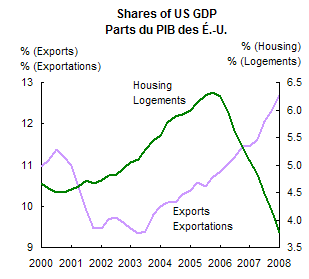
But these losses were offset by gains elsewhere in the economy. Exports continued to strengthen. Goods exports slowed, partly due to lower auto assemblies in Canada that rely on the US for about half their parts, but services were boosted by an influx of travellers. Over the past year, the little-noted growth in both exports and net exports has matched dollar-for-dollar the much-publicized slump in housing. In the past year, export volume rose 9.5% while imports eked out a 0.7% gain.
Services sustained overall growth in consumer spending despite a drop for goods (notably autos). A modest 0.3% growth in real disposable incomes helped buttress consumer outlays. Government spending also rose vigorously, while tax rebates will start arriving in force at households in May. Finally, the sharp cuts to inventories in the fourth quarter did not continue in the first. This is the reverse of the pattern in Canada, where inventories rose in the fourth quarter and slowed in the first. Housing remained soft in March, with housing permits as well as existing and new home sales all registering considerable declines. Existing home sales fell back after a more sizeable increase in February, and have been relatively stable in 2008. Durable goods orders dropped 0.3%, weighed down by transportation equipment. Excluding transportation, orders rose 1.5% with widespread gains, the most pronounced in machinery. Retail sales were up slightly in March. Chain stores were reporting gains for April, although a sharp retreat in truck sales may provide a drag on April’s retail figure. The pace of output in the euro-zone slowed in February, as industrial production rose 0.3%, half its January gain. The weakness occurred in every sector except energy. New orders also decelerated, dampened by falling demand for machinery and transport equipment. External trade was brisk, however, widening the energy deficit and the surplus for machinery and autos. While exports to the US and Japan continued to wane, trade surged with Russia and China. Consumers reined in spending in February after a brief spurt in January. Inflation rose to an annual rate of 3.6% in March, up from 1.9% a year earlier. The unemployment rate was stable at 7.1%. Industrial production in Germany posted its third consecutive monthly gain, albeit at a decelerating rate, even as new orders declined further. External demand remained upbeat, despite the rapid appreciation of the euro, and Germany maintained the largest surplus in the euro-zone. Consumers closed their wallets in February, while inflation rose to 3.3%. French output rose for the third straight month in February, although the 0.3% rise was half its January gain. Growth in new orders also slowed after a surge the month before. Consumer demand was fragile, as confidence hit a 21-year low in April and inflation hit an 11-year high of 3.5%. The unemployment rate was stable at 7.8%. Industrial production in Britain grew in February for the first time in four months. Exports picked up in tune with the falling pound. Consumer spending recovered, boosted by widespread discounting. Inflation, at 2.5% in March, remained the second lowest in the EU. Japanese exports were dampened by the strengthening yen. Exports in March saw their slowest growth in almost three years. While exports to the US fell steadily, this had been more than offset by shipments to Asia. In March, however, exports to China were up just 3.2% after a 14.8% gain in February. Both business and consumer confidence have waned as prices and unemployment continued to rise. China’s real GDP expanded 10.6% year-over-year in the first quarter of 2008, down slightly from its fourth quarter pace due to severe winter weather. The trade surplus posted its first year-over-year quarterly fall in almost three years, dampened by weakening demand in the US and Europe and the appreciation of the yuan. Since it was de-pegged from the US dollar in July 2005, the yuan has risen 18%. Inflation was 8.3% in March, boosted by soaring food costs. Note* Based on data available on May 9; all data references are in current dollars unless otherwise stated. |

|
|