


|
|
| |
Information identified as archived is provided for reference, research or recordkeeping purposes. It is not subject to the Government of Canada Web Standards and has not been altered or updated since it was archived. Please "contact us" to request a format other than those available.

|

Tuesday, March 28, 2006 Youth custody and community services2003/04 In the year following the April 1st 2003 implementation of the Youth Criminal Justice Act (YCJA), the number of young persons aged 12 to 17 who were admitted into some form of custody declined by nearly one-half. Overall, during the fiscal year 2003/04, there were about 17,100 admissions to custody. This was well below the 22,700 admissions in the previous year. Of the 17,100 young persons admitted to custody, 4,700 were to sentenced custody, a 44% decline. (There were similar declines among admissions to both open and secure custody.) The remaining 12,500 were admitted to remand, down 13%.
One of the concerns with the Young Offenders Act (YOA), which preceded the YCJA, was the overuse of custody. A key objective of the YCJA was to decrease the use of custody. The YCJA does not recommend a young person to be sentenced to custody unless the person has committed a serious violent offence, has not complied with a non-custodial sentence, has committed an indictable offence for which an adult would be liable to imprisonment for more than two years and has a history indicating a pattern of findings of guilt, or in exceptional circumstances where the youth has committed an indictable offence and a non-custodial sentence would be inconsistent with the Act's purpose and principles of sentencing. The YCJA directs the increased use of community-based alternatives, which focus on rehabilitation. A requirement of the YCJA is that young persons sentenced to custody serve the final one-third of most custody sentences under community supervision.
The YCJA also introduced new sentences for young persons, including deferred custody and supervision and the intensive support and supervision program, which are supervised in the community. Three-quarters of custody admissions were to remandRemands comprised nearly three-quarters (73%) of all admissions to custody in 2003/04. The decline in the number of admissions to remand from the previous fiscal year was relatively small when compared to the decline in sentenced custody. As a result, admissions to remand increased in proportion compared with all admissions to custody. In 2002/03, remand comprised 63% of all custody admissions. 
Just over one-half (52%) of all young persons released from remand were released within one week in 2003/04. Another 26% were released after one week, but within one month. Only 20% of those released from remand served more than one month. In comparison, almost two-thirds of those released from sentenced custody served more than one month in custody. Increase in proportion of Aboriginal youth admitted to custodyIn recognition of the high level of representation of Aboriginal young persons in custody, the YCJA draws attention to the needs of Aboriginal young persons. The legislation calls for special considerations when dealing with these young persons within the justice system. In 2003/04, approximately 1,000 Aboriginal young persons were admitted to sentenced custody, down from 1,500 admissions in 2002/03. Aboriginal young persons represented 29% of those admitted in 2003/04, an increase from 22% in 2002/03. (Aboriginal young persons comprised about 5% of the population aged 12 to 17.) The proportion of Aboriginal young persons admitted to sentenced custody had been decreasing prior to implementation of the YCJA. However, because the decrease in the number of admissions to sentenced custody of non-Aboriginal young persons was more substantial than the decrease in admissions of Aboriginal young persons, there was an increase in the proportion of Aboriginal young persons admitted to sentenced custody during the year following enactment. With respect to remands, prior to the YCJA, the proportion of Aboriginal young persons among remand admissions had been gradually declining. However, in 2003/04, there was an increase in this proportion, from 23% in 2002/03 to 27% of all remand admissions in 2003/04. In 2003/04, 3,000 Aboriginal young persons were admitted to remand, 3% more than in the previous fiscal year. One of the possible contributing factors to the increased proportion of admissions of Aboriginal young persons to custody is due to a disproportional number of repeat contacts within the correctional system, as well as a higher level of criminal risk factors when compared to non-Aboriginal people. 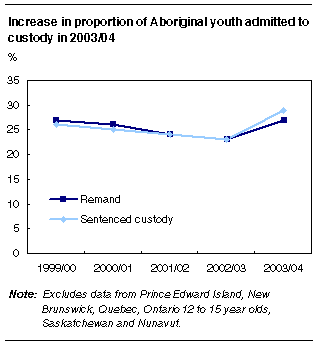
Proportion of female admissions to custody declinePrior to the YCJA's implementation, the proportion of female young persons aged 12 to 17 who were admitted to custody had been gradually on the rise, compared to the proportion of males. However, this trend changed following the new legislation. In 2002/03, about 20% of all young persons sentenced to custody were young women. This fell to 13% in 2003/04. In general, females tend to be incarcerated for less serious offences, consistent with the YCJA sentencing practices; this may be resulting in diversion away from custody. The proportion of females admitted to remand also declined from 20% in 2002/03 to 18% in 2003/04. This could also be attributable to the less serious offences which are committed by females, as remand is not recommended for less serious offences. Admissions to probation also declineAdmissions to probation fluctuated around 23,000 between 1999/00 and 2002/03. With the YCJA's implementation, however, admissions to probation dropped 34% to about 15,000. This decline was not uniform across all jurisdictions. It ranged from a 4% decrease in Prince Edward Island to a 52% decline in Newfoundland and Labrador. New YCJA community-based sentencesThe YCJA introduced a number of new sentences which place emphasis on community supervision, including deferred custody and supervision, the intensive support and supervision program (ISSP). As well, most custody sentences are accompanied by a period of community supervision. In 2003/04, there were about 3,900 admissions to these programs. Deferred custody and supervision allows young persons to serve a custody sentence in the community under a number of strict conditions. There were about 1,100 admissions to the deferred custody and supervision program in 2003/04. The ISSP, an optional program for jurisdictions, provides closer monitoring and support than traditional probation. Among the four jurisdictions that implemented and reported on intensive support and supervision programs, there were about 100 admissions. Finally, all custody orders require a period of community supervision on the final one-third for most sentences. As a result, there were 2,700 admissions to community supervision under this sentence. The Juristat: "Youth custody and community services in Canada, 2003/04," Vol. 26, no. 2 (85-002-XIE, $9/$75; 85-002-XPE, $11/$100) is now available. Available on CANSIM: tables 251-0009 to 251-0017. Definitions, data sources and methods: survey number 3323. For further information, or to enquire about the concepts, methods or data quality of this release, contact Client Services (613-951-9023: 1-800-387-2231), Canadian Centre for Justice Statistics. | |||||||||||||||||||||||||||||||||||||||

|
|

